Welcome to the mindfulness meditation podcast presented by the Rubin Museum of Art.
We are a museum in Chelsea,
New York City that connects visitors to the art and ideas of the Himalayas and serves as a space for reflection and personal transformation.
I'm your host,
Dawn Eshelman.
Every Monday we present a meditation session inspired by a different artwork from the Rubin Museum's collection and led by a prominent meditation teacher from the New York area.
This podcast is a recording of our weekly practice currently held virtually.
In the description for each episode,
You will find information about the theme for that week's session,
Including an image of the related artwork.
Our mindfulness meditation podcast is presented in partnership with Sharon Salzberg and teachers from the New York Insight Meditation Center,
The Interdependence Project,
And Parabola Magazine.
And now,
Please enjoy your practice.
Hello everybody,
Happy new year.
So great to be here with you and practice together in the new year.
My name's Dawn Eshelman.
I'm here with the Rubin Museum of Art and welcome to our mindfulness meditation practice.
We're a museum of Himalayan art and ideas in New York City for those of you who might be new to us.
And it's so great to have you all join us for our weekly program.
This is where we combine art and meditation online together.
And we'll be talking about the idea of interdependence.
So this concept that we are all connected,
We're not separate.
And we'll be looking at our practice through that lens.
And to kind of give us a little bit more detail to grapple with here,
We are looking today at an art image from our collection that I'll get into a little bit more in a moment.
But this is the Jadakah Tales.
This is the story of the previous lives of the Buddha.
He has some wonderful examples here for us about how we're connected and what does that have to do with our practice.
Our wonderful teacher,
Sharon Salzberg is here and will help us connect those dots.
So let's get into it together here.
So today,
Again,
Inspired by a work from our collection,
We will talk for a moment together.
We'll hear from our teacher and then we'll have a short sit together,
15 to 20 minutes for the meditation guided by Sharon.
So let me share my screen here and let's take a look at today's theme and artwork.
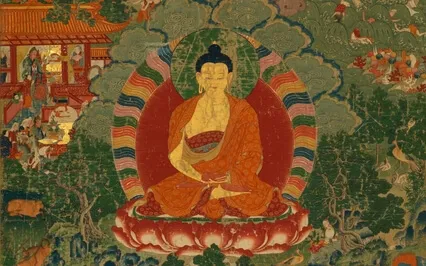
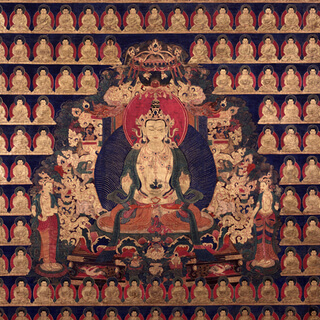
So here we are with this beautiful tanka,
The stories of the previous lives of the Buddha or Jadakah Tales as it's known.
And this tanka is from Tibet,
18th century,
Pigments on cloth.
We'll post the details here for you.
And the tales of Shakyamuni Buddha's past lives are some of the most well-known narratives in Himalayan culture.
And they're often presented in a series of paintings like this one with each painting depicting a part of the collection of the stories.
So they're presented at these small vignettes surrounding our central figure here,
The Shakyamuni Buddha.
And these narrative scenes are usually arranged around that central figure.
And then you can see here,
They're kind of visually separated by landscape elements.
And the traditional set of 34 tales later expanded to 108 tales and it includes the stories of the Buddha's previous lives as a Bodhisattva,
A king,
A merchant,
And animals.
And we'll look here together at our central figure,
Buddha Shakyamuni.
You can see that he's seated on the Lotus throne.
The petals of the Lotus flower are kind of curving up and hugging his seat there.
And there are these deep red petals that have a bit of white on them that almost makes them look like flames.
Like he's seated in this sort of flowering flames.
But those are the Lotus petals.
And this kind of rich red-orange color continues up through the body of the Buddha who is seated in a meditation posture with his legs folded and his hands one in the other in this gesture of meditation and his eyes gazing very calmly,
But directly straight out at us.
And that orange color covers his robes as well.
So over his legs,
His shoulders,
And we see a kind of bare chest and face,
Calm,
Calm face there.
Behind his head and his top knot there,
We see a kind of green halo with an even deeper rich orange halo behind his body.
And then it's all encompassed with this outline of a rainbow halo as well.
So again,
We'll hear more about this starving Tigress and how the Buddha helps the starving Tigress through this lens of compassion and generosity and this acknowledgement of our interconnectivity in just a moment.
But for now,
I'll leave you with that image and that thought as we bring on our teacher today,
Sharon Salzberg.
And Sharon is the co-founder of the Insight Meditation Society in Barry,
Massachusetts,
Where she has guided meditation retreats worldwide for many years.
Her latest books include Real Change,
Real Love,
And Real Happiness.
She's a weekly columnist.
And oh,
I wanted to make sure to tell you about her 28-day challenge for 2022.
So head on over to her website,
SharonSalzberg.
Com,
To learn about the 28-day challenge,
Meditate Every Day,
And the month of February for 2022.
So great to have you kicking off the new year with us,
Sharon.
Thank you so much for being here.
Thank you so much.
And we're discussing interdependence in this new year,
Happy new year.
And what my mind went to,
You know,
Especially looking at depictions of the past life of the Buddha and things like that is just the ways in which we can see contingency.
We can see connection in kind of immediate ways in our lives and how that implies a bigger picture of life in meditation,
In terms of the kind of progression of experiences people have.
Sometimes there's an emphasis on just seeing that there's a connection between the mind and the body,
That there's conditionality that we get.
For example,
A certain painful sensation arises in our knee and we experience that.
As painful.
And because of that sensation,
Maybe a dislike arises in our mind.
So there's a link right there.
And with the dislike,
Maybe comes an impetus to move,
To shift posture.
And then we move.
So there's a physical movement and subsequent sensation that's based on that intention that arose in the mind,
Like shift,
Buster.
And you just kind of watch one thing linking to the next.
In order to do that,
Just as a side note,
We can't be judging it like,
Dammit,
I have pain.
You know,
I really let my yoga practice go.
Why am I so terrible?
This shouldn't be here.
But it's just watching one thing leading to the next.
And that's like a deeper glimpse into how nothing stands alone,
Everything is interwoven,
Interdependent,
That that's the nature of our existence.
And we kind of take that learning,
Which is like the template,
That's like seeing the pattern.
And we begin to look for it in many things and we begin to get a sense of causality often,
Ways in which we see,
Oh,
That actually influenced that.
If I hadn't been in that emotional state,
That particular somatic or physical experience might not have felt so alarming.
And then,
You know,
And we kind of watch things as they interrelate.
And it's very,
It's both wisdom producing and that we may not take so personally things we once took personally.
We just see it's kind of a pattern,
Which is sort of impersonal.
And we understand that if we want to change something,
Maybe we have to look a little more deeply into that linkage to see what's going on rather than kind of isolate certain feelings or certain reactions as though they were not connected to anything and sort of try to attack them,
Which is never going to work.
We look for causes and conditions.
We look for what's the flow of events or connections or influences that's coming into this moment because maybe that's the place to really be looking.
So that brings me to what is maybe the most kind of classical experience of cause and effect.
That is a part of meditation practice.
It's a part of living differently.
And that is,
It's often depicted in the wheel of dependent origination.
And that is to say it almost as a chance.
I'm feeling craving.
The idea is that we experience the world in any moment of life in one of six ways,
Seeing,
Hearing,
Tasting,
Touching,
Smelling,
Or what is known as the sixth sense,
Which is not something paranormal.
It's the mind.
We can know through hearing,
We can know through the mind or as they say,
That's imagery,
Emotion,
Ideation.
So in the depiction of life,
Every moment of life in this world of knowing an object,
There are six senses.
And every moment is one of those senses at play.
There's contact between what is a sense door,
Like the ear or the eye and an object.
And that brings up the consciousness of that particular type hearing consciousness,
Seeing consciousness or someone that might bring up again,
As a side note,
The question of where's the mind door,
Like where's the mind?
Of course,
We think in the West,
It's in the brain and the East,
You wouldn't hear that.
Some schools would say the mind door is actually in the heart center,
Right in the center of the chest.
Other people would place it everywhere,
Which is also interesting.
And then there's the object,
The thought,
The conceptualization,
The fantasy,
And there's contact between the two.
And there we are thinking,
Um,
That's contact.
And then the next link is feeling.
So what feeling means in this context is not emotion,
But it's feeling tone.
It's a quality of pleasantness,
Unpleasantness or neutrality that comes along.
It's part of the package really for us of every moment of seeing every moment of hearing,
Every moment of smelling and so on.
We feel it to be pleasant,
Painful or neutral.
And this is not something that is kind of locked into or inherent in any experience.
You know,
It might be one Monday we experience a certain comment somebody makes as amusing.
Monday night,
Tuesday night,
We didn't sleep at all.
Wednesday comes around,
We hear that comment.
It's like the most terrible thing you've ever heard.
It's very,
Very unpleasant.
It's really painful.
Different factors go into how we sense something to be on that spectrum of pleasantness,
Unpleasantness,
Neutrality.
And there's some amount of work that's kind of interesting.
Just looking at that and kind of peeling that apart a little bit.
Like,
Why is it that I pretty often hear that kind of comment as horribly insulting?
Like,
What is it that's cooking in there?
But the work of mindfulness as a healing quality actually comes later.
And it's kind of saying,
You know,
That sense of something as pleasant,
Unpleasant or neutral is so fast.
And you don't have to think of,
You know,
A world where that's going to change.
Like some of these people think if I get really good at meditating,
Then the highs and lows will disappear and everything will sort of blend into this gray blur,
Which is OK because the worlds are gone.
You know,
Some people long for that state.
Other people are terrified of the very thought,
But it's not what happens anyway.
So that's sort of irrelevant.
We experience some things as pleasant,
Some things as painful,
Some things as neutral and sometimes intensely pleasant,
Sometimes intensely painful.
But those are only the first of that link in that section of the Wheel of Independent Origination.
There's contact,
There's feeling and then there's craving.
So what craving means here is a normal state of reactivity.
It's not inevitable.
We don't have to go there.
We have many options.
But the kind of conditioned,
Ordinary way would be,
They say,
We feel something pleasant and we have a somewhat distorted relationship to it.
We cling to it.
We insist that change is not going to happen this time.
The person's not going to change.
The situation's not going to change.
The object isn't going to change,
Which is clearly an exercise in futility.
So craving,
Holding on,
Clinging becomes the strongest thing,
Much stronger than the enjoyment of the pleasant,
Whatever it was.
Sometimes,
You know,
To extrapolate further,
We have other distorted relationships to pleasure,
To just the simple enjoyment of something we're seeing or hearing or whatever.
We're competing with somebody else.
So what we have is not good enough or we're competing with what we had last year or we're competing with our idea of what should be happening or we feel guilty about in the midst of so much suffering worldwide,
Experiencing any joy or pleasure at all.
And there's so many possibilities and they're kind of symbolized by that word craving.
And when something is painful,
A sound,
Sensation in our body,
An emotion,
We certainly have many distorted relationships to that.
We reject it.
We feel ashamed.
We want to push it away.
We feel we've lost control.
It shouldn't be this way.
And on and on.
And then when something is neutral,
It's like repetitive,
It's routine,
It's worrying,
Often,
We go to sleep.
We numb out.
We pull back.
We stop feeling.
We stop connecting.
So that's grasping,
Aversion and delusion,
All of which are symbolized again by that word craving.
And that is the common moment by moment sense of contingency,
Interdependence that we experience.
We experience the world in one of six ways.
It's pleasant,
Painful and neutral.
We hold on.
We push away.
We go to sleep.
But it doesn't have to be that way.
Right there,
Having experienced the pleasantness,
The pain or the neutrality of something,
We have every possibility of being mindful,
Being aware,
Not reacting in the same old way,
Being interested,
Connecting to what's happening,
Having compassion,
For example,
For ourselves when it's painful,
Allowing ourselves to enjoy things that are pleasant without the clinging,
Waking up and actually paying attention when our tendency is not stimulating enough,
It's not intense enough to capture our attention.
I think I'll just snooze here a while.
So it's right there that some of the most powerful aspects of meditation take place.
It's contact feeling mindfulness,
Contact feeling balance,
Contact feeling awareness,
Contact feeling compassion,
Something like that.
And so,
Uh,
As we sit together,
That's something to pay attention to.
And,
Uh,
Really it's that sense of not judging.
It's watching what may be your ordinary habit,
Seeing that there's a pattern,
Understanding,
Oh,
There's every possibility of shifting it right there.
Okay.
So let's sit together.
You can sit comfortably,
Close your eyes or not.
Let your attention settle into your body.
See if you can find the place where the breath is clearest for you or strongest for you.
Maybe that's the internet movement of air,
The nostrils or the rising,
Falling movement of the chest or the abdomen.
You find that place,
Bring your attention there and just rest.
See if you can feel one breath.
If you like,
You can use a quiet mental notation of in,
Out or rising,
Falling to help support the awareness of the breath.
There's sounds or images or sensations.
Emotions should arise,
But they're not very strong.
If you can stay connected to the feeling of the breath,
Just let them flow on by your breathing.
Just one breath.
If something comes up that is pretty strong,
It's capturing your attention.
Spend a few moments just noticing what it is,
Joy,
Sorrow,
Whatever,
How it feels in terms of pleasantness,
Unpleasantness or neutrality,
If that comes easily and maybe how you're reacting to it and see if you can relax.
Let go of whatever it is and bring your attention back to the feeling of the breath.
And for all those times that you're just gone,
Lost in thought,
Fall asleep,
You're spun out in a fantasy,
Truly don't worry about it.
You realize you're gone,
You've been gone maybe.
See if you can let go and just begin again by bringing your attention back to the feeling of the breath.
Let go of whatever it is that you're just gone,
Lost in thought,
Feel it,
Let go,
Let go.
Let go of whatever it is that you're just gone,
Lost in thought,
Feel it,
Let go,
Let go.
Let go of whatever it is that you're just gone,
Lost in thought,
Feel it,
Let go,
Let go,
Let go.
Let go of whatever it is that you're just gone,
Lost in thought,
Feel it,
Let go,
Let go.
Let go of whatever it is that you're just gone,
Lost in thought,
Feel it,
Let go,
Let go,
Let go,
Let go.
Let go of whatever it is that you're just gone,
Lost in thought,
Feel it,
Let go,
Let go,
Let go,
Let go,
Let go.
Let go of whatever it is that you're just gone,
Lost in thought,
Feel it,
Let go,
Let go,
Let go,
Let go,
Let go.
Let go of whatever it is that you're just gone,
Lost in thought,
Feel it,
Let go,
Let go,
Let go,
Let go,
Let go,
Let go,
Let go,
Let go,
Let go,
Let go,
Let go,
Let go,
Let go,
Let go,
Let go,
Let go,
Let go,
Let go,
Let go,
Let go,
Let go,
Let go,
Let go.
You you you you you you you And when you feel ready you can open your eyes or lift your gaze and we'll end the meditation That concludes this week's practice.
If you'd like to support the Rubin and this meditation series,
We invite you to become a member.
If you're looking for more inspiring content,
Please check out our new podcast awaken hosted by Laurie Anderson.
The 10 part series features personal stories that explore the dynamic path to enlightenment and what it means to wake up.
Now available wherever you listen to podcasts.
Thank you for listening and thank you for participating in this series.
And as always,
Thanks for listening and we'll see you in the next video.