Welcome to the Mindfulness Meditation Podcast presented by the Rubin Museum of Art.
We are a museum in Chelsea,
New York City that connects visitors to the art and ideas of the Himalayas and serves as a space for reflection and personal transformation.
I'm your host,
Tashi Chodron.
Every Monday we present a meditation session inspired by a different artwork from the Rubin Museum's collection and led by a prominent meditation teacher from the New York area.
This podcast is a recording of our weekly practice currently held virtually.
In the description for each episode,
You will find information about the theme for that week's session,
Including an image of the related artwork.
Our Mindfulness Meditation Podcast is presented in partnership with Sharon Salzberg and teachers from the New York Insight Meditation Center,
The Interdependence Project,
And Parabola Magazine and supported by the Frederick Lance Foundation for American Buddhism.
And now,
Please enjoy your practice.
Hello everybody,
Tashi Dalek and welcome to Mindfulness Meditation Online with Rubin Museum of Art.
I am Tashi Chodron and I'm happy to be your host today.
It's so great to see so many of you on the chat letting us know where you're joining from.
I see Lancaster,
Georgia,
Sunny northern Manhattan.
Yes,
It's very strange to be in the 70s at this time of the year in November.
We have Brooklyn,
San Francisco,
Seattle,
And from the five boroughs of New York making best use of the virtual platform.
Thank you so much.
And for those of you who are new,
The Rubin is a museum of Himalayan art and ideas in New York City.
And it's great to be here with you and to practice together for our weekly session where we combine art and meditation online.
As many of you may know,
We will take a look at a work of art from our collection together,
And we will hear a brief talk from our teacher.
And today is our wonderful teacher,
Tracy Cochran.
And then we will sit together for a short sit,
15 to 20 minutes for the meditation guided by Tracy.
And now let's take a look at today's theme and artwork.
The theme for this month of November is awakening.
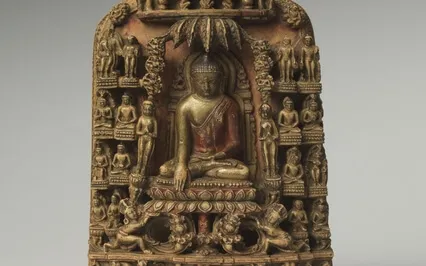
And our connection is this beautiful sculpture made of Andagou stone with pigments depicting major events of Buddha's life.
This is from northeastern India.
It's about from the 12th century and about six and a half into four and a half into one and a half inches sculpture.
Bodh Gaya,
Also known as Dorje Den in Tibetan,
Is one of the most important and sacred Buddhist pilgrimage center in the world.
It was here under a banyan tree,
Also known as the Bodhi tree.
Gautama attained supreme knowledge to become Buddha,
The enlightened one.
The place of the Buddha's enlightenment was and continues to be an important pilgrimage site.
I've had the great fortune of visiting Bodh Gaya as young as a few months old with my mother and grandmother.
And my most recent visit was a year before the COVID.
While in Bodh Gaya,
Some pilgrims picked up small souvenir sculptures dedicated to Buddha's life.
And this small portable stone relief carving is an example of such an object.
The image of the Buddha at the center shows he's seated under a Bodhi tree,
His right hand touching the earth,
A common visual reference to the moment of his enlightenment,
In other word awakening.
This figure and the six Buddhas at its sides represent the seven weeks the Buddha spent meditating in Bodh Gaya under the Bodhi tree.
The scenes of this intricate stone sculpture depicting events from the Buddha's life culminating at the top with his achievement of nirvana,
Often referred to as Mahabharinirvana,
The Buddha's death.
This scene always reminds me of growing up in exile in Tibetan refugee camps in India.
My mother used to tell us to sleep on the right side with our right side of face resting on the right palm,
Just like how Buddha went to sleep,
So we will have better dreams.
The physical appearance of the Buddha,
As you see here,
Featuring a disproportionately short and thick neck is a direct reference to the main image that occupied the Mahabharati temple at Bodh Gaya from about the 11th to the 13th century.
Now let's bring on our teacher for today.
Welcome Tracy.
It's great to have you back.
Tracy Cochran has been a student and teacher of meditation and spiritual practice for decades.
She's the founder of Hudson River Sangha,
Which is now virtual and is open to all.
The link for her weekly meditation can be found on our website,
Tracycockran.
Org.
In addition to the Rubin Museum of Art,
Tracy Cochran has taught mindfulness meditation and mindful writing at the New York Insight Meditation Center,
As well as in schools,
Corporations and other venues nationally and internationally.
She's also a writer and editorial director of Parabola,
An acclaimed quarterly magazine that seeks to bring timeless spiritual wisdom to the burning questions of the day.
Her writings,
Podcast and other details can be found on her website and on parabola.
Org.
Her new edition,
Darkness and Light is out now.
Welcome Tracy.
Thank you so much for being here.
Thank you,
Tashi.
I'm very happy to be here.
And I'm delighted to be speaking about the story of the Buddha's life.
And as you saw in that artwork,
People would sometimes take a small altar or replica with them that would denote all the key moments in the Buddha's life story,
His great journey to awakening.
And what I was mentioning to Tashi before I was speaking about in my own meditation group is it's interesting to note that his story included darkness and light.
It wasn't just a blinding trajectory to the top,
To awakening.
It's very interesting to remember,
To consider that when he left home,
He left the palace and he left his position,
He left his marriage for the darkness of the unknown.
When he did that,
It must have been considered a tragedy.
We have evidence that it was.
It was crying.
They even,
They wept when his horse came back without him.
Someone even punched the horse.
It was later reported in heaven.
But anyway,
The point is that the Buddha's story,
Just like our stories,
Contained times of darkness,
Of not knowing what would come,
Of seeming failure,
And also light.
And there's a tendency,
Particularly in our culture,
To want it all to be light all the time or to think that we've done something terribly wrong.
In fact,
Last night when I was leading meditation,
I talked a little bit about light pollution.
Because it's daylight savings time,
We're moving into the darker season in our hemisphere.
And it seems to be the case that the whole planet practically cannot bear darkness.
And views from our earth,
From space,
Are of a kind of yellowish glare of light.
There are whole cities that can be seen from every space.
Might there be another way to be with darkness?
And after I speak and meditate,
Tashi's going to show some images for those who can stay of Bodh Gaya,
The place of the Buddha's awakening,
And the Bodhi tree,
The tree under which he sat.
What's interesting to reflect on for just a moment before we sit,
Is that when he sat under the tree,
It's portrayed in the ancient story as a night.
He sat through the night.
And it was a night that lasted 40 days,
40 days.
And apparently scholars of ancient texts and many traditions think that the word 40 wasn't literal.
It meant a long,
Long time.
Like 40 days in the desert,
Or Moses and his people spent 40 years wandering in the wilderness.
The point of that number and of the story is that sometimes it's necessary for us to descend into darkness.
To not know.
There's a sacred mantra in Tibetan Buddhism,
Om Mani Padme Om,
The dual in the lotus.
And this means many things.
But one thing we can consider as its meaning is the dual of the mind descending into the heart,
Descending into the heart.
The Buddha was sitting in the dark.
He didn't know what would come.
But he used the mind,
The awareness of the heart.
He wasn't looking at his phone.
And yes,
I know they didn't have smartphones then.
The point is he wasn't distracted.
He wasn't strategizing how to get out of the darkness or picturing his life beyond darkness.
What was he doing?
He was sitting and watching.
He was looking within.
He was watching his thoughts,
His feelings,
Noticing the ones that lifted him up and those that made him descend.
He was looking.
He was coming to see himself,
His likes and dislikes,
His tendencies,
His past lives.
And again,
That's how he could strategize his way out,
But so that he could open to a deeper kind of awakening.
It turns out that awakening might not just be a flight up.
It might be awakening downward to come to know our own hearts,
Our own bodies,
Taking away all of our distractions and even our hopes so that we can come in touch with what's here,
Even in darkness.
In the darkness of the unknown,
What did he do?
There is that famous gesture of touching the earth.
Mariah came to him and filled him with fear,
Fearful images of what might come,
Just assailing him.
Instead of getting hooked in and letting the mind take him,
He reached down and touched the earth.
He was here.
The body was here.
It was part of life.
And according to the ancient stories,
The trees burst into bloom.
The earth answered him.
We are with you.
Yes,
You are here.
And we are with you.
Last night,
It was quite beautiful.
One of the students at my sangha is blind.
And I mentioned the gesture of touching the earth.
And she said that when she first was learning a new way of seeing,
Of being in the world,
She was very frightened because she couldn't see outward.
She couldn't see ahead.
And she was given the guidance to touch the earth,
Touch the earth.
Come back to yourself,
To your elemental knowing.
I am here.
Just being here.
And then notice the heart without poking and prodding for it to come up with words.
Just notice its presence.
And notice,
Like the Buddha did in his seeing,
That the heart has likes and dislikes,
Aspirations,
And things it withdraws from.
Let it be that simple.
Because that simplicity,
That willingness to be with what we are,
Just that begins to open us to qualities that are anything but small.
Memories of patience,
Of openness,
Of faith.
Faith that more will be revealed,
More will open.
And of course,
In the great story of the Buddha's awakening,
It did.
By the light of the morning star,
That patience,
That quiet attending to what was arising inside him gave rise to awakening.
How extraordinary for us to get to sit together and remember that that awakening took place in the dark.
It took place as his,
The Buddha's,
Willingness to descend into his own experience.
Not relying on something that came before,
Old thoughts,
Old traditions.
But something unknown.
As I prepared to sit with you today,
I came across a wonderful quote from Trungpa Rinpoche.
He says,
Everybody wants to change their lives instead of using their lives to awaken.
Isn't it great?
It means opening.
Because opening does open the door to awakening.
Opening to our whole story,
Not just liking the light parts,
The fun parts,
The times when we want,
But also opening our hearts and our bodies and our willingness to look inward to those dark times.
To see what sustained us in sorrow,
In grief,
In uncertainty,
In bewilderment.
To see that there's a mind here in the heart below the thinking mind that has qualities of knowing,
Of faith,
Of constancy,
Of being with,
That can lead us to a deeper truth.
There's a great Indian sage named Sri Nisargadatta who says very wisely,
The mind creates abyss and the heart crosses it.
We die and die and die in this life.
We imagine all kinds of ends for ourselves when things go upside down or plunge into darkness.
And the heart often very quietly reminds us,
I am here,
I am here.
So let's sit together,
See for ourselves.
I will take a comfortable seat,
And that word comfortable is important.
It means upright,
As upright as you can be,
But also relaxed.
So allowing yourself to be soft,
To be just like you are today,
Without straining and striving to be other,
And if you're able to allow your eyes to close,
The better to have an inner experience.
And notice when you close your eyes,
There is still a glow,
A soft light,
A knowing that isn't thinking,
It's more like seeing,
Like being with.
And notice that this softening,
Softening that appears when we close our eyes can touch everything that's here,
Including tension,
Places of pain or worry.
Notice what it's like to let yourself rest in stillness,
In darkness.
So striving for answers,
For dazzling insights,
Just being,
Just breathing,
Just willing to allow awareness to appear.
And notice that all these thoughts can be in the head,
Percolating away,
And still we can come back to the body,
To the sensation of being present.
And notice that the tension around the body and inside the body is not the same as thinking.
It's light,
Like the sky,
Like a gaze.
And notice that you can bring the attention to the heart,
To the centre of the chest,
Without seeking that the heart have any particular feeling that it be open or warm,
Just allowing it to be as it is,
Quiet,
Whenever you find.
And notice that this heart brings a feeling of intimacy with what is,
That we have a feeling about being here on the earth.
It doesn't have to have words,
Just a feeling of closeness,
Depth.
Somehow we know,
We feel our connection to mystery.
And notice how it feels to let yourself just let go and let be,
And let awareness appear.
And notice that we feel our connection to mystery.
Just rest in stillness,
In darkness,
Noticing that it's not an absence but something very full and alive,
Nourishing you,
Touching you.
And notice how it feels to let go and let be,
And let be,
And let be,
And let be,
And let be,
And let be,
And let be.
Notice how it feels to let go and trust that the earth is supporting you,
Is with you,
With you.
You you you just like oh like of all thoughts or hopes about awakening and notice what's here your basic willingness to be here to be part of life to open you to wake up not with thoughts but with seeing sensing feeling presence you you Notice how it feels to let everything be acceptable the going away thinking coming back to sensation and presence all of acceptable all of it you you you Noticing that stillness that darkness can be nourishing supporting like going into the forest sit down and see to touch the earth leaving the known for the unknown you you you thank you thank you thank you so much for that beautiful session Tracy that concludes this week's practice if you would like to support the Ruben and this meditation series we invite you to become a member of the Ruben if you're looking for more inspiring content please check out our other podcast Awaken which uses our to explore the dynamic path to enlightenment and what it means to wake up season 2 hosted by Ravina Aurora is out now and explores the transformative power of emotions using a mandala as a guide available wherever you listen to podcasts thank you for listening have a mindful day