Welcome to the mindfulness meditation podcast presented by the Rubin Museum of Art.
We are a museum in Chelsea,
New York City that connects visitors to the art and ideas of the Himalayas and serves as a space for reflection and personal transformation.
I'm your host,
Dawn Eshelman.
Every Monday we present a meditation session inspired by a different artwork from the Rubin Museum's collection and led by a prominent meditation teacher from the New York area.
This podcast is a recording of our weekly practice currently held virtually.
In the description for each episode,
You will find information about the theme for that week's session,
Including an image of the related artwork.
Our mindfulness meditation podcast is presented in partnership with Sharon Salzberg and teachers from the New York Insight Meditation Center,
The Interdependence Project,
And Parabola Magazine.
And now,
Please enjoy your practice.
Hi,
Everyone.
Good afternoon,
And welcome to mindfulness meditation online with the Rubin Museum of Art.
I'm Dawn Eshelman.
Great to be here with you.
And for those of you who are new to us,
We are a museum of Himalayan art and ideas in New York City,
And so glad to have you all here joining us for our weekly program.
This is where we combine art and meditation and we practice together online.
I hope you all are well.
I hope you've had a great sort of kickoff to the season of feasting and happy Thanksgiving,
Happy Hanukkah.
And today we'll just come together in a way that I think will be,
Can be really grounding,
Especially as we kick off this holiday season,
To practice together.
And I'll share a few things going on here at the museum before we dive in today.
One is that the shrine room is open again and we have some new shrine room projects.
So come and check it out.
These Sundays are back and sold out and so exciting to have families really taking over that third floor of the Mandala Lab and being such a presence in the museum.
It's really exciting.
And we are offering art making projects for free every Sunday.
You do need to secure a ticket in advance.
And it's just great to have families really back in the museum spaces in this way again.
And we are really excited about our latest installation,
The Mandala Lab.
This is where emotions can turn to wisdom.
And this is where you can explore really interactive,
Really engaging experiences.
These thought provoking,
Playful experiences,
Including scents that you can smell that might evoke different memories or associations for you,
Video art,
These short video artworks that have been created by five different artists,
Sculpture,
Including a Polden-Weinraub sculpture that is really offering a guide for breathing.
And oh my goodness,
Some really amazing percussion instruments,
Gongs that you can strike and submerge into water.
So this is all in the spirit of bringing you along an inner journey focused on self-awareness and your awareness of others so that you can see and smell and touch and breathe your way through the space and really grapple with some big questions about how we deal with afflictive emotions and how we might transform those afflictive emotions into wisdom.
And that is our theme this month.
We're touching upon for the last time here today,
Transforming afflictive emotions.
And we have a beautiful artwork to share with you,
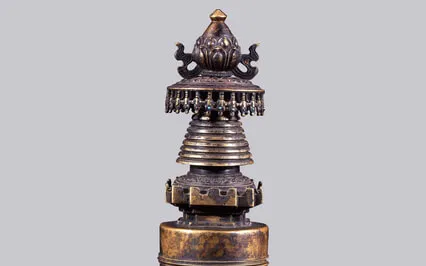
A stupa that really kind of frames this whole concept for us.
So let's take a deeper look at today's artwork.
And again,
This idea of transforming afflictive emotions.
So we're looking at a beautiful stupa here.
This is copper alloy inset with turquoise.
This is from 13th to 14th century Nepal.
And it's quite a large piece.
If you are regular at the Rubin Museum,
You may have seen this piece because it's often out,
But it's typically displayed on a pedestal that's about waist high.
And then the object is about as tall as a grown adult.
So it's quite large,
Maybe a bit smaller than that.
And the stupa is a symbol.
It is found across all Buddhist traditions and it can come in all sizes,
Actually.
It can be as large as a building and it can be as small as a traveling amulet.
So it originated in India as a mound made to hold sacred remains like those of the historical Shakyamuni Buddha.
But this is not limited to the mortal remains of a holy person.
It can also include objects associated with that person,
Such as clothes,
Sacred texts,
Etc.
While a statue or a painting of a Buddha represents the divine body of an enlightened being and a book symbolizes divine speech,
The stupa represents the mind,
The mind of supreme spiritual awakening.
And that is how it is a symbol of Buddhahood.
So it's this physical embodiment,
This almost kind of talisman to this potential we all have to transform afflictive emotions into wisdom and to really transcend and connect with that peace of enlightenment that is in all of us.
So it is my great pleasure to bring on our teacher today,
Tracy Cochran.
Tracy has been a student and a teacher of meditation and spiritual practice for decades.
She is the founder of the Hudson River Sangha,
Which is now virtual and open to all.
You can learn all about that at TracyCochran.
Org.
And in addition to teaching here at the Rubin,
Tracy has taught mindfulness meditation and mindful writing at the New York Insight Meditation Center,
As well as in schools and corporations and all over the place.
She is also a writer and the editorial director of Parabola,
An acclaimed quarterly magazine that seeks to bring timeless spiritual wisdom to the burning questions of the day.
Her writings and podcasts and much more about her can be found on her website and on parabola.
Org.
Hi,
Tracy.
Thanks so much for being here.
Thank you.
I'm very happy to be here.
And just like the theme we just mentioned and stupas,
We tend,
I thought it would be interesting to reflect for a few moments on what we enshrine inside and also outside.
And I can't help but think of a New Yorker cartoon that I saw years ago that showed people,
Not Buddhist culture,
But in Celtic culture,
Standing around a huge and mysterious monument saying I can't wait.
I just love picturing how people many,
Many years from now will stand in front of this and say,
What the heck is this?
And it was a place like Stonehenge or Newgrange.
And just like in Buddhist culture,
There are sacred places and sacred mounds and sacred amulets and sacred,
Like we saw,
Smaller objects that preserve and encase reminders of what once was.
And in some instances,
This is the Buddha.
It's a reminder that awakening is possible.
And one of the great gifts of the Buddha in particular is that he always reminded people that he was a human being,
That what he could do,
Others could do.
In the West,
We just referenced Newgrange and Ireland,
An ancient mound that was indeed a complete mystery,
And they thought it was probably a cemetery of type.
And they discovered quite by accident that it was also a very special observatory designed to let the dawn light of the winter solstice pass through a passageway and illuminate a chamber and a spiral.
But the point is that in all of these cases,
As wondrous as it is to have these reminders that human beings once did such things,
The Buddha awakened.
It's easy to say that all of us are gathered together to open to today,
Or in the West,
These people were so sensitive and observant that they came to see exactly when darkness turned to light,
When the days that were darker became lighter.
But there's a tendency in us to not just cling,
But to think that,
Oh,
That awakening happened in another time,
That something passed.
There's a kind of poignancy and longing for what we think of as past.
And instead,
We tend to personally enshrine painful experiences.
And this too is completely natural.
It's natural to have defenses to guard and protect our wounds.
And this is a practice for softening and opening this way,
For coming to see that we're not just those little stupas inside that protect our hearts,
Our broken hearts,
Or our long ago states of love and joy now past.
It's also a practice for opening to see that we're not just those benchmarks,
Those experiences,
Those long ago cherished holidays for that matter.
We're also an awareness that's fluid,
That flows around all those attachments,
All those things we cling to,
Whether they're sacred to us or our hidden protected pain,
Our secret envy,
Our rage,
Our loneliness,
Whatever it is,
We're also an awareness that sees.
And it's interesting to note,
It sounds quite,
Quite outrageous,
But it's quite true that as much as we cherish this tradition that's come to us from the time of the historical Buddha and before,
As much as we cherish our own higher states,
We've had moments of waking up.
It's heartening to know that there is more to come.
And often we tend to think of a wonderful example of the way the mind comes to kind of cherish its own painful emotions.
It's that there's a tendency in us always to think that we already know.
We know what's going to happen.
We know and we know because things have happened to us early in our lives and what's coming is bound to be like that or maybe worse.
And so we come to be driven in a sense that this is the second day of Hanukkah,
Which it's even if you didn't grow up with Hanukkah,
It's interesting to know that detail in the story that there was a fear that there wouldn't be enough light,
That the oil wouldn't last to keep the lamp lit.
And notice how often we lead with such a feeling of fear or grasping.
Oh,
I need to make this work,
I need to control it,
There won't be enough.
And see that when we sit down to practice together,
We open to the realization that we are more than enough.
And the great Christian writer C.
S.
Lewis once wrote a description that is wonderfully apt for this practice and he spoke of God,
He means a higher awareness,
An awakened mind like the stupa represents.
And he said the way we approach opening to this higher mind is to find,
Is like in-flying it and to fix up our house and we watch,
This is how practice begins,
Get like a new paint job and maybe the roof is repaired and all the leaks are tended to and we feel more comfortable as we do when we begin to sit less stress.
But suddenly this awareness starts doing unexpected things,
Knocking down walls and opening windows and putting on towers and holding wings and it seems very alarming and frankly even destructive until we discover moment by moment that what's being opened and prepared is so much bigger and better than we could have imagined,
Clinging to the past,
Clinging to our past experiences,
That we might have pictured some cozy little cottage where we would always be safe and what's being created moment by moment when we bring the attention to the present moment is a palace,
A wonderful new place where this higher intelligence,
This greater awareness plans to reside.
So as we come to sit today I invite you to notice your stupas,
Your treasured things inside and outside and let them be and also notice an attention that's greater,
That flows around them like a stream,
Around rocks.
So let's take our seat and just let yourself be completely welcomed by your own attention.
Welcome and let the back be straight so that you can have a more complete experience of yourself,
Body and heart and mind,
An experience of the whole of yourself.
So let your eyes close.
If you're comfortable with closed eyes,
If not you can lower your gaze but closed eyes is wonderful for turning the attention within.
And just notice how it feels to be sitting here just like this without striving for a better state or a state that you may have experienced in the past.
Just let yourself be exactly like this.
And notice that this attention,
This seeing that is present softens you.
It relaxes you just a bit.
And just let it travel where it seeks to travel,
Like water flowing downhill.
Let it go to places of tension or pain or just settle in your feet or your hands wherever it seeks to light.
And just let yourself sense how it feels to come home to sensation,
To being in a body.
And notice that there's a presence here,
An aliveness.
It's inside you and also surrounding you.
When we come home to sensation we open to the aliveness of life.
And just notice how it feels to be sitting here just like this.
And see that when you drift into thinking this is completely natural and that you can bring the attention back again to the sensation of sitting here,
Breathing,
Sensing,
Opening to a presence that sees without comment,
Without judgment,
With kindness,
With complete acceptance.
.
And see that if a thought or an emotion or any combination comes up that feels painful or difficult,
You can use the mantra,
This belongs.
This belongs.
There is a presence here,
An attention that meets everything that comes up with kindness and interest and loving acceptance.
.
Whenever you feel lost or taken by thinking or feeling,
Just come back to sensation,
To a presence inside you that meets everything that comes without comment,
With seeing,
With kind acceptance.
.
And see that when you're seen by an attention that's light,
Not judgment,
It's literally enlightening.
When you see this,
You begin to see that you flow,
That you're not fixed.
.
Notice that there is a light of attention.
.
.
.
.
.
.
.
.
.
.
.
.
.
.
.
.
.
.
.
.
.
.
.
.
.
.
.
.
.
.
.
.
.
.
You you you you just rest in awareness you noticing how alive you are you you Tracy thank you so much thank you that concludes this week's practice if you'd like to support the Rubin in this meditation series we invite you to become a member if you're looking for more inspiring content please check out our new podcast awaken hosted by Laurie Anderson the ten-part series features personal stories that explore the dynamic path to enlightenment and what it means to wake up now available wherever you listen to podcasts thank you for listening and thank you for practicing with us