Well,
We've had some new folks showing up in the last couple of weeks.
We've been doing this particular meeting for about six or seven weeks.
We've been working with practices from what's called the Anapanasati Sutra,
Which translates basically into full awareness of breathing.
Well,
Let me run through what this is.
Usually I have some notes in front of me and I got caught up in some weirdness around the house with a hot water heater and this sort of thing,
So I'm just going to wing it a little bit this afternoon.
The Anapanasati Sutra,
The Anapana part of that name,
Literally refers to the inhalations and the exhalations of the breath.
And sati basically means attention or mindfulness.
So the word,
The name of the sutra,
Is mindfulness of breathing.
It's a very early sutra.
We know that it was taught by the Buddha in the time of the historical Buddha.
We know that this style of meditation is a style of meditation that he himself practiced.
It consists of 16 steps and those steps are broken up into four groups and they have to do in sets of four with contemplations of the body,
Contemplations of the feelings,
Contemplations of the mind,
And contemplations of objects of the mind or of dharmas.
So I'm going to go into a little more detail,
What I want to recommend to you all after today is if you go on to Insight Timer and look me up,
Sheldon Clark,
You'll find some recordings of previous meetings from here where there's a lot more detail about what these ideas are about.
The purpose of the sutra and of this style of meditation is to develop the power of mindfulness.
All right?
And the power of mindfulness when you're talking about recovery especially but really for anybody is to be able to bring attention to one's thoughts,
To one's behaviors,
To start to get at the root of what's happening for oneself.
Thing is mindfulness,
That kind of mindfulness doesn't really spring out of nowhere.
Mindfulness like anything else has to be cultivated.
All right?
There's several different ways you can do that,
This style of meditation is one.
So what we've been doing over the last number of weeks is working through the first two sets of four instructions,
Contemplations of the body,
Contemplations of feelings.
The contemplations of the body are very simple.
One is,
The first one is,
Breathing in,
I know that I am breathing in.
Breathing out,
I know that I am breathing out.
Some translations might say,
Breathing in a long breath,
I know I am breathing in a long breath.
Breathing in a short breath,
I know I am breathing in a short breath.
You don't have to say these words to yourselves.
The idea is simply to become accustomed to what your breath is and I want to stress that when you're doing meditation,
Sometimes people have this thought that their breath is supposed to be a certain way.
My breath is supposed to be deep,
My breath is supposed to be calm,
My breath is supposed to be whatever.
Honestly,
The only thing your breath needs to be is yours.
Your breath is your closest friend,
It's the only thing that you carry with you everywhere you go.
It's the only thing that you can turn to no matter what is happening.
So the idea of those first two steps is just simply to bring a sense of mindfulness to your breath,
What your breath is like,
And to just experience the breathing itself.
Those are the first two steps.
The third step is breathing in,
I am aware of my whole body.
Breathing out,
I'm aware of my whole body.
Breathing in,
The next step,
Breathing in,
I calm my body.
Breathing out,
I calm my body.
So what these first four instructions in the total of 16 are intended to do is to really ground us in our seated position,
Into a meditative posture,
A mental posture,
Just to really bring us into where we are.
And I real quickly,
Because I'm only seeing one person here who I really know well,
I teach children and sometimes when I really want to get a sense of what their experience and understanding of something is,
I'll say,
Give me fingers one to five,
And one means I have absolutely no experience with this at all,
Five means I could write the book on it,
And three means,
Yeah,
I kind of have some experience,
You know,
I don't fully get it but I basically get it.
Just in terms of meditation experience,
Can you all hold up some fingers for me?
I see threes,
I see fours,
Threes,
Threes,
Fours,
Cool.
Alright,
So everybody's got some meditation experience,
That's great.
So what I want to do,
And I'll go ahead and do a guided meditation I hadn't planned to today,
It kind of depends on who shows up,
And we'll run through first these first four sets of instructions,
The first four instructions.
What I want you to think about as we do though,
One is remembering that there's just no pressure here.
It's really just about bringing a sense of mindfulness,
Finding your rootedness,
Finding a relationship,
A friendship with your breath.
When I get to the step that says,
Breathing in,
I'm aware of my whole body,
It really means just that.
See if you can find a linkage between your breath,
Your breathing,
And a sensation that's not just your eyes or your hands or whatever,
But your whole body,
All at once.
And then for calming the body,
Just let things be calm.
And as you do,
What you may find is that there is a simple sense of contentment there.
And if you think about it,
If you're breathing calmly,
If you're in touch with your breath,
If you've relaxed your body,
You're in touch with your body,
Contentment is a reasonable way to feel.
So the first thing I want you to do is just take whatever meditation posture is suitable for you.
That could be a seated position for people.
If it is,
You don't want to sit bolt up right,
But straight.
Relax your shoulders,
Let your shoulders be kind of rounded.
You can let your hands lie gently in your lap.
Your eyes can be closed.
Your eyes can be gently half open,
Sort of unfocused down at a 40 degree angle toward the floor.
I want you to just take a couple good deep breaths.
And as you do,
Let your body sink.
Let your weight sink down through your body.
Feel the rootedness to the meditation cushion,
The chair,
The floor.
If you're lying down,
That's fine.
Lie straight on your back.
You may want to put a pillow under your knees.
Put your hands up over your,
You know,
Either by your sides or up onto your body,
But not on your belly or on your chest.
You want your breath to be able to free flowly.
When the Buddha taught this sutra,
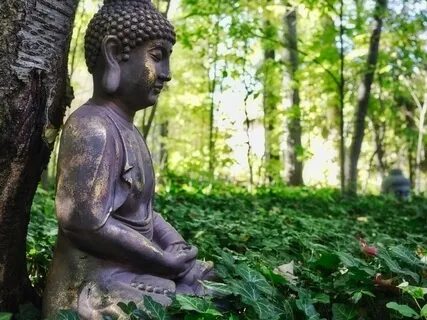
He spoke about the idea of a meditator going to a secluded place at the base of a tree,
Someplace quiet.
That's harder to find in today's world.
But what I'd like you to do is be aware of the space right around you.
See the room you're in as a friend.
It's secluded from the business of the world.
The shelter in place for you to practice and as for the body for the mind,
Bring a sense of seclusion to the mind.
One way to do that is to set an intention in this time and in this place to practice with the breath,
The expectations that others put upon you,
The projects that may greet you tomorrow morning,
The stresses and relationships you may have,
The worries,
No need for those now.
You're in a secluded place,
Set your intention to bring your heart and mind to this practice in this moment.
Now I'd like you to bring a sense of mindfulness to the foreground.
Simple bare awareness of the moment.
This is not something that can be forced.
Rather mindfulness is manifested.
No pressure,
Just simple awareness.
Consider what your mind feels like when mindfulness is present.
Your body.
Welcome a sense of mindfulness as if you're welcoming a friend,
Someone who can support your heart,
Someone who can support you on your path.
And now bring that mindfulness to your breathing.
Feel your breath coming into your body.
Feel it flowing out.
Breathing in,
Know that you are breathing in.
Breathing out,
Know that you are breathing out.
No harder than that.
No trick.
Easy gentle awareness.
Re beings.
As you exhale,
Notice that brief moment at the bottom of your breath,
Between the bottom of your exhalation,
And when you begin to inhale,
Notice that space.
Don't try to keep it there.
Let your body inhale when it's ready to inhale.
It'll do so on its own.
But in that space,
At the bottom of your breath,
There's pause,
And there's calm,
Stillness.
Just your breath,
Your closest friend.
Now I'd like you to bring a subtle shift in your mindfulness,
Still mindful of the breathing,
But let that mindfulness recede just a little bit into the background,
And bring your mindfulness to your whole body.
Feel yourself in your meditation position,
Erect,
Stable.
Breathing in,
I'm aware of my whole body.
Breathing out,
I am aware of my whole body.
No space between your breath and your body.
Your breath and your body is one.
And breathing in,
I calm my body.
Be relaxed.
Feel the muscles of your face,
The tension in your jaws.
Let your tongue be loose,
Relaxed.
Head straight,
Shoulders relaxed.
Breathing in,
Breathing out.
Aware of your whole body.
Calming your body.
Be at peace.
Be at peace.
Be at peace.
Be open to a sense of contentment in this moment.
Mindful of your breath,
Rooted in your body.
Content.
Be open to a sense of contentment in this moment.
Be open to a sense of contentment in this moment.
Be open to a sense of contentment in this moment.
Be open to a sense of contentment in this moment.
Be open to a sense of contentment in this moment.
Be open to a sense of contentment in this moment.
Be open to a sense of contentment in this moment.
Be open to a sense of contentment in this moment.
Be open to a sense of contentment in this moment.
Be open to a sense of contentment in this moment.
Be open to a sense of contentment in this moment.
Be open to a sense of contentment in this moment.
Be open to a sense of contentment in this moment.
Be open to a sense of contentment in this moment.
Be open to a sense of contentment in this moment.
Let's come back to the moment.
Open your eyes slowly.
What we often do after a period of meditation in this group is we'll take a few minutes to do walking meditation.
It's not a full-on walk.
It's a slow walk.
Have your hands folded across your belly.
Keep your posture upright.
Feel your feet as they touch the floor.
Keep your eyes cast downward.
In a moment,
I'm going to,
In a few minutes,
I'll ring a deeper tone bell.
And that's when I'll ask you to come back to your seat.
If you have your cameras off,
You could turn them back on.
I can see your faces.
That's nice.
What we just did seems like a very simple thing.
And in some ways it really is.
And in other ways it can be a lifetime practice.
Just that.
How many of you during that time felt like,
Wow,
I have these thoughts that are just coming up in my head?
Raise your hand if that was the case,
Because I'm going to raise my hand.
Right?
Absolutely.
One thing I want you to know is that that is a normal process.
That's a normal thing.
Our brain,
This is what it does.
It's its job is to think.
And our brain is egotistical.
And if we tell it,
Don't think,
Brain's like,
Well,
Screw that.
This is my job.
I'm going to think.
So I want to encourage you in several different ways.
One is to not beat yourself up about it.
The idea that you're supposed to be able to still your mind.
Well,
There are maybe some people who can do that.
I'm not one of them.
But there are ways to deal with thoughts and there are ways to deal with distractions.
One of which is,
You know,
When a thought comes,
There's a Zen priest,
Dainen Kedigiri,
Who wrote a book called Opening the Hand of Thought.
And he talks about a thought that arises in the mind and he calls it Thought A.
Wonder what I'm going to have for dinner.
Sure wish I had a cup of coffee.
Can't wait till that TV show starts.
First thought.
But what he said in the writing was,
Just because you have thought A does not mean you have to carry it forward into thought B and thought C.
You don't have to develop it.
You don't have to chase the thought.
You don't have to push the thought away.
Let it come.
Let it go.
Like a cloud that just drifts in front of the sun and blocks the light of the sun for a moment.
And then it just passes on.
With practice,
Thoughts can come and they're just thoughts.
They just are there.
And if you don't chase them,
If you don't engage them,
If you don't push them away,
They'll move on.
But it takes practice.
The other thing is just having to do with distractions.
I mean,
I've got two greyhounds in the other room and they're padding around and I've got three or four children who live next door here out the window and they're outside playing.
I don't know if you can hear them.
And these sounds come in.
There's writing that talks about,
You know,
Our senses and the Buddha talked about six senses,
Not five.
He talked about the eyes and the ears and smelling and touching,
Etc.
But he also talked about the mind as a sense that presents sensations to us just as our ears do.
And there's writings that talk about putting guardians at the sense doors,
Your eyes as the sense door of vision,
Your ears as a sense door of hearing.
And greeting the sensations that come to these sense doors with mindfulness.
And the term guardian is a little misleading because you can't keep these things out.
It can be something as dramatic as a child screaming outside.
It can be somebody coughing in the room.
It can just be the ticking of a clock.
You can't keep these things out,
But what you can do is place them.
You can,
With practice,
Place them into your peripheral awareness.
They're there.
They're part of the field of your awareness.
But what you're really paying attention to is your breath.
What you're really paying attention to is your body.
And so these sounds that we hear,
The ringing of a telephone,
Etc.
If you think about it,
Not so much as a distraction that pulls you away from your mindfulness,
But rather something that is simply part of your field of mindfulness.
Then you're able to put them where they belong,
Just sort of in the background,
If that makes sense.
So something that is important in this practice is the sense of contentment.
Most of you probably lead lives that put a lot of demands on you.
And it's a weird world out there these days.
And there's a lot to think about.
And when we take the time to be aware of our breath,
Be aware of our body,
To calm our body,
I want you to hold yourself open as you practice this.
I want you to hold yourself open to that sense of contentment.
And just be open to it and let that develop.
And the main reason is,
Apart from the fact that it feels nice,
Is that the second set of four instructions have to do with contemplation of the feelings.
These instructions are,
Breathing in,
I feel joy.
Breathing out,
I feel joy.
Breathing in,
I feel happiness,
I feel happy.
Breathing out,
I feel happy.
Breathing in,
I'm aware of mental activity.
Breathing out,
I'm aware of mental activity.
Breathing in,
I calm mental activity.
Breathing out,
I calm mental activity.
Now this is where the Wild West show starts,
Right?
Because my mental activities can be a pretty weird place.
And I have all kinds of thoughts happening,
And you probably do too.
And some of them are nice.
And some of them are not particularly nice.
So the interesting thing about this sutra is that as we get into the second set of four instructions,
Breathing in,
I feel joy,
It gives you an emotion,
It gives you a feeling to land in.
One that's positive and one that's supportive.
Now,
A lot of times what people do when they say,
Hey,
I want you to meditate,
Has anybody ever said to you,
Just sit down and count your breaths.
Count one to ten.
If you lose track,
Start over,
Start at one.
That's what I was told when I first started to sit meditation at a Zen meditation hall.
And I hated that,
First of all,
Because I would always lose track along about two and a half.
That's just kind of what it was.
The other thing is,
Though,
Is it kind of locks you just into this weird little pattern.
Okay,
I'm going to count one to ten.
That's cool.
But so what?
And what the Anapanasati sutra does is it gives us something to do with that concentration.
It gives us a next step because if we truly are rooted in our sitting,
If we truly are calm in our breath,
Being mindful of our body,
Calming our body,
Contentment is a natural response.
So is joy.
To be able to take the time and to be able to create that space for yourself can be a joyful experience.
Sometimes that joy can wash over you like a cleansing wave.
Sometimes not so much.
But what I want to encourage you to do is hold yourself open to the idea that this practice can calm you and bring you a sense of joy.
As we move through that second set of instructions,
What you'll find is we start to practice this idea of non-attachment and stepping back and stepping back and stepping back.
I'm feeling joy and sometimes that can be a very overwhelming and very positive experience,
But I'm going to step back a little bit and feeling happiness.
I'm feeling contentment.
Then I'm going to step back a little bit.
Now I'm just going to be aware of my mental activities,
That there are thoughts happening.
Then we step back a little bit and we calm mental activities.
Now there's a lot more to say about that and I would encourage you,
If you're interested,
To go to Insight Timer,
Look me up and listen to Anapanasati 3 and 5.
There are good information as well as guided meditations there about the second set of instructions.
But for now what I want to encourage you to do is,
If you don't already have a different meditation practice that you're using,
To do what we just did.
Once a day,
A couple times a day.
It can be for 20 minutes.
It can be for 5 minutes.
Anytime you consciously just stop and be with your breath.
Anytime you consciously just stop,
Be aware of your body.
It builds your spirit.
Think of doing that as a gift that you can bring to yourself.
I also want to encourage you to think about this concept of walking meditation.
If you ever read Thich Nhat Hanh,
Who's a Vietnamese Zen master,
He wrote very short little books,
Pieces every step,
I can't even remember more but a lot.
He's a big walking meditation fan.
This idea of just if you have an outside place to walk or even just inside somewhere,
Just walking for the sake of walking.
Thich Nhat Hanh was one who always said,
You know,
If you're going to do the dishes,
Just do the dishes.
If you're going to drive a car,
Just drive a car.
Don't do the dishes and think about the person you had an argument with earlier in the day.
Keep your mind on what you're doing.
Cultivating mindfulness is what this is all about.
So I'm going to stop talking.
We often do a period of quiet meditation now.
But I thought I would throw it open because I think this is new to a lot of you.
And just give you the opportunity either to talk about your own experience as we were meditating before or observations or questions you may have about this or anything else having to do with Buddhism for that matter.
So I'll throw one out there because it's this one.
Despite having a couple of years meditation under my belt,
I still have a hard time detaching from thoughts.
Right.
So I usually don't realize that something's hijacked until I'm well in the middle of it.
I haven't figured out yet how to just let it go.
I always stop it and then carry on with the meditation.
Right.
I don't know if there's any.
.
.
Yeah,
That weird feeling when you suddenly realize that you're replaying a scene from The Godfather or something in your mind.
Yeah,
I know exactly what you're talking about.
And again,
Because that's what the mind wants to do.
The practice is to be with the breath.
And when you find.
.
.
I'm going to say a couple of things,
Matt,
In answer to your question,
But the practice is to be with the breath that we're talking about.
There are other practices.
But if you find that happening,
Just see it as a natural process and just return to your breath.
And I used to sit at the Denver Zen Center years ago and I went and had a talk with a more senior practitioner.
And I said to him something similar to what Matt just said,
You know,
It's like in a 40 minute period of meditation,
That's what they did there 40 minutes is a long time.
It's like my mind,
I find myself,
My mind wandering,
You know,
50 times.
And each time it does,
You know,
I bring myself back to my breath.
But for crying out loud,
50 times I have to bring myself back to my breath.
And the guy looked at me and he said,
Isn't that wonderful?
He says,
Every time you bring yourself back to your breath,
That in itself is a moment of awakening.
And if you do that 50 times in a meditation period,
You're having 50 moments of coming back to your practice.
And that just set the whole thing on its head for me.
You know,
It allowed me to not beat myself up over what's a natural thing that's going to happen anyway.
My brain is going to think.
Now the other thing that I can say is that we get into the second group of four instructions.
We start talking about mental activities,
Which is just another way of saying conditioned thought.
Our reactive patterns,
The things that happen to us,
The planning that we do,
The regrets that we have,
All these things that arise and what the meditation starts to get into.
I'm not going to go into a lot of detail here,
But the idea of seeing a difference between being aware that a thought is arising and becoming ensnared in the thought.
So if the thought arises that,
Man,
I really screwed up when I took that drink a couple weeks ago and I didn't want to and then I made a fool of myself.
Okay,
That thought can arise or man,
I really loved that dinner I had last night.
It was so good.
That thought can arise.
That's fine.
But that doesn't mean you have to go into it.
It doesn't mean you have to get into the content of the thought.
These are two different things.
Being aware that the thought has arisen and getting into the content of the thought.
One does not necessarily have to follow the other.
Your mind wants it to and it often will.
When it does,
Cut yourself a break,
Come back to your breath and go on.
Don't beat yourself up about it.
You just go on.
I can promise you two things.
One is that the more you do that,
The easier it's going to get.
The other thing I can promise you is your brain is still going to fuck with you.
It's still going to throw this stuff up into your mind and you're still going to have to say,
Oh man,
Come back to my breath.
It's a lifelong process.
I know people who have been meditating for 30 years,
40 years.
In fact,
Another story I like to tell is we had a visiting teacher,
Shohaku Okamura.
He's a very famous Japanese Zen monk.
He's written a lot of books and he came to the Zen Center in Chapel Hill where I was practicing at the time here in North Carolina.
I went in to have a one-on-one,
It's called Dokasan,
Just a practice meeting just to talk about what he wanted.
I went in and I said,
And this guy's like,
He's the guy,
Right?
He's been practicing for 50 years and I'm like,
You know,
I sit and I get these thoughts that just come up in my head and it's like,
I can't control it.
He looks at me and says,
Me too.
I'm like,
Oh,
So don't beat yourself up about it.
You practice,
You go on,
But it does get easier.
Yes?
I made it a long time ago.
I saw an extra watching box and I actually got to see the beginning of it and then moved in.
And I was just watching them.
It got slower.
It just got slower.
And then after a while,
It seemed like I got sucked into that box.
And where I can see,
I wanted to remember thinking,
Is this worth thinking?
And then I was,
Let me tell you,
That was a little experience,
But it caused a problem.
It caused me just that and I wanted all that.
I was experiencing my nerves.
Yeah.
It caused problems in my nerves.
Because of disappointment by not achieving that again,
Is that what I'm hearing you say?
Yeah.
Yeah,
I hear you.
I hear you.
Yeah.
Well,
You know,
That's clinging.
That's desire.
And you talk about what the Buddha taught in terms of the four noble truths.
The first truth being that there is suffering in this life.
Suffering is kind of a weird word,
Right?
The word that some of you may have read in the book,
Which is Dukkha,
Which is often translated as suffering,
What the word actually means is a wheel that doesn't fit correctly on the axle.
And so it doesn't turn smoothly.
And so it's a rough ride.
And so a lot of people have started to talk less about suffering and rather just a sense of dis-ease,
Right?
And we don't want that.
We want to get out of that,
Right?
What the second noble truth is,
Is that there is a reason that we have this sense of dis-ease in our life.
And the two main ones are that we are always trying to get at something that we want.
We're always trying to keep something that we have.
We're always reaching out and trying to bring something in.
We're trying to hold it once we've got it.
And we're afraid because we're going to lose it.
Or we're disappointed because we can't get it.
Or we're always trying to get rid of something.
We're always trying to push something away.
I do not want to deal with this right now.
Please make this stop.
And we live in this.
And it causes me to be unhappy.
Third noble truth is that there is a way out of this.
One can cause this to cease or bring this to cease or at least to lessen.
And the fourth noble truth is the eightfold path.
Are you all familiar with what I'm talking about?
Let me just see hands yes or no.
Are you familiar with what I'm talking about?
Okay.
There's some good books on the subject.
There's a real good book if you look on Amazon or somewhere called.
.
.
Oh,
I don't remember the name of it.
Eight Paths to Happiness or something like that by a man named Gunaratana.
But it's just a series of ideas through which we can consider our lives.
Right action,
Right effort,
Right speech.
And look at the ways that we're clinging.
I'm coming back around.
I hear what you were saying.
Roland,
Is that your name?
I feel like what I was hearing you describe was that you had this experience and it felt positive and it felt fruitful and useful and good.
And then it didn't happen every time.
And you wanted that,
Right?
So that's just it.
That's that clinging thing.
And then there you didn't have it again.
And it became a source of suffering.
It became a source of dis-ease.
There's another Zen teacher who died a long time ago,
Shunru Suzuki.
And he used the term non-gaining mind.
You don't come into meditation expecting anything necessarily.
You don't come into meditation expecting enlightenment.
You don't come into meditation expecting to feel good.
You just come into meditation,
You sit down and you breathe.
Right?
And that's enough.
And if you have further experiences that feel fruitful and feel helpful,
Wonderful.
But you can't grasp after them.
That's the thing.
And I spend a lot of time in my life,
I have spent a lot of time in my life over the last any number of years of looking at ways that I cling to things,
To ideas,
To people,
To possessions.
How I try to,
I feel aversion to try to get rid of situations that I don't want or try to get out of the place where I am and into the place where I want to be.
And I know how it just burns me up and has burned me up.
So if anything can come out of this conversation,
I encourage you all to think about that.
And if you really start to take some time to notice that with mindfulness and practices like what we're doing with the Anapanasati Sutra,
The part of the work of it is to cultivate mindfulness.
If you start to really look at your life with mindfulness and see how often you are wanting something or trying to get rid of something,
You may shock yourself with the frequency.
It's like,
Shit,
Is that where my head is and my heart is all the time?
Whoa.
So,
You know,
You realize it.
You take a breath.
You move on.
And maybe two minutes later,
You're there again.
You take a breath.
I'm not going to follow that thought.
You know what?
The thing is,
You can say to yourself,
I don't have to follow that thought.
You have that power.
I don't have to.
I may need to train myself how not to.
But these things that burn yourself up,
You don't have to.
There is another way.
So,
Anybody else?
Hey,
Yeah.
I found there was like a time when I was meditating and I was very controlling.
And it almost seemed like the more I learned about this type of stuff,
Like at first it was helping me really well.
And then I started learning about stuff and I was like,
Oh,
I'm going to practice this,
This,
This,
This,
This.
And I jumped around and I totally related with what Roland was talking about,
Like how we had like a good experience.
And then we're like,
Yeah,
Man,
I want every experience to be like that.
And,
You know,
Oh,
Man,
I didn't have as much thought.
But this time I did have a lot of thought.
And,
You know,
What I kind of,
What I sort of,
I'm sort of going into this frame right now.
And I'm still learning,
But if I can kind of create everything,
Like an experience stuff,
As if it's its own thing rather than something else,
That helps me out a lot.
Like,
My meditation doesn't have to be like this other meditation.
It's its own experience right there,
You know.
And that's like a really beautiful thing.
It kind of means like,
You know,
Okay,
So it's not exactly like this.
And I kind of wanted this,
But it's its own thing.
And I realize every time I meditate,
I'm going to have good ones and I'm going to have bad ones.
And if I could just say,
Well,
That's just the way that experience is right now,
I seem to accept it.
Like,
The more I can go with the flow,
The better it seems that,
You know,
All of these crazy emotions and all of these crazy cleanliness that I have,
If I could just sort of accept it and say,
Well,
It's just that's the way it is.
I do a lot better.
Yeah,
Yeah,
Exactly,
Exactly.
And,
You know,
People talk about a Buddhist practice.
Well,
That's what it is,
You know,
You got to practice.
You know,
Sounds silly,
But you got to practice.
I encourage you to do it every day.
And like I said,
Even if you just do this much,
Even if you just do what we did today,
And what happens is you wind up bringing a sense of calm to yourself.
Like I said,
That's a gift.
You know,
There's more to it that we're going to be going into.
And there's some other folks who are usually here who aren't here today.
Sam's here a lot.
You know,
Who have already talked through with me a lot of that second group of instructions,
Contemplation of Feelings.
And Matt,
I know you've got some familiarity with this as well.
So like I say,
If you're interested in tuning in,
You know,
On Sundays at 5.
30,
Go ahead and listen back through some of the other meetings that we've had on Insight.
And you can catch yourself up pretty easily and there's some guided meditations there.
And there are a couple of good books you can look into.
Thich Nhat Hanh,
Breathe You Are Alive,
Is a real nice book.
And another book by a fellow named Larry Rosenberg.
The name of that book is Breath by Breath.
Those are both good books.
But mostly,
You know,
Sit down and breathe.
That's my best advice.