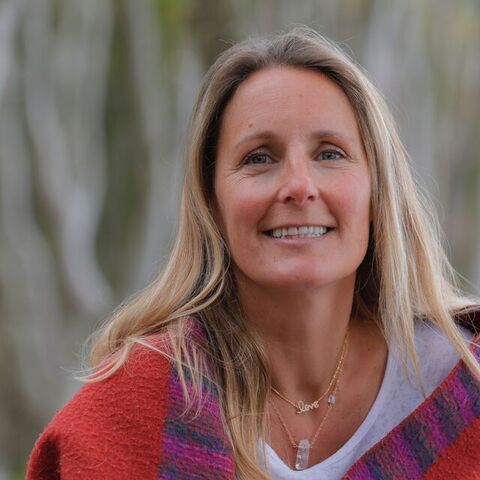
The following practice is led by Sonia Lockyer,
Host of the Wellbeing Ritual Club.
We are going to be doing a practicing a mantra meditation and actually in my personal life I've really upped my meditation recently and this mantra that we're doing today is my personal practice so I do it morning and night,
20 minutes,
Which is the sort of the structure of a TM practice.
20 minutes in the morning,
20 minutes at night you take a mantra.
This mantra is not my TM mantra,
Just in case,
I don't want to cause confusion,
But it is my preferred mantra and that is Vishwa Shakti Avahan.
A prayer of devotion to the goddess of the feminine.
And as we come in towards winter,
Darkness is the feminine,
The sun is the masculine and the moon is the feminine and everything to do with planting seeds in the earth and being nourished from the darkness is a feminine energy.
And I happened upon a beautiful documentary on Saturday night,
I think it was,
With Brian Cox,
Dr.
Brian Cox about stars,
I don't know if anyone else has seen it,
But I was just so lucky to fall upon it because he is just amazing anyway,
Isn't he?
When he talks about things he has so much enthusiasm and this series,
This Saturday night series,
Which I think is going on at the same time as Strictly,
It talks about the planets and the galaxies and it's just literally like mind-blowing information about the huge curve of our galaxy and the fact that,
I mean he's talking in like gazillion,
Billion,
Million years,
But the fact that the sun is not going to be here forever,
The sun is a star and it will burn out.
I didn't realise that.
The sun will burn out and what's left after the sun is something called a red dwarf,
Which is the slowest burning star.
Now you guys probably all know this already,
But for me it was new,
So it just blew my mind,
I thought the sun was there forever,
But it's not.
And at the end of the sun you get the red dwarf and then eventually the red dwarf will burn out as well and then we will be in the age of darkness,
But that won't be the end of life.
It'll be the end of our lives obviously,
But it won't be the end of life,
Just life that we know.
So it just gave me this incredible perspective on the immensity of the galaxies and the fact that our worlds are such a macro,
Macro,
Macro,
Macro,
Macro,
Macro expression of life and then there's this immense expression of life going on all around us,
You know,
We're however many planets,
In however many galaxies,
In however many universes and it just gets bigger and bigger and bigger and keeps expanding.
So all of that little enthusiasm about the stars is just to say that this darkness that we find so scary is so inevitable and also just a part of this immensity of our human existence and our game of life that we're playing.
So not to be scared of it but to just look at it and love it and see it for what it is.
Okay,
So Vishwa Shakti Abahan.
Find a comfortable position.
You can use the beads,
I'm not using the beads today,
But you are welcome to use the beads if you want to.
We'll take 20 minutes to repeat the mantra silently and allow it to start to resonate inside of us.
So it becomes a drumbeat almost,
This repetition,
Vishwa Shakti Abahan and everyone will have their own rhythm,
It will take its own pace and as you repeat the mantra the breath starts to weave its way in.
So Vishwa Shakti Abahan will have its own inhale and its own exhale rhythm that moves with it and you don't need to control that,
It will fall into its own natural place.
And we know that meditation has three clear stages,
The part where you start and you're on track and off you go,
The part where you notice you've drifted off and that is an important part of a meditation practice,
Not the fact that you've failed,
It's a part of it.
And then the part where you come back and you're off again.
Three clear stages to a meditation practice.
So as we sit here for 20 minutes doing that you are going to notice,
You'll notice when you drift away,
You'll notice that you haven't noticed you've drifted away,
Sometimes for the entire practice and all of that is good,
All of that is a triumph.
So you want to be sitting comfortably with your spine straight,
If that's in a chair that's fine,
That's great or down on the floor,
You can even be lying down on your back if you don't think you'll fall asleep.
And your mouth will be gently closed,
The lips aren't pursed together,
They're just softly resting against one another,
Tongue pressing up into the roof of your mouth,
Breathing in and out through the nose.
And let's tune into our sense of hearing so we notice the expansion of our capacity to hear.
And then bringing your sense of hearing back so that you notice the sounds of your breath,
Perhaps the sounds of your body.
You might get a tummy gurgle,
You might hear your heartbeat.
And then gently starting to circle your head in a way that feels good for your neck.
And then changing direction.
And coming to center and circling shoulders in a way that feels good for you.
Some morning movement before we settle into the mantra.
Maybe some heart circles.
And then changing direction.
Coming to settle for the mantra,
Vishwa Shakti Avaham.
Take your time,
Let it find its own rhythm.
20 minutes.
Here we go.
.
.
.
.
.
.
.
.
.
.
.
.
.
.
.
.
.
.
.
.
.
.
.
.
.
.
.
.
.
.
.
.
.
.
.
.
.
.
.
.
.
.
.
.
.
.
.
.
.
.
.
.
.
.
.
.
.
.
.
.
.
.
.
.
.
.
.
.
.
.
.
.
.
.
.
.
.
.
.
.
.
.
.
.
.
.
.
.
.
.
.
.
.
.
.
.
.
.
.
.
.
.
.
.
.
.
.
.
.
.
.
.
.
.
.
.
.
.
.
.
.
.
.
.
.
.
.
.
.
.
.
.
.
.
.
.
.
.
.
.
.
.
.
.
.
.
.
.
.
.
.
.
.
.
.
.
.
.
.
.
.
.
.
.
.
.
.
.
.
.
.
.
.
.
.
.
.
.
.
.
.
.
.
.
.
.
Sometimes there are very strong stories that come up,
Narratives that come up as we practice.
Other times,
Not so much.
Just reflect on how that practice was,
What came up,
What you felt,
Allowing it all.
And then offering the fruits of our practice up to all sentient beings so that our personal wellbeing is collective wellbeing.
Namaste.