.
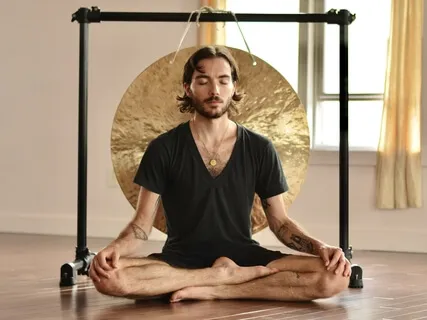
The first part of this short practice will be seated.
So find a comfortable way to sit.
This could be cross-legged.
It could be on your knees.
You could be sitting onto a block.
Or any other seated posture that allows you to sit comfortably and tall.
And for the body to be as relaxed as possible.
As you settle into this comfortable seat,
There's no need to rush it.
But when you do feel ready,
You can let your eyes close.
Perhaps even let the eyes open and close a couple of times.
Before finally,
Softly,
Shutting them for good.
Let the eyes themselves slowly cease to move or dart around.
And to help you to do this,
Just ensure that the eyelids are very softly closed.
So they're not squeezing.
And that all of the muscle and tissue and even the bone around your eyes is soft and supple.
And feel how that starts to neutralize the expression on your face.
Inviting it to become restful and serene.
Now take a few slow,
Deep breaths.
And you might take these breaths in and out through the nose.
But if it feels better,
You could exhale out through your mouth.
And you might even want to make a little bit of sound with each exhale.
And really here,
There is no correct way.
Whatever feels like a fulfilling,
Helpful and relaxing breath.
What type of breath is going to be most nourishing for you?
And commit to a few high quality versions of those.
Once you finish those breaths,
Simply let your breathing return to a normal rhythm.
Natural and easy.
Breathing through your nose.
For a moment here,
Slowly let your mouth fall open,
But continue to breathe through the nose.
Doing this so that the jaw can slacken and relax.
Feel that relaxation all the way up towards your ears.
And from the tip of your tongue,
All the way down its length.
Then,
With all of that softness remaining intact,
Gently bring the mouth to close again.
And notice where everything sits.
The teeth,
Your lips,
Your tongue.
And notice that serene,
Easy expression on your face expanding.
Becoming more fully formed.
Let this expression that is on the face inform how the whole body is being held.
Neutral and serene.
This is not to say that there's no strength in the body,
But the engagement that is present is subtle.
In the same way that we subtly hold our attention on an object in meditation,
We're subtly holding the body in this perfect alignment as we sit.
This is your physical manifestation of meditation on your face,
In your body,
As sensation.
Let that same neutral,
Serene quality start to emanate through all levels of your being.
The physical,
As we've established,
The felt sense of your body,
Its sensations,
Your thoughts,
Your emotions.
Every single aspect of you is starting to express this neutral,
Serene ease.
There may still be thoughts present,
And there may still be emotional states felt,
But this expanding sense of ease creates something like a buffer.
You can rest knowing that you can relate to any thoughts and to any emotions with that ease,
Even if it's just for the length of this practice.
Now start to become aware of the additional space that you have to notice,
The additional space and capacity you have to attend to something specific.
And that additional space might be felt to be small,
Or it could be felt to be fairly significant,
And both are fine.
But this is what we're aiming to develop.
Leveraging that additional capacity towards our ability to listen.
And we'll take a broad definition of listening.
So in this sense of listening,
It may be the case that there's something to be seen.
We're expressing this enhanced ability to listen as we gaze softly at the backs of the closed eyelids,
As we maintain our physical posture,
And as we continue to sense all of the information that the body is sending us.
This broad definition of listening largely translates as attentiveness and receptivity.
All of this space,
This increased capacity is going to be leveraged in our ability to sense.
Sensing what is there in your field of visual perception as you gaze onto the backs of your closed eyelids,
As you gaze inwardly.
And in particular,
With respect to your sense of hearing,
Your ability to sense silence,
Space,
Inner sound.
At first,
It might feel like there's nothing to be heard,
Nothing to be seen,
Nothing to be sensed.
With a little bit of practice,
We'll start to notice that there is a whole universe inside of us to see,
To hear,
To sense.
We'll spend just a couple of minutes watching inside of ourselves,
Listening inside of ourselves,
And in general sensing our inner state as a way of priming ourselves for a short sound bath,
Which will be the second part of this practice.
Listen for silence,
Gaze into space,
Sense everything that is inward.
And in a few minutes time,
It will be the same quality of attention with which we perceive the sounds and vibrations of the gongs.
.
.
Good.
Very softly,
Taking a couple deeper breaths and shift yourself onto your back,
On the floor,
On a yoga mat,
Or on your bed.
Keep your eyes closed as you do so,
If you can,
And try not to break the quality of attention that you've produced with the first part of the practice.
Make yourself comfortable physically,
Make sure you're warm enough,
And let everything but that quality of attention totally relax,
So that the sounds and vibrations of these gongs completely wash over and through you.
There's no need to engage other than with that quality of attention.
Sensing,
Seeing,
Hearing,
All that the gongs produce in your inner state.
And I'll call you back to finish the practice when the sound portion has completed.
.
.
.
.
.
.
.
.
.
.
.
.
.
.
.
.
.
.
.
.
.
.
.
.
.
.
.
.
.
.
.
.
.
.
.
.
.
.
.
.
.
.
.
.
.
.
.
.
.
.
.
.
.
.
.
.
.
.
.
.
.
.
.
.
.
.
.
.
.
.
.
.
.
.
.
.
.
.
.
.
.
.
.
.
.
.
.
.
.
.
.
.
.
.
.
.
.
.
.
.
.
.
.
.
.
.
.
.
.
.
.
.
.
.
.
.
.
.
.