So let's begin our session by settling our body in its natural state,
Just scanning through the body to see if there's any tightness or tension.
Breathing into those areas,
Relaxing them,
Releasing them on the out-breath.
And just checking to make sure that you have a conducive posture,
That the back is straight,
Hands are resting in the lap,
The right hand resting on the left hand with the thumbs touching,
The head tilted slightly forward,
The eyes can be open or closed,
Whatever you prefer.
Shoulders are even,
The jaw and the tongue are relaxed.
Just allow yourself to settle into a kind of stillness for our meditative session.
And then just take two or three deep breaths into the body,
Just letting go on the out-breath.
And then allow your breath to return to its natural rhythm,
Not controlling it in any way.
And then we just bring our attention to notice the sensations of the breath,
Sensations of the rise and fall of the abdomen or the sensations at the tip of the nostrils.
Noticing each new in-breath,
Each new out-breath.
And of course discursive thoughts will continue to arise in the mind,
That's their habit,
But with a sense of mindfulness,
A mind of mindfulness.
Not forgetting the object,
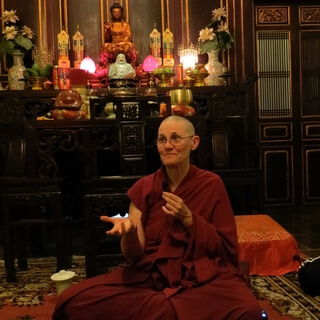
Whether you're choosing the breath or focusing on the image of the Buddha in the space in front.
Trying to extend that sense of mindfulness on the object,
The familiar object,
Without forgetting,
Without distraction.
And also activating one corner of the mind to check up from time to time to see if we're still on the object.
If you find counting the breath helpful,
You can employ that or just simply notice the breath or the Buddha in the space in front.
When you notice the mind has wandered away into some other thought or distraction,
Some other sensation,
Just gently bring it back without any disappointment,
Without any judgment.
We may have to do this a million times and that's okay.
We just keep coming back to the object of our meditation,
Gradually extending the awareness,
The clarity of our awareness on the object.
And if you come to recognize that you forgot to set your motivation,
Like I just did,
It's never too late to set a motivation during our meditation.
So just observing our own minds.
One of our greatest sufferings is that our mind is not under our own control.
At any moment,
Afflictions can arise,
Suffering feelings can arise.
There's so much that we have no control over.
And this is something that makes our lives very unsatisfactory.
And just reflecting how this is also true for every other living being.
And so with a sense of compassion for ourselves and for all beings,
And with a real sense of possibility to develop more of our potential to learn about our mind,
To learn to bring some control over the afflictions and cultivating the positive states of mind,
Then let's do the analytic meditation with a real aspiration to develop our qualities,
Our good qualities,
More and more,
So that we can be of greater benefit to ourselves and to all the beings we come in contact with,
And really extending that to all living beings.
So then let's shift our attention to think about the mental factor of faith.
And as our text said,
Faith brings about a joyous state of mind.
So think about the possibility of that by simply turning our attention to one of these aspects of faith and cultivating that in our own mind.
We can test for ourself to see what kind of state of mind that brings about.
And as it's often said in the different scriptures,
Faith is the support to bring about aspiration for virtuous qualities or wholesome states,
Wholesome qualities in ourselves.
And then that aspiration is what supports us to generate joyous effort to engage in our practice.
And then joyous effort is what brings about the positive results that we're looking for,
The good qualities,
Different states of mind,
Progression along the path.
So let's think about that first type of faith,
Inspired faith or clear faith.
This is the kind of faith that helps us to overcome doubts,
Which can be so helpful.
So we can either think about the benefits and the good qualities of the different topics that we find in the Lam Rim,
Like the qualities of loving kindness,
The qualities of bodhicitta,
The qualities of concentration and wisdom.
Or we can think about the qualities of the Buddha,
His fearlessness,
His ability to lead others to be free of fear,
Et cetera.
We could think about the qualities of our teachers,
We can think about the qualities of his holiness,
The Dalai Lama.
So choose one of those,
Choose one topic or one person and let's just spend a few minutes cultivating this sense of inspired faith or clear faith that comes about through putting our attention on the good qualities of either a virtuous topic that we're trying to develop or a person that we admire.
And then secondly,
Let's take a look at the faith of conviction.
This is a type of faith that comes about through contemplating,
Through analyzing,
Investigating.
So we could choose any number of topics we find in the Lam Rim,
Such as precious human rebirth,
Thinking about the freedoms of fortunes,
Or thinking about death and impermanence,
Nine point death meditation,
We can think about the four noble truths.
So we can think about karma,
The four general characteristics of karma.
So choose one Lam Rim topic and just go through that thinking about the logic and the reasoning of how that's presented and just notice how that can increase the sense of faith or conviction in your own mind.
And finally we can take just a few minutes to think about aspiring faith.
So aspiration is the mental factor that seeks something,
Some quality or some understanding.
But aspiring faith is that once we've understood something can be attained,
Then we really wish for it.
In fact,
We can think very definitely,
I will definitely attain this.
So either thinking about the good qualities from clear faith that you reflected on earlier,
Or the faith of conviction,
Just the brief meditation we did just now.
See if you can generate this state of mind that thinks,
I will definitely attain either these good qualities or this understanding of what I've developed conviction in.
See if you can cultivate that sense of certainty in your mind,
That aspiration.
And just conclude the meditation by simply noticing the feeling in the mind,
The state of mind.
Has there been a shift to a slightly more elevated or expansive joyous state of mind?
And then we'll dedicate whatever merit we've accumulated in this session.
Due to this merit,
May we soon attain the awakened state of Guru Buddha,
That we may be able to liberate all sentient beings from their suffering.
May the precious bodhi mind not yet born arise and grow.
May that born have no decline,
But increase forevermore.