Hello everyone,
Thank you for joining me.
Throughout this year I'll be recording a series of talks discussing the path of MIDL mindfulness meditation practice.
MIDL is a type of mindfulness meditation and its goal is to live a better quality of life,
A relaxed life,
A life free from anxiety.
It's based on the methodical process of self-investigation of looking within,
Which leads to developing a deeper understanding about ourselves.
MIDL offers a complete meditation system with a clear path for training for establishing mindfulness meditation within your daily life.
It requires no special props,
Postures or conditions and can be done within the distractions of your home,
Work or recreation.
First let's understand the name MIDL.
MIDL stands for mindfulness in daily life.
This points towards its goal of making the observation of our relationship to our daily life our meditation practice.
Also the letters MIDL sound like the word middle when pronounced.
This is not an accident,
But is intentionally done to point towards the meditation path.
The middle in MIDL means the middle path or middle way,
Which is mentioned in the first talk given by the Buddha on Satipitana Vipassana practice,
Or what is more commonly known today as mindfulness meditation.
The middle way in MIDL is a practice of neither running towards nor running away from any experience that arises within our life.
The middle way is found by learning how to deeply relax into our relationship of aversion to any unpleasantness that is being experienced.
This is done by cultivating and refining the MIDL softening into skill.
This practice of softening into is based on the understanding that we are all driven by a protective anxiety against experiencing unpleasantness within our life.
This protective anxiety gives rise to all our defensive emotional responses and personality traits,
Those responses that push away.
Literally,
Who we are now is a creation of our relationship towards pleasure and pain throughout our life.
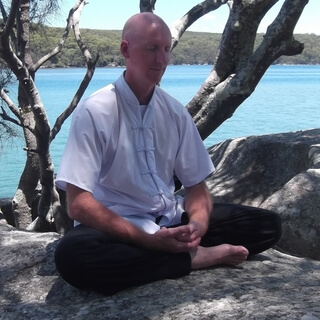
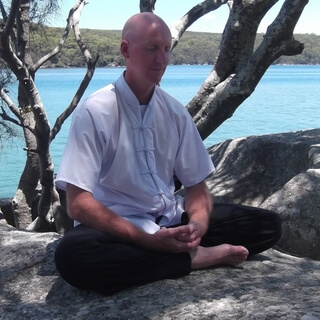
MIDL mindfulness meditation can be separated into two practices,
Formal seated mindfulness meditation and mindfulness of your everyday activities.
When practicing MIDL meditation it is important to understand that formal seated mindfulness meditation is training for mindfulness in everyday life.
In essence the practice is the same whether you are sitting still or engaged in your everyday activities.
The main difference is that when you intentionally sit down to meditate you are,
To a certain degree,
Creating a more comfortable environment in which to observe yourself.
When practicing this style of mindfulness meditation you systematically train your attention so there is no difference between sitting in formal seated meditation and everything else.
This comes with the understanding that meditation is a posture of the mind and heart,
Not a posture of the body.
With MIDL meditation training you will be able to meditate throughout the day regardless of what posture your body is in and experience the benefits within your life.
What is important in this practice is developing a clear awareness of your relationship to whatever you are experiencing now.
It is within your relationship to what you are experiencing now that happiness and peace can be found or lost.
If you are unaware of how you are relating to what is being experienced within your life the survival,
Habitual part of your mind will do it for you.
It will habitually react with aversion towards unpleasantness and with longing towards pleasantness,
Embedding you in an addictive cycle of attraction and aversion.
The development of MIDL sits on the basis of three pillars.
Flexible attention training is the first,
Softening into training is the second and allowing stillness training is the third.
The first two pillars of flexible attention training and softening into training create the foundation so that your meditation practice transfers into your daily life.
These two pillars also give you the ability to work with,
To be with any difficult emotions,
Thoughts or reactions that arise within your life.
To develop the first pillar of flexible attention you need to structure awareness in very specific ways.
During your MIDL training you will learn how to ground your awareness or make it soft and relaxed or large and open or completely focused on one experience.
Having the skill of becoming comfortable with the changing focus of awareness,
Dependent on the situation that is being experienced is part of the MIDL pillar of flexible attention.
During your training you will also cultivate accuracy of attention by observing how your mind moves,
How attention moves during your meditation practice.
With this approach distraction during a meditation practice is not your enemy,
But your friend.
Actually distraction is needed for MIDL meditation practice to develop.
This is why MIDL guided meditations contain periods of silence within them.
The meditation practice and training does not occur while my voice is speaking,
But rather during the periods of silence.
These silence gaps are put there so that you will become distracted,
So that your mind will wander off.
These wanderings in mind are necessary for you to develop the factor of mindfulness in MIDL.
The very act of observing when your attention is wandered and where it is wandered to is what strengthens the mindfulness factor.
As your practice develops you will also learn the skill of observing the processes of your mind and its interaction with your body and emotional heart center.
As this ability deepens you will be able to observe the contact with your five senses – eye,
Ear,
Nose,
Tongue,
Body and the six sense your mind – as your mind interprets them all.
It is the training of this flexibility of attention and the ability to stay with your mind when it moves that will allow you to transfer this practice into your daily life.
When the practice first transfers it will be for short periods at first.
And these periods of mindfulness of course will collapse.
That is what it does.
Your task is to encourage these periods of mindfulness to grow and flourish.
When these periods of continuous mindfulness establish it is no longer necessary to cultivate flexibility of attention in seated practice.
This is not needed because formal training has fulfilled its purpose and continues to develop within your daily life.
The second M.
I.
D.
L.
Pillar – the skill of softening into – gives you the ability to deeply relax both physically and mentally to responses of the heart and mind.
This is an important part of M.
I.
D.
L.
Practice.
It is coming with the understanding that the base way that our mind gets us to do anything in life is by producing a vedana,
A pleasant or unpleasant feeling.
Our mind produces a pleasant feeling and releases it within our body if it wants to attract us towards an experience.
Our mind produces an unpleasant feeling and releases it within our body if it wants us to push an experience away.
It is these two feelings that we react to throughout our life.
It is our relationship to these feelings that give rise to all likes,
Dislikes,
Opinions and views.
It is our relationship to these two feelings that creates our emotional responses and also the characteristics of our personality.
Our relationship of dislike of unpleasant feeling in particular gives rise to all defensive emotional reactions and defensive personality traits.
Since pleasantness and unpleasantness demand our response,
The skill of softening into allows us to deeply relax into that response,
Deeply relax into our attraction or aversion.
This allows us to be with these feelings without responding,
Cutting off the process of reaction and response.
The M.
I.
D.
L.
Softening into skill is cultivated in four main stages.
Stage 1,
We retrain complete deep diaphragm breathing until it becomes natural.
Stage 2,
We learn how to totally disengage to develop relaxation of mind and body with the deflation of the breath.
Stage 3,
We learn to deeply mentally soften into our bodily sensations.
Stage 4,
We learn the skill of softening into unpleasant feeling when triggered by thoughts and memories.
The softening into skill once developed and refined combined with the first pillar of flexible attention will allow you throughout the day to be of difficult responses within your life.
These responses will then become your teacher,
Your friend.
Through being aware of how you are relating and responding to things within your life and deeply softening into your response,
You have the ability to decondition the process so it is no longer part of your personality or life.
The third pillar of allowing stillness is developed once the first two pillars transfer into your daily life.
Once the first two pillars have transferred,
The flexible formal attention training is no longer needed.
At this stage your formal seated meditation training swaps to the third pillar of allowing stillness.
Allowing stillness is a meditation practice that is literally not meditating.
Allowing stillness is sitting still,
Not moving,
Not doing anything at all.
Is literally the skill of not doing.
Through not doing anything your mind will naturally start to return to your emotional heart center.
Normally this is the very place that our mind does not want to be.
It does not want to experience the emotional pain within.
It separates from our heart center to the fantasy world of thinking within our head.
It does this in an attempt to escape from emotional pain,
Emotional pain that has not been accepted throughout our life.
Your only task during this practice is to be,
To allow yourself to be still,
Regardless of what arises.
To teach your mind that your heart center is safe,
This is your purpose.
Just to allow your body and mind and heart to settle,
To reunite as one.
You may find that as you do this at first,
Your body will start to relax deeply,
Becoming very,
Very heavy,
Very relaxed.
Yet your mind may produce anxious feelings,
Restlessness and thinking,
Bringing you out of the deep relaxation.
This is perfectly normal,
This is okay and this is exactly what is meant to happen.
This bouncing of deep relaxation is just your mind trying to protect you.
To relax deeply is to lower your defenses.
Your mind does not want to lower its defenses.
Your task is just to keep relaxing deeply,
Allowing everything to be,
First physically,
Then mentally,
Stripping back your mind's armor,
Teaching it that now is safe.
The skill of allowing stillness temporarily removes your armor,
Allows your mind to access a deep level of rest.
In this deep level of non-activity,
Of not doing,
Your mind can rest and repair itself.
One thing you need to remember when resting your mind,
As my teacher said to me,
It does not need your help.
You just have to get out of the way.
When your mind sinks below its normal,
Habitual functions,
It will naturally start to heal,
Naturally start to repair.
Also as it learns to sink more deeply,
To let go,
Its defense mechanisms based on fear will weaken.
You will experience a softening of your personality.
Through training these three pillars,
You will start to experience periods of equanimity during your day.
When equanimity arises,
All your likes and dislikes will dissolve.
Life will feel effortless and perfect within its essence.
You will be experienced as deep contentment.
Nothing could be added to this to make it any better than it is now.
There will be the arising of subtle pleasure and also the feeling of peace.
Your only task is to continue to soften into everything.
At first these periods of equanimity will be short and of course they will collapse.
But this is okay.
At this stage you will understand that everything flows and changes,
Nothing is permanent.
Through further refining these skills,
In particular the softening skill of softening into your attraction and aversion to what you are experiencing within your life,
These periods of equanimity will become more frequent and establish within your life.
Thank you for spending this time with me.
I really appreciate it.
Take care of yourself.
And goodbye.