Last time you saw me we looked at blessing number 29 on the site of a true monastic.
With the Dharma talk today we'll continue in our series on Enlightened Living to the fourth and final blessing of the Instilling Oneself with Higher Virtues subsection,
That is number 30 on regular discussion of the Dharma.
Many people can talk all day and all night on ephemeral matters but if they had to talk for even five minutes on the subject of the Dharma they would be left scratching their head discussing the Dharma is no easy skill.
Even the Buddha himself spent many lifetimes perfecting his speaking and listening skills before he could move on to discussion of the Dharma.
Dharma discussion is a challenge because it is the culmination of almost all the blessings already mentioned.
Back in blessing number 7 on learnedness,
Dharma discussion required participants to listen carefully to others first before expecting to be listened to themselves.
Later in blessing number 10 on effective communication we learned about the hallmarks of effective speech rather than just saying what others want to hear by complimenting and praising them.
Even if someone speaks seven languages they could hardly be considered an effective speaker if everything they said is controversial.
More recently in blessing number 22 those joining a discussion were expected to be respectful.
In other words,
Since most things in the world have pros and cons you'd be expected to emphasize the constructive aspect of things you talk about.
Following on in blessing number 23 we learned that those in the discussion need to be humble,
Not looking down on others or their opinions.
Later in blessing number 26 it was advocated that having listened to many Dharma talks our understanding would come from reflecting on what we've learned and otherwise interrogating these teachings.
Of course it is an acquired taste to want to listen to the Dharma rather than gawk at a comedy show because firstly it is hard to concentrate on something abstract like the Dharma when we are used to focusing on more concrete matters.
A second challenge is that it's hard to be receptive to the Dharma.
Supposing the monk talks about precepts we run the risk of realizing that we haven't managed to keep our own precepts very well.
Therefore to be reminded of our bad habits is always unwelcome.
It's hard to want to listen to someone talk about your shortcomings.
It's like touching on an open wound.
This is why people like sitting right at the back of the lecture hall whenever listening to Dharma teachings in case the teaching monk puts them on the spot.
Furthermore in blessing number 27 we learned that those in a discussion need to be patient.
The sort of patience needed is of patience in the face of interpersonal conflict when differences of opinion arise.
Most recently in blessing 28 we learned that those in a discussion must be open to criticism.
You will know about this as soon as the topic of Dharma discussion gets personal.
We may find during a discussion that others will test our patience first to see how much criticism we are able to accept.
If someone is due some heavy criticism a fellow participant in the discussion might start by doling out minor criticisms first such as when you're listening to sermons you shouldn't fidget because it shows lack of respect towards the Dharma and gradually get heavier for example when you're listening to sermons you shouldn't daydream because it shows lack of respect towards the Dharma.
This is why you can see that discussing the Dharma is no easy matter.
If it were easy we would already have come across it much earlier in the series of blessings.
However this subject has been placed at the 30th step of the path of Buddhist practice for the reason that it may be disastrous to organise a Dharma discussion if you don't know what you're doing.
Dharma discussion is much more demanding than just listening to the Dharma talk because discussion means that it's interactive.
Similarly it's easier just to talk and have people listen to you than it is to respond to what others are saying.
The objectives of this blessing are firstly to discuss the Dharma in a way that brings benefit to oneself and others.
In the words of the Buddha a large merit awaits if Dharma discussion is practised correctly because at Dhammapada verse 354 he said,
Sabba dānaṃ dhamma dānaṃ jīnāti which translates as,
The gift of Dharma excels all other gifts.
The second objective of discussing the Dharma is to discuss it in a way that does not detract from the value of the Dharma.
This seems to be mentioned because discussing Dharma in an inappropriate or distorted way will hasten its disappearance from the world era.
This is why the Buddha taught in Yāngudūrūṇikāya's Ānāpati Sutta and I paraphrase that,
Monks who claim there is no harm in breaking this or that monastic rule,
Or who fabricate new monastic rules,
Bring harm and unhappiness to the many folk,
Suffering to humans and angels alike,
And in so doing,
Earn grave demerit,
Causing a premature end to the Siddhamma.
He went on to explain in the Bāla and Samajitta Suttas again of the Yāngudūrūṇikāya that,
And again I paraphrase,
Distortion of the Dharma includes faking what the Buddha said or claiming the Suttas contain things they don't,
Which reiterates what was mentioned in Blessing 3 about the inadvertent harm of making jokes about the Dharma.
The third objective of discussing the Dharma is to acquire wisdom,
Because Dharma discussions are intended as a way to cultivate wisdom.
The Buddha praised wisdom above all other things regarding it as beyond price,
Because in the Jara Sutta,
He taught Bhaññā-Nāra-Nang Rattanam,
Or Wisdom is the wish-fulfilling gem of the people,
An observation in contrast to many from the latest generation who seem to think that a wish-fulfilling gem comes in the form of the latest video game console.
Since life is always full of problems to solve,
Whether it be problems from physical hardship,
The people around us,
Or inside us from illness and pain,
We need to rely on wisdom to resolve all of them.
The wisdom each person can draw upon comes from two main sources,
As mentioned in the first blessing,
Namely from discussion with the wise people around us,
And from the insights we get from our intuitive abilities in meditation.
The fourth and final objective of discussing the Dharma is to sharpen our wits,
Because having to think and apply the Dharma we know,
In real time,
During a discussion,
Is a sort of performing art.
In order to do so well,
We need to be quick-witted,
A quality known in Pali language as patiparnā.
Of course,
All four of these objectives are in addition to the five objectives of listening to the Dharma already mentioned in Blessing 26.
So before we do anything else,
It is necessary for us to define both the word Dharma,
As well as what we mean by a discussion.
The word Dharma is not easy to define,
And we have up to a hundred meanings depending on the context.
In Blessing 16,
We have already described Dharma as being a description of the reality of things,
While at the same time referring to virtue.
However,
At this stage in the 38 Blessings,
It is perhaps useful to reflect that the Dharma,
In its context,
As the teaching of the Buddha,
And as the second component of the Triple Gem,
Is recognizable by the following six characteristics.
Firstly,
It has the characteristic of being properly expounded by the Exalted One,
Or Svāgāto bhagavata-tamo.
Secondly,
It has the characteristic of being clearly perceived within ourselves,
Or santitiko.
Thirdly,
It has the characteristic of being timeless,
Or akāliko.
Fourthly,
It has the characteristic of being inspiring to those who see it,
To call others to come and see it,
Or ehipassiko.
Fifth,
It has the characteristic of being something that is internalized,
Or opanayiko.
Lastly,
It has the characteristic of being something that is realized subjectively by the wise,
Or pacchatthang,
Veditapo,
Vinyuhi.
The word discussion means that there must be at least two people in the conversation about a subject of the Dharma,
Rather than other things.
Such discussions should ideally occur regularly,
And they should be aimed to increase the wisdom of the participants,
Rather than show off who is the smartest,
As if it were some sort of a contest,
Arranged on an appropriate occasion,
And taking no more time than is appropriate.
Discussion of the Dharma can be divided into two types.
The first category is that of giving a dharma talk,
Which is more or less a monologue on the Dharma.
This subject has already been touched upon in Blessing 26,
However,
In this blessing we are no longer simply on the receiving end of the teachings,
Because at this point in the blessings we ought to be ready to speak on the Dharma for ourselves,
Without devaluing the Dharma by doing so.
The second category is that of dharma debate,
Which means a discussion between two or more people.
So,
To look in more detail at each of these two categories,
If we are talking about giving a dharma talk,
Beyond the five qualities of a good dharma preacher,
The Buddha taught in the Samyukta Nikaya's Jhandupama Sutta,
That anyone who teaches simply to attract followers has missed the point.
However,
Those who recognize the benefits brought to those who learn dharma,
With the six characteristics I've just mentioned,
It's closer to the true objectives of a dharma discussion.
In addition to these basic skills,
According to the Angotra Nikaya's Gesi Sutta,
Different approaches are required for training different types of people in the Dharma.
And at this point,
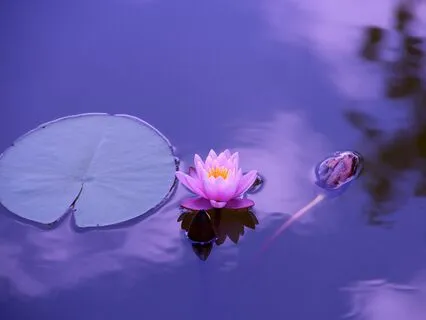
You might think of the parable of the four sorts of lotus flower,
Above the water,
At the water's surface,
Below the water's surface,
And beneath the mud.
The disciples who are lotus flowers above the water need to be taught gently,
By elaborating the meaning of good behaviour and the wholesome fruits of such good behaviour.
Those below the water's surface need to be taught sternly,
By elaborating the meaning of evil,
Yes,
For once I am not using the euphemism for this term,
And the harm returning the perpetrator of such evil behaviour.
Those who are on the water's surface need to be taught by a combination of these two means.
And those who are below the mud,
Who cannot be helped in any of the previous three ways,
Will need to be put on a back burner until such time that they can gain benefit from regular teaching.
Turning to the category of Dharma debate,
Although giving a one-way talk on the Dharma is challenging enough,
Debating on the Dharma is more challenging still,
Because one must have the ability to think on one's feet.
It's not only a question of accuracy in explaining the Dharma,
But also of gauging the needs of the listener.
Sometimes the listener's needs can be apparent from their appearance or expressions as they are listening.
More commonly,
It's apparent from the nature of the questions they ask.
In this respect,
Though,
Not all questions can be taken at face value.
To give an example,
If I travel on public transportation,
It is common for people to come up to me and ask something like,
Hmm,
How about rebirth?
It is very obvious that they've gone to great trouble to think up a deep question suitably profound for the occasion of having tracked down a real-life monk.
In fact,
For the most part,
It's likely they don't even know what they're talking about.
So,
The job that falls to me is to size up that person and consider,
What do they really want to know here?
Generally,
I'd start off by directing them to something a little more basic.
I might say,
Well,
You know,
Rebirth,
It's a really quite an advanced concept,
And if you want to get a satisfactory answer to things like that,
Then you have to find it out for yourself.
And the most important way you can find out for yourself is to start with some sort of personal meditation practice.
In that way,
I would gradually move the conversation towards the question that perhaps the person really wants to know.
Oftentimes,
People see you as a monk and they ask,
Why are you dressed in orange?
Really,
They're not interested in the colour.
It's not like they're going to dress up in orange too.
They're probably interested to know what the point is of choosing to be a monk,
And they don't know how to ask an appropriate question about that.
So asking about the colour orange is a good start,
But it may not really be what they're interested to know about.
So the first rule of Dumber Discussion is that not all questions are to be taken at face value.
For a Dumber Discussion,
It's necessary to read between the lines.
Amongst five types of questions that are not worth answering directly are when you can tell the question comes firstly from those who are not really interested in your answers.
Secondly,
When there are those who ask a question when they already know the answer,
But they're just trying to test your knowledge.
Thirdly,
There are those who ask a question because they are teasing you.
More seriously,
In a fourth category,
There are questions that come from those who like to talk about meditation attainments,
But never practice meditation for themselves.
The spiritual equivalent to looking up the answers at the back of the book.
Lastly,
There are rhetorical questions that are statements rather than questions.
By contrast,
The sort of questions that deserve to be taken seriously and possibly at face value,
And which at least deserve a proper answer,
Are questions that show a serious interest,
Questions from a practitioner about things they have not yet seen for themselves,
Questions from a practitioner to verify things they have already experienced in spiritual practice,
Or questions to alleviate doubt.
In short,
Contributing to a Dumber Discussion needs a multifaceted strategy in answering questions.
It turns out that in the Angutta Indic Ayas of Banhassutta,
The Buddha enumerated four different strategies for answering a question.
Firstly,
It's possible to answer a question directly,
Which would be suitable for questions that have been well thought out in advance.
The second way to answer a question is by giving what's known as a divided response,
In other words,
Where your answer requires that you make a distinction clear.
If someone is mixed up in their practice because they are confusing steps,
Which should be made separate,
Or practicing things in the wrong order,
Then your answer must start by making a clear distinction between the component parts of an issue.
Sometimes you need to limit the scope of what you are answering.
Sometimes you need to make sure that both you and the listener understand the same thing by the terms you are using in the dialogue,
For example,
When you are talking about evil,
But they are talking about sin.
A lot of misunderstandings,
For example,
Happen when the word merit is used unexplained.
A third possibility for answering a question is to pose your own question in response.
Sometimes people ask questions not because they are interested in the answer,
But they are interested in whether you can answer.
In such cases,
Maybe you should ask such people why they are asking such a question.
In some cases,
You need to ask them whether they would like to know,
Or whether they would like to experience it for themselves,
Without actually answering.
Often you need to ask a question in return if their question is not clear to you,
For example,
Have I understood correctly that such and such is what you are asking?
Only when you get confirmation would you go on to answer the question.
A final possibility for answering questions is to keep your silence,
Or maybe just avoid answering.
This is otherwise known as noble silence,
Or in modern day parlance,
No comment.
It is applicable when giving any answer irrespective will only serve to muddy the waters further.
An example of this is when people ask about the specific inner experiences gained as a result of meditation,
But they have never practised it for themselves.
It is not much use to give an answer because they would not believe you,
Whatever you answer,
And they may use what they've remembered instead of striving to attain such an experience for themselves.
So,
We have time for a quick story which illustrates the point for Dhamma monologues that it is neither the breadth of your repertoire nor your academic prowess that counts as much as having personally mastered the virtues that you are speaking about.
There was once the son of a wealthy Brahmin of Savatthi who entered the Buddhist order.
He dwelled in the forest,
Fulfilling his novice yid,
And came to the Buddha to request a subject for meditation.
Seeing that Sariputta was otherwise occupied,
The Buddha gave the novice a short teaching himself,
Starting with the words,
Adhichittaso,
To the effect that there is no sorrow for the monk of transcendental thoughts.
The novice learned this verse by heart and returned to the forest to reflect on it.
Although he didn't know any of the other verses of Dharma,
He understood this one thoroughly and eventually became an Arahant by contemplation of it.
Later,
He came to be known as One Exclamation or Ekudaniya,
Because he would exhort others to listen to the Dharma and he would recite this single verse that he knew.
He chose to reside in a remote location,
But he was not lonely because each time he had finished his recitation,
The guardian spirits or devas in the forest rejoiced in his merit resoundingly.
On one occasion,
Two learned monks who were well-versed in the Tipitaka,
An equivalent of modern-day academics,
Each accompanied by a group of 500 monks,
Visited this particular monk at his dwelling place in the forest.
Ekudaniya invited the two monks to preach the Dharma.
They inquired if there were many who wished to listen to the Dharma in such a remote area.
Ekudaniya told them that even the guardian spirits of the forest would rejoice at the end of every discourse they hear.
Thus reassured,
The two learned monks took turns to preach the Dharma,
But when their discourses ended,
There was complete silence from the guardian spirits of the forest.
The learned monks were puzzled and they doubted the words of Ekudaniya,
But he insisted that the guardian spirits always rejoiced at the end of every discourse.
The two learned monks then requested him to do the preaching.
Ekudaniya recited the usual verse and at the end of the recitation,
The guardian spirits rejoiced resoundingly as usual.
Some monks in the retinue suspected the guardian angels inhabiting the forest were showing favoritism to Ekudaniya,
So they reported the matter to the Buddha on their arrival at the Jetavana monastery.
However,
The Buddha admonished them,
Saying,
I don't say that a bhikkhu who has learned much and talks much of the Dharma is one who is versed in the Dharma.
One who has learned only little and knows only one verse of the Dharma but fully comprehends the four noble truths as a result of it and who is ever mindful is the one who is truly versed in the Dharma.
So it turned out that the guardian angels in the forest were better judges of Dharma authenticity than monks or academics in this story.
Therefore,
Although Dharma debate can be thought of as being like an academic conference,
Like the sharing or exchange of ideas in order to foster academic progress,
Regular discussion of the Dharma goes deeper than academic knowledge,
Bringing wisdom and the pathway to liberation from suffering.
It reminds me of the exemplary teachers like the master nun Kunyai Chandra,
Who founded our main temple in Thailand,
Who never opened an academic book in her life,
But who developed the ability to debate the Dharma,
Coming entirely from her own striving in meditation and eventual inner attainment of transcendental experience.
So to return to our subject matter for today,
It's hard to get a good Dharma discussion going if you don't follow clear guidelines.
In other words,
You need to be well prepared when you enter a Dharma discussion.
It's not like just having a chat,
And as many as 12 issues have to be addressed before a successful Dharma debate can take place.
So to conduct a Dharma discussion,
The first thing you need to do if it's going to be fruitful is to keep the precepts in advance.
If you are a householder,
You should keep 5 precepts for at least 7 days beforehand,
And if possible,
8 precepts would be even better.
The precepts will make sure that we embody the Dharma about which we are going to talk.
It's not the idea to discuss the Dharma when you're drunk,
Or if any of the participants have been drinking.
It's hard enough to make sense of everyday issues under the influence of alcohol,
Let alone esoteric ones.
The slightest misunderstanding can cause a fight.
So to discuss the Dharma,
You need to be fully in command of your faculties,
But alcohol interferes with this clarity.
So if you can't even manage to keep the 5 precepts,
Don't kid yourself that you're going to be able to discuss the Dharma fruitfully.
You'll end up arguing over misunderstandings such as whether eating is wicked because of the harm it brings to the bacteria that live in your gut.
The second thing which you need to do if preparing for a fruitful Dharma debate is to meditate in advance by meditating regularly in the run-up to the discussion and meditating immediately beforehand.
In this way,
Your mind will be sufficiently refined to understand the subtle nature of the subject under discussion.
The third thing you need to do if preparing for a fruitful Dharma debate is to dress politely and modestly to participate.
The dress code would rule out clothes that are too garish,
Provocative,
Sheer,
Dirty,
Stained or ricked.
The fourth thing which you need to do if preparing for a fruitful Dharma debate is to maintain good manners.
Nothing you do should be potentially insulting to the others participating.
The fifth thing you need to do if preparing for a fruitful Dharma debate is to speak politely.
You should speak calmly rather than with excessive volume.
The main temple in Thailand,
There used to be a training exercise similar to reverse Chinese whispers where you scored points for saying something to a second person just loud enough for them to hear but without a third person a little further away being able to hear you.
Also,
It's not the idea to boast about your attainments or how great your own lineage of meditation is.
You should be honest about the limits of your knowledge and not pretend to be an expert in everything.
The sixth thing you need to do if preparing for a fruitful Dharma debate is to give unfamiliar teachings the benefit of the doubt.
Even if you don't understand some of the Buddhist teachings when you first hear them,
Don't refuse them outright.
Sometimes we don't instantly understand the meaning of teachings we learn because they are outside our experience or beyond the level of refinement of our mind.
Suppose when we hear the teaching,
Forge your own destiny with diligence,
If at the time our main project in life is social welfare work,
We might assume that the teaching must be wrong.
How could it be better to help ourselves rather than to spend our time being altruistic to others?
If we are reflecting more deeply over time,
We will realise that the benefits we bring to others will be of no use in the long term if we are not steadfast to as our first priority.
So if you don't agree with the teaching,
Don't reject it,
But express your doubt together with what you think might be a better alternative.
Supposing you have already categorically refused the teaching and later someone points out that it is right using appropriate reasons,
It will be hard for us to make a U-turn because we will be more afraid of embarrassment than of being wrong.
The seventh thing you need to do in preparing for a fruitful dhamma debate is to avoid provocative language which means that our choice of words should always be that which fosters harmony.
The eighth thing you need to do in preparing for a fruitful dhamma debate is to avoid expressing anger when confronted by differences of opinion.
Even classic proverbs can be contradictory.
For example,
Make hay while the sun shines and more haze less speed.
Both can be true in the appropriate context but not at the same time.
If two people have different notions in mind,
Then they will be sure to have differences of opinion,
But we should not let these trivial differences lead to acting out of angry emotions.
The ninth thing you need to do in preparing for a fruitful dhamma debate is to avoid being motivated by thoughts of fame or one-upmanship.
If scoring points of others is the reason you won dhamma discussion,
It would be better for you to stay at home.
The tenth thing you need to do in preparing for a fruitful dhamma debate is to remind yourself that dhamma discussions are designed to bring forth wisdom.
In other words,
They are meant to further our knowledge by using the strengths of others to fill in the gaps in our own knowledge.
Dhamma discussions are never supposed to be an excuse to show off how much we know.
The eleventh thing you need to do is to avoid letting the conversation drift off-topic.
If we start by talking about generosity and later find ourselves boasting about all the times we've been generous,
Then we have exceeded the limits of the dhamma discussion.
Similarly,
If you find that you are gossiping about how stingy such-and-such another person is,
Then again that is no longer a dhamma discussion.
The final thing you need to do is to avoid letting the discussion go on for too long,
Otherwise everyone involved will be bored and the discussion will inevitably go off-topic.
A secondary area of concern if planning to hold a dhamma discussion is to make sure you choose suitable participants.
Choosing the wrong people to engage in a dhamma discussion can be disastrous and cause a quarrel.
The ideal sort of dhamma discussion would take place if all the participants are noble friends towards each other.
So for the nature of the discussion to be mutually uplifting,
You should invite those possessing the seven characteristics of a good friend.
So prospective candidates for a dhamma discussion need firstly to be endearing,
In other words,
Who enable others to feel at ease,
Ready to ask questions and seek advice.
At the same time they need to be respectable,
Which means they have the authority to get others to do the right thing rather than the easy thing.
They also need to be cultured and amiable,
Which means that they cannot be a hypocrite but instead exemplify the virtues that they are discussing.
They need to be a wise counsel,
Which means that they have an accurate understanding of applying dhamma in every context,
Perhaps through knowing the appropriate time to give due praise or criticism.
They need to be a patient listener,
Always open to others' advice,
Questions and criticism without being irritated by these.
They need to have the ability to explain profound matters in a way which can be easily understood.
And finally,
They should never be the sort of person who speaks of things for no good reason or who leads conversations to a useless or harmful end.
These criteria apply to conversations where you have some choice over the participants.
If the conversation is within the family,
Then you have to work with what you've got.
Turning now to look at the sort of subjects that will make for an effective dhamma discussion,
According to the Buddha,
There are ten criteria,
Known as katavatthu,
For selecting subjects amenable to a dhamma discussion.
They are subjects that you can't go far wrong with in a dhamma debate and include the topics of wanting little,
Contentment,
Seclusion,
Solitude,
Energetic striving,
Self-discipline,
Concentration,
Wisdom,
Liberation,
And the seeing and knowing of liberation.
At the same time,
The Buddha advocated avoiding unproductive talk of things like kings,
Robbers,
Ministers,
Armies,
Panic,
Battle,
Food,
Drinks,
Clothes,
Beds,
Flowers,
Garlands,
Perfumes,
Relatives,
Vehicles,
Villages,
Townships,
Cities,
Districts,
Women,
Champions,
Streets,
Gossip,
Ghost stories,
Superficial talk,
Fables about land and sea,
Prosperity and decay.
In addition,
The subject of conversation must be relevant to the participants.
If you are going to discuss self-discipline,
You ought to choose participants who are invested in the subject.
If you are going to discuss meditation,
Then it should be a discussion between those who have already gone on to practice for themselves.
Finally,
We need to consider the appropriate occasion for the dhamma discussion.
Just like listening to dhamma teachings,
The practice of dhamma discussion should be regular,
Perhaps weekly or monthly,
Or it might be on the occasion of a particular calendar event with an appropriately related topic.
For example,
A new year,
It might be appropriate to hold a discussion about new year's resolutions.
The choice of time might also differ depending on whether the discussion is planned to be held within a family or more publicly.
In the time of the Buddha,
Even though Arahants had already freed themselves of all defilements,
They would still hold discussions of the dhamma to sharpen their knowledge,
So we cannot underestimate possible benefits to those who are less enlightened.
In ancient India,
Discussion of the dhamma was like the national pastime of that time,
With debate on spiritual and philosophical matters to be found in groups,
Meeting informally on every street corner.
In Thailand in the 1800s,
Any village where the mayor was interested in the dhamma would hold a public dhamma discussion every full moon day.
The discussion would have very simple rules so that all the villagers could have the chance to join in.
For example,
Each villager took it in turn to talk about the best good habit they had,
Something which even the village thief could manage.
The nature of rural society in those days meant that multi-generational families lived together.
The young and middle-aged adults would go out into the fields to work,
Meanwhile the old folks would stay at home to mind the children.
Usually the old folks would make baskets or do other sedentary tasks,
And often they would tell tales to the children playing nearby,
Often cautionary tales and the Jataka stories,
And the young children would have a lot of questions for the old folks,
And in answering such questions before long,
They would strike up a conversation on the subject of the dhamma.
As a result of such conversations,
The children would learn the foundations of ethical behaviour from a very early age.
These days the opportunity to discuss dhamma is becoming scarcer because family tends to centre itself more on individualised multimedia than shared spiritual wisdom.
However,
Anyone who hopes to pass spiritual values down to their children should realise that they ought to become spiritually literate before it's too late.
If a family cannot manage to come together for at least one communal meal per day and talk to each other while doing so,
They'll lose the chance for their family to have a dhamma discussion.
Within a better organised family,
Topics of discussion around the dinner table might take the form of parents giving advice to their children or asking their opinions on certain aspects of their children's behaviour.
The parents might speak for 80% of the time,
With the child contributing 20%,
Otherwise they will end up with the children teaching the parents instead.
Another slightly more stylised version of the dhamma debate is hosted between monks down to the present time in the Theravada tradition where they give a sermon from two pulpits.
That is,
Two monks with expertise in a subject would discuss that subject with each other in front of an audience.
In the Tibetan tradition,
There's also the tradition of debating for students and teachers and you can see them doing the hand clapping to punctuate arguments delivered with the objective of honing their mastery of scriptural material.
While giving a dhamma talk might be compared to shadow boxing,
A dhamma discussion where the audience can talk back is like boxing against a real opponent.
Some dhamma discussions can have very high stakes.
Just as St Patrick had to debate with Druids to establish Christianity,
There have been a series of historical disputations to settle the contest between Buddhism and colonial missionaries.
One very high stakes dhamma discussion was the debate in Sri Lanka for the right not to be colonised.
It is known as the Panadura debate or Panadura Vadaya and it had its beginnings in 1873.
The debate may be considered as a cornerstone for modern Sri Lanka.
Rather than being a symbol of fanaticism,
It is a landmark in the social transition for the island.
The context for the debate was that the movement of western engagement with Sri Lanka went from curiosity and trading in the 16th century to dominance and exploitation from the 17th to the 19th centuries.
At the spearhead of domination,
Portuguese,
Dutch and British colonists deployed various forms of Christianity and as a result Sri Lanka became a colonial protectorate whereby Buddhism fell into disarray.
Buddhist monks were neglected and held in low social esteem.
Temples fell into disrepair and the religion's influence on the nation's social fabric was diminished.
The culmination of this disarray was a missionary scholar who had working knowledge of the Pali language called Reverend Daniel Gogoli.
As a result of Gogoli's campaign,
Another Methodist minister called Reverend David de Silva in Panadura Methodist Church preached then published a series of sermons denouncing Buddhism.
The Venerable Mekhetuwate Kunenandatero,
A robust spokesman for Buddhism,
Took exception to these sermons and challenged de Silva to a public debate to defend his remarks.
For an almost breathless audience numbering at times from 5,
000 to 7,
000,
The debate lasted a full two days.
Two hundred Buddhist monks and several dozen Methodist,
Baptist and Anglican clergy were also present with fourteen police officers and a mounted inspector on hand to supervise proceedings.
After setting out their positions,
Each attempted to refute the arguments of the other in hour-long sermons from 8 to 10 am,
Resuming again from 3 to 5 pm.
The Venerable Kunenanda's more populist approach appeared to win over the crowd.
After each had spoken twice on the first day,
At the start of the second day,
A Methodist brought in a substitute,
Forte de Silva,
Calling in F.
S.
Sirimane,
Who was an Anglican lay evangelist.
The latter made a last-ditch attempt to win back the crowd.
However,
At the conclusion of the disputation,
The crowd acclaimed Kunenanda and Buddhism claimed the victory.
Although the Methodist accounts the incident differs from the Buddhist,
Finding the debate inconclusive,
It was conceded that the Buddhists had put the Christians on the back foot.
Of course,
The debate at Panadura in 1873 was not an isolated incident.
It was a culmination of a series of similar events involving Christians and Hindus in Sri Lanka and in India too,
In the same era.
Nonetheless,
It can be argued that Panadura was a watershed that completely changed the social and religious context of Sri Lanka.
The debate inspired many,
Including theosophists like Cornel Hockhort,
To help to re-establish Buddhism in Sri Lanka,
Increasing national awareness and paving the way to independence.
In 1956,
A life-sized statue of Venerable Kunenanda with his trademark accusing finger was set up as a monument in Panadura,
Where it still stands today,
And English translations of the debate from the times of Ceylon were collected in book form,
And in the intervening 150 years have never gone out of print.
In conclusion,
The principles governing a discussion of the Dharma are that they ought to be by the Dharma and for the Dharma,
So Dharma both in means and in ends.
For this to happen,
The Dharma needs to be discussed within the scope of what is Dharma.
If you want to talk about virtues,
Don't tolerate mission creep into boasting about virtues.
If you want to speak on protecting yourself from temptations,
You shouldn't let the discussions digress into gloating about others' addictions.
Secondly,
You need to discuss by means of the Dharma.
Those participating in a discussion must not behave out of keeping with the Dharma.
Respect should be given to others where it's due,
Rather than looking down on other participants you assume know less than you.
We need to speak politely,
With five-star speech at the very least,
And we need to remain polite if occasion arises to point out faults in another's argument,
Rather than insulting them personally.
If you make a mistake yourself,
You should apologize humbly,
Rather than painting yourself into a corner because of your arrogance.
Lastly,
You need to discuss for the Dharma,
Which means,
Ultimately,
The conversation should be for the goal of furthering everyone's knowledge of the Dharma through conversation,
Rather than showing off or scoring points.
In expressing your knowledge,
It should be with the aim of facilitating others to share their knowledge with you.
It should never be forgotten that whether knowledge gained comes from a sermon or from a discussion,
It can be of no use to anyone if we don't practice it for ourselves as a result.
As the Buddha mentions in addition to the criteria for a subject of discussion,
That the most praiseworthy topics of discussion are those where the debaters not only talk about it,
But also practice it for themselves.
But to finish with today,
I'd like to illustrate what goes on during a Dharma debate,
So that you can actually see the skill needed in understanding and answering questions.
Best illustrated by the Buddha himself,
Who was forced to explain away a lot of misconceptions brought to the table by an influential Brahmin at the time,
About why the Buddha did not see fit to pay respect to Brahmins who were more senior than him.
And I should mention that this example is one of the shorter ones.
There is a longer example,
Which I didn't have time for,
Where Brahmin Babari set a whole gang of his disciples on the Buddha with 35 different questions.
So to come back to our Brahmin,
Whose name was Biranja,
He once visited the Buddha at Naleru Pichumanta and a series of merely 10 questions.
And the way the Buddha responded is a good example of getting to the real question.
First,
Brahmin Viranja asked,
Is it true that you have no respect for aged Brahmins?
The Buddha replied that because of attainment,
Not seniority,
Brahmins ought to respect the Buddha rather than the other way round.
Brahmin Viranja did not understand the Buddha's explanation put so succinctly.
So he continued asking further questions,
Continuing with a whole series of accusations he had heard against the Buddha.
He asked,
Then is it true that you are tasteless?
The Buddha replied that the fact that they say I am tasteless is correct in as far as I have relinquished attachment to the sense perceptions of eye,
Ear,
Nose,
Mouth and body.
But surely that is not the question you really wanted to ask.
Next Brahmin Viranja asked,
Is it true that you are without wealth?
The Buddha replied that the fact that they say that I am without wealth is true in as far as I have relinquished attachment to wealth.
But surely that is not the question that you really wanted to ask.
Next Brahmin Viranja asked,
Is it true that you are inactive?
The Buddha replied that the fact that they say I am inactive is true in as far as I exhort my disciples not to commit any evil doing of body,
Speech or mind.
But surely that is not the question you really want to ask.
Next Brahmin Viranja asked,
Is it true that you are a nihilist?
The Buddha replied that the fact that you say I am a nihilist is true in as far as I advocate the annihilation of greed,
Hatred and delusion from the mind.
But surely that is not the question that you really wanted to ask.
Next Brahmin Viranja asked,
Is it true that you are full of hatred?
The fact that they say that I am full of hatred is true in as far as I advocate the hatred of evil choices of body,
Speech and mind.
But surely that is not the question you really wanted to ask.
Next Brahmin Viranja asked,
Is it true that you are a terminator?
The Buddha replied that the fact that you say I am a terminator is true in as far as I advocate the termination of greed,
Hatred and delusion and I teach the Dharma for the termination of all forms of evil and unwholesomeness.
But surely that is not the question you really wanted to ask.
Next Brahmin Viranja asked,
Is it true that you are an incinerator?
The Buddha replied that the fact that they say that I am an incinerator is true in as far as I advocate the burning up of the unwholesome states of body,
Speech and mind.
But surely that is not the question you really wanted to ask.
Next Brahmin Viranja asked,
Is it true that you will not be born anymore?
The Buddha replied that the fact that they say I will not be born anymore is true in as far as I will never again enter the womb or take future birth.
Finally Brahmin Viranja asked,
Then are you saying that you should be called the oldest because you emerged before all the others?
The Buddha replied that in a clutch of hen's eggs,
Wouldn't it be true to call the first chicken to hatch the eldest of the clutch?
I was the first to break through the shell of ignorance by attaining recollection of previous lifetimes of myself and others and reaching the end of defilements.
Only after this explanation did Viranja realise the answer to his original question about why the Buddha thought he deserved the respect of other Brahmins and appreciating the uniqueness of the Buddha in this world,
He took refuge in the triple gem as a Buddhist layman for the rest of his life.
So this session I have introduced to you blessing number 30 on regular discussion of the Dharma.
For my next session we'll continue the first blessing in the ninth group with the blessing number 31 on practicing austerities.
Hopefully as a result of today's session you will manage to get full benefit from any Dharma discussions you organise or participate in.
So for today this is me,
Pranayiklas Thanissaro,
Signing off for now.
So long folks and stay safe.