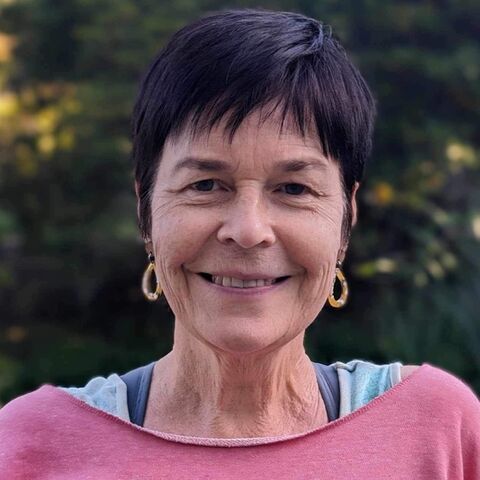
This meditation was recorded by MBSR teacher Adele Stewart at the day retreat at the Mount Keira Scout Camp,
June 2020.
You're invited to find a patch of ground outside or inside the house,
Around about 6 to 10 feet long where you'll be able to walk in privacy.
So finding yourself a patch of floor or ground that's just a couple of metres long.
Starting off by finding a standing position,
Feeling your feet on the floor,
Relaxing the knees a little,
Noticing how the whole body,
Mind and heart feels right now.
Starting to walk,
Just not too slowly straight away but not too fast to the end of your path and then pause,
Notice yourself turning around and continuing.
Investigating whether at the moment it feels right to have the attention on the soles of the feet,
All the movements of the soles of the feet and the textures and the contact,
Or maybe it feels right to have your attention on all the movements of the body,
The legs and the feet and even the upper body.
Keeping your eyes down past but not looking right down at your feet because that will affect your balance,
It's looking a little out from you.
But with this particular focus practice we're not looking out too far afield.
Finding the end of the path and the turning as a reminder to be present.
You might find as you continue to walk that the walking naturally slows down.
You might consciously slow the walking down,
Not so slow as you lose your balance.
Usually with walking meditation we would have our hands either by our sides or perhaps clasped in front or behind the body.
And if it's appropriate for you to have your hands in your pockets,
Just be aware that it doesn't feel too much like a casual stroll,
Like our meditation posture.
We want to be reasonably alert yet relaxed with that real intention to meditate.
Deep breath in.
And again,
Like any of the other meditations,
There's likely to be a lot of other experience that arises.
So keeping the walking in the foreground,
Gently noticing any other experience,
Other body sensations,
Sounds,
Thoughts,
Emotions.
No need to block them out,
Just noticing them,
Gently bringing the attention back to the walking.
No need to block them out,
Just noticing them.
No need to block them out,
Just noticing them.
No need to block them out,
Just noticing them.
One technique that can be fun to try for a little while is to,
Whenever you notice a thought to stop and only continue once you know that your attention's back with your walking.
This should be done in a light fashion,
Not a striving,
Forced fashion.
No need to block them out,
Just noticing them.
No need to block them out,
Just noticing them.
No need to block them out,
Just noticing them.
No need to block them out,
Just noticing them.
No need to block them out,
Just noticing them.
It's bringing the attention back over and over again to either the soles of the feet or the movement of the walking.
No need to block them out,
Just noticing them.
Remembering to use your turning around as an opportunity to strengthen your mindfulness.
No need to block them out,
Just noticing them.
No need to block them out,
Just noticing them.
No need to block them out,
Just noticing them.
No need to block them out,
Just noticing them.
No need to block them out,
Just noticing them.
Perhaps your mind is steadied enough that you can really start to investigate the walking more.
The way we got closer to our breath becoming really intimate with the sensations of walking,
Maybe even labelling them for a little while,
Tingling,
Tightness,
Contraction,
Relaxation,
Burning,
Pulsing.
Being really curious but in a very friendly,
Kind way about the nature of walking.
Really noticing how the earth feels,
All your socks,
Your shoes,
Your feet,
Your legs,
Your shoes,
How the clothes feel as you move.
The texture of the surface beneath your feet,
The temperature.
Very Disc OCD.
Can we be open to the pleasant and the unpleasant?
It's lovely to have a steady mind,
Not a lot of thoughts and be completely involved in the walking.
But at other times the mind will be restless or agitated or drowsy.
Emotions like boredom or frustration might arise.
So if we notice these unpleasant mind states,
We can investigate them.
Allow them to be there if at all possible.
Or perhaps we can really get more curious about the actual walking or about the difficult emotion.
Really activate that kind curiosity.
Can you notice that moment that you're aware that you're thinking?
Immediately dropping the attention into the body as you notice.
No need to give yourself a hard time.
That's the nature of the mind to wander.
No need to give yourself a hard time.
No need to give yourself a hard time.
No need to give yourself a hard time.
No need to give yourself a hard time.
No need to give yourself a hard time.
No need to give yourself a hard time.
Perhaps your mindfulness is a little more refined now.
You can really notice that the process of walking is an ever-changing flow of sensations.
No need to give yourself a hard time.
No need to give yourself a hard time.
No need to give yourself a hard time.
This poem by Dana Faulds is called Walk Slowly.
It only takes a reminder to breathe.
A moment to be still.
And just like that,
Something in me settles,
Softens,
Makes space for imperfection.
The harsh voice of judgement drops to a whisper and I remember again that life isn't a relay race.
That we will all cross the finish line.
That waking up to life is what we were born for.
As many times as I forget,
Catch myself charging forward without even knowing where I'm going.
That many times I can make the choice to stop.
To breathe.
And be.
And walk slowly into the mystery.
To stop.
To breathe.
And be.
And walk slowly into the mystery.
To breathe.