Sotapadimaga,
The path of the sotapanna,
Translated from talks given in Thai by venerable Ajahn Anand Akincheno.
Sotapanna,
The stream-enterer,
One who has entered the stream leading to nibbana,
One who is freed from the first three fetters of self-view,
Skeptical doubt,
And attachment to precepts and practices.
He or she has unshakable faith in the Buddha,
Dhamma,
And Sangha and is incapable of breaking the five moral precepts.
He or she will be reborn seven times at the utmost and not in a state lower than the human realm.
More than any earthly power,
More than all the joys in heaven,
More than rule over the entire world,
Is the entrance to the stream.
Dhammapada,
178.
Introduction by Ajahn Kalyanoo.
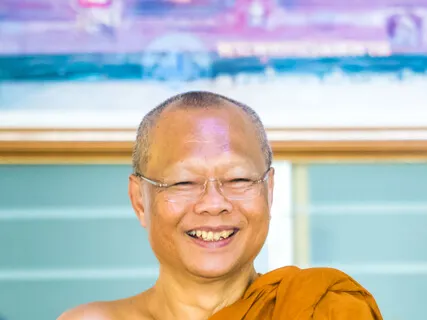
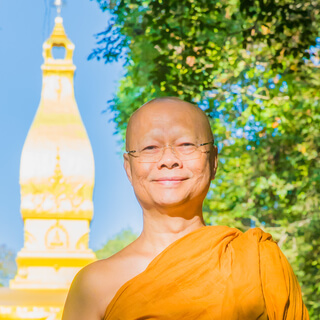
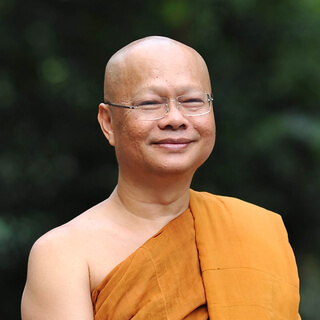
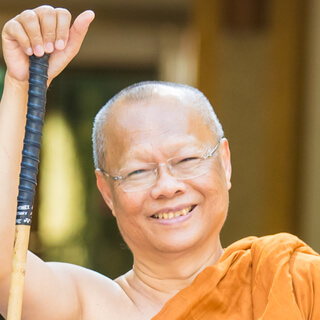
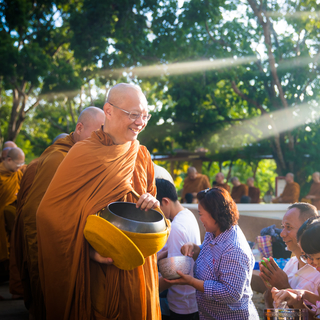
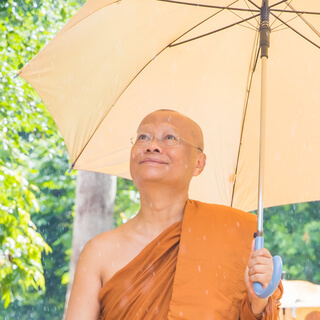
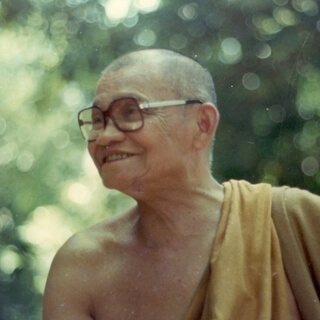
Venerable Ajahn Anand is the abbot of Wat Mopjan,
A forest monastery in Rayong province,
Thailand.
Having begun practicing meditation as a lay Buddhist in his youth,
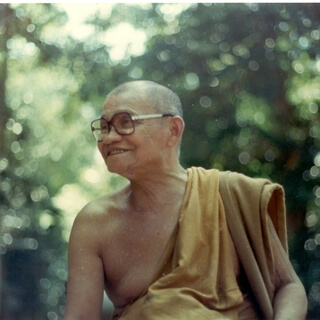
He entered the monastic Sangha as a monk in 1975 under the guidance of the late Venerable Ajahn Chah,
1919-1992,
One of Thailand's most well-known and highly respected meditation masters.
In 1984,
After having developed his personal practice as a close trusted student of Venerable Ajahn Chah for a number of years,
Venerable Ajahn Anand was invited to establish a monastery on a piece of forested mountain in eastern Thailand.
From that time until the present day,
He has both continued to develop his own practice and with great kindness and patience given up his time and skills to train others in the Buddhist path to liberation.
Venerable Ajahn Anand has not only successfully preserved the spirit of Venerable Ajahn Chah's teachings in a living monastic tradition at Wat Mopjan,
But also he has used the unique wisdom and compassion gained through his own inspiring practice to bring the Dhamma to others.
He has now become an internationally renowned spiritual guide to hundreds of monks and nuns and thousands of lay practitioners in different Buddhist monasteries throughout Thailand and around the world.
The work of translation and editing this book has been carried out by the students of Venerable Ajahn Anand with deep respect and sincere gratitude for his continued guidance and teachings in the practice of Dhamma Vinaya and out of a wish to make his teachings more available to non-Thai practitioners.
The Sangha humbly begs forgiveness from the readers for any errors contained in the translation.
Aadankalyanā,
Abbott,
Buddha Bodhihāna Monastery,
Melbourne,
Australia Translators Preface Staying close to the Venerable Ajahn and listening to his teachings,
One is immediately impressed by how he is able to teach the Dhamma on so many different levels.
Throughout each day he will teach people ranging from monastics to lay persons,
Always using wisdom and the power of his Dhamma to send it straight into the heart of the listener.
Though one may not yet be able to understand the Venerable Ajahn's Dhamma with full clarity,
His enormous amount of loving-kindness allows one to persevere with patient endurance in the practice.
One is confident that following this path will lead to the highest goal.
This collection of talks was originally given to the monastic community at Wat Mopjan.
As these talks were specifically directed to monastics,
They often refer to many of the fundamental practices and routines of monastic life.
In addition,
One can find details on the higher levels of practice.
Though these talks were not originally aimed towards those in the lay life,
Lay people dedicated to the practice are sure to find inspiration and benefit nevertheless.
In the English translation,
We have attempted to preserve the immediacy of the spoken word,
And in some cases have opted for fluidity over a strict grammatical rendering.
Our hope was to allow the readers a glimpse of the Venerable Ajahn's simple and direct speaking style.
Owing to the relative inexperience in the Dhamma of the translators when compared to their teacher,
It is inevitable that there may be some mistakes contained in this work.
The translators apologize for any distortions in the transmission of the Dhamma,
And accept full responsibilities for these errors.
Throughout these talks Ajahn Anan often refers to the teachings of Lungpuca,
His preceptor and teacher.
The Venerable Ajahn has great respect for Lungpuca,
Frequently talking of him with much fondness.
We often hear of how Lungpuca taught using various methods,
Leading by example,
Using similes,
And often methods that went beyond words,
All aimed at developing mindfulness and wisdom.
Many of Venerable Ajahn Anan's loyal and dedicated monastic disciples have contributed to the production of this work of Dhamma.
May the good results from this work act as an offering to the Triple Gem,
And to the Ajahn for his generosity and patience.
We hope the wisdom and compassion of Venerable Ajahn Anan,
Who is like a loving parent and is highly venerated by all his followers,
Come through in these pages.
May the readers find inspiration and deepen their resolve to the practice.
The translators,
Wat Map Jan,
Rayong,
Thailand.
Part One With sati,
Mindfulness,
Firmly established within the sphere of our bodies,
Our restless thinking and conjuring will diminish,
And the mind will be at peace.
This is samadhi.
When the mind is quiet,
We will clearly know what it's like not to have any mental impressions or hindrances disturbing it.
The mind is bright and clear.
When thoughts come into the mind,
We will know.
With this stilled mind,
We can investigate and know all mental impressions,
All nama and rupa,
Mind and matter,
Before us as anicca,
Impermanent,
Dukkha,
Suffering,
And anatta,
Not self.
Then the mind will step away from them all,
Including the body.
This body is merely a body,
Not a person,
Me,
Mine,
Or them.
This knowledge arises from the one who knows,
And it doesn't hold to anything as mine.
This is a mind totally still and free.
Although there might be some sense impingement and thoughts passing through,
The mind will continue to be still because it has stepped out of the way of these mind objects.
When we know how to step away from them,
Then we will truly understand what a quiet mind is like and what a disturbed mind is like.
Sometimes we will notice that even when there is thinking and movement in the mind,
Or even when we speak,
It stays still.
Mungpu Chah would explain it in this simile.
If it's taken to this level,
It's the same as water.
Flowing water we know,
Still water we know,
But what is still flowing water like?
Have you ever seen still flowing water?
This is the sabhava citta,
The mind in its natural state.
It has stillness there,
And all the moods are just flowing by.
But the mind doesn't move.
They are two separate things.
The mental objects are just the mental objects,
And the mind is just the mind.
They exist separately.
The whole reason we practice meditation is to firstly make the mind settle down and step away from these mental objects.
We then do the investigation,
Separating the mind from the body.
The mind will then turn away and be free from clinging to nama or rupa,
Even if it is only a temporary suppression.
This is the path that leads to paññā,
Or wisdom.
The one who is walking this path walks the path of sotapādhi-māgha.
This is the path of the sotapāṇā.
Doubts can't enter a heart at peace.
When we practice in the way of sila,
Morality,
Samādhi,
And paññā,
We will notice that the way of practicing samādhi is much harder than merely maintaining sila.
This is because we have to abandon all moods that give rise to liking and disliking,
Anger,
Ill-will,
Proliferation,
Agitation,
Restlessness,
Doubt,
And worry.
It can be compared to the body.
If the body has five kinds of sickness,
It won't find any ease at all and will give rise to discomfort.
These five sicknesses become the center of our attention because we can't find any comfort or ease in the midst of the painful feelings throughout.
But as time passes,
Each one of the sicknesses passes away,
One by one,
And we begin to feel better as we become free of each.
Then the body starts to feel at ease.
It's the same as this mind.
The nīvarana are like the five sicknesses,
But afflicting the mind.
Whenever one of these hindrances comes upon us,
It stops us from experiencing peace and drives us into all sorts of liking and disliking,
Drowsiness,
Restlessness,
Or doubting.
Then all we feel is unrest and agitation that leads to doubts about the way of practice.
Sometimes Lungpu Chah would talk about these doubts and worries in his Dhamma talks.
He would teach that these doubts come for us to investigate,
To watch them arise,
Stay for a while,
And pass away.
There is no real abiding self,
Being,
Me or us in them.
In the course of practice,
Doubt will arise in many different disguises.
The question may arise that,
If I don't have any doubts at all,
How am I going to be absolutely certain that I'm following the correct mode of practice?
Then we start doubting about our doubts.
They will wear on us,
Grinding us down until we start believing and taking these doubts on.
Soon we don't know the way to find any peace at all,
And the mind falls further into this darkness of confusion.
The way to cross over this flood of doubts is to firmly keep the parikamma,
Preparatory meditation object,
Within the heart at all times,
Like using putto.
A heart infused with putto will always be at peace,
Or we may even keep with a recollection of death constantly.
When the mind is calm,
Desire,
Anger,
Delusion,
Doubts and restlessness aren't anywhere to be found.
There is only silence.
Then we will know that keeping our parikamma always in mind is the correct and direct path of practice.
If we keep our meditation subject firmly within our mind at all times,
When we have the opportunity to meditate,
The mind will gather easily.
We will feel a tranquility that we have never experienced before because of this sustained samadhi.
Our minds will have radiance and peace within.
A mind that is in the state of quietude will have continuous sati stemming from it.
When we investigate the sankaras,
Particularly rupa sankaras,
This bodily form,
Or any other external forms in the physical world,
We will see that the elements that make up this body exist,
Just as they are.
The body is just elements here,
In their natural state,
Living according to nature.
It is only the mind that condors up and builds these forms to be something.
For instance,
We can build up some material object and give it a label,
But in reality it is only the four elements that have temporarily come together.
They never came up to proclaim that,
I am earth,
I am fire,
I am air,
And I am water,
Or even to say that,
I am attractive or unattractive.
These concepts are only within our minds.
When our eyes,
Ears,
And so forth come in contact with sensory objects,
It gives rise to these assorted feelings.
When we investigate with panya,
We will understand this mental act of labeling how we impose reality on the outside world.
This reality we experience is only conventions we as humans have conjured up.
We have built up and created so many of them down to their finest details of various sorts.
But when we throw all of these conventions out and see the underlying reality,
We will see that they are just anicca,
Not stable or lasting,
Dukkha and anatta,
With no true entity behind them.
Contemplated in this way,
We call this giving rise to panya,
And it arises right here within our hearts.
All of this comes from our practice of bhavanah,
Or mental development,
From a quiet and peaceful heart.
We should work to maintain this solace every day.
This is the food and sustenance for the heart.
We have enough sustenance to maintain the body already.
We have enough of the four requisites to support the needs of this body.
We have the medicine to cure sicknesses and to prevent various sorts of diseases,
And to relieve the ones that are already present.
The four requisites are something quite important,
Because they are what the body needs.
If the body lacks any of the four requisites,
It makes life very difficult.
We have a hall to practice bhavanah,
Sit meditation,
And to develop merit.
Suppose we didn't have this hall.
If it was raining or if the sun was beating down,
Our bodies would experience painful feelings.
And now that we have the four requisites for the body,
We have to find a refuge for the heart.
Refuge for the heart.
On some occasions,
Lungphu Chah would ask the monks,
Do you know where the practice really lies or not?
Do you know the real place of refuge for the heart already or not?
Some monks would reply that they knew how to make their hearts calm and how to use samadhi to temporarily suppress mental impressions and moods,
But they still didn't know how to let go and be completely free of these impressions and moods.
We have to really practice and develop our heart.
We have to firmly establish an inner refuge within ourselves.
This isn't something beyond the scope of what humans can do.
We have already put forth a lot of effort,
Patience and endurance in our various work and duties.
Now we have to do the same with our bhavanah,
To sustain and succeed in this task we have put before ourselves.
We have to endure many ups and downs,
Traveling on the path of bhavanah,
To develop enough sati to supervise and control our mental fluctuations.
Even if we only progress a little,
This is still the path of Arya-magha-jnana,
The noble way for our hearts to destroy its main enemy,
Namely dukkha.
I ask everyone to press forward in this way of practice.
Practicing for Release,
Nibbana When we have an eye that is functional,
A visual object in light,
The sense of sight will arise.
The visual object contacts the sense base and sends the impression straight to the heart.
Similarly,
Hearing,
Smelling,
Tasting,
Touching and mental cognition arise,
Differing only in the sense organ and their corresponding object being sensed.
If this sense impression comes about at the eye,
It is called jaku-vijnana.
For the ear it is sota-vijnana,
The nose,
Ga-na-vijnana,
The tongue,
Jihva-vijnana,
The body,
Kaya-vijnana,
And the mind,
Mana-vijnana.
All the six kinds of vijnana,
Or consciousness,
Are of the same characteristics.
They come about,
Persist and pass away.
But this whole process occurs very quickly.
When the mind grasps at vijnana,
We have the feeling that I am seeing,
Or I am hearing.
We then grasp onto the pleasurable and painful feelings that arise.
This is vedana.
Then the mind forms ideas,
Which is sankara,
And labels them,
Becoming sannyas,
Memory and perception.
This is how the namadhamas,
Or mental aggregates,
Function together.
It is normal for us to experience the world in this way.
All of our sensory experiences function in this process,
And the more that we grasp at them,
The more that the cycle of pleasure and pain arises.
But the Buddha had us stop and investigate this process by separating out the khandhas and the elements with paññā.
We do this in order to see clearly that this heap of rūpa is just comprised of the four great elements.
It is sankhata,
Something that is formed together and is in a constant state of fluctuation.
But it still has to break down and pass away.
As for this heap of nāma aggregates,
Vedana,
Sannyā,
Sankhārā and vijnana,
They remain for an even shorter period before they cease.
We must arouse paññā in the heart so that it won't go chasing after and carrying around all the things we experience as mind.
It will temporarily leave all the mental impressions alone and not get involved in them.
This gives rise to emptiness of self,
And just this is nibbāna,
A fire extinguished and now cool.
This is cessation,
The abandonment of the longing and desire for all mental states,
Non-clinging.
But if we yearn for nibbāna and are continually expecting it,
Then we will never realize nibbāna.
Lungpuca would always emphasize that we have to let everything go.
The most important thing is to practice towards letting go.
Although we may not let go of all rūpa and nāma 100%,
Because this is the level of the arahant,
At least we will have some understanding and insight into the phenomena of rūpa and nāma.
Depending on the level of our investigation,
To a certain extent,
We can let go in the way we perceive the world.
Our suffering will diminish because we are seeing in accordance with the saccadamma.
So why doesn't this wisdom come about regularly?
It's because our strength and stability of samādhi isn't yet sufficient.
Samadhi is an unshakeableness of the heart.
It is a heart that has the stability on one object,
Be it putto,
Dhammo,
Sangho,
The in-and-out breathing,
Or whatever we choose.
Samadhi will make the heart gather into stillness,
Even if only for a short instant,
So as to give the strength to investigate this physical form,
The rūpa.
Can we see that it's unstable?
Have we studied it enough to see it clearly or not?
This formation is just a natural condition that has the nature to fluctuate and change.
There is nothing wrong or irregular with it.
Actually,
It can't be any other way.
Can we see this yet?
This physical body has pain riddled all throughout it as a normal condition,
Has constant change and instability as its nature,
Has old age as an inseparable part of it,
And eventually has to break down and disappear.
It's just like this.
We are born into this human realm and have a form again.
It has to follow this process.
Born like this in every realm,
In every life,
It has to be like this.
And it's not just like this for humans.
Devaṭṭha,
Celestial beings,
Have saṅkaras as well.
They have rūpa-saṅkāra,
But it's called opa-pātika,
That is spontaneously born in a fine material form.
Still,
Their bodies have to break apart the same as ours.
They can't just remain for time immemorial,
Because they are also saṅkāra-dhattu,
The conditioned element.
But there is also another side of this called asaṅkata-dhattu,
The unconditioned element,
That is nibbana.
Nibbana is reality.
It is something that is there,
But we can't locate it in any fixed place or direction.
It isn't a destination on any conventional plane,
Because it's empty.
It is emptiness that can't be measured in size.
The state of emptiness has no defining place,
It has no color,
But it's there.
It's the truth,
Right here,
Reality.
Nibbana is the only thing that is ever really here,
Because it's the only thing that is lasting and permanent.
It doesn't change or fluctuate,
Because it has no supporting conditions.
It isn't any form of saṅkāra,
It is we-saṅkāra.
But it's there,
They exist together.
When we have saṅkaras existing,
We-saṅkāra must also exist alongside.
This is reality.
Our body will return to elements.
When we put forth effort in bhāvanā,
The mind will gather into quietness.
This is samādhi.
We use it to investigate into this pile of saṅkāra,
This pile of rūpa,
And this pile of nāma.
At the beginning we look directly at the rūpa,
From the head hairs,
Body hairs,
Nails,
Teeth,
Skin,
And into this whole mass we call a body.
Now where does its real essence come from?
The real essence of the body comes from elements.
The food that supports us initially starts out as the earth element.
We can see this with trees.
The tree absorbs the minerals and moisture from the earth.
The sun supports the process of photosynthesis in the green leaves of the tree,
And through this the tree grows.
Eventually it produces flowers and fruits.
In the beginning the tree grows and flourishes,
And finally it produces flowers and fruits.
This can provide food and a home to different kinds of animals.
It becomes part of the food cycle,
Supporting life.
Humans rely on animals,
Plants,
And fruits to keep their life force going.
It's a cycle that revolves around.
It is all reliant on the elements earth,
Air,
Water,
And fire,
Providing this body with earth,
Air,
Water,
And fire,
Thereby facilitating its further growth.
However,
When we misunderstand this simple natural process and latch onto it,
Taking this heap of elements to be me or mine,
We fail to acknowledge that in the end it will all just pass away.
In the end it will start to degenerate and change its form.
When the breath comes to its end,
This body will start to decompose.
The different kinds of bacterias will begin to eat away at it,
And the body will change color until the various elements decompose back to their respective elements,
All following their natural course.
Earth goes back to earth,
Water back to water,
Fire to fire,
And air to air.
All the conditioning factors that have made up this form come to their end.
So when we see that the body comes to its end like this,
Where is this me?
In the past we took this body to be ourselves,
But now where is this being?
Where are all my things?
Our parents,
Whom we call mother and father,
When their breath has come to its end,
Where have they gone?
The heap of elements have broken apart and scattered,
Earth back to earth,
Water to water,
Fire to fire,
And air to air.
The truth is just like this,
But if we follow after all the worldly conventions,
There is still a me,
A him,
A them.
There are still relations,
Brothers,
Sisters,
Husbands,
Wives,
Mothers and fathers,
Sons and daughters.
In truth these things exist,
But are just conventions,
And if the heart can't see the truth,
Then it will take on all these conventions as reality,
That they are actual and self-existent.
The peaceful heart discovers the truth.
The Buddha discovered the truth.
He uncovered that what we consider as reality doesn't exist.
It's all empty.
There is only arising,
Existing,
And passing away.
This is the reality of all phenomena.
He saw the saccadamma,
Or the truth of things,
Right down to its finest details.
Dwelling in the bliss of liberation,
He felt that it would be impossible for others to follow this path and see its fruits.
He thought that because there is nothing more refined and exquisite than nibbana,
It would be easier to remain quietly to oneself.
Then the Brahma God,
Who had been closely connected to the Buddha,
Came in request that the Buddha teach this truth to others.
The Buddha first thought of his two former teachers,
Udaka Ramaputta and Alara Kalama,
But both of them had passed away into formless Brahma realms where such beings lack sense spaces in which they might be able to perceive or hear the teachings.
Then he thought of the pancha-vagya,
The five ascetics that had previously waited on him during his days of austere practice.
He realized that they were capable of seeing the Dhamma.
Venerable Anya Kondanya was the first to attain the eye of Dhamma,
With the other four of the group shortly following.
They then all successfully reached Arahantship together.
They were able to realize nibbana because they saw that all Rupa and Nama are merely Anicca,
Dukkha,
And Anatta,
That everything is ownerless.
If we have Samadhi and use its strength to investigate,
Step by step we will be able to see.
See that this body is neither beautiful nor attractive.
It's just elements.
Have you seen a leaf?
Imagine one.
It starts out small as a green shoot,
Then gets greener and bigger.
It then gets older,
Withers,
And eventually falls to the ground.
All the green is gone,
And now it's just brown.
This brown leaf gradually decomposes.
Finally,
It changes back to earth.
Our body is just the same as this leaf,
The same as a tree,
The bark,
The heartwood.
They all go through changing conditions in this sequence.
When the life force is gone,
It just decomposes and disappears.
In the end,
Whether it's the hair of the head,
Hair of the body,
Nails,
Teeth,
Or skin,
They all follow their natural course of change.
The color changes and they break up.
The bones are the same.
They go from white to brown.
In the end,
They will just end up as the earth element,
Just as they were originally.
Then the perception of bones as a body disappears,
And only the earth element remains.
When we really pull it apart and analyze it as the earth element,
We find that it's just a huge mass of naturally existing elements that have fused together.
If we break it down even further,
We see that they are just tiny molecules and elements.
If we blow them apart,
We find they are just energy.
But in the end,
They can be separated out until they aren't even there.
Only a mass with no real abiding essence,
A fusion of energy that eventually dissipates.
It's the same with water.
It's just hydrogen and oxygen that have come together.
But if we pull these two apart,
The water isn't there anymore.
In the same way,
What we call us and our bodies have no real essence,
As they will also break apart and disappear.
The Rupa Sankaras and Nama Sankaras that are dependent on causes and conditions simply arise,
Remain here for a while,
And then fade away.
If the heart is calm in samadhi,
When we investigate,
It will be able to penetrate and see clearly.
We can let go of the conventions of a being,
Person,
I,
Us,
And them.
But if the heart doesn't have this samadhi,
Then we will only see in terms of me and self.
So we have to develop the power of samadhi.
Investigating the body's elements is one method we can use,
Dividing the body into four parts.
Like someone cutting up a cow into four parts,
Get in there and investigate every part,
Bit by bit.
The earth element is all the harder parts of the body.
The liquid parts that have the characteristic of being fluid and soft is the water element.
The air element is basically the breath,
And the places where there is warmth is the fire element.
All the four elements combine together to fulfill their purpose.
Yet in the end,
When they all break apart and disintegrate,
We can't find any being,
Person,
I,
Us,
Or them.
So the feeling that we get that this body is ours,
Where does it come from?
It comes from the mind itself,
The mind still in ignorance that latches on to everything.
We ask ourselves,
How come this body isn't mine?
These painful feelings arise,
And I feel sore here,
Pain there.
If I sit here long,
It hurts,
It might even go numb.
So how is it that this feeling isn't mine?
Well,
If these feelings are ours and we have labeled them as ours,
Before we came to sit here,
Did we have these feelings?
Of course not.
We didn't have this pain or discomfort.
As we have come now to sit here for a long time,
Our circulation isn't moving around as much,
So these painful feelings arise.
And these painful feelings,
Are they always here?
Are they going to soon pass away or not?
Of course they will disappear.
These feelings are merely coming up,
Staying here for a while,
And then passing away.
We can also question,
Are these feelings the mind?
Are they the mind,
Or just one part of it?
We see that they are just something that has arisen.
They aren't here all the time.
The mind remains,
But vedana has arisen,
Will be here for a while,
And then disappear.
This is the nature of the vedana khanda.
Still,
Our minds attach to these feelings and drag along all the suffering with it.
We don't yet have enough strength,
Our sati is weak.
So we have to get in and practice.
We have to get to the stage where sati and samadhi are firm.
We have to sit meditation and do the practice until our hearts are calm,
Until they are still.
Then we can move into investigation.
Sometimes the heart is calm,
Sometimes it's not,
But this is just normal.
We have to keep pushing forward with patience,
Putting forth effort to develop our meditation.
Gradually seeing the dhamma At the very least we have to keep sila,
Make merit,
Develop wholesome qualities,
And always keep in mind that this opportunity we now have as a human is so precious and rare.
We already came to this life with a lot of merit because we have this form,
The form of a human.
This human form is the perfect vehicle for developing meditation,
Capable of knowing and seeing the dhamma.
If we have really seen the dhamma,
That is,
We have seen anicca,
Dukkha,
And anatta clearly,
Then we see nibbana.
We see emptiness and know that it really exists.
In the past we took this form to be ourselves,
That this is atta,
Or self.
But when we see the body as anatta,
See that it's all anicca,
Dukkha,
Anatta,
We will experience emptiness.
We will realize that everything in the world is in essence empty.
There are no real permanent entities,
Only parts that have come together and have arisen dependent on conditions,
Anatta.
The entire universe is totally empty.
Its whole substance is emptiness.
If our contemplation brings us to the point where we have insight into this emptiness,
This shows that on one level we understand the true nature of existence.
Although sometimes there will be happiness and suffering present,
Our sati will be right there with it.
Lady Visakha experienced this state,
That is,
Of sotapanna as well,
And understood that this was the nature of all phenomena,
But didn't know it in its entirety.
There was still upadana there.
There was still some upadana towards rupa,
Still some towards nama that remained.
But the grosser kilesas had been abandoned.
Anger,
Delusion,
And forms of liking and greed at the grosser levels had been diminished decisively.
But the more refined kilesa hadn't been completely abandoned.
There was still some there.
We must continue with the practice,
Constantly investigating anicca,
Dukkha,
Anatta,
Anu,
Until we can abandon these kilesas completely.
Again we have to strive to develop our samadhi,
An investigation of anicca,
Dukkha,
And anatta,
To the final level so as to abandon the most refined kilesas once and for all.
At this point,
Birth and becoming will be extinguished.
Once the grosser kilesas have been abandoned,
With the ending of this life,
There is no chance of being reborn into the lower realms,
The disastrous states of the hell or animal realms.
We won't fall.
We can only be reborn into human or heavenly realms.
This is the state where the grosser kilesas have been abandoned,
But there is still some upadana.
We have to keep probing.
Sometimes there will be elation,
Other times depression.
Simply take a look at it.
It's normal for this to occur.
When we have been born as humans and have come in contact with the Buddha Sassanā,
We are fortunate enough to have the teachings on the way that leads us out of this cycle of birth and death.
We can follow this path of dhamma that won't lead us further into the cycle of birth and death,
But will lead us instead to nibbana.
We have to develop goodness,
Dhāna,
Or generosity,
Sila,
Samadhi,
And paññā constantly,
Until we know the dhamma,
See the dhamma,
And understand the dhamma completely.