Ever feel like you're constantly on the go?
Your mind racing even when your body is still?
What if I told you there's a practice,
An ancient technique,
That allows you to tap into a state of rest so profound it's been called yogic sleep?
Intrigued?
Let's dive into the fascinating world of Yoga Nidra.
What exactly is Yoga Nidra?
The name itself,
Coming from Sanskrit,
Hints at something special.
Yoga,
Meaning union or focused awareness,
And Nidra,
Which translates to sleep.
But this isn't your average nighttime slumber.
Think of it as a guided journey to a state of deep relaxation.
A sweet spot between being fully awake and soundly asleep.
Often linked to that hazy,
Dreamy state just before you drift off.
The goal?
To consciously unwind,
Physically,
Mentally,
And emotionally,
By turning your attention inward,
Away from the constant noise of the outside world.
Imagine being deeply relaxed,
Yet still aware,
Observing your inner landscape without judgment.
Some even describe it as a state of psychic sleep,
Or sleeping consciously.
A powerful tool for transforming both body and mind.
So how does this work?
A typical Yoga Nidra session is a carefully instructed sequence,
Often guided by a teacher or a recording.
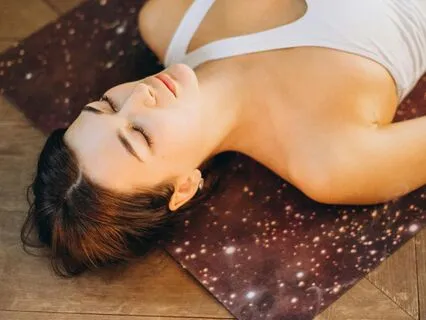
You'll usually start by lying down comfortably in Shavasana,
The corpse pose,
Eyes closed,
Limbs relaxed.
Shavasana is also what you do at the end of a yoga practice.
So you're lying on your back,
Supported with pillows,
And maybe even covered by a blanket.
Then comes a wave of gentle instructions.
Releasing tension in different body parts,
Setting a sankalpa,
Which is a personal intention or affirmation,
And a systematic rotation of consciousness,
Or body scan,
Where you'll be guided to bring awareness to various parts of your body.
Throughout this,
You're encouraged to breathe slowly and deeply.
You might even be guided through visualizations or calming scenes,
Called dream journeys,
One of my favorite ways to practice.
The session then gently concludes by bringing you back to full awareness.
Now you might be thinking,
Isn't this just meditation?
While both aim to quiet the mind,
There are some key differences.
Traditional meditation often involves sitting upright,
Whereas Yoga Nidra is all about lying down.
And while meditation is usually practiced in a fully awake state,
Yoga Nidra guides you to that in-between space of wakefulness and sleep.
Think of it this way.
Meditation often requires focused attention,
While Yoga Nidra encourages a gentle withdrawal of the senses,
With your awareness directed inward.
So why lie down?
Let's dive into the power of the supine position.
Have you ever wondered why Yoga Nidra is almost always done lying down in shavasana,
The corpse pose?
It's not just about comfort,
It's a strategic choice rooted in yogic principles.
The supine position allows for the ultimate physical comfort,
Letting go of any muscular tension.
When you're lying flat on your back,
Your body can truly surrender to gravity,
Which is the perfect foundation for your mind to also unwind and access those deeper states of consciousness.
Plus,
This position minimizes how much your body is touching the ground,
Reducing external sensory input and helping you turn your focus inward.
But it's not just about feeling good.
Lying down in shavasana actually has physiological benefits.
It helps calm your nervous system,
Which has a positive ripple effect on your digestion and immune system.
It promotes a sense of calm and lowers the stress levels.
Perhaps most importantly,
This posture encourages the activation of your parasympathetic nervous system,
Which is the rest and digest and repair part of you.
This leads to a slower heart rate and lower blood pressure.
Some variations even involve slightly elevating your feet to further improve circulation and relaxation.
Interestingly,
The idea of yogic sleep in a reclined position has ancient roots.
Think of depictions of Lord Vishnu resting between cycles of creation.
While not exactly the same as modern yoga nidra,
These ancient references highlight a long-standing connection between deep rest and lying down.
Of course,
Life happens,
And sometimes lying down isn't possible.
The beauty of yoga nidra is that it can be adapted.
You can practice sitting in a chair or lying on your side if needed.
The key is to find a position where your body can be still and comfortable for an extended period,
Allowing your mind to fully relax and journey inward.
But there's a trade-off to lying down,
Which is people drift off and fall asleep.
Let's be honest,
Have you ever tried yoga nidra and found yourself drifting off to sleep?
You're not alone.
It's a pretty common experience,
Especially for beginners,
And in many ways it makes sense.
Yoga nidra is designed to bring you to a state of profound relaxation.
If you're carrying a lot of stress or are sleep-deprived,
This deep relaxation can naturally lead you to fall asleep.
Many describe feeling like they're right on the edge of sleep during a session.
This deep relaxation is closely tied to your autonomic nervous system.
If you're constantly stressed,
Your fight-or-flight system might be in overdrive.
Yoga nidra deliberately activates the rest and digest system,
Which can be such a significant shift that your body simply seizes the opportunity to catch up on much-needed sleep.
Brainwave activity also plays a role.
As you relax,
Your brainwaves slow down from the active beta waves to the more relaxed alpha waves.
As you go deeper,
You might even enter the theta state,
Which is associated with light sleep and deep meditation.
In very deep states,
Some experienced practitioners can even access delta waves,
The slowest waves linked to deep dreamless sleep and restoration.
These shifts naturally bring you closer to the neurological state of sleep.
Yoga nidra is also thought to stimulate the pineal gland,
Which releases melatonin,
The hormone that regulates sleep.
While the goal of yoga nidra is to remain consciously aware in a state of deep relaxation,
Occasionally falling asleep isn't necessarily a bad thing,
Especially when you're starting out or are totally stressed.
Even in sleep,
Your subconscious mind might still be receptive to the positive intentions set during the session.
However,
For the full transformative benefits,
Maintaining that relaxed awareness is generally encouraged.
The ideal state is often described as that sweet spot right before sleep takes over,
Where deep relaxation and stress release occur.
Let's explore the ancient origins of yoga nidra.
Where did it all begin?
While gaining popularity now,
Yoga nidra has a rich history stretching back to ancient Indian spiritual traditions.
While the modern structured technique is relatively new,
The core ideas have been around for centuries.
You can find early hints of a state like yoga nidra in ancient scriptures like the Upanishads around 600 BC,
Which mention a fourth state of consciousness beyond waking,
Dreaming,
And deep sleep.
The Hindu epic Mahabharata,
Which was completed around the 3rd century,
Also refers to yoga nidra,
Often associated with Lord Vishnu's deep meditative rest.
Even a goddess named yoga nidra appears in the Devi Mahatma around the 600th century,
Embodying the power of sleep itself.
During the medieval period,
Yoga nidra became more connected to meditation in Shaiva and Buddhist tantras.
Some texts even used it as another word for samadhi,
That super deep meditative rest.
The tantric practice of Niyasa,
Involving placing Sanskrit mantras on the body during meditation,
Is also seen as a precursor to the body scan in modern yoga nidra.
The modern form of yoga nidra as we know it today really took shape in the 19th and 20th century,
Influenced by western relaxation techniques.
The first modern use of the term appeared in 1973,
But it was Swami Satyananda Saraswati who truly developed and popularized a systematic approach in the mid-20th century.
He simplified the ancient Niyasa practice,
Making it more accessible.
Other key figures like Swami Rama and Richard Miller,
Who developed I-rest,
Also contributed significantly.
Now let's come to my favorite part.
Let's separate fact from fiction.
What are the myth and fun facts around yoga nidra?
Like any popular practice,
Yoga nidra has its share of myths.
Let's clear some of them up.
It is not just about physical relaxation.
It involves active inner awareness.
And while visualizations are common,
It's not just guided visualization.
It's also not the same as dreaming,
Where your mind is often uncontrolled.
And despite being done in shavasana,
It's not just about the corpse pose itself.
While it shares some similarities with hypnosis,
You remain consciously aware and in control throughout yoga nidra.
A big one is thinking yoga nidra can replace sleep.
While incredibly restorative,
It doesn't fulfill all the physiological needs of regular sleep.
Also,
It's not always a blissful experience.
Sometimes it can bring up underlying emotions.
And although its benefits are usually felt instantaneously,
It's not a quick fix.
With yoga nidra,
Too,
Consistency is key.
Finally,
It's for everyone.
Not just yoga teachers.
And its benefits go way beyond just improving sleep.
And yes,
Science is starting to back up its many benefits.
Now for some more fun facts.
You might have heard that 30 to 45 minutes of yoga nidra can feel like two to four hours of sleep.
While more research is ongoing,
It definitely taps into your rest and digest system,
Helping to reduce stress and anxiety and improve sleep.
Regular practice can also boost concentration,
Memory,
And even help regulate your nervous system.
It can be a powerful tool for emotional release and even healing from trauma.
It's even been used by the US Army for soldiers with PTSD.
And in tantric philosophy,
It's seen as a potential path to profound spiritual realization.
So as we see,
The story of yoga nidra is a fascinating one.
Evolving from ancient philosophical ideas to the structured techniques we use today.
From mentions in the Upanishads and Mahabharata to its association with samadhi in medieval hatha yoga.
The concept of conscious deep rest has been explored for centuries.
The modern revival really took off in the 20th century.
While Dennis Boyce used the term in 1973,
It was Swami Satyananda Saraswati who truly systematized it in the mid 20th century.
He drew from tantric practices,
But made them more accessible.
Swami Rama and Richard Miller also played crucial roles in its development and therapeutic applications.
Today,
Yoga nidra is gaining serious traction as a way to reduce stress,
Improve sleep,
And enhance overall well-being.
It's now even recognized in holistic medicine for its potential to help with PTSD,
Anxiety,
Depression,
And chronic pain.
We're even seeing different styles emerge,
Like I-Rest,
Which is tailored for specific needs.
And with technology advancing,
We're seeing yoga nidra integrated with things like smart yoga wearables and virtual platforms.
Scientific research continues to explore its many benefits,
Further solidifying its value.
So is there a best way to practice,
Or a best practice?
While the core of yoga nidra remains the same,
Different teachers and traditions have developed their own styles.
Swami Satyananda's method often involves eight stages,
Including setting an intention or sankalpa,
The body scan,
Breath awareness,
And experiencing opposite sensations,
Visualization,
And repeating the sankalpa or intention.
Swami Rama's approach included an inner pilgrimage through 61 energy points,
And Richard Miller's I-Rest has a 10-step protocol focused on therapeutic applications.
Some might focus on chakras or use specific symbols.
Even breath awareness techniques can vary.
But most practices share some common ground.
You'll usually start lying down very comfortably,
Often with props for support.
Setting a sankalpa is a key step.
The rotation of consciousness or body scan is almost always included,
As is breath awareness.
You'll often be encouraged to observe feelings and thoughts without judgment,
And guided imagery is frequently used.
The session typically ends with revisiting your sankalpa or intention and a gradual return to full awareness.
So is there a best way?
Not really.
It's very personal and depends on what you're looking for,
Whether it's deep relaxation,
Stress relief,
Healing,
Or spiritual exploration.
The best method is the one that resonates with you.
Creating a comfortable and quiet space is essential.
Using props for comfort is highly recommended,
Like pillows and blankets,
Or even an eye mask over your eyes.
Consistency is more important than length,
And for beginners,
Guided sessions are a great way to learn.
Setting a clear sankalpa can be powerful,
And remember to be gentle with yourself,
Observing whatever arises without judgment.
Experiment with the timing to see what works best for you.
All right,
Let's sum things up.
So what to keep in mind when practicing yoga nidra?
First,
Be patient.
Don't force relaxation,
And don't worry if you drift off occasionally or fall asleep.
And set a sankalpa.
Setting a sankalpa is really important.
Choose a positive and clear sankalpa.
When you practice,
Try to practice regularly,
But avoid practicing right after a heavy meal,
And make sure you're comfortable.
Even short sessions can be beneficial,
And if you fall asleep,
Gently bring your awareness back when you wake up.
Try to minimize movement or not move at all during the practice,
And if using a guide or recorded track,
Try to stay connected to their voice.
Be aware that it might not be suitable for everyone,
Especially those with severe mental health conditions.
And remember,
Balance is key.
Don't overdo it on relaxation practices.
So that's it.
That was a glimpse into the fascinating world of yoga nidra.
It's more than just a relaxation technique.
It's a guided journey to state of profound rest and awareness,
With roots stretching back to ancient times and a growing relevance in our modern world.
Whether you're seeking stress relief,
Better sleep,
Emotional healing,
Or simply a deeper connection with yourself,
Yoga nidra offers a powerful and accessible path to greater well-being.
So,
Why not give it a try and unlock the secrets of your own yogic sleep?