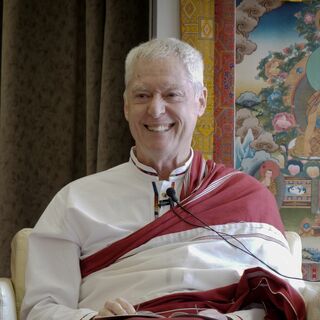
Let's settle the body once again in its natural state,
Letting your awareness permeate the whole field of the body,
Setting the body at ease,
In stillness,
In a posture of vigilance.
And if you find it helpful,
You may take three slow,
Deep breaths to round off this initial settling of the body.
Then settle your breathing in its natural rhythm,
An effortless flow,
And,
For a little while let your awareness continue to be diffuse that is filling this whole field of the body.
Continue letting your attention move at will within this field,
Attending to whatever sensations arise,
Especially those correlated with the breath.
Keep it within the field of the body without getting caught up in thoughts or carried away off to other sensory fields.
Continue relaxing and letting go with every out breath.
Keep it within the field of the body without getting caught up in thoughts or carried away off to other sensory fields.
Keep it within the field of the body without getting caught up in thoughts or carried away off to other sensory fields.
Keep it within the field of the body without getting caught up in thoughts or carried away off to other sensory fields.
Keep it within the field of the body without getting caught up in thoughts or carried away off to other sensory fields.
Keep it within the field of the body without getting caught up in thoughts or carried away off to other sensory fields.
A sense of ease,
Relaxation is indispensable for cultivating attention skills,
Indispensable for lucid dreaming and dream yoga,
But by itself it's not enough.
We need to also introduce the element of stability,
Of voluntary continuity of attention.
So let's step up this practice now by somewhat more narrowly focusing the attention instead of on the whole body or letting the attention roll within the body,
Now more stably focus it on the tactile sensations of the rise and fall of the abdomen with each in and out breath.
Narrow your focus.
Continue to let the breathing flow unimpededly without constraint or effort and with bare attention simply attend to the sensations themselves with no conceptual overlay,
No cogitation,
Just the sensations in the area of the abdomen corresponding to the in and out flow of the breath.
Click the link below.
Relax,
Let go with each out-breath as you've done before,
Immediately releasing any involuntary thoughts or images.
With each in-breath,
Arouse your attention,
Pay close attention,
And to the best of your ability maintain an ongoing flow of mindfulness,
Of the ongoing flow of tactile sensations corresponding to the in and out-breath as they manifest at the abdomen.
Let this be a full-time job.
There's always something to do.
Remain engaged.
Sustain the focus,
Relaxing with each out-breath,
Arousing your attention with each in-breath.
Relax,
Let go of each out-breath as you've done before,
Instantly releasing any involuntary thoughts or images.
Let this be a full-time job.
There's always something to do.
Remain And now to help stem the flow of obsessive thinking,
Compulsively being carried away by thoughts,
You may find it helpful,
At least time and again on occasion,
To count the breaths,
To substitute many rambling thoughts for a few regular thoughts,
The thoughts of counting.
There are various methods,
Here is one.
Breathe in,
Again allowing the breath to flow in quite effortlessly,
All the way to the end of the inhalation and just before the exhalation begins,
Mentally and very briefly count one.
Breathe out,
Relaxing,
Letting go of thoughts,
All the way through the out-breath.
Quietly arouse your attention during inhalation,
All the way to the end,
Where you count mentally,
Very briefly,
Two.
One count at the end of each inhalation.
You may count one through ten,
One through ten,
Or simply continue counting as you wish,
But the counting be very succinct,
Very brief,
Simply as a reminder to maintain to the best of your ability an ongoing flow of awareness,
Of the ongoing flow of sensations of the in and out breath in the area of the abdomen.
In a way,
We're in the process of creating a mental vacuum,
A space of the mind that is voluntarily empty of clutter,
So we fill the whole space of the mind over time with a continual engagement with the sensations of the breath.
We fill the mind with a mindfulness of breathing,
Like filling a jar with water,
Turning it upside down and letting the water drain out through a hole,
Leaving a vacuum where the water is drained out above the surface of the water,
A vacuum.
Likewise,
Fill your mind,
The space of the mind,
With mindfulness of the breathing.
Create a spaciousness,
A quiet and emptiness in the space of your mind,
Which may be very useful for later investigations.
You