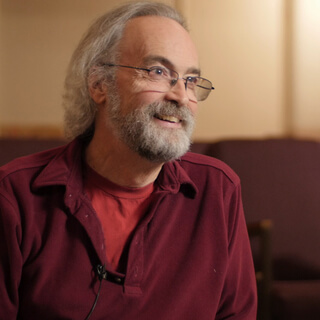
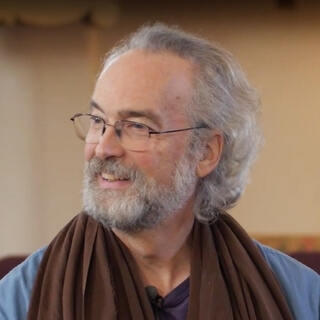
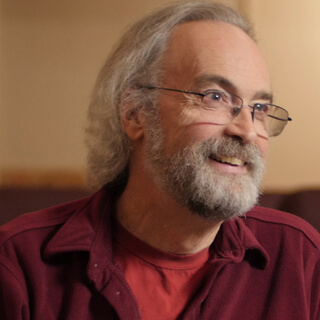
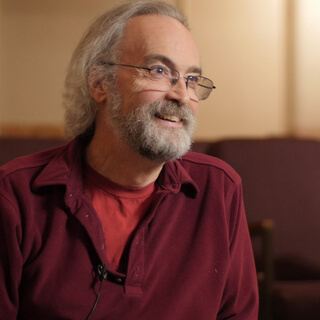
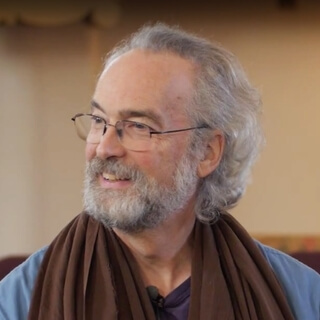
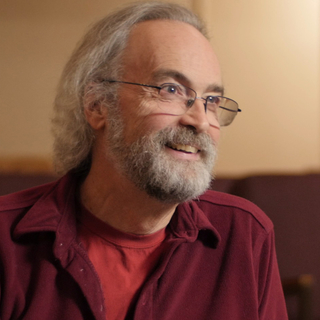
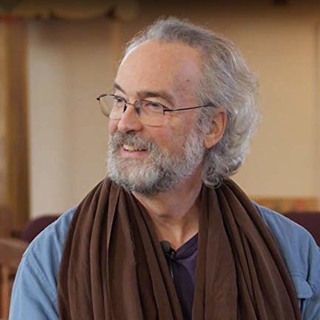
Resting in the Waves by Doug Kraft.
This is Amanda Kimball reading from Resting in the Waves,
Welcoming the Mind's Fluidity,
Written by Doug Kraft,
Published by Easing Awake Books,
Copyright 2020.
The Little Duck.
Now we are ready to look at something pretty special.
It is a duck riding the ocean a hundred feet beyond the surf.
No,
It isn't a gull.
A gull always has a raucous touch about him.
This is some sort of duck,
And he cuddles in the swells.
He isn't cold,
And he is thinking things over.
There is a big heaving in the Atlantic,
And he is part of it.
He looks a bit like a mandarin or the Lord Buddha meditating under the bow tree,
But he has hardly enough above the eyes to be a philosopher.
He has poise,
However,
Which is what philosophers must have.
He can rest while the Atlantic heaves,
Because he rests in the Atlantic.
Probably he doesn't know how large the ocean is.
And neither do you.
But he realizes it.
And what does he do,
I ask you?
He sits down in it.
He reposes in the immediate,
As if it were infinity,
Which it is.
That is religion,
And the duck has it.
He has made himself part of the boundless,
By easing himself into it,
Just where it touches him.
I like the little duck.
He doesn't know much,
But he has religion.
Donald C.
Babcock,
The New Yorker,
October 1947.
Introduction,
Welcoming Fluidity.
Sometimes I wake up in the wee hours of the night,
Roll over and fall back to sleep.
Other times I don't drift off so quickly.
I'm wide awake,
So I get up and meditate.
Leela,
Our cat,
Curls up in my lap and purrs herself back to sleep.
The crickets purr in the background.
I love meditating in the quiet of the night.
The world feels gentle and smooth.
I'm less tempted to push or strain.
Thoughts,
Images,
Memories,
Plans,
Song fragments,
Feelings,
And more ramble through.
I don't get caught up in them,
At least not for long.
And I don't tell the mind to shut up,
Watch the breath,
Or even send peace into the world.
I'm content letting the mind do its thing without getting entangled in its stories.
I relax on the sideline and let the mental parade mosey on down the street.
I'm simply aware,
Nothing more,
Nothing less.
The Buddhist term for mindfulness is sati.
Sati is sometimes translated as bare attention,
Meaning awareness without commentary.
Buddhism doesn't distinguish between mind and heart,
So sati can also be translated as heartfulness.
Sati means knowing and seeing what's going on and taking it to heart at the same time.
We could call this welcoming the mind's fluidity.
Rather than controlling the mind,
We watch it with clear and open-hearted friendliness.
Rather than getting engrossed in its content,
We watch it flow by.
Do you ever wake in the middle of the night and hang out with the mind?
Or lie in a hammock on a lazy summer afternoon and watch the mind drift here and there?
Or on a long drive,
Gaze outwardly at the scenery flowing by you as you gaze inwardly at the flow of thoughts?
If so,
You know what I mean by welcoming fluidity.
You watch the mind drifting with curiosity and an open heart without getting caught up in the contents.
It sounds simple and innocent,
Yet welcoming the mind goes to the heart of the spiritual journey,
Awakening,
And freedom from suffering.
It has nuances and complexities that may not be apparent at first glance.
Nevertheless,
When we truly welcome the mind,
It naturally settles into spaciousness,
Clarity,
And contentment.
Welcoming the mind's fluidity is the essence of the meditative process as I understand it.
It is also the subtitle of this book.
Let's look at what the words connote.
Welcoming.
Welcoming a person or anything requires two things.
Seeing them as they are and accepting them as they are.
Clear seeing.
First,
We must perceive them truly as they are.
If Frank joins our sangha,
Our community,
And I greet him with,
Welcome Bob,
It's good to see you.
I've enjoyed your music over the years.
It's great to have you with us.
Frank might think,
I can't carry a tune in a bucket and he doesn't even know my name.
I may feel wonderfully welcoming,
But Frank feels alienated,
As if I've confused him with someone else.
Welcoming someone requires seeing the person with all their beauty and warts,
Gifts,
And confusion.
Otherwise,
We may welcome an idealized image or a caricature,
But not that complete person.
Acceptance.
Second,
To welcome someone,
We must accept them as they are.
Out of caring,
We may wish them more happiness,
Clarity,
Or wisdom,
But our affection is not diminished by their imperfections.
We don't welcome them on the condition that they change.
We are open to them as they are.
Acceptance does not necessarily imply approval or disapproval.
Moral judgment is a different faculty,
Which comes later if at all.
If we feel we must judge someone,
It helps to see and accept them first before applying a set of values.
Like mindfulness,
Sati,
Welcoming requires both seeing clearly and taking what we see to heart,
Whether we're looking at another person or at ourselves.
Mind.
In the same way we might openheartedly welcome a person,
The subtitle of this book recommends welcoming the mind.
What is the mind?
This is not a philosophical or metaphysical query.
I'm asking in our direct experience,
What is the mind?
The mind is a field of awareness in which phenomena arise,
Move,
Morph,
And fade.
It's fluid rather than stable.
This flow goes on constantly when we're awake and often in our sleep.
However,
The mind often directs our attention to the content of experience rather than to the process of experiencing.
It's as if we're walking through a meadow.
We notice a chipmunk on a boulder,
A robin swaying on a branch,
A stream gurgling near our feet,
Without being cognizant of the expanse of the meadow itself or of the sky as it stretches to infinity.
In a similar manner,
The mind points attention to what's in the field of awareness more than to the field itself.
We often miss the field or at best take it for granted.
We miss the forest for the trees,
The ocean for the waves,
The particulars for the context.
Sometimes we try to control the mind by directing it to a specific topic,
But we rarely just observe the mind to see the pointing itself.
Nonetheless,
If you have ever gazed at the mind in the middle of the night or while resting in a summer hammock,
You may have sensed the field of awareness itself.
If you are a practitioner of certain styles of open awareness meditation,
You already do this intentionally as part of your practice.
Fluidity.
Welcoming has practical implications that touch on both meditation and daily living.
To put it bluntly,
There is no mind.
What we refer to as mind is a subjective flow of phenomena with no perceived beginning or end.
Realizing this no mind can be unnerving.
We want a rock to hold onto or a boulder to stand on.
We may feel like the cartoon character Wile E.
Coyote who chases a roadrunner off a cliff.
Wile E.
Keeps running through the air until he realizes he is suspended far above terra firma and crashes to the rocks below.
Then he miraculously recovers and begins the chase anew.
But just as Wile E.
Never catches the bird,
We will never grasp an objective experience of the mind.
To engage in an effective spiritual practice and lead an awakened life,
We need two things.
A.
A way to connect with the underlying reality of fluidity,
I.
E.
No undergirding self essence and no solid mind.
And B.
When we get a glimpse of this fluidity,
We need to embrace it without freaking out and clinging to the delusion of solidity.
In other words,
How do we relax into the freedom of no self and no mind?
How do we rejoice in the fluidity of never-ending change?
Even though there is no solid,
Enduring self or mind,
It still helps to welcome the qualities that do arise,
To be open to an accepting of fear,
Anger,
Ease,
Delight,
Infatuation,
Etc.
There is nothing personal about them.
They are hardwired biological responses.
They are automated signals.
We can't control what comes into the mind and we can't control the biological responses that result.
Even though we can't control them,
We don't have to indulge them either.
We don't have to get caught up and carried away.
The easiest way to do this is to see and accept the responses as they are.
Then we can stand back rather than act them out.
We can't get rid of the signals.
Welcoming means seeing and accepting them as they are,
Without getting lost or entranced.
This helps us gradually stop identifying with the contents of the mind and see it as a flow and a process.
In the long run,
The attitude with which we greet the mind can have a profound effect on contentment and well-being.
It doesn't change the contents in the moment,
But ultimately seeing the larger field enriches our lives.
Resting in the Waves A more poetic way to express this is resting in the waves.
Meditating in the middle of the night with my cat curled up in my lap as I gently watch the ebb and flow of the mind-heart without getting entangled in it.
That is the essence of resting in the waves.
Trying to stop the whitecaps in our lives is as impractical as trying to calm the heaving of the sea of life itself.
The ocean is vast,
Extending far beyond the horizon.
We sit like ducks in the expanse.
The heart of spiritual practice is as humble as sitting down.
As the poet and philosopher Donald C.
Babcock put it,
We repose in the immediate as if it were infinity,
Which it is.
Rather than try to rise above the ocean,
The duck made himself part of the boundless by easing himself into it just where it touches him.
That is freedom.
I hope this book helps you rest in oneness.
.