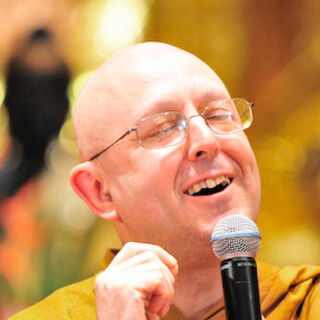
Very good and welcome to today's meditation class.
For those of you who have come for the first time,
The Introduction to Meditation class is being held in the room to my right.
This is a class for those who have meditated before because we do ask people to be able to sit still for about 40-45 minutes,
Which is a long time if you have not meditated before.
And it can be a little bit challenging.
So for those who are just beginning their journey of meditation,
This is being held in the room to my right,
This is the ongoing class.
And in order to be able to be comfortable for 40-45 minutes when you are meditating,
It's not just finding a comfortable position for your body,
It's also having a mind which isn't so restless.
Even if you go to sleep at night,
You have the most comfortable beds,
But if your mind isn't calm,
You will toss and turn all night.
You have your worries,
Concerns or any other sort of emotional problems which we do carry around with us.
So it is important to learn how to not just bring some comfort to the body but also to bring some happiness to the mind.
We talk about happiness but it's more like contentment.
There are many types of happiness in this world,
But the happiness which is not exciting but just being at peace being here.
I would always say that this is good enough,
Happy to be here,
Don't really want to be anywhere else for those 45 minutes.
And if one can develop that idea of contentment,
At first it's a bit made up,
Fake,
Because you may be a bit hot or a bit cold this time of the year.
Some people like it cold and chilly,
Some people like it hot,
You can't please everyone,
We do have air conditioners and fans,
But you can't have your personal air conditioner to keep you cool.
So sometimes for some people it's a bit hot,
Some people a bit cold.
So what I always say for Buddhist climate control,
When it's hot you keep a cool head.
Don't think about it so much.
And when it's really cold,
Keep a warm heart,
Which means that this is the best for many,
Many people,
So a beautiful kindness and compassion which allows you to know that at least somebody in this room is content and happy,
Wonderful for them.
In other words,
You don't just think of yourself,
You have wonderful compassion for other people,
Contentment,
And it's not that cold that you're going to have to go to the hospital with hypothermia.
It's not that hot that you're going to have heat stroke after you leave this place.
So you don't need to over-respond to the temperature set.
It's good enough.
So when we have this wonderful sense that this is good enough,
That this hall is good enough,
My body is good enough,
My meditation is good enough,
Then you can actually find you have contentment.
Now,
Contentment isn't just copping out of the world.
Contentment is the stillness from which things start to develop.
We always have this assumption,
Which I've often challenged,
The assumption that to get anywhere you have to strive.
Maybe in the world,
But in meditation to get somewhere,
You have to be still.
In other words,
You stop going places and you go deeper,
You explore the last unexplored place in the world,
This moment,
This body,
This mind,
Right here,
Right now.
Exploration is always going out somewhere else,
Forgetting the most unexplored territory of the world lies right within you.
It was a saying of the Buddha,
That the truth,
The beginning and the end of all things,
Lie within this fathom-long body and mind inside.
So we go exploring in inner space.
I remember years ago,
I actually went to visit Adelaide years ago and gave a meditation retreat there.
There was a fellow there,
He was from the ABC radio and he had this program called Inner Space.
It was always broadcast from about 11 o'clock to 1 am in the morning.
And chakra music,
What some people said,
Was a program which all the hippies would listen to late at night as they smoked their marijuana.
It was really weird stuff,
But anyway,
Inner space.
So he actually had many of my quotes on there.
And just the idea of going on,
Going rather inside to inner space,
Inside instead of going out,
To be able to actually develop that understanding of where you already are and explore the unexplored of now and here,
It takes a lot of stillness.
And if you do it correctly,
It's not boring at all.
People always think that if you don't do anything,
Go anywhere,
That it becomes extremely boring.
But that's not the case.
As you become still,
The stillness grows in interest.
You become vibrant just in its energy and brilliant in just its beauty.
This present moment which you can only access through stillness becomes such a huge goldmine of insights and happiness and joy,
Which is beyond your wildest dreams,
As I used to say.
So this is actually what we do.
At first,
The present moment is a bit rough.
But as you stay there,
You get softer and warmer,
More comfortable.
And the reason is that as you become more in this present moment,
So stay here,
Your stillness empowers your mindfulness.
You become more and more aware,
More and more alive.
It's as if when you give your mind a rest,
It starts to heal,
Bring up really powerful energies,
And people experience that aliveness,
That energy,
With this deep inner happiness.
The similes are very hard to come up with,
But one of the similes was that if you've been travelling in your life and you come to the only place you can sit down and take a rest,
The hard,
Cold,
Uneven stone bench,
The only place to sit down,
It's not the most comfortable,
And it's cold and it's hard and it's lumpy,
But you sit down on it.
Not the best,
But the longer you sit down on it,
The smoother it becomes.
The stone transforms into something very soft like a cushion.
It becomes warm,
It accommodates you really comfortably,
And soon it becomes one of the most pleasant places to sit down on.
And that stone bench is called the present moment.
This present moment when we first come into it,
I don't like this,
There's better things to do in life,
But more important things,
No,
Just stay in this present moment,
Don't move,
Be still,
And as you become more still,
This present moment becomes more and more comfortable.
It always was comfortable,
But we never noticed it,
Because our mindfulness was not sharp,
Was not powerful enough.
The more powerful it becomes,
The more pleasant is this present moment,
Which means it's easier just to be here.
You don't want to go anywhere.
It's crazy to want to get out of this position,
Because you're having a wonderful time.
This becomes the key part of meditation.
The body,
Put it down,
Looked after it,
Made it comfortable,
But then when the mind gets really comfortable,
That is when you start to understand the power of stillness.
Stillness is not boring.
Stillness is not stagnant.
Stillness becomes vibrant,
Powerful,
The source of huge amounts of energy,
And bliss,
And insights,
And also health.
You really start powering up.
So that is why stillness,
Literally doing nothing,
Is not inactivity.
It's a key,
It opens up this huge world of inner energy,
Peace,
Power and deep insight.
It's called stillness.
Not concentration,
Concentration is what you do.
It's the wrong word,
Wrong path.
Stillness.
And how do you become still?
Letting go.
Letting go of the past and the future,
And letting this present moment be.
Letting be,
Letting go,
Are they the same?
Well,
Sort of,
But to be precise,
Letting be is whatever is happening right now,
Let it be,
It's like being content with the stone bench on which you are sitting.
That's a metaphor.
Content with this.
That's letting it be.
Letting go is letting go of controlling,
Wanting,
Trying to get rid of things.
Letting go,
Let go of the past,
Let go of the future,
And let this moment,
What's left,
Let this moment be,
And see what happens next.
Da da da.
Okay,
So that's just one little way of looking at the meditation for today.
Now,
As I mentioned,
Those people who have just come in late,
Those people who come into meditation for the first time,
It might be a bit confusing for you.
So they've got a very good teacher next door,
Chris,
So if you need to,
He's from Montgomery years ago.
So if you want to do the meditation for the first time,
It's in the room next to me.
Very good.
So his wife and father-in-law are here,
He's a good man,
Mr.
Chris.
So anyway,
We can now start the meditation,
So if you'd like to get yourself comfortable,
If you're not already comfortable,
And then we can begin.
Here we go.
So I'll usually lead the first 10 or 15 minutes to get people in the right direction,
And then I will let you go.
So first of all,
It's very difficult being aware in the moment if our body is causing us aches and pains.
The first thing to do is just spend some time with your body,
Caring for it.
By caring for it,
I mean just part by part being aware of your legs,
First of all,
As your legs.
And if you find they're not in the best position,
Adjust them.
Caring means being a good friend.
So I'm a good friend to my legs.
And one skillful means of developing kindness and awareness at the same time is actually regarding each part of your body as if it has its own separate autonomy,
Like individual beings.
So I ask my legs,
Legs,
How are you?
Just as sometimes you meet an old friend and say,
How are you today?
And I do that to parts of my body,
How are your legs?
And I listen.
Listening is very important for wisdom.
And I get answers that my toe is not comfortable.
And if that was a good friend of yours and you find out they weren't comfortable,
You do something about it.
Once my toe is in a good position,
It's much better.
Check the body,
Check the legs,
Sorry.
Is that better now?
Are you okay down there?
And my legs say,
Yeah,
I'm okay now.
I go up the body to my butt.
If you don't get your bottom in a good position,
You can have all sorts of aches and pains.
Fidgeting is good at the beginning.
Once my butt feels good,
Then I ask my back,
Do you need any adjustments?
Shoulders,
I ask my shoulders,
How are they?
Because people do get lots of pain in their shoulders.
They hold their body way too tight.
I feel my shoulders and learn how to relax them.
How do you learn how to relax?
You have to be aware of that area,
First of all.
Pay attention to the teacher.
And the teacher now is my shoulders.
I learn from them,
Learn how to relax them.
I can tense them up when I need to tense them up.
Now I relax them.
And I can also feel their comfort levels.
The shoulders comfortable?
Yeah,
I feel pretty good now.
Go down my arms,
My hands.
How are you,
Hands?
Do you need to be adjusted or moved?
See,
Not my hands,
My nose needs to be scratched.
As my arms and hands are comfortable,
My neck.
.
.
Make sure there's no aches and pains there.
If there are,
I linger there,
I learn,
I've got a lesson to learn from my neck.
How to put less strain on that neck.
How to ease off any irritations in the throat.
So my neck feels comfortable.
I look up,
Be aware of my head.
I often say that the muscles on my face,
They're the ones which I really get to know.
And learn how to relax them.
Because one of the insights you get,
Understand is you get through meditation through being aware of your body,
To know that many of the emotional problems in life,
Whether it's grief or fear or disgust,
Aversion,
Happiness,
Joy,
They all interact with most of the muscles in your face.
So people can tell by your expression what emotional state you're in.
So you can learn about the muscles in your face,
How to relax them at the same time.
Relax the emotions inside.
So I loosen all the muscles around my eyes,
Around my forehead,
Around my mouth.
I can feel them.
I learn from them.
I relax them.
And then just to add to this little preliminary mindfulness kindness practice,
I just go just behind my eyes about two inches,
In the middle of my ears,
Between them,
Right in the center,
Where my brain is supposed to be.
Sometimes you have to do many,
Many things and you work our brain too hard.
So I go right to the center,
I imagine my brain and give it some kindness.
Imagine it relaxing.
Like it's put in a beautiful spa bath,
Just the right temperature.
So it's no strain,
It doesn't need to perform.
It's got no work to do,
My poor brain.
No emails to answer,
No questions to formulate or to find answers to,
No work to do.
No future to worry about,
No past dragging it back into what's already happened and can't be changed.
Just imagine my brain,
All pressure,
All deadlines,
All stress,
Just being removed.
If my brain can take a rest,
It doesn't need to understand meditation or to do it.
It's just more work for my brain.
Let my brain take time off.
Time off being no past,
No future.
Then I just become aware of my whole body,
Just as a unit,
Sitting here,
Part by part,
Being cared for.
So it feels good.
That's this tingling sensation,
My body anyway,
Of a delightful feeling that I imagine you would get if you went to a spa,
Had a full body massage,
Soaked in a hot tub,
Whatever they do in spas.
There's no tension anywhere that I can find.
The body relaxes.
It's like putting the kids to bed in the evening so you can meditate or do whatever you need to do.
Putting your body into a comfortable position so you can focus on your mind.
Starting with what I call your peace-ometer.
How peaceful are you or how agitated?
Like a thermometer or speedometer,
Some dial with a needle or something so you can know how peaceful or how agitated you are.
Number from one to ten.
Ten really agitated,
One really peaceful.
What number would you give your mind right now?
So you can see what makes your mind more peaceful,
What makes it more agitated.
Once you have mindfulness,
An important thing like a peace-ometer,
You get feedback.
It's from feedback you learn.
You learn what you have to do or more importantly what you don't do,
Which moves that needle of your peace-ometer closer and closer to one.
And all the times that you move it closer to ten.
Why?
You learn cause and effect.
And in particular,
You find that letting go of time,
No past,
No future.
You don't learn from the past.
You certainly can't fix up the past.
It's done,
Finished with,
It's dead.
Learning from the past?
No.
You learn much more from the present moment,
From now.
And the future now is where your future is being made.
This moment is the only time you'll ever have to make a good future.
This is where your world is created,
Right now.
As you come into the present moment,
It can be a little bit uncomfortable to begin with.
You wonder,
What on earth am I supposed to watch?
Whatever is happening right now,
You're not dead,
You're not unconscious,
You're aware of something right now.
That is your object of meditation.
It will change.
It's always in this moment.
Don't go anywhere,
Be here.
See how here becomes more powerful with every moment you don't move.
You don't seek for answers by thinking.
Seek for the deepest answers by going deep into this moment.
Sitting on the bench for the present moment.
The longer you sit here without moving,
The more comfortable it gets.
Not talking about physical movement,
Talking about your mind.
Not going to past or future.
Breathing,
Watching or breathing,
The breathing may come up,
Fine.
As long as it's happening now.
It is the now-ness,
The presence in this moment of the breath happening now that's the most important aspect of your breathing.
If the breathing happens to dominate,
Be quiet now until about a minute before the end of the meditation or the end of the bell.
See how here becomes more powerful with every moment you don't move.
Not going to past,
Not going to past.
Breathing,
Watching or breathing,
The breathing may come up,
Fine.
As long as it's happening now,
Not going to past.
Breathing,
Watching or breathing,
The breathing may come up,
Fine.
.
.
.
.
.
.
.
.
.
.
.
.
.
.
.
.
.
Deep meditation,
A wave-like sound,
It's not usual,
But if you were in front of me I would ask you if you feel like a wave-like sound or whatever experience you are feeling,
Is it pleasant,
Is it relaxing,
Is it really peaceful?
Because usually the sound is not one of the best ways to get into deep meditation.
It's one of the reasons why the Buddha said sound is like a thorn,
It can penetrate the deepest of meditation,
Just like the sound of an alarm clock gets you out of sleep in the early morning.
Or why they have alarms like fire alarms,
It's usually sirens which penetrate so deep that you can't really ignore them.
Or why children,
Especially young babies,
They alert their mothers by their screams or their cries,
Which you can't really avoid,
They really penetrate into you.
So it's usually unlikely,
It's much better that we,
In our meditation,
We somehow don't pay attention to the physical things of our world,
But go deeper inside.
You may have noticed at the beginning of the meditation,
I said to see if you can just make the body comfortable so it's not a bother anymore,
So you can go into your mind,
Into that sixth sense,
Go inside,
Deeper inside.
The sounds are almost like taking you outside.
That's almost like a segue into the other question that somebody just passed me just beforehand.
Following the Anapanasati method,
Which is the mindfulness of the breathing,
That's its name.
But if you've followed the teachings or listened to the YouTubes or seen as many different translations,
I'm not sure which book Anapanasati is referring to.
But after some months practicing meditation based on the breath,
When I start practicing now,
My breath becomes very fine quickly and I feel a sensation like a tickle or subtle pressure around my nose and in my forehead.
I do not know if this is an acquired sign,
Like a tactile nimitta,
Or if it's just a distraction,
So I don't know how to continue.
It's usually,
If you see something which is somehow connected to your body,
It's usually not a very good place to go.
Because once you have some connection to your body in meditation,
You find that these other connections come there as well.
So it's one of the reasons why the idea of Anapanasati,
The breath meditation having something to do with nose meditation,
Is not correct.
If you are meditating,
It has like a purpose,
Like a general overview is to be able to transcend the body,
Let it go to the point that it disappears,
But still keep your attention just on that sixth sense,
The mind,
Taking the energy from the body onto the mind,
So the mind becomes more prominent.
And every time there is anything to do with the five senses,
It takes away the energy from the mind.
One way of looking at this is looking at the five senses,
Seeing,
Hearing,
Meditating and touching,
As taking up so much of our attention,
Being so important to us,
They dominate.
And the thing which we call the mind,
The sixth sense,
Is just so weak,
So much so that many people just don't really understand what this mind really is.
So in our meditation we are trying to take away the importance of the body by sitting comfortably,
Sitting still,
In usually a quiet place,
Not too noisy,
In a place where we close our eyes so we can shut off the eye sense,
And so you're not sort of smelling or tasting.
In those days that's one of the reasons why they had incense in temples,
Meditation rooms,
To take away the smell of human beings when their hygiene wasn't so good.
So it just has a constant smell and obviously just not moving,
So the sense of touch was the subdued.
So when those five senses,
Seeing,
Hearing,
Meditating,
Are subdued,
It's not that you go unconscious,
It means that the other sense,
The sixth sense,
Which hardly gets any attention,
Starts to get stronger and stronger and stronger.
You become mindfulness,
The mind sense becomes empowered.
So what's happening here?
This is the amplitude of your five senses,
This is the amplitude of the mind,
This dominates so much,
But when we start to calm down,
Especially when you go into retreat situations,
When you're not doing very much,
You're not watching TV's or checking your iPhones or iPads or whatever it is you call them,
As the sensory input gets restrained,
The mind actually starts to become empowered,
It's almost like it's waking up.
And there comes a time when they're about the same amplitude,
And that is the time,
You can still maybe hear some of the sense input,
But it is so subdued and the mind has a chance to grow.
Only when the sun goes down can you actually see the stars and the moon at night.
So the moon is like the mind and the sun is like these five senses.
Only when that really gets very,
Very weak can you start to see the moon.
It's only a metaphor of the mind.
So when this starts to happen,
That is when you start to experience what they call the nimittas,
The first signs of the sixth sense by itself,
The mind.
So it sometimes does happen that you kind of feel,
So the usual nimittas are usually the lights in the mind,
Because that's our dominant sense,
Is seeing.
But it can happen,
Like smells sometimes,
When people just in meditation retreats,
They can almost like smell like the favorite fragrance,
Like jasmine or sandalwood in the hall,
And there's no one else who can smell that,
It's just because you're starting to get a very powerful mind.
And it starts to perceive in terms of its usual,
Strongest sense.
So there are times when sometimes people just are meditating and sometimes they hear these beautiful sounds,
Almost like chanting or some beautiful music or whatever,
And it's not happening just in the real world,
But they're starting to get some mind power coming up,
And this is where they start to interpret the first arising of the mind.
When it comes to be a sound,
It's like waves,
Then it should be like a long distance away.
And of course the simile,
Which I do personal similes,
I can just get away with this,
Because I'm not supposed to say much about personal experiences.
When I was doing walking meditation as a young monk,
I really got into it,
Just so many different sensations you can feel in the feet as you do one step.
Like you focus on the breath,
I was focusing on the walking,
As you were moving,
And it just got so refined and so soft,
And of course you're just in your own little world here,
You're focused.
And as I was focusing,
Just naturally,
Not force,
No effort,
Just enjoying every moment of this,
Just when I heard a sound which was such a long distance away,
It was like hearing the traffic in the background,
Only much further.
And I could make out what it was saying,
Someone was calling my name,
Rama Wang So,
Rama Wang So,
And it was weird,
Somebody I could recognize who was calling my name,
It was like such a long distance away.
So I turned my attention to the source of that,
And it was a monk who was shouting in my ear about an inch away.
And that was the point I remembered that I was supposed to go to an appointment,
To a ceremony in somebody's house,
I'd forgotten all about it,
And they sent me,
Sent a monk to try and get me out of my meditation,
Actually to go to the dana,
To the blessing ceremony.
And that's what it felt like,
And it was very tough,
I was only about three or four months ordained,
But I realized I had let somebody down,
I was trying my best to move,
To get out of that state of meditation,
It took me just a couple of minutes just to turn my head,
Because when you're actually turning your head,
The number of muscles which have to move,
It's fascinating,
Just turning your head,
What's going on there is just so amazing,
I couldn't do anything fast,
And then when I got eye contact with this monk,
All I could do is say,
What?
Because he was a monk,
He knew I wasn't crazy.
That was just what's happened,
Because the five senses were getting so subdued,
That even somebody shouting in my ear was like a long distance away.
So if you hear the sounds of the waves,
Like a long distance away,
That's what it feels like,
Then that's maybe getting close to being in deep meditation.
And it's the same with the feeling the tip of the nose.
It's not feeling the tip of the nose,
Because it's just feeling a sensation somewhere,
It may feel like a tactile nimitta,
But don't locate it anywhere in the body.
You don't know if it's in the nose or if it's in the left toe or anywhere,
Because as soon as you locate it in the body,
The perception of the body comes up,
And as soon as I had to listen to that sound and realised it was a real sound coming from another monk,
I had to break my meditation.
So the science of those very deep states of meditation,
If it is a sound,
It's incredibly beautiful,
And it's much more beautiful than anything you can hear like any of the waves in anywhere,
In any ocean or any beach in the world.
If it's a fragrance which is rare,
It's just the most beautiful fragrance,
Just lovely to smell,
Not so exciting but just so calming and so delightful.
Not of this world.
And if it's the lights,
Lights which are not of this world.
In other words,
Blues or greens,
Deeper blue than it's ever seen before.
And just to end up with this,
Sometimes people think,
Oh,
I'm going a bit too deep,
Just to bring it down to earth.
Not this last range retreat,
The range retreat before meditating in my cave.
Just I got one of the rarest nimittas I'm thinking of,
The only monk who's ever got this type of nimitta in their meditation.
It was a nimitta because the yellows,
It was a very deep yellow,
More yellow than any yellow you could see in this world,
A very deep,
Unworldly,
Vivid yellow.
But it was the shape of the nimitta which broke the meditation because I recognized it straight away.
It was an image of Garfield the cat.
I've been reading too many comics and that's the image which I got.
And I just burst out laughing,
That was the end of that meditation.
But it was a nimitta because the colours,
You don't see in any comic strip,
More yellow than yellow,
That's sort of the sign.
It's only just the way I perceived it was just a bit idiosyncratic and not very skilful.
So that's the sign.
If it's the tip of the nose,
Forget about the tip of the nose.
Forget about the forehead or whatever,
Just disembody these feelings.
And so you just get to the mind,
Not the five senses.
The whole point is just to drop the five senses so you can really get to see what your mind is.
That's a powerful,
Brilliant,
Beautiful,
And at the same time you realize what these five senses are and how the mind can transcend them.
Anyway,
So,
Any questions or comments on that?
There's only just a couple of questions today.
I'll just give you one more simile just to make it clear.
You have to make up metaphors from modern world.
So one of the metaphors I have is the Emperor.
And this Emperor,
Apparently,
I made up this simile a long time ago,
But apparently it fits with one of the.
.
.
It was Star Wars,
That happened after my time when I was a monk,
So I couldn't see that.
But apparently there's a fellow in Star Wars called Darth Vader.
Is that correct?
That's all right?
Okay.
And apparently no one could actually see who he was.
He was covered in this big.
.
.
Was it a hood or a helmet?
A big helmet.
Big helmet.
And in my simile this Emperor has a big helmet,
Really powerful,
And a long jacket,
Which goes right up to his.
.
.
Did he have a jacket,
Darth Vader?
Sort of.
And big gloves.
How long?
I don't know.
Anyway.
So big jacket,
Gloves,
Trousers and boots.
So five pieces of clothing,
Just the boots,
The trousers,
The jacket,
The gloves and the helmet,
Which cover the body totally.
So you don't know what's actually underneath.
So that was the simile.
That was the simile for the five senses,
Seeing,
Hearing,
Smelling,
Taste and touching,
And the Emperor underneath the mind.
So the only way to find out what this Emperor is,
Whether it's a girl or a boy,
Or whether it's a robot,
In artificial intelligence,
Whether it's old or young,
What race,
How old?
The way to do that is to take off all the clothes,
To see what's underneath all these five senses,
What is running the show.
So that's the job of meditation,
To take off the five senses and see what's left.
That's called the mind,
The Emperor,
And find out what this Emperor really is.
That's one of the reasons why we sort of subdue the five senses,
The material stuff,
To go to the spiritual stuff,
The world of the sixth sense,
The mind,
Isolate it.
And it's incredibly powerful,
Enjoyable,
And then you can find out what it really is.
It was Darth Vader anyway.
What?
Was there anybody there?
I don't know.
I'd have to watch the movie instead of just relying on my monks to tell me what happened,
The younger monks.
Oh,
In meditation,
You have to get into deep meditation to find out what's left when your five senses get subdue.
Okay,
Any other questions on that?
No?
Okay,
So let's finish off for the day.
Sadhu,
Sadhu,
Sadhu,
May the force be with you.
That's right.