Hey everyone,
It's Judy Cohen and this is wake up call number 351.
It's really good to be back.
Nice to see you all.
I was traveling in the UK for about five weeks and I hadn't spent much time there before.
So it was interesting time to be there.
One wonderful thing was the rain.
I'm a Californian and it was really glorious to have rain every day in Scotland and England.
Just felt really good.
So you don't have much rain out here.
It was also interesting to be in London for the platinum jubilee,
The 70th anniversary of Queen Elizabeth's rain.
And as far as it looked to me,
The English really love their queen.
So it was interesting since,
Of course,
We intentionally don't have a monarch in the US.
And you might even remember the words from Common Sense where Thomas Paine said back in 1776,
In America,
The law is king for us in absolute governments.
The king is law.
So in free countries,
The law ought to be the king and there ought to be no other.
And yet I wouldn't say most Americans love the law in the way that the British love their queen.
And then,
Of course,
The saddest difference being in the UK and being home was that in the UK,
I never felt afraid.
You know,
I never had a moment,
Even in the really big,
Huge crowds during the jubilee weekend,
When I was afraid somebody would pull out a weapon and start shooting.
And unlike here,
Where Black and Latinx and other Americans were being gunned down.
And,
You know,
The words I was writing this that came to mind as horrifying as they are,
Are,
You know,
As usual.
So I know we have a maybe deal in Congress for gun control legislation,
But it's limited and not even certain to pass yet.
And in Scotland,
There was one school shooting in 1996,
Terrible one.
And within a year,
Parliament had banned our ship of guns and semi-automatic weapons and required registration for exceptions,
Which according to friends in the UK are almost impossible to get.
And there have been exactly zero school shootings so far since.
So,
You know,
Here we have the NRA,
But as a country,
We also have just a different mindset,
You know,
A different imagination of who we are.
And so I'm beginning to wonder if it's not really so much about politics as it is about imagination.
And I'm reading Norman Fisher's book,
The World Could Be Otherwise,
About the six Zen Paramitas or perfections of mind and heart.
According to Norman,
The word paramita comes from the root words param,
Which means the other side,
And eta,
Which means gone.
And so paramita means gone to the other side,
Which Norman says means gone all the way out to the end of possible and then beyond the possible.
So for me,
That brings up the question,
How can we attain things that are beyond possible and if we can't,
Then why study them or practice them?
And I love Norman's answer,
Which is that although we can't attain the impossible,
The paramitas,
The perfections,
We can imagine that we can.
We can imagine ourselves as deeply loving and compassionate without boundaries,
Without issues.
You know,
We can even imagine a society like that.
And he notes that imagination also got us into the mess we're in right now,
But he reminds us that it has also given us virtually all of the awesome aspects of humanity.
You know,
Our arts,
Our literature,
Our poetry,
Our architecture,
Our science,
Democracy.
And we could argue that it's given us all of our religions,
All of our spirituality.
And so much more.
And even day to day,
Like today,
I've imagined a birthday party for my daughter-in-law tonight in order to make it happen.
So imagination is what enables us to create the small and good parts of our own lives as well and to care for and love one another.
So I love this invitation to imagine ourselves into a different way of being and essentially into a different future and not in a Pollyanna way.
We still have to deal with racism,
With climate collapse,
With Covid,
With so many things,
But not in a Pollyanna way,
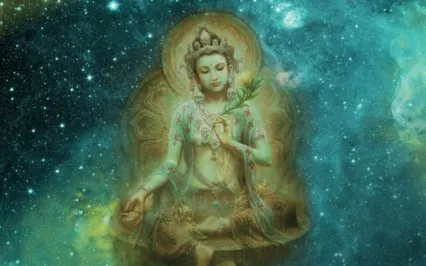
But in the way Lama Rod Owens talks about imagination as imagining ourselves as the goddess Tara,
The female embodiment of compassion.
So as a young lawyer,
You know,
I would have to say I didn't consider my work imaginative.
It felt very logic based,
Very cut and dry.
And maybe a decade later,
When I felt like I knew what I was doing a little bit,
I realized that wasn't necessarily the case and practicing law can be imaginative.
But I also think that what Norman and the Paramitas and Lama Rod are inviting us to imagine,
At least initially,
Is not so much the external as in the legal profession or even practicing or teaching law.
I think initially they're inviting us to imagine a different internal experience that translates out into the world.
They're inviting us to see that the form our work takes and our lives take or could take,
The spirit in which we could offer it,
In Hebrew,
We would say the Ruach,
Which means the holiness that sits beneath or inside of everything.
Could be radically different and better,
More loving,
More peaceful,
More easeful,
Fairer,
More just.
If we could first imagine it that way and then practice basically for our whole lives in that direction.
And in fact,
They might be saying,
Lama Rod,
Norman might be saying that we have to imagine it first.
The six qualities of heart and mind,
The six Paramitas,
And this is from the Zen tradition,
The six Paramitas or sometimes we say Paramis for short,
That we're invited to imagine are generosity,
Ethical conduct,
Patience,
Joyful effort,
Meditation and understanding is what Norman calls it.
I've also heard it called wisdom.
And,
You know,
You might hear that list and think,
Well,
I'm patient or I'm ethical or I'm a joyful person.
And yeah,
You probably are.
But the Paramitas invite us to imagine generosity,
Imagine ethical conduct,
Imagine patience and joyful effort.
Even imagine our meditation and our understanding or our wisdom in such detail and to such depth and in ways we just might never have thought of,
Far outside of any ordinary kind of Oxford English dictionary or even rules of conduct definitions.
Or,
I mean,
At least I could say for myself in ways I hadn't thought of,
Hadn't defined,
Hadn't imagined.
So the invitation is to spend the next weeks exploring these six impossible qualities of heart and mind,
You know,
Imagining the qualities,
Imagining how to live into them,
Keeping in mind their impossibility the whole time.
And also imagining what the law and the world might look like if we practice them and taught them in our law school classrooms,
Even going so far as to imagine that we might love the law in some different way.
And our country might love the law and those who practice it and even make it.
Maybe,
Maybe even in the way Thomas Paine was suggesting,
Maybe in the way the British love their queen.
And,
You know,
Of course the question why comes up and I'm not sure yet.
You know,
We'll see.
Maybe to heal ourselves.
Maybe to heal the law.
Maybe to heal the world.
Maybe to form a more perfect union.
Yeah.
I guess that why will be up to the imagination of each of us.
So let's sit.
So finding a comfortable posture.
And being upright.
Bringing dignity to the moment,
To your practice.
Maybe bringing a small smile to your lips.
You're welcome to practice with eyes closed if you come from a tradition of eyes open.
And the image on the screen of this is the image of Tara,
The goddess of compassion.
If that's helpful to you,
I'll leave that image.
And so first just locating yourself in the chair or on the cushion or wherever you might be sitting or standing or lying down.
Just feeling your body.
Settling in.
And then bringing the attention to the breath.
Just the easeful way that we can attend to the breath,
Whatever the breath is like right now.
Deep or shallow.
Slow or fast.
And whatever quality this moment,
This sit has for you.
Can you also notice the goodness,
The good effort that brought you to sit for a few minutes?
The good intention to be quiet and rest for a few minutes.
To connect to yourself and to each other.
To the earth.
So well.
There is such goodness in that intention.
And just in this act of sitting together.
Tap into that goodness.
Or into the imagination of that goodness.
All right.
.
.
.
.
.
.