Welcome to the Gathered Truths podcast.
My name is Jen Yaki.
Join me as we create this sacred container for discovery and healing,
A place where you are invited to safely inquire,
Contemplate,
And explore the paths of wellness,
Awareness,
And truth.
Together we will listen,
Breathe,
Learn,
And grow so that we can show up for ourselves,
Our families,
And our communities.
Welcome to Gathered Truths.
Hello friends,
And welcome back to the Gathered Truths podcast.
This is episode number 19,
And I am recording this on April 1st,
2020,
And we are in the middle of the things.
So I wanted to give you a couple of resources.
JenYaki.
Com and GatherLakinta.
Com.
Currently I am offering free live yoga Monday through Friday at 10 AM.
I have a women's circle that meets monthly,
And you can join us until the 3rd of April for April's month,
And then just check the schedule from there.
And then there,
If you can't make the 10 AM classes Monday through Friday for some movement and meditation,
There is a website that you can go to that houses all of the recordings,
And it is on NAMASTREAM.
I'll put that in the show notes,
But I wanted to give you that information because I think it is important at this time to do some meditation,
Some centering and grounding exercises,
And things that we can do at home,
Even with our families.
So as I have been greeting my friends and my friends have been greeting me with,
How are you in this moment?
How are you in this moment,
Because when we ask,
How are you,
That can be quite overwhelming.
And I'm sure just like I am,
You are feeling the full range of emotions.
This morning,
Our governor announced that public school was going to be canceled for the rest of the year,
And I was having a conversation with a friend of mine about this and about her concerns for her child.
And I was immediately brought back to something my father told me many years ago when I was playing junior golf.
And we grew up in Northern California,
So we had very mild climate,
And pretty much when it rained,
We were not practicing or playing golf.
But if a tournament was scheduled,
That was something different.
So there were several occasions that we were on the Central Coast at around the Thanksgiving holiday.
And it was a time that all of us traveled together to the tournament.
My brother and I would both play.
My dad had the time off,
So he was with us.
And I remember that each time we would go down to this tournament,
And it may have only been once,
But the way that my mind is processing this is that it happened more than once,
Is it would just be a gong show of weather.
I mean,
Just horrible,
Torrential rain.
And I remember distinctly having to squeegee off the greens.
They'd have a roller and we'd roll the greens,
Getting the water off the area that we were trying to put.
But it was always so cumbersome.
You had your golf bag and 14 clubs and all the crap that was in it.
Plus you had a couple of gloves that you had.
And you know,
At that point when I was playing,
They didn't have rain gloves.
I don't even know if we had plastic bags,
You know,
Like Ziploc bags.
And we have towels,
We have these ungodly umbrellas that were certainly not safe in a lightning storm.
And it was just this cacophony of stuff.
And you're trying to play a game while you are dealing with all this stuff.
And it was always one of those things that,
You know,
You went into it with the best intentions of keeping everything dry.
And by about the third hole,
I mean,
You were just trying to deal with what was not as wet.
But what my dad would tell me when I came off the golf course was,
Listen,
Everybody is having the same experience today.
Everybody's playing in the rain.
Everybody's having to squeegee greens.
Everybody's having to keep towels and gloves and grips dry.
You're all experiencing the same thing.
And the person who will win this tournament is the person that navigates this situation the best.
And I was telling my friend this story and because we were talking about the fact that all of our children are going through this right now.
Some of,
Some kids are in private school.
Some kids across the nation have been out of school for two weeks,
Three weeks.
And that we're all experiencing not being in school.
All the kids are.
And some kids have more privilege than other kids,
Some families do.
All of the kids,
I would guess,
A lot of them,
Many of them are missing their friends.
But we're all experiencing this situation together.
And how we come out on the other side is really our decision.
And in telling her this,
I then texted her back to let her know that my dad's advice at that point did not land very well.
I really did not want to hear that I needed to suck it up and try to find the silver lining in all of this and persevere and gut it out.
That is not what I wanted to hear and this does not have a happy ending like I won the tournament.
That was not the case.
But that lesson,
That story has stayed with me and I can vividly remember us having it.
And I can remember pulling all my golf clubs out and lying them on the hotel room floor and trying to get them dry for the next day.
But it is so appropriate for today.
And here's the thing,
I am sure because this nation is experiencing shelter in place at different times,
That we are all going to be in different cycles of grief.
That we will all be experiencing this scenario in so many different ways because we are experiencing it at different times.
So for instance,
My friend Laura is in Florida and just today,
The first of April,
Their state is finally going on a lockdown.
Shelter in place.
But us in California have been on,
We have been shelter in place since,
Let's see,
Like the 17th of March.
My brother has been on shelter in place before that.
He was in one of the six counties in Northern California.
So for instance,
I might be in a place today where I'm feeling more in the groove.
We have a schedule down.
We have groceries in the house and we are feeling like we have a routine that we can follow on a daily basis and we are feeling more mentally at ease.
But the truth is that Laura is at the beginning of this.
And so in three or four days,
She might be experiencing a whole other host of emotions and feelings and thoughts.
Those of which that I,
For instance,
Felt two weeks ago.
So really this is the grief cycle that we are in.
Denial,
Anger,
Depression,
Bargaining,
Acceptance,
And around we go again.
And just because we go around once or twice doesn't mean that we're absolved of going through it again because something might trigger us,
Upset us,
And we might be back into bargaining,
Back into anger,
Back into denial,
Or just pulling the covers over our head and just not wanting to get out of bed feeling apathetic and lethargic and depressed.
All rightfully so.
There is no right way to navigate this.
There is no right way.
And if somebody tells you that there is,
I would really question that.
Now certainly we don't want to stay in one of these stages too long simply because it just causes damage to our psyche,
Our mental wellness,
Our mental health,
And our ability to help those that are around us.
And that includes us.
So I'm not sure where you are today in this cycle of grief.
I can share that,
You know,
When we initially started this there was a whole lot of anger and denial about the studio.
A lot of fear in losing the studio.
All that Jay and I have built over the last two and a half,
Three years.
The community that we've built,
The community that we don't want to let down.
So there was a lot of denial,
Bargaining,
Anger.
I don't know that I actually got into acceptance for a while.
Same thing with Lucas being home.
You know,
The,
But when with Lucas being home there was a little bit more of acceptance.
I didn't really go through the rest of those sensations and feelings because I had a task with him.
And we had to step up and become his primary educators with the assistance of the school.
And then there's the whole relationship thing.
Jay and I,
Although we've been together for a decade,
Very rarely spend a significant amount of time together simply because of his job and my job and our responsibilities with Lucas.
And so we have been here together for the last three weeks and that has,
Was initially very challenging because as much as I don't want to admit it,
We are,
Well,
Or not,
We're more,
We're very individual people and we have led very individual lives and then come together and then led individual lives again.
And we've really had to come together and figure out how can we work together to make this thing work because this is not ending anytime soon.
And so there's that.
There's that question.
When is this going to end?
And I find for myself that that question is just lighter fluid on a fire.
It takes me out of the present moment of what is and what is is today.
And today we are shelter in place.
Today the studio is closed.
Today Jay's not going to work.
Today Lucas isn't going to school.
But what it also means is today we get to walk the dogs as much as we want.
We get to take our time on homework.
We get to connect with our friends and families in different ways.
We get to cook meals together.
We get to read books and take naps.
Unless you're Lucas,
Then you're not taking a nap because naps are not for big boys.
In case you were wondering.
But there's a lot of things that we get to do.
And that is a second lesson that my parents,
My father imparted onto me which is you get to do things.
I used to say I have to go practice.
You know,
Big sigh,
Oh I have to go practice.
And my dad would be,
Listen you get to go to the country club and go practice.
You get to do that.
That's pretty,
Pretty amazing.
And it was.
It was.
And so today I'm trying to rephrase things with I get to do this.
I get to take time and cook breakfast for Lucas.
Or I get to sit down and have lunch with Jay.
I get to sit in my closet and record a podcast.
You know there are a lot of things that I am completely and fully aware that other people don't get to do.
I have a friend who is a first responder.
I'm fairly sure that they would want to be home and record a podcast and hang out with their child rather than exposing themselves to COVID and the mental stress that the job is.
That job is already stressful,
Helping people in distress without also taking risks with their own health.
So today I am really focused on being here in this moment and when my mind freaks out and wants to go into the future.
It wants to predict the future.
It wants to find peace and ease in knowing,
Predicting what the future might be.
Or worse,
This morning I was up at 1.
30 because I just all of a sudden awoke and was in a complete panic about a friend's family that is being affected by COVID and then I start catastrophizing and I'm like every other human being.
I'm fortunate that I have some different tools and that I have breath work that can settle me back in and I can go back to sleep.
So let me share with you that breath work.
For me it works in three to five breaths and I'm able to settle myself.
Central nervous system goes from fight or flight back into a rest and digest and that is simply inhaling for four,
Pausing for seven and exhaling slowly like you are blowing up a balloon for eight.
And doing that,
Like I said,
Three to five times settles me and I fall right back to sleep and that has been a game changer for me because insomnia,
For those of you that experience it,
Is no fun.
It is no fun.
Having a startling wake up and having your heart racing and your temperature hot and your mind racing for no apparent reason is unsettling.
And there's enough unsettling things happening at this time that we don't need to layer the unsettling things and of course our responses to those things.
So that four,
Seven,
Eight breath is super helpful and it's not just helpful for insomnia.
It's very quick to ground you if you are feeling out of sorts.
You're feeling as if you are out of control.
And then speaking of out of control,
And I tell you those things,
These things because I have experienced these things and then I have an awareness that I have experienced these things and I have an awareness of what I am doing.
So I find a couple weeks ago when this all started and the proverbial poop was hitting the fan,
I started really micromanaging my family,
Having a lot to say or even a lot to think about what they were doing.
And I could feel a lot of anger and frustration and irritation and that's a red flag for me.
When I am in somebody else's business,
It is a red flag that something is up and that thing that is happening,
The thing that is up is the thing that is happening with me.
And sometimes I am ready to dig around and see what I am truly upset about,
What's really going on.
And then there are times that that's just not going to happen.
I'm just,
I'm aware that I am in somebody else's business,
But I'm not ready to look within.
But at the very least,
When I am aware that I am in somebody else's business,
I just stop.
That doesn't mean that I have to take a look in the mirror straight away,
But it just means that that's a hard no for me because I have enough going on with myself that I have zero need to be in somebody else's business.
It's not my job.
So if you find yourself micromanaging your kids,
Micromanaging your partner,
You might want to just take a step back,
Take a deep breath,
Maybe pause for a bit and kind of check in with yourself to see what is going on.
Now for me,
I was feeling very out of control of everything in my life.
Like all of a sudden,
One day I'm at work,
I'm doing all the things and the next day,
Nothing.
And having to revamp the way that we instruct yoga,
Being concerned about the other teachers that teach at Gather,
Figuring out what they're going to do.
Concern for my clients.
Many of my clients are,
You know,
Over the age of 60,
Many of them have are immunocompromised.
So all of a sudden there was just this platter of concern and worry and I go into wanting to control everything,
Wanting to fix everything.
And what I quickly realized was I cannot fix COVID.
I cannot fix the governor's orders.
I cannot fix the county's orders.
I cannot control what the corporations that I worked for want to do.
And so after a couple of days,
And by a couple of days I mean like seven,
I was able to find homeostasis again and it wasn't that I wasn't trying,
But I was definitely going through the grief cycle over and over and over again.
And let's just be honest.
It's important to allow for that.
It's important to allow your mind,
Body,
Heart and spirit to go through that cycle.
As many times as needed.
Because when you do,
When you move through it,
The intensity of the emotions are less.
All of the fight or flight mechanisms in your body,
They are less.
Less cortisol,
Which is a stress hormone.
Less blood pressure raising.
And so when you continue through the grief cycle and you allow for these emotions and feelings and thoughts to be and to move through you,
Then it clears up space and room for you to breathe and actually have a response.
Not a reaction,
But a response.
When you are in fight or flight,
Freeze or fawn mode,
There is no room for your frontal lobe to engage and for you to have executive function.
Because at that moment,
Your brain and body are on complete and total survival mode.
That is it.
That is it.
The only thing that it is trying to do is survive.
And so when we have those deep breaths,
When we have those grounding moments,
When we can finally be still and allow,
Then we have a chance to create some space to respond from our frontal lobe,
From our executive function.
And so if you are in the middle of it right now and you are feeling fight,
Flight,
Freeze,
Fawn,
If you are feeling that,
Just the awareness of,
Oh,
I'm freaking out.
I can't even think right now.
I am so overwhelmed.
I feel like my head is going to pop off my shoulders.
It just having that awareness is amazing.
It's excellent.
So helpful.
And then that allows you to stop and figure out a few different ways that you can take a few steps back before you can take a few steps forward.
But never having that awareness is where we get into trouble because then we stay in the grief cycle or one part of it for too much time.
Too much time in the sense that it becomes a detriment to our physical and our mental wellness.
So even small steps forward out of the muck is better than standing still for long periods of time.
So one of the tools that I use is when I finally recognize that I am spinning completely out of control is to give myself a timeframe.
And I used to think that I could negotiate this in my brain.
I could just think about it.
But you cannot find solution from the place that you have created the problem.
And that being said,
I cannot figure out in my brain where the problem has been created,
How I'm going to get into solution.
So pen to paper,
Even texting,
Your note app on your phone and telling somebody those ways are super helpful of I'm going to give myself 30 minutes to continue to be like this.
And then that's it.
If you need to give yourself a couple of days,
Do that.
You might find that you give yourself a couple of days and you don't actually need it.
But giving yourself a timeframe to freak out,
To have a cry or nine,
To scream into the pillow and then a deep breath and then small step forward out of the muck.
Remembering that you're not going to be able to quote unquote fix everything and that this is our new abnormal for now.
And so how we navigate this is our choice.
Once we're able to take a deep breath,
To stand still,
To acknowledge how we are feeling,
Then we can move forward.
But saying things like get over it.
I shouldn't be feeling this way.
Realizing or denying your emotions or feelings.
It does nothing.
Bypassing those feelings.
It does nothing but kick the can down the road to future issues.
You will have to let this pass through you at some point.
And the longer you wait,
The more problems it causes.
So I invite you to take a pen and paper and maybe write down the grief cycle.
Maybe you can make a circle.
And you write grief in the center.
And then around that with arrows,
Denial,
Anger,
Depression,
Bargaining,
Acceptance.
And maybe just take a look about where you are.
And maybe throughout your day you put this chart up on your refrigerator and you just see where you are throughout the day.
And then notice the intensity of the emotion when you have the awareness of where you are.
Notice where that emotion resides.
Is it in the belly or the chest,
The low back,
The head?
But just having that awareness of where this emotion,
This part of the grief process is residing.
So I would like to finish this podcast with a reading that will serve as our meditation.
And if you are not aware,
There is something that's called Gather Five Minute Meditations on Facebook.
On Instagram,
Jen.
Yaki,
I've started an IGTV channel.
And so some meditations are up there.
I think you could probably find Gather Meditations on YouTube.
But even just taking five minutes to just be.
And meditation,
All that it is,
Is you paying attention to what is currently happening in this present moment.
Just noticing it.
Seeing if you can practice noticing what is happening via your sensory doors without judgment or analyzation.
And you might be able to do that for a breath.
And then you notice that you're off hooked onto a thought or a feeling or an emotion and running after it.
And when you notice that you are hooked onto something,
Just bring yourself back to where you are seated.
That's all that it is.
It's just a practice.
It's like training a puppy.
You are going to have thoughts.
You are going to have feelings and emotions and actions and reactions and responses to all of it.
But the thing that I think that we forget is that instead of letting it all go to default,
We actually have the capacity to choose.
And it's a skill.
It's not a one-off.
It's not a one and done.
Believe me,
I've been practicing meditation for a very long time and there are some days I feel like I have never practiced mindfulness in my life.
It's like I've never learned a tool ever.
So please don't beat yourself up.
And those of you who have children or you are living with other people,
Remember that you cannot regulate somebody else if you are dysregulated.
So if you are losing your mind,
Freaking out,
Yelling and screaming,
Crying and just absolutely having a fit,
There is no way that you can help somebody else.
And there's nothing wrong with that.
Any of those things.
But before you start to try to put on somebody else's oxygen mask,
And I apologize for the pun,
You have to put yours on first.
It has never been truer.
So if you are in a place to come to a seat,
You can do that.
You might be out walking the dog,
But just being aware of your body,
How your posture is,
How you are noticing yourself upright or seated.
And taking a big breath in through your nose and pausing and exhaling through the mouth,
Tight lips like you are trying to blow up a balloon.
How big can you make the balloon?
Taking two more breaths just like that.
Big inhale,
Pausing and an exhale.
One last time,
Deep breath in,
Pause and exhale.
Soften the face and the jaw.
If you want to close your eyes and you're not walking or driving,
You can do that.
Softening the jaw by separating your teeth.
And just noticing the surroundings around you.
Noticing the sound,
The temperature.
Maybe there's a breeze where you are,
Maybe the air condition,
The fan,
The heat.
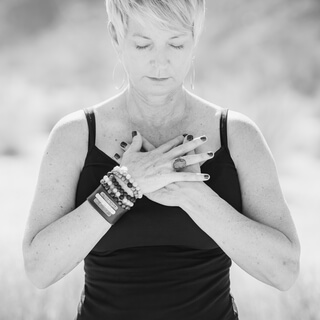
And you can keep your hands in your lap or perhaps you want to bring your hands to heart center just for a gentle pressure into the upper torso like you are giving yourself a hug like a heavy blanket.
Ground is what lies beneath our feet.
It is the place where we already stand.
A state of recognition.
The place or circumstances to which we belong,
Whether we wish to or not.
It is what holds and supports us,
But also what we do not want to be true.
It is what challenges us physically or psychologically,
Irrespective of our hoped for needs.
It is the living underlying foundation that tells us what we are,
Where we are,
What season we are in,
And what no matter what we wish in the abstract is about to happen in our body,
In the world,
Or in the conversation between the two.
To come to ground is to find a home in circumstances and in the very physical body we inhabit in the midst of those circumstances and above all to face the truth,
No matter how difficult that truth may be.
To come to ground is to begin the courageous conversation,
To step into difficulty,
And by taking that first step begin the movement through all difficulties.
To find the support and foundation that has been beneath our feet all along.
A place to step onto.
A place on which to stand.
And a place from which to step.
And perhaps taking another deep breath in and exhaling out.
You can release your hands down into your lap if they're not already there.
You are all in my thoughts and in my prayers.
And in this moment we are all okay.
And in this moment we are all okay.
And in this moment.
Until next time,
I wish you much peace,
Ease,
And health.