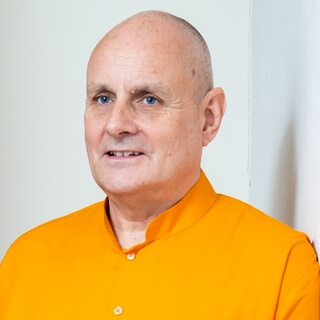
This episode is called Four Foundations of Mindfulness and it's part of the Buddha Dharma series.
Mindfulness is traditionally based on the four foundations and that's what I want to address here.
But before I do,
I want to discuss an issue I have with the modern mindfulness movement.
To be more specific,
Their definition of mindfulness.
People who know me will tell you that I'm not a traditionalist.
So my issue is not about secularism versus traditionalism.
It's solely about their interpretation.
Mindfulness cannot be summed up in a single statement.
It's too vast for that.
Yet that is what has happened.
Their definition is,
Mindfulness is an awareness of what is happening in the present moment,
Brought about by purposefully paying attention in a non-judgmental way.
Mindfulness was never meant to be a standalone practice.
It was part of the three basics of the path,
Namely ethics,
Awareness and wisdom.
The above definition only covers one of these basics of the path,
Namely awareness.
A thief breaking into your house,
A soldier on the battlefield about to kill someone and a person putting poison into someone's food are all good examples of being aware of what is happening in the present moment.
But all of them lack ethics and wisdom.
My next gripe concerns the part that reads,
Paying attention in a non-judgmental way.
I actually wonder if that's even possible,
But I certainly think it's not beneficial.
We make judgment calls all the time,
From what we wear,
What we eat,
The job we do and so on.
It's impossible to live without some form of judgment.
If I'm harming someone and I bring myself back into the present moment and I don't judge what I'm doing,
How am I going to change my behavior?
If mindfulness is going to be effective,
It needs to cover all three aspects of the basics of the path and that's why I've devised a practice called AWARE.
I feel this can be a bridge between traditional and secular mindfulness.
You bring yourself into the present moment by using a breathing exercise or focusing on your senses or bringing your awareness back to your body.
And once you're in the here and now,
You can start the AWARE practice.
AWARE stands for Attention,
Why,
Assess,
Reality and Examine.
Attention.
Bring clear attention to what you're doing.
Are you on autopilot?
Are you being led by unconscious habits,
Behavior or biases?
This part covers the awareness aspect of the three basics of the path.
Why?
Ask yourself,
Why am I doing it?
What is my motivation?
What is my intention?
This part covers the wisdom aspect.
Assess.
Assess if your behavior is beneficial.
Is it ethical?
Is it helping me to be the person I want to be?
Is it compassionate or hurtful?
This covers the ethic aspect.
Reality.
Is it based in reality?
Or am I generalizing,
Catastrophizing or letting my imagination run wild?
This covers the wisdom aspect.
Examine.
Examine a more mindful,
Beneficial and compassionate way to act.
A way that is based in fact and not fantasy.
A way that helps support me and others.
This part covers all three aspects of the path.
I personally believe by adopting the AWARE practice,
Once you've brought yourself back into the present moment,
You'll be able to make changes to your behavior.
You'll be able to change and grow.
And that,
I feel,
Is the whole purpose of mindfulness.
So,
Now I've got my winging out of the way,
Let's look at the four foundations.
The four foundation practices of mindfulness are of being aware of our bodies,
Of our feelings,
Of our minds and of our mental states.
The purpose of these practices is to get to know ourselves better.
It will help us understand what is working for us and what isn't.
This will allow us to change more effectively and positively.
Awareness of body.
The first practice is for the body.
We need to be aware of our body and all the actions carried out by it.
But we don't need to see it as my body.
If we think of it as my body,
It could lead to attachment and give us a false sense of identity.
Reflect on the time and effort we spend on this body just to look good.
Just imagine how much money is spent each year on plastic surgery and beauty products.
It would appear we are completely obsessed with our bodies.
We might be mindful of how the body looks but very rarely spend time on observing the actions it carries out.
There are many ways to contemplate the body but a simple and effective one is doing a full body scan.
You can find guided body scan meditations on my website buddhismguide.
Org.
In today's world we always seem to be running from pillar to post.
So this meditation will help you get back in tune with your body and calm your mind at the same time.
I'm sure you'll be surprised at how much tension you're carrying around with you and what different sensations you have in various parts of your body.
The full body scan is one of my favorite practices and I'm always surprised at the sensations I'm carrying around.
Over the years I've noticed certain sensations correspond to different emotions and experiences.
When I was young I started to have asthma and I noticed that 10 to 15 minutes before an attack I would start to get an itching sensation under my chin.
This gave me ample time to take my tablet and prevent the attack from taking hold.
Many sensations in the body are there for a reason but unfortunately we have lost the art of reading our bodies and rely too much on our minds.
This application of mindful awareness will bring you back in touch with your body.
As we become more in touch with our bodies you may ask how can we integrate this awareness into our daily practice?
Whatever you do with the body affects you and those around you.
So this is where a daily reflective practice will help you.
Look back on the day and see what actions you've carried out with the body.
The ones that are conducive to responsible living should be noted.
This will ensure that through repetition they can become spontaneous.
The ones that are not conducive to living responsibly should also be noted and a clear effort should be made to refrain from doing them again.
It is through staying mindful of our bodily actions that we'll be able to live responsibly.
Awareness of Feelings Another application for mindful awareness is feelings.
Now I'm not talking about emotions here.
Many people get the two mixed up.
Emotions are mental states whereas feelings arise when our senses come into contact with something.
There are three types of feelings namely pleasant,
Unpleasant and neutral.
One of these three are present during every moment of our experience.
They may be strong or weak but they're always present.
Here are some examples how feelings occur.
You may be walking down the street and you pass a good-looking person.
This brings up pleasant feelings.
As you work further,
A dog barks at you and unpleasant feelings arise.
A bit later you walk past a group of people you don't know.
None of them are of any interest to you so you have a neutral feeling.
If we're not mindful and leave our feelings unchecked,
Pleasant feelings can lead to clinging desires,
Painful feelings to hatred and neutral feelings to apathy.
When paying attention to our feelings,
The important thing is simply to notice them,
Become aware of them without either clinging or pushing them away.
Here are two ways we can mindfully get in touch with our feelings.
Firstly,
During meditation,
After you've spent some time watching your breath,
Notice what comes into your mind and observe what feeling is attached to that experience.
Don't try to change or judge that feeling.
Just become aware of it and then let it go on its way.
Then do the same with the next object that comes into your mind.
You can do this for as long as you like and then return back to your breathing awareness.
This practice helps you notice how you feel and what's going on with you.
It also helps you to understand that a feeling is present in every experience you have.
As with your awareness of the body,
You can also review your feelings during your daily reflective practice.
When you think of an incident that happened that day,
Check to see what feelings it invoked in you.
Did it bring up pleasant,
Painful or neutral feelings?
Don't try to control the feelings,
Just be mindful of them.
Being watchful of our feelings helps us see what desires we are chasing when a pleasant feeling is present and what is being invoked by our unpleasant feelings.
We can also learn to simply observe an experience without getting all tangled up in it.
This will help us to form neutral responses instead of getting attached to pleasant feelings or repelled by unpleasant feelings.
Awareness of mind The next area of focus is on our minds.
We can apply mindful awareness to explore deep into our minds.
If I'm honest,
This was always the most difficult for me to get my head around.
How can the mind look at itself?
The answer that came to me is that we look at the mind as though we are looking in a mirror.
When we talk about the mind,
We tend to think of it as a single thing.
But it's actually a sequence of instances that arise from moment to moment in response to the perceptions coming to us through our six senses things we see,
Hear,
Smell,
Taste and touch,
And from internal mental states.
The mind is a process and cannot exist alone.
So when we look at the mind,
We're actually looking at the processing going on in the brain.
We rarely stop and spend time observing our minds.
We just let thoughts,
Hopes,
Fears and dreams come and go unchecked.
But our minds,
If left unstrained,
Can lead us into all kinds of situations.
So we practice simply observing our minds.
We don't engage with what we see.
We just allow it to arise and go.
I understand that this is easier said than done.
But with practice,
Patience and effort,
It's achievable.
During your meditation or a daily reflective practice,
Observe your mind and see what state it's in.
Is it tired,
Lazy,
Angry,
Happy or disturbed?
Note the state,
But don't try to change it.
Ask yourself,
How is my mind at the moment?
Is it full of desire,
Full of anger or full of ignorance?
Is it present in the moment or distracted?
We need to look at our mind in this way and just see it as it is,
Not passing judgement or thinking of it as my mind.
You can also focus your awareness on the way each thought arises,
Remains and then moves away.
This helps us to stop blindly following one thought after another.
We gain insight and understand that we're not our thoughts.
We don't need to chase after each and every one.
In fact,
We can't find any part of our mind to identify with.
It is just a constantly changing process.
Once you've learned how to dispassionately watch your mind,
Whenever your mind is disturbed,
You should firstly examine it and then,
With calmness,
Act in a proper way,
A way that is not going to harm yourself or others.
Developing awareness of the mind will help us lead a life where we're not being disturbed or disturbing others.
We come to know the mind as it really is,
A process.
Awareness of mental states The final application of mindfulness is concerning mental states.
A mental state is an awareness of objects that come into contact with their senses,
Which occur on a moment-to-moment basis.
As we bring awareness to these moments of consciousness,
We begin to strengthen our ability to take mindfulness into our daily lives.
There are pleasurable mental states,
Such as happiness,
Compassion,
Empathy,
Contentment,
And there are painful mental states,
Such as greed,
Apathy,
Anger,
Selfishness,
And so on.
We're not looking to oppose these mental states,
But just become aware of them,
Acknowledge them,
Learn from them,
And let them go.
There are several ways of letting the mental states go,
And here are the ones that have worked for me.
You can change the painful into a pleasurable,
Such as replacing greed with generosity,
Or hatefulness with compassion.
Thinking of the consequences of the painful mindset can be another way of letting go.
If we understand that this mindset is leading us down the wrong path,
We should not follow it.
We could,
For example,
Bring to mind the insight that all things that arise are impermanent.
The painful mental factor is not going to last,
So just let it go.
All of these practices are not easy,
But they're doable.
It just takes effort.
We should also look to reflect on mental factors,
And here is a suggested practice.
Sit comfortably and place your awareness on your breath.
When a mental state arises,
As it will,
If it is strong enough to disrupt your focus on the breath,
Rest your awareness in that new state,
Allowing yourself to be aware of what that state is,
Such as joyful mind,
Or angry mind,
Fearful mind,
Or contented mind,
Until it naturally subsides.
If the mental state is strong,
Notice what it feels like in the body.
Is there a tightness,
Discomfort,
Or pain?
Where is it located?
Now look at the consequences of this mental state.
Will it lead to a sense of peace in your life,
Or lead to more difficulty?
If another mental state arises and is strong enough to hold your attention,
Continue to practice with it.
If one doesn't,
Then return to watching your breath until your meditation session has finished.
This brings us to the end of the four foundations of mindfulness.
If we're going to be mindful and live a responsible life,
We have to be fully aware of,
But not all tangled up in,
Our bodies,
Our feelings,
Our minds,
And our mental states.
By being mindful,
We'll be able to take full responsibility for all of our actions.
This will ensure that our minds become calmer,
And we spend more time in the present moment,
Not being tossed backwards and forwards from the past to the future.
Being mindful means being conscious of every thought,
Feeling,
Emotion,
And action.
Repeatedly during the day,
Take a few moments to bring your awareness to your breath,
Body sensations,
Mind,
Feelings,
And mental states.
Then use the aware practice,
As this is a good way of helping yourself to settle down into the present moment,
And to expand your formal meditation practices into your daily lives.