Okay,
So now moving on to the third limb of yoga,
Which is asana.
This is something we're probably most familiar with.
Whenever we think of yoga,
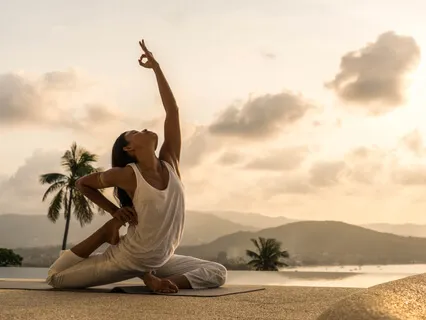
We think of yogis doing back bends and forward folds and sun salutations and the postures.
But actually asana,
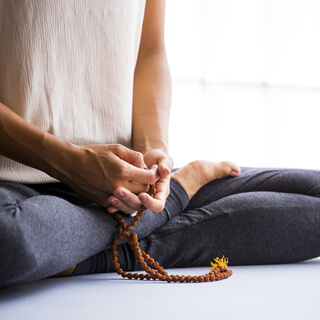
The Sanskrit word for it means seat.
So it's just basically finding,
Being able to find a comfortable seat,
Which will allow you to meditate better.
And in the hatha yoga pradipika,
Which is an ancient hatha yoga text written in the 15th century,
It only actually describes 14 postures or asanas and 11 of which are seated.
So there is an emphasis on the ancient yogic system,
An emphasis on seated poses.
And in the yoga sutra,
In verse 2.
46,
It says,
Tritha sukham asana,
Which means steadiness,
That's the first word,
Sukham,
Which is ease,
And asana is postures.
And this basically means that your yoga poses that you should do should be done with steadiness and ease.
So if you're struggling in a yoga pose that isn't considered yoga.
And at the end of your yoga postures,
You go into what is called shivasana,
And that's where you just lay down and close your eyes.
And this allows a period of decompression because you've done the work of moving your body in a physical way,
And then now you basically surrender and you relax.
And this allows your body to relax after the physical poses and also activates your parasympathetic nervous system,
Lowers your heart rate,
And makes you feel very relaxed at the end.
So if you notice,
The whole theme behind this is that yoga is meant to be,
The postures are meant to be very relaxing,
Focused,
And steady,
And brings about an ease.
So if you contrast this with modern yoga today,
Namely I'm talking about more power-based yoga,
Hot yoga,
Bhikram yoga,
And maybe even some vinyasa classes,
They have it really wrong.
And this is because the yoga poses aren't held long enough to build that steadiness.
And then also,
There are unnecessary movements which make the postures hard on purpose.
So you have a lot of unnecessary planks and push-ups that are kind of incorporated in between the poses.
I've also seen in classes that I've taken that when you're a downward-facing dog,
You bring your knee to your nose,
And then you bring your knee to your elbow,
And then you kind of make it more like a workout.
And this goes against building the steadiness that we talked about earlier.
And also,
Yoga is not an effective form of exercise,
And there's also a lot of studies that show that yoga only burns the same amount of calories as just walking.
So yoga is never intended to be an exercise,
And I don't know why the trend now is to make it more like a workout.
But rather,
Yoga is supposed to just be a practice which will allow you to meditate easier,
Which is why a lot of the poses are seated or supposed to be seated,
And there isn't much moving around.
And one thing that I noticed with the modern types of yoga is that 90% of the poses are standing and only 10% are seated.
I've actually just took a class last week.
I won't tell you what studio,
But it was a,
I think it was a vinyasa class or power class,
And we had 90% of the class which is all standing poses,
And then maybe we did one pose at the end which was a one-seated pose,
And we went to shavasana.
And what was awful was that the shavasana was only one minute.
So essentially you have almost like a workout type of class where it's 90% you're moving and standing poses,
And then maybe just one seated pose,
And then you don't even have a time to decompress because your shavasana of rest is only a minute or 30 seconds.
So at the end of the class,
My heart was actually beating faster than before taking the class.
So this is the examples of why modern yoga is,
You know,
Really,
Just really wrong in the sense and not following the how yoga is supposed to be.
And there are other things I can talk about like how yoga is now focused on very trendy clothes and all that which is the opposite of the ideals we talked about in the previous talks on just being content with what you have,
But that's just another discussion.
So what can we do?
So you can either form a home practice where you incorporate a lot of seated poses and take time to incorporate pranayama which I'm going to discuss in the next talk,
Or you can find a lot of hatha yoga classes.
They are more rare to find nowadays,
But there are a lot of hatha yoga classes out there.
And slow vinyasa classes,
You can take those but just skip the transitions.
A lot of those vinyasa classes will have a lot of chaturangas which will take you out of the steadiness and ease you're trying to build.
So you can just kind of skip it and hold your downward facing dog or hold whatever pose without doing the transition.
And then you can also take yin yoga classes.
This is a relatively modern type of yoga.
And this was based on hatha yoga and also traditional Chinese medicine.
And in yin yoga,
You are holding a pose for anywhere between 3 to 5 minutes.
And you are accomplishing the goal of yoga which is the asanas which are the steadiness that you hold in the pose and then also the ease of the pose.
Because you're holding a pose,
You're very steady,
You're not moving.
And also it's not supposed to be like an intense kind of thing.
So you're also easeful in that sense.
I also like yin yoga because it deals with the energy system and it's more internal.
And now you'll find that once you've mastered the asanas or you're working on the physical body,
You're now able to go into the more subtle realms.
And the next limb up from asanas is pranayama which is the balance or movement of energy or prana in the body.
And that's done through breathing exercises which I'll discuss.
And now you'll find that the practice becomes more subtle because at first,
The first limb was dedicated to how you relate to the outside world.
The second limb was related to your inner observances.
And now the third limb is asanas which is actually the only physical aspect of the limbs.
It's only a mix of one-eighth of the full limbs of yoga.
And now you're starting to go more subtle into energy body and that starts to become more of a subtle journey.
So keep in mind that asana is only one limb of the eight limbs and it tends to be more over-inflated or overemphasized nowadays.
And keep in mind you're only supposed to focus on finding good seat.
And the yoga poses that are designed in these systems were only meant to make sure that you're able to sit for longer periods of time through meditation without your knee kind of aching or your back starts to hurt.
You'll find that when you do yoga the right way you feel really light in your body.
So I hope this helps.