Welcome to the mindfulness meditation podcast presented by the Rubin Museum of Art.
We are a museum in Chelsea,
New York City that connects visitors to the art and ideas of the Himalayas and serves as a space for reflection and personal transformation.
I'm your host,
Dawn Eshelman.
Every Monday we present a meditation session inspired by a different artwork from the Rubin Museum's collection and led by a prominent meditation teacher from the New York area.
This podcast is a recording of our weekly practice currently held virtually.
In the description for each episode,
You will find information about the theme for that week's session,
Including an image of the related artwork.
Our mindfulness meditation podcast is presented in partnership with Sharon Salzberg and teachers from the New York Insight Meditation Center,
The Interdependence Project,
And Parabola Magazine.
And now,
Please enjoy your practice.
Hi,
Everyone.
Welcome to mindfulness meditation online here with the Rubin Museum of Art.
I'm Dawn Eshelman.
It's so nice to be back here with you and to practice together.
This is our weekly mindfulness meditation practice in which we pair an artwork from our collection with a theme that we are exploring together in our practice.
And for those of you who are new to the Rubin,
We're a museum of Himalayan art and ideas here in New York City.
And it's just great to have all of you join for this weekly practice,
Combining Art and Meditation Online.
Today,
As we usually do,
As is our ritual,
We will take inspiration from a work of art from our collection and we'll hear a brief talk from our teacher.
Today we have the fabulous Kate Johnson here with us.
And I'll introduce her later.
Then we'll have a short sit after we have that talk.
15 to 20 minutes guided by Kate.
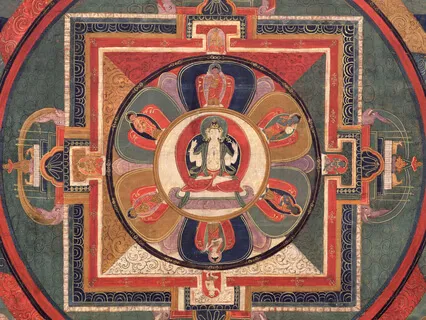
So we'll take a look together at this work of art,
Which we're kicking off a number of weeks here together,
Really focusing on the idea of mandalas.
And mandalas are Buddhist teaching tools,
Really.
They are tools for visualization,
For practice,
For teaching,
For learning.
Then they can be used to navigate very detailed depictions of a universe,
An ideal space.
And they can also be used to visualize one's own transformation.
So learning how to really confront and engage with the self and transform that self.
Mandalas come in many forms.
Most often we see them in this form,
Which is a tanka,
A scroll painting.
But they also come in sculpture form.
And when they are in sculpture form,
We really are able to see that these are actually kind of 3D depictions of palaces.
So what we're looking at here in this tanka is kind of the bird's eye view of a palace,
A footprint.
If you were looking overhead at a palace,
This would be the kind of the layout,
Right?
The four gates that you see,
North,
South,
East,
And west.
The circles and squares that create this architecture.
But most famously,
You might know mandalas in this incarnation of sand,
Right?
And this idea that is often conveyed through that depiction of sand mandalas is a concept of impermanence,
That everything changes.
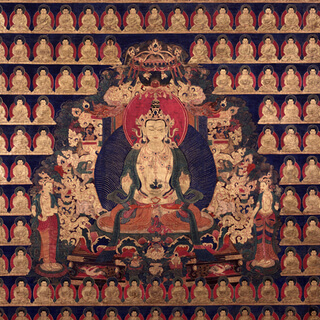
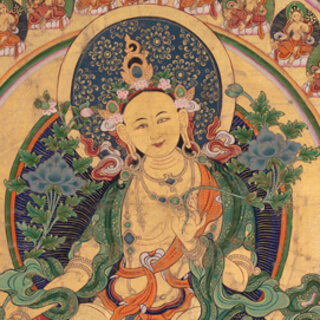
In this mandala that we're looking at today,
This is called the four-armed Avilo Kateshvara.
This is from Tibet,
18th century.
And we have pigments on cloth here.
This is the focal point,
The central point here is Avilo Kateshvara.
Avilo Kateshvara was regarded as a bodhisattva that exemplifies compassion.
So whenever we think about compassion,
We often through the Buddhist lens,
Especially Tibetan Buddhist lens,
Think of Avilo Kateshvara.
So in Vajrayana Buddhism,
There are many forms of Avilo Kateshvara,
Peaceful,
Wrathful,
And sometimes as a meditational deity and regarded completely as a Buddha.
Here we have the peaceful Avilo Kateshvara,
White in color,
Four hands.
And the first pair of his hands are clasped at his heart,
Holding a wishing jewel.
And we can see that he is surrounded on these petals of a lotus by six Buddhas of the six realms.
For now,
I will leave you with this image,
With this concept of Avilo Kateshvara,
This bodhisattva Buddha of compassion at the center of this universe.
I'm just transitioning us here to welcome our teacher,
Kate Johnson,
Who works at the intersections of spiritual practice,
Social action,
And creativity.
She's been practicing Buddhist meditation in the Western Insight or Theravada tradition since her early 20s,
And she's empowered to teach through Spirit Rock Meditation Center.
She holds a BFA in dance from the Alvin Ailey School at Fordham and an MA in performance studies from NYU.
She is a core faculty member of MIT's Presencing Institute and has trained hundreds of leaders and change makers in using social presencing theater,
Which is a mindfulness and dance improvisation methodology used for strategic planning and systems change.
And I'm so excited to share that Kate's book,
Radical Friendship,
Seven Ways to Love Yourself and Find Your People in an Unjust World,
Is now available for purchase.
So you can find more about it on Kate's website.
I know we're about to carry it in the shop as well at the Rubin.
And Kate,
Congratulations and welcome.
Thank you so much,
Dawn.
Hi,
Everyone.
It's really good to be here.
And yeah,
Wow,
What a stunning image.
I was really enjoying looking at the mandala and hearing you talk about it.
And we'll practice a little bit today with the quality of compassion inspired by Avalokitesvara,
The Bodhisattva of compassion,
And with situating ourselves in our own mandala and in the center of our life.
So as Dawn mentioned,
Avalokitesvara is known as the Bodhisattva of compassion.
Bodhisattva is a being who has taken vows to not to transcend the earthly realm,
Right,
But to actually remain connected and in relationship with all beings until all beings are also enlightened.
So it's a vow that has a deep reverence for our inherent interdependence.
And the thing that's awesome about Bodhisattvas is that they love to hear from us.
They love to help us.
It's their whole mission.
So if that resonates with you,
You can think of Avalokitesvara as someone who is both someone we can emulate in terms of how they express compassion and also someone who has compassion for us in the very moment where we're practicing compassion for other beings,
Which we'll do shortly.
One thing I'd love to say about compassion is that in these traditions,
It's said to be an experience that is a quivering or tenderness of the heart that we feel in response to our own or another being suffering.
So it's a really specific kind of experience.
It's a little bit different from empathy or sympathy.
And it needs other qualities to support it in staying in its sweet spot.
Because one of the things about compassion is that we can easily overshoot compassion and end up in another place.
So what I mean by this is that if you think of a fuel gauge or something,
A lever,
That compassion,
When there's too little of it,
We end up in cruelty or indifference.
We can't actually bear to see someone else's suffering or our own.
We shut it away.
And when we do see suffering,
We respond with harshness or cruelty.
Like,
Get that out of my face.
I don't want to see that.
If we have compassion without a certain degree of steadiness and groundedness and equanimity,
We end up kind of overarching and in a realm that we would call pity,
Where we feel so waterlogged and burdened by suffering that we just can't even,
We can't even,
Can't hardly get out of bed.
You know,
It's just,
It's all too much.
So the idea with this kind of compassion is it's a compassion that is both able to open to the suffering that is present and also to remain upright enough to respond.
And a good way to do that is to remain resourced and connected through our sense of our body and our body in space.
So that's a little bit of the sweet spot of compassion that we'll try to access today in the practice.
So in terms of how we'll practice today,
I'll offer a little bit of framing at the beginning of the practice to guide us in.
And then I'll provide some space to allow each of us to gather and collect and unify our attention by attending to what we call an anchor,
Either breath or body sensation.
And towards the end of the practice,
I'll offer a little bit of a visualization that will call upon this structural,
Down to the 3D element of a mandala to help us express compassion in an expansive way.
In my lineage,
We often do this with metapractice.
It's called the extending metapractice,
Meeting loving kindness.
And in that sense,
We cultivate a heart quality and then practice extending it spatially in different directions.
So that's what we'll do with the compassion here,
Which is another heart quality,
Beautiful quality of heart and mind.
And by the way,
A quality of heart and mind that only arises in response to suffering.
So it's hard to say if there's a bright side to suffering,
But if there's a bright side to suffering in this realm,
It's that it provides us with many,
Many opportunities to tap into this boundless divine quality of heart and mind that is compassion,
One that expands our sense of self beyond our individual experience and helps us to connect with every other living being.
Not a bad opportunity at all.
I should say before we begin,
You may hear from time to time my child playing in the background,
But I'll see if I can minimize that the best I can.
So go ahead and find your comfortable meditation position.
You can close your eyes or soften them to the space in front of you.
And if it's accessible for you,
Just take a couple of deep breaths.
Take a moment to bring forward your awareness of your physical body if you can,
Noticing what in your body you can feel right now.
And seeing if it's possible to bring a loving and nonjudgmental awareness to your body as you start to settle in.
You might start with some appreciation for the body,
Which is so innocent in a way and so tirelessly trying to be good and healthy to live.
Having a sense of thank you body for this opportunity to feel.
And then also noticing if there's anything in the body that needs your attention.
Any sore spots or places of ache and pain as we begin trying to bring your awareness there,
Even touch a shoulder that's tight or a knee that's complaining with a sense of I see this suffering,
I cared about this.
May I hold this part of my body with compassion.
And now see if it's possible to find a part of your body that feels neutral or on the pleasant side of neutral.
It could be a familiar anchor that you work with often.
Your breath or another body sensation.
Start to gather your attention there.
Allow it to rest.
For many of us,
The mind is so tired throughout the day,
It actually desperately needs to rest even giving it some time like this is an act of compassion for the mind.
Start to allow the experience of your anchor home base that you've chosen for your attention,
The breath or another body sensation.
Allow your experience of it to really fill up the space of your awareness such that other thoughts and experiences start to fade into the background.
Study relaxed awareness to the simplicity of this present moment experience.
Taking the attitude that you cannot do this wrong.
And every once in a while just open your eyes.
And every once in a while,
Just opening the heart to the weary mind when it wanders and saying,
Come here,
My love,
Rest.
Just this moment of breath,
Just this moment of body sensation.
It's okay to relax in this moment.
It's okay to relax in this moment of body sensation.
It's okay to relax in this moment of body sensation.
It's okay to relax in this moment of body sensation.
It's okay to relax in this moment of body sensation.
It's okay to relax in this moment of body sensation.
And now having gathered and collected the mind to some degree,
Invited it to rest,
Let's Reflect if there's been any few moments of sense of steadiness that you've been able to cultivate,
Sense of groundedness.
And staying connected to that sense as we start to expand our awareness out in different directions.
And again by bringing your awareness to the parts of your body that are closest to the floor,
Closest to the earth.
And imagine that your awareness is streaming down through your body,
Through whatever structures you're living inside of or working inside of,
All the way down into the ground.
And feeling the quality of support that the ground is offering.
And feeling some appreciation for that support.
And also some awareness of the way in which the earth is currently suffering.
And experiencing if you can open your heart and pour your love and your care into the earth below you with respect for the land itself,
With respect for the indigenous people of the land that you're on.
I say,
I see that they're suffering here.
I care about this suffering.
May I hold this suffering with compassion.
I'm just repeating that a few times.
I see this suffering.
I care about this.
May this be held with compassion.
And I say,
I see that they're suffering.
May I hold this suffering with compassion.
May I hold this suffering with compassion.
May I hold this suffering with compassion.
Now bringing your awareness to the back of your body,
Feeling the back of your head and your shoulders,
Your back ribs,
Lower back,
Sending your awareness out through the back of your body into the space behind you and imagining that behind you are beings who literally have your back,
Your ancestors of your family,
Of your spirit,
Of the lineages in which you practice,
And those mentors and imagining that they have placed their hands on your back and are sending love to you in this moment.
And being aware too of a way in which perhaps their lives have not always been easy.
And with love,
Sending some love back to them through your back body.
I care about you.
May I hold your suffering and compassion.
And being aware of the sides of your body now and extending your awareness out like hued awareness antennae out to your sides.
And as you do,
Connecting with the awareness of the beings who you are shoulder to shoulder with in this life.
Friends,
Neighbors,
Colleagues,
Comrades,
And the awareness move out out out to the sides and the great support that is these beings who you're moving through this life with.
And as you send them your love and connection and feel it coming back to you also letting in the truth that sometimes life is hard.
We're not always in control of how the people around us feel.
So,
Sending out to them this wish of compassion.
I see you.
I care about your suffering.
May I hold your suffering and compassion.
Imagine it.
Bring your awareness now to the front of your body.
Imagine yourself in the center of this mandala,
With your heart shining in front of you,
And bringing into your awareness as you do all of those who will be our collective descendants who will look to us as ancestors and mentors and heroes.
Sensing their presence,
Perhaps their concern for the future.
As you open the heart to them,
Sending them care and desire to hold their concern with compassion.
And finally,
Bring your awareness back to your own body in the center of your own mandala,
Feeling yourself surrounded by the beings that you are aware of and love and who love you.
Feeling yourself supported by the earth,
Turning your awareness towards your own heart,
Perhaps a hand on your heart.
And if there's any tenderness in the heart,
Quivering,
Letting that be there,
Holding it gently in your awareness.
This is a sign that the heart is working.
It's a good heart.
So offering this phrase to yourself,
I see you heart.
I care about any way in which you're suffering.
May I hold this heart with compassion.
And then bring the mind and the body as best you can into a relaxed state again,
Letting go of any visualization,
Being with the sense of the body breathing or another physical feeling.
And connecting with the wish that our practice today,
Prepare us to open our hearts to respond with awareness and wisdom.
Whenever we encounter suffering,
Whether within us or anywhere around us.
Okay.
Thank you so much for your practice today.
Thank you,
Kate.
That concludes this week's practice.
If you'd like to support the Rubin and this meditation series,
We invite you to become a member.
If you're looking for more inspiring content,
Please check out our new podcast Awaken,
Hosted by Laurie Anderson.
The 10 part series features personal stories that explore the dynamic path to enlightenment and what it means to wake up.
Now available wherever you listen to podcasts.
Thank you for listening and thank you for practicing with us.