Welcome to the Mindfulness Meditation Podcast presented by the Rubin Museum of Art.
We are a museum in Chelsea,
New York City that connects visitors to the art and ideas of the Himalayas and serves as a space for reflection and personal transformation.
I'm your host,
Tashi Chodron.
Every Thursday we present a meditation session inspired by a different artwork from the Rubin Museum's collection and led by a prominent meditation teacher from the New York area.
This podcast is a recording of our weekly in-person practice.
In the description for each episode,
You will find information about the theme for that week's session,
Including an image of the related artwork.
Our Mindfulness Meditation Podcast is presented in partnership with Sharon Salzberg and teachers from the New York Insight Meditation Center,
The Interdependence Project and Parabola magazine and supported by the Frederick P.
Lenz Foundation for American Buddhism.
And now,
Please enjoy your practice.
Hello,
Good afternoon and Tashi Delek.
Welcome,
Welcome to the Return of Mindfulness Meditation with Rubin Museum of Art.
My name is Tashi Chodron and Himalayan Programs and Communities Ambassador.
I'm so happy to be your host today.
How's everyone doing?
And happy Passover,
Right?
And today is actually a very auspicious day of the second month in Tibetan lunar calendar.
You know,
Each month there is certain auspicious days and on the 15th day is known as the full moon day.
And in fact,
It was full moon yesterday and today.
There is two 15th day in the Tibetan lunar calendar.
And then I also find out today's our Passover and Kimberly and I said we were just talking about how there was Ramadan just started last week and spring.
So there's so much to celebrate.
So we are a museum of Himalayan art and ideas in New York City.
And we're so glad to have all of you join us for this weekly program where we combine art and meditation.
Inspired from a collection,
We will hear a brief talk from our teacher.
And we're so happy to have Kimberly Brown back in person again.
And we will hear a brief talk from our teacher,
Of course,
And then we will have a short sit for 15 to 20 minutes for the meditation guided by our teacher.
And so let's look at today's theme and artwork.
And as this is the beginning of this month,
Our theme is Life After.
And it is tying to the newest exhibition called Death is Not the End.
It is a cross-culture exhibition that explores notion of death and afterlife through the art of Tibetan Buddhism and Christianity.
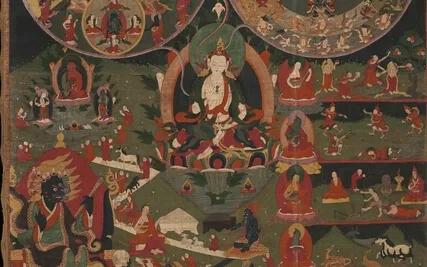
The art for today is this beautiful Thangka painting.
As you see here,
It's called Shuto,
Peaceful and Wrathful Deities of the Pardo.
So the word pardo means intermediate stage,
In between.
It's original from Tibet and dated about later 18th to early 19th century.
The mineral pigment on cloth,
This is a Thangka painting.
And the dimension,
The image size is about 33 and a half into 21,
A rough estimate.
This is on the sixth floor.
And the connection for the theme is the image depicts the mind's experience between death and rebirth.
So what you're looking here,
It's Tibetan Buddhist traditions maintain that if we are trained to recognize the true nature of our subtle consciousness at the moment of death,
We could attain awakening.
So this image depicts the mind's experience between death and rebirth,
The pardo as described in the text,
Pardo terdrel,
The liberation upon hearing,
In the intermediate state and imagined by an artist.
So first the clear light appearance as peaceful deities who encourage the mind to become aware and free when negative karma triggers frightful visions,
Recognizing their nature can help avoid rebirth in the lower realms,
If not reach enlightenment.
This painting shows all possible outcomes.
This is called Dawa Shuto Rabjam in Tibetan word.
And what you're looking at here is,
As I mentioned,
The peaceful and the wrathful deities.
So there are 42 peaceful deities.
There's two big circles you see.
The one or two hour left on the top is the peace,
42 peaceful deities.
And then to our right is the 58 fierce wrathful deities.
So together is known as the 100 peaceful and wrathful deities.
Then in the middle,
You see the white figure that is the Dorje Sempa,
The Vajrasattva,
Where a practitioner can visualize oneself as the deities.
And then during the 49 days after a person dies,
And once we leave the body and the consciousness goes through different stages.
And if you recognize these figures as enlightened deities,
Then you would have better rebirth and you will not go to lower realms.
So what you're seeing on this side,
These are the six different realms,
The god realm,
Demigod,
Human realm that we are all in,
And then the animal realm and the hell realm.
In each realm,
There is a Buddha figure who can actually help liberate as well.
And on this side is the three deities,
The Amitabha,
And then the Vajrapani and Avalokiteshvara.
So this is the pure realm.
So if a deceased person has good action and good karma,
Then you go to pure realm.
This figure that is very fierce looking is the Yama,
The Lord of the Death,
Who's holding the scale of your good karma and bad karma.
And based on that,
We will be returning in one of these realms.
And now let's bring on our teacher for today.
Our teacher is Kimberly Brown.
Kimberly Brown is a meditation teacher and author.
She leads classes and retreats that emphasize the power of compassion and kindness meditation to reconnect us to ourselves and others.
Her teachings provide an approachable pathway to personal and collective well-being through effective and modern techniques based on traditional practices.
She studies in both the Tibetan and Insight Schools of Buddhism and is a certified mindfulness instructor.
Her latest book,
Navigating Grief and Loss,
Kimberly Brown,
Thank you so much for being here.
Please help me in welcoming Kimberly.
Hi,
Everybody.
Thank you for being here.
I was talking with Tashi Chodron before you all arrived.
And it's important to remember that these artworks and these practices and the tradition of Buddhism,
It's not just a cultural artifact.
You know,
It might feel that way because modern people don't kind of see things in so much in mystical ways anymore.
But it's still a useful tool to see the truth,
To see the truth of all of our lives.
And each one of us,
Everyone here,
Are going to go through changes in life.
And that is what this bardo is talking about,
The in-between,
The in-between life and death,
Death and rebirth.
And you can see that as,
You know,
Your human lifespan,
But you can also see this just every day and throughout your life.
You were childless and then you had children.
You were married and then you divorced.
You had this job and that job changed.
You can see all these transitional times.
And in a certain way,
We're always in this transition.
Everything's always changing.
The weather's different moment to moment.
Our mind is different moment to moment.
So for a modern person,
And I think most of us have a sense that we can control a lot more than we can.
Okay.
We see this,
I see this in myself.
I'll be so mad it's raining outside.
It's no,
That's up to me.
It's nothing to do with me.
Right.
And we really suffer in these moments when we think we can change things that we can make the impermanent permanent.
And so one thing that these practices of Buddhism really help us see is that each one of us will grow older.
Each one of us will get sick and have illness.
Each one of us will die.
Each one of us will lose everything that we love.
This is the nature of being human.
And sometimes people hear this and they think,
Oh no,
I don't want to hear that.
It's terrible.
It's bad news.
You know,
But it's not good or bad news.
It's reality.
And if you will,
The good news is that all of us can orient our speech,
Our thoughts,
And our actions in ways that are meaningful.
That we all have that choice,
That we can ground ourselves in this.
And whether you believe in heaven or rebirth or nothing,
The truth is that each one of our actions,
The outcomes of those actions will survive us.
So we all have choices of how we want to contribute to the world and how that will affect others even after we die.
And it might,
It's hard to see in your own life how might that manifest,
But you can all think of the countless people that are dead and have affected your life,
Both very,
You know,
Personally,
The architects of this building.
I don't know,
I doubt they're alive.
This building was built some time ago,
Right?
And yet here we are.
The outcomes of their actions survived them.
So we do get a choice.
We get a choice on how we can orient our mind.
And one way that we can orient our mind,
Train our mind is through meditative practices.
Okay?
This develops skills of mindfulness so we can see clearly what's happening and how to respond appropriately.
We can also develop a compassionate heart because this truth that I mentioned,
That everybody's going to get sick,
Everybody's growing older,
Everybody's going to die and lose things,
That's very painful.
And all of us will encounter it.
So to really recognize that is to have the spark of the great brave heart.
It's what the early texts call the Buddha.
This great brave heart of compassion,
This ability for us to not look away in our suffering,
In others' suffering,
But to be able to find this commonality and this connection in what we share,
Right?
This difficulty,
This loss.
And we also can share in joys,
Okay?
That balances out what seems to be for many of us very frightening,
But that there are also joys in life and we can develop appreciation for this precious birth that we have.
So let's practice a little bit.
I'd like all of you to go ahead and just close your eyes,
Okay?
And this is a bardo state between meditating and not meditating,
Right?
Noticing what was this shift?
What happened in here between watching me talk and closing your eyes?
What's happening now?
Allowing yourself to notice your senses.
There's light entering through your eyelids.
There's smell and there's taste.
Sound is entering your ears.
You're having all of your personal body sensations,
Places of warmth,
Of coolness,
Of heaviness,
Places free from stress,
Tense places.
And of course,
You're all breathing.
So taking just a minute here to not do anything,
To just experience what it is to be alive right now and just checking in,
Where is your attention right now?
Maybe you drifted off into a plan or what you're having for lunch or conversation.
It's okay,
Gently choosing to bring your attention back to your senses,
Your breath,
The light entering through your eyelids,
Smell,
Taste,
The sounds entering your ears.
And I'd like you to take a moment to connect with someone you know who might be struggling right now.
You could imagine them as you know them.
You could put your hand on your heart and just feel their presence.
And I'd like you to give them these three phrases of wisdom.
May you be gentle with yourself.
May you be at peace with what you can't control.
May you be gentle with yourself.
May you be at peace with what you can't control.
May you be gentle with yourself.
May you be at peace with what you can't control.
And I'd like you to continue repeating these phrases silently,
Like you're giving a gift to this being.
Just checking in with yourself,
Where is your attention?
If you've strayed from this connection with this loved one,
That's okay.
You can always begin again,
Reconnect.
May you be gentle with yourself.
May you be at peace with what you can't control.
And just for another minute,
Repeating these phrases to this person.
May you be gentle with yourself.
May you be at peace with what you can't control.
You can let go of this connection with this loved one,
This friend.
Noticing your breath,
Allowing sound to enter your ears.
And now making a connection with yourself.
Again,
You could put your hand on your heart and just feel your presence.
You could imagine you're looking in the mirror and give yourself the same wisdom.
May I be gentle with myself.
May I be at peace with what I can't control.
May I be gentle with myself.
May I be at peace with what I can't control.
May I be gentle with myself.
May I be at peace with what I can't control.
And just for a couple of minutes here,
Silently giving this gift to yourself,
Repeating these phrases.
May I be gentle with myself.
May I be at peace with what I can't control.
You could keep this connection with you as you include that first struggling person or being.
And including everyone in this room,
Everyone who's here with us and everyone who works at the Rubin who makes it possible for us to be together.
May we be gentle with ourselves.
May we be at peace with what we can't control,
Including the people that you're in conflict with that you don't like,
That you find frustrating.
May we be gentle with ourselves.
May we be at peace with what we can't control.
And finally,
Taking a moment to include all of us,
All the beings on the earth,
All the humans we'll never meet,
Different ethnicities and languages and cultures and ages,
All of the flying creatures and the creatures in the water,
All of the non-human beings.
May we be gentle with ourselves.
May we be at peace with what we can't control.
And you can let go of this technique.
Allow yourself just to rest here for a few seconds.
Not meditating,
Not not meditating.
And as we transition from this meditative moment back to our interaction,
Just noticing this transition,
Noticing what's arising,
Taking your time as you open your eyes,
As you move,
As you stretch,
Thanking yourself for your practice.
I thank you.
Thank you.
Thank you for that beautiful session,
Kimerly.
That concludes this week's practice.
To support the Rubin and this meditation series,
We invite you to become a member at rubinmuseum.
Org slash membership.
If you are looking for more inspiring content,
Please check out our other podcast,
Awaken,
Which uses art to explore the dynamic paths to enlightenment and what it means to wake up.
Season two,
Hosted by Raveena Arora,
Is out now and explores the transformative power of emotions using a mandala as a guide.
Available wherever you listen to podcasts.
And to stay up to date with the Rubin Museum's virtual and in-person offerings,
Sign up for a monthly newsletter at rubinmuseum.
Org slash e-news.
I am Tashi Chodron.
Thank you so much for listening.
Have a mindful day.