Welcome to the Mindfulness Meditation Podcast presented by the Rubin Museum of Art.
We are a museum in Chelsea,
New York City,
That connects visitors to the art and ideas of the Himalayas and serves as a space for reflection and personal transformation.
I'm your host,
Dawn Eshelman.
Every Monday we present a meditation session inspired by a different artwork from the Rubin Museum's collection and led by a prominent meditation teacher from the New York area.
This podcast is a recording of our weekly practice,
Currently held virtually.
In the description for each episode,
You will find information about the theme for that week's session,
Including an image of the related artwork.
Our Mindfulness Meditation Podcast is presented in partnership with Sharon Salzberg and teachers from the New York Insight Meditation Center,
The Interdependence Project and Parabola Magazine.
And now,
Please enjoy your practice.
Hi everyone,
Welcome.
Welcome to the Rubin Museum of Art and our weekly mindfulness meditation practice where we combine art and meditation online here with you.
My name is Dawn Eshelman.
I'm so happy to be your host today.
And we are a museum of Himalayan art and ideas in New York City,
For those of you who are new to us,
And really happy to have you all joining us today.
We're going to look at a work of art together from our collection.
We'll hear a brief talk from our teacher today,
The wonderful Rebecca Lee,
And then we'll have a short sit together,
15 to 20 minutes of meditation guided by Rebecca.
So happy Asian American Pacific Islanders Month and Mother's Day and springtime.
We are taking inspiration from an exhibition that is somewhat new at the Rubin Museum of Art.
It's called Healing Practices,
And it really is a special one.
It helps us see through the voices and the lives of local Himalayan Americans,
How weaving traditions combine with contemporary lives.
And this exhibition was developed with an advisory group,
An emergency room nurse,
A Tibetan doctor,
Social justice advocate,
Artists.
And really what the exhibition shows us is that healing means so many different things to different people.
And really,
As we kind of explored some of the different themes here,
We wanted to talk about kind of the big purpose or the next step beyond just feeling better or healing from something is kind of for what purpose.
And so this month,
We're really calling in this idea of harmony,
Of balance.
Tibetan medicine,
We know,
Speaks so much about bodies in balance and having all of our elements in the earth around us,
The different elements of our health and healing balanced.
So today we'll look at one of those elements.
Let's take a look at today's artwork.
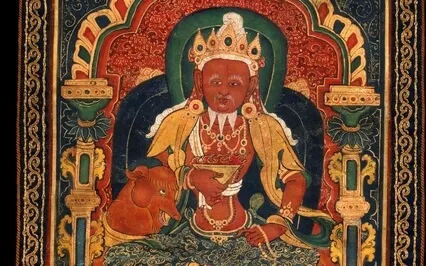
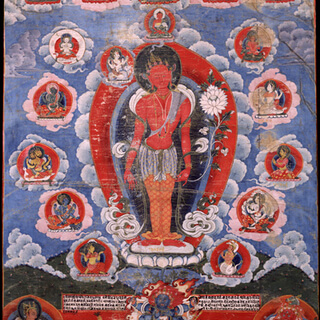
So this is Agni,
The god of fire.
And this artwork is part tapestry,
Part painting,
Tangka.
And it was made in China during the Ming dynasty.
And we can get even more specific and say that it was made during the first half of the 15th century.
And so this is pigments on cloth and surrounded kind of top and tail here by this embroidered textile.
And I'll zoom in a little bit here so we can see just the main figure himself,
Agni.
And then also we'll take a look at the bottom here.
This is the tapestry.
And then I'll zoom out and we'll talk a little bit more about this in general.
So Agni is the god of fire.
And so fire is just one of the elements that Tibetan medicine practitioners and others take into account when they're talking about balance,
Creating balance in the ecosystem of a human being and also more generally.
And so if we kind of back out from that and think a little bit more abstractly about that,
We can think about what kind of balance we want to bring into our meditation practice or what balance we really gain from that.
And how about this element of fire and how does it speak to us in our practice is a question I'll pose to you.
So this banner specifically is part of a set of works that is dedicated and illustrates the various deities found in the mandala of the Medicine Buddha.
So really pulling out each of those deities that is in relationship to the Medicine Buddha and examining them in detail.
And so Agni is the ancient Indian god of fire in Tibetan Buddhism.
He's also the guardian of the Southeast.
And this painting,
I'll zoom in a little bit more here on the center portion,
Was executed in the same Tibetan style as that that we see in China's early Ming Dynasty court and uses this fine gold detailing in the deity's red throne back.
So you can see there's some fine gold detailing right here.
And then we have auspicious symbols above and below here in this tapestry.
So we'll leave it there for now and ask you to contemplate this idea of balance of harm and harmony and also this element of fire.
And we'll hear also from our wonderful teacher today,
Dr.
Rebecca Lee.
Welcome.
She is a Dharma heir in the lineage of Chen Master Sheng Yen,
Is the founder and guiding teacher of Chan Dharma's community.
She started practicing with Master Sheng Yen in the 1990s and served as his translator until his passing in 2009.
She later trained with and received full Dharma transition from one of his Dharma heirs,
Dr.
Simon Child,
In 2016.
She teaches meditation and Dharma classes,
Gives lectures,
Leads retreats.
And you can find all of her talks and writing at RebeccaLee.
Org.
She is also a sociology professor at the College of New Jersey,
Where she serves as a faculty director of the Allen Dolly Center for the Study of Social Justice.
And she has a beautiful new book championed by her students called Allow Joy Into Our Hearts,
Chan Practice in Uncertain Times.
Please give a warm welcome to Rebecca Lee.
So lovely to join everyone here.
Welcome.
Thank you so much,
Dawn,
For the wonderful introduction.
And I learned so much about this beautiful artwork that we have today.
So I hope everyone will get to enjoy some more later.
I really love having this opportunity to reflect on the theme of this month,
The theme of harmony.
And as Dawn has been talking about,
Indeed,
Is very much about what we are cultivating in the meditation practice.
Because in Chan meditation practice,
It is about allowing the body and mind to be at ease,
To be in harmony with our surroundings.
Wherever we are,
Whoever we are with,
Whatever we are doing together,
Co-creating the space together.
So first of all,
We need to take a moment to think about our idea of harmony.
Sometimes we may have this notion that harmony is where maybe nothing's happening,
That everything is going as we planned.
And that is not what harmony is.
So it's not that nothing's happening or everyone agrees with each other,
Everyone has the same idea,
That everything's going as planned,
And everything's wonderful.
That's not what harmony necessarily means.
When we think about harmony,
We can think about really how we are cultivating in a way that allows us to harmonize.
Harmonize with the body and mind,
Harmonize with whatever situation we're in.
Meaning allowing everyone,
Everything to be as is.
We're fully present with all as is,
While being fully engaged.
Now when we really think about it,
We might realize that we usually are not harmonizing with ourselves and our surroundings.
We're usually not living in harmony.
So for example,
We can think about what happens when we do meditation.
When we are meditating,
We may notice thoughts arising,
And we may think that this is not supposed to be happening.
I'm meditating,
Hoping that I would sit here with this very calm mind,
With no thoughts,
And now there's this thought here,
Bothering me,
Or even disturbing me.
And so we start to get frustrated.
We hate these thoughts.
And when this happens,
Then we are maybe trying to get rid of the thoughts.
And we may do the same thing when we encounter physical discomfort in meditation.
Maybe we notice some soreness in our lower back,
Or maybe I heard in New York,
It's a humid day,
So some humidity,
And we notice that,
And we don't like it,
And we try to get rid of it.
And what happens is,
With this habit of becoming averse to something that we find disagreeable,
Then we agitate the mind by trying to get rid of them.
So in this way,
We are not in harmony with our body and mind.
Every moment we are not in harmony with our body and mind,
We are generating suffering.
We're generating unnecessary suffering.
So for example,
There are thoughts,
There's no problem,
There are thoughts in meditation that's part of being a human being with our mind,
And there are some physical sensations that we find uncomfortable,
That's part of having a body,
And we live in this environment,
Maybe there are changes in temperature and humidity,
That's not a problem.
It's part of causes and conditions of every moment.
We can turn it into suffering by giving rise to aversion,
To agitating the mind.
So when we give rise to suffering,
Generate suffering unnecessarily,
That's not wisdom,
And that is also not compassion for ourselves,
Because we are causing unnecessary suffering to ourselves.
And this reminds me of the story a Dharma student of mine shared with me recently.
He was telling the story how he had a fairly serious migraine for a week recently,
And so because he's been practicing in the Dharma course I offer,
So this time he said instead of doing what he usually does,
Which is to wage war against the migraine,
Like trying to find out what caused it,
And trying to get rid of the migraine,
And getting frustrated and agitated and tense,
Which can worsen the migraine.
What he did this time is to allow it to be as it is.
Now it does not mean that he didn't do anything,
And just be like passive about it.
He identified some things that he could do to make the body a little bit more comfortable,
Doing some gentle massage around his neck area,
That helped with alleviating some of the discomfort,
But that did not mean that the migraine is gone.
Yet,
Because of this mindset that he allowed the migraine,
Allowed himself to coexist with the migraine,
Well,
He was able to work as usual without much difficulty while the migraine is there in the background.
What happened is he didn't allow the migraine to take over and completely define his experience,
And as a result,
He was able to be with the migraine.
Yes,
He could feel the pain,
But there is no suffering.
And so what it is,
Is that he was allowing the body and mind to be at ease,
To be in harmony,
Despite this challenging situation of having the migraine.
So this is what we can do in our practice,
Also in meditation.
I just talked about an example of working with physical challenges.
We can also practice with allowing difficult thoughts or emotions to be as they are.
Maybe in our daily life,
Or in meditation,
Sometimes when we notice some thoughts that we have tried not to allow into our mind,
But they are there.
We probably have been trying to fight against them,
Get rid of them,
Block them out,
Not allow them to be there many times.
And what it is,
Is that we are perpetuating the habit of aversion by hating this present moment,
Which is this thought is here,
It's part of the present moment.
And so,
Instead of perpetuating the habit of hating,
Aversion,
Which agitates the mind,
Which causes suffering,
We can practice remembering the teachings of Dependent Co-Arising.
Remembering that every moment is coming together of causes and conditions.
Recognizing that,
Yeah,
There are these thoughts,
And maybe we feel kind of uncomfortable.
And remembering that,
Well,
These thoughts are coming together of all kinds of conditions.
Maybe bodily,
Maybe we didn't sleep well,
Maybe we did not eat well.
Maybe the weather that we are reacting to,
Maybe it's an allergy in the air,
Maybe some information,
Maybe from news,
Or messages we've been reading.
All these kind of come together,
And bring about these thoughts.
And also,
The habit of being feeling agitated,
Conditioned by past moments in our life,
How we've been using our mind,
Allowing,
Perpetuating the habit of aversion,
Perhaps.
So when we recognize that this moment of thought and emotion,
This way,
We'll notice,
Ah,
Okay,
These thoughts,
We're not dismissing them,
But by its nature,
Is that it's really no different from the bubbles on the surface of a river or ocean,
That are the manifestation of the coming together of current and movement of wind,
And then they come together,
And there's no need to turn them into our enemies and try to fight against them,
Because these bubbles will be here for a little moment,
And then they will be gone.
Like these thoughts,
However powerful and disturbing they might be,
They come through,
And then they will be gone.
Now,
Here we're not talking about,
Oh,
These thoughts,
Let them go,
I don't need to pay any attention to it.
It's just that there's no need for us to wage war against them.
And that way,
We can harmonize with our body and mind.
Yet at the same time,
We allow them to be fully felt and seen and heard.
So it's like a little child coming to us to tell us what's been bothering her.
We are fully present and listen to her telling us,
This one thing that's bothering her,
And then she feels hurt and loved,
And then the pain is released.
And similarly,
When these thoughts arise,
That's maybe quite painful thoughts,
Allow them to be fully felt,
And then that moment is released.
It's charged.
And so as we practice this way,
Whatever is happening in the body and mind,
We can live in harmony with the present moment as it is.
Then when we encounter perhaps challenging situations,
Or maybe people who have very different worldview,
Very different ideas about how to do various things,
We can be fully present with them.
And appreciate their full humanity.
That seeing that they are from very different backgrounds,
With very different experiences,
That their views are coming together of causes and conditions.
Just like our views,
Our beliefs are coming together of the causes and conditions of our own background and experience.
In this way,
We can harmonize with them and enjoy this moment,
This miracle of the moment that we can share together.
And perhaps learn from someone with very different experience and perspective,
Which will allow us to spot our biases,
Or maybe what we've been omitting in our life,
And in this way,
Enrich our own life.
So let's practice together this meditation that allows us to harmonize with our body and mind,
With everything in the present moment.
So I'm going to invite you to set up that posture in a comfortable position.
And I take you through a guided meditation.
Feel the relaxation.
At the top of the head,
Directly experience the subtle sensations.
As we allow,
Allow the tension to melt away.
And feel the relaxation spread to the forehead.
Check to see if we're holding tension in this area by habit.
Maybe from wearing.
And allow,
Allow the tension to melt away.
And feel the relaxation spread to the eyeballs and eye muscles.
Directly experience the subtle sensations of these muscles softening.
As we allow,
Allow the tension to melt away.
And feel the relaxation spread to the facial muscles.
Check to see if we are holding tension in some part of the face by habit.
Maybe in the jaw,
Or near the ears.
And allow,
Allow the tension to melt away.
And feel the relaxation spread to the entire head.
And feel the relaxation spread down to the neck muscles and shoulder muscles.
Directly experience the subtle sensations of these muscles softening.
Like melting butter.
As we allow,
Allow the tension to melt away.
And feel the relaxation spread down the arms into the forearms.
And all the way down to the fingertips.
And feel the relaxation spread to the chest area.
Check to see if we're holding tension in this area by habit.
Maybe from anxiety,
Sadness,
Grief,
Fear.
Right here,
Right now,
We can give them a rest.
And allow,
Allow the tension to melt away.
And feel the relaxation spread down the torso.
All the way down to the lower abdomen.
Trust that the skeletal structure can hold up the body.
And these muscles do not need to work so hard.
We can give them a vacation.
And allow,
Allow the tension to melt away.
And feel the relaxation spread to the upper back.
Directly experience the subtle sensations of these muscles softening.
As we allow,
Allow the tension to melt away.
And feel the relaxation spread down the back to the lower back.
And all the way down to the buttocks where we feel the sensations of the body on the chair.
And feel the relaxation spread down to the thigh muscles.
And down the legs,
And all the way down to the toes.
And feel the relaxation spread to the entire body.
Sitting right here,
Right now,
Not a moment,
With this wakeful,
Clear mind.
And we notice the subtle changing sensations of the body breathing.
We can rest our attention gently on the subtle changing sensations as the body breathes.
Moment after moment,
Allowing the body to breathe on its own.
The body knows how to breathe.
It's been doing so since the moment we were born.
All we need to do is to be right here,
Enjoying the body breathing,
Moment after moment.
And when we notice the mind drifting off,
Losing contact with the direct experience of the subtle sensations of the body breathing,
Not a problem.
Use that as an opportunity to practice remembering to come back.
To reconnect with the direct experience of the subtle changing sensations of the body breathing.
It doesn't matter how often or how long the mind drifts off.
As long as we eventually find our way back,
We are practicing well.
And when we notice thoughts coming through,
Allow them,
Allow them through.
They're already part of the present moment.
Trying to block them out,
Chasing them away,
Only agitates the mind more.
And allow them to be fully felt and seen and heard.
And when they are ready to move on,
Allow them to move on.
There's no need to talk back against them,
Try to change them,
Moment after moment.
Allow whatever comes through the mind to be as they are and fully experienced.
Maintain this clear awareness as we transition from stillness to motion.
As we open our eyes,
Move our fingers and palms.
Maintain this clear awareness of changing sensations as the body begins to move.
Thank you,
Rebecca.
That concludes this week's practice.
If you'd like to support the Rubin and this meditation series,
We invite you to become a member.
If you're looking for more inspiring content,
Please check out our new podcast,
Awaken,
Hosted by Laurie Anderson.
The 10-part series features personal stories that explore the dynamic path to enlightenment and what it means to wake up.
Now available wherever you listen to podcasts.
Thank you for listening and thank you for practicing with us.