Welcome to the mindfulness meditation podcast.
I'm your host,
Dawn Eshelman.
Every Wednesday at the Rubin Museum of Art in Chelsea,
We present a meditation session led by a prominent meditation teacher from the New York area.
This podcast is a recording of our weekly practice.
If you would like to join us in person,
Please visit our website at rubinmuseum.
Org slash meditation.
We are proud to be partnering with Sharon Salzberg and the teachers from the Interdependence Project and the New York Insight Meditation Center.
In the description for each episode,
You will find information about the theme for that week's session,
Including an image of a related artwork chosen from the Rubin Museum's permanent collection.
And now,
Please enjoy your practice.
Hi,
Everyone.
We're talking about being whole this month.
And so I hope you made it here in one piece.
It looks like you did.
And believe it or not,
Next time we see each other,
If you're here next week,
It will officially be spring.
Just take that in for a moment.
Might help you on the track home.
So as I mentioned,
We're talking about being whole this month.
And we're using the visual element of the fractal to symbolize that.
And when we see fractals in nature,
We often will see them in a snowflake or frozen water or we'll see them in plant life like the fern frond or we'll see them even along the shape of a coastline.
And a fractal is a repeating pattern that builds in terms of its size.
And you can see in the most minute detail of a fern frond,
The same exact shape that you see in the actual fern itself.
And this reminds us of the relationship between the whole and the part.
And as a metaphor for us this month in terms of the Buddhist teachings and what we can find even if we sit with just one teaching in particular and how fruitful and deep an experience that can be in and of itself.
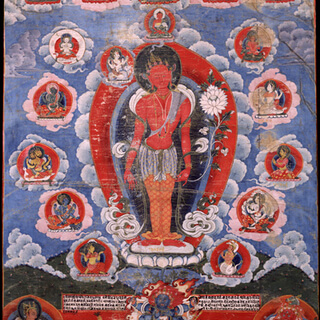
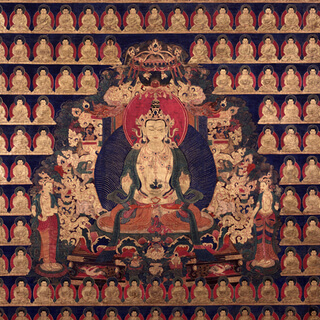
Today we are looking at a mandala.
And mandalas typically are a kind of maybe not exactly an exact representation of a fractal,
But they certainly evoke that experience of looking at a small detail and seeing that resonate throughout the rest of the image.
And certainly the shape of a mandala is repeated in that same way.
So we have the center core and then kind of circles and squares around one another concentrically until they reach the outside.
And a mandala is from one perspective thought to be a kind of palace that you enter really through your mind,
Not necessarily a physical place,
But a place that you that a practitioner might go specifically for meditation.
So it's interesting to consider today in this setting,
Though we're coming at this from a different way.
But the mandala is in fact this one that we're looking at today includes four different mandalas within one.
So you see that these four are distinct from one another.
And the experience of the practitioner would be to picture themselves inside this kind of layout of a palace.
So what you're seeing here is sort of like the bird's eye view of four palaces that make up one.
And so you can see the doors,
The four doors,
Four directions,
The four gates that you can enter through and work your way towards the center.
And at the center of each mandala is the sort of most divine being or the most divine physical location there.
And that's true for each of these four segments here,
As well as the overall mandala.
If you look at the very center of what we're seeing here,
There is the red Buddha Amitayas in the middle there.
And this is the four mandalas of the Vajravali cycle.
And at the center of each one is a different representation.
So we have clockwise from the bottom left,
We have Vajrapani.
And then above that,
Vajradhatu.
And then Shakyasima or Shakyamuni Buddha,
The historical Buddha,
Some refer to this figure as.
And then lastly,
On the bottom right,
Marichi.
So Sharon Salzberg is here with us almost for the whole month.
So great.
And she's talking with us about this idea of being whole and this metaphor that we're looking really quite deeply into this month.
Of course,
Many of you know Sharon by now.
Anybody new here today?
I'm just curious.
Oh,
Good.
Great.
Welcome.
So Sharon is the co-founder of the Insight Meditation Society of Berry,
Massachusetts.
She has been studying and teaching for many years and is the author of really wonderful books.
If you want to,
If you're new to this and you want to take your practice to another level and you want a great book to help you do that,
Sharon's books are excellent for practitioners experienced and brand new.
So please welcome her,
Sharon Salzberg.
So beautiful,
Isn't it?
I love looking at that.
Hello.
Snow.
I was supposed to go to Massachusetts on Sunday and back here yesterday.
So everything switched.
I didn't make it to Massachusetts at all.
And I had one of those days,
Many of you probably did as well yesterday,
Where I didn't leave my apartment.
It was quite interesting.
Snow.
So next week is spring.
Maybe we'll talk about renewal next week.
So I was thinking and also looking at that very beautiful piece of art that often when one thinks of a fractal,
What we think of as repetition,
Right?
And repetition is a very interesting notion because the aliveness of something that's repetitive depends on the degree of our presence,
Of our observation,
Of our interest.
Because mostly we tune out,
We rely on some kind of novelty in order to feel alive,
In order to really feel captured by something.
Rather than looking at the quality,
The degree of our awareness,
The quality of our awareness really to see what makes this an experience of connection and fulfillment or one of just kind of skipping over or waiting or boredom or whatever it might be.
So I also thought of this time in 1984 when I co-founded,
As you know,
A retreat center in Massachusetts,
The Insight Meditation Society in this little town called Barry.
And in 1984,
We invited a Burmese meditation master named Sayada Upandita to come visit and lead a three-month retreat.
And we'd never met him before,
But we heard he was a very great teacher,
So we invited him.
And I sat that retreat,
As did many of my friends,
And he was a really tremendous,
A great,
Great teacher.
He also turned out to be really kind of intense and demanding and fierce,
Even ferocious,
You know?
And it was like every once in a while I'd look at him and think,
What did we do?
You know,
Although he and I had a really great relationship.
And we were seeing him six days a week for each of us individually for just these short meetings where we were supposed to describe our practice,
And he would get some feedback.
He would give us some feedback about that description.
So I began my meditation practice actually in January of 1971.
So it had been almost 14 years by the time he appeared.
And I hadn't worked with a teacher for a few years at that point.
And in addition to Sayada Upandita being kind of intense,
He also had a teaching style which involved a lot of repetition,
Both in his discourses.
Sometimes it would be like night after night after night after night.
Like,
Really?
Same topic,
You know?
And also in those meetings,
He would just get on a thing.
And it would last for who knows how long,
Usually,
Until something shifted inside of you.
And then he'd go on to some other thing.
But we got into a thing very quickly where I would go in and I would describe something,
Maybe something beautiful and peaceful and delightful happening in my meditation practice.
And he would look at me and he would say,
Well,
In the beginning it can be like that.
And I'd think,
I'm not a beginner.
I've been practicing for almost 14 years,
But there's nothing to say.
So that was it.
That's the only thing he said was,
In the beginning it could be like that.
Maybe I'd come in the next day and I'd describe something very challenging and difficult that I was grappling with my practice.
And he would say,
Well,
In the beginning it could be like that.
I think I'm not a beginner.
And then day after day after day after day,
Whatever I described,
He had one answer.
Well,
In the beginning it could be like that.
I even left his room at one point in some frustration thinking,
I wonder how come everyone said he was such a great teacher?
He never says anything.
All he ever says is,
Well,
In the beginning it can be like that.
I'm not a beginner.
And at one point I felt like there was a giant neon 14 in my brain flashing out.
I'm not a beginner.
I'm practicing for 14 years.
And then one day something did shift inside of me.
And I thought,
Oh,
That's not an insult.
Remember like beginner's minds.
And it's supposedly good to be a beginner,
To feel like a beginner.
That when we're at the beginning of something,
We are open and interested.
And we're not so jaded and not so caught up in expectations,
Which I frankly was at that point.
Like,
Oh,
Yeah,
I know what comes next.
Or,
Oh,
Yeah.
I just have to get through this.
And then there's that.
Or,
You know,
Or,
Oh,
I've seen this before.
Or whatever it is.
And I was a long way from the days when every single breath was different,
Even though it was just the breath.
And I was like,
I got it.
And I thought,
Oh,
It's good to be a beginner.
That's actually what you want.
It's not the state that you awkwardly start out with and circumvent as soon as you can.
You know?
That's actually a good thing.
So of course,
The day I got it was the day he stopped saying it.
And he went on to something else.
But I think we can be so much that way in terms of meditation practice.
For one thing,
There are methods.
There's guidance.
There are tools.
And it's easy to think,
Oh,
I started with that.
Why is that still here?
You know,
Like,
That's like 101.
I should be way,
Way beyond that now.
101.
And it's confounding to us that in a lot of ways,
The instruction never changes.
We change.
And our understanding changes.
And our experience changes.
And our ability to let go changes.
And our interest in what's happening,
Even if it's not like flamboyant and dramatic,
It changes.
Our ability to be with adversity changes.
Our compassion changes.
But it's still often,
Like sit down and feel your breath,
Really.
We used to joke,
My colleagues and I,
That this was like the easiest thing in the world to teach on a certain level.
I mean,
Not like upadita level.
Because he got it in me.
It was like amazing.
He just picked that up,
That sort of jadedness or half-heartedness.
And would I have gotten it myself?
Eventually,
I actually do believe that,
Because I really believe in the integrity of one's practice and that these things do get revealed to us.
But he got it a little sooner,
I think,
Than I got it.
And he really made sure I understood it.
But apart from that,
We used to joke,
Yeah,
You only ever say one thing.
Be aware of it.
Or could you be mindful of it?
It's not a lot to learn in terms of the scope of your instruction.
But it's not that easy to do.
And it's not that easy to be that simple,
For one thing.
And to do the same thing again and again with that kind of actual intensity,
Presence,
Whole-heartedness.
I do look back in those days when I first began,
Which is now 45 years ago or more,
My meditation,
I think,
It felt like a miracle to be aware of a breath.
It was like such a big thing.
Like,
Wow.
And so amazing.
And something you'd talk about,
Like I felt little tingles or whatever.
And I think,
Oh my god,
I can't believe we talked about that.
But wow,
It was so extraordinary.
And that spirit is not dependent on the object.
It's not dependent on the tool or the technique.
That's dependent on what we're bringing forth in the process of paying attention.
And so that's our opportunity with repetition,
With simplicity.
It's our challenge,
Of course.
And it's our opportunity to really arrive and reawaken and kind of get there again.
So you have your inner Upandita now,
Who if you start feeling like,
Yeah,
I know what's coming next,
Or I can't believe I'm still with the breath,
Or whatever,
You can Google him to get a visual.
You have that inner voice now that can just remind you of,
Like,
It's all right if this is it.
How are you with this?
OK,
So that's it.
See if you can sit comfortably.
Your back can be straight,
But not strained or over-arched.
Close your eyes or not,
However you feel most at ease.
If you start to get really sleepy,
It's fine to open your eyes and continue on.
You can start,
If you like,
By listening to sound,
Whether it's the sound of my voice or other sounds.
Just let the sounds wash through you.
And bring your attention to the feeling of your body sitting,
Whatever sensations you discover.
Bring your attention to the feeling of your breath.
And in this system,
It's just the normal,
Natural breath.
You don't have to try to make it deeper or different.
You can find that place where the breath is clearest for you or strongest for you.
Bring your attention there and just rest.
See if you can feel one breath.
Without concern for what's already gone by,
Without leaning forward for even the very next breath,
Just this one.
And if you like,
You can use a quiet mental notation,
Like in,
Out,
Or rising,
Falling,
To help support the awareness of the breath.
Just relax and then turn back.
If you find your attention wandering,
You get lost in thought,
You fall asleep.
Don't worry about it.
You say the most important moment in the whole process is the next moment after you've been gone,
After you've drifted away.
It's the moment of recovery,
Of recapturing our attention.
First,
Letting go of whatever's been distracting,
Letting go gently,
And then with kindness toward oneself,
Just returning your attention to the feeling of the breath.
So if you have to let go and begin again a few billion times in the next few minutes,
It's totally fine.
Thank you.
Be well,
Be happy.
See you next week.
That concludes this week's practice.
If you'd like to attend in person,
Please check out our website,
Rubinmuseum.
Org slash meditation,
To learn more.
Sessions are free to Rubin Museum members,
Just one of the many benefits of membership.
Thank you for listening.
Have a mindful day.