Tonight's format is going to be just a little bit of an introduction and discussion about what chaos really is and what finding our calm really means.
So I wanted to offer a tool and teach you a tool,
A breathing technique that when we're feeling chaotic and anxious that we can move into that tool and into that breath and try to find more spaciousness within ourselves.
So when we think of chaos,
We think of a lot of spinning and whirling,
Busyness,
Noise,
And often it feels really,
Really out of control.
We feel really powerless in that situation.
And so when we feel powerless,
It often brings up feelings of fear and grief.
We constrict,
We get smaller when we're feeling helpless.
And so where I wanted to go tonight is to really offer you that idea that in order to find the calm,
We actually need to expand.
So our fear contracts us and keeps us afraid.
There's this idea of when we're afraid of bumping into things that make us feel uncomfortable.
And so we get smaller and smaller and smaller.
Don't touch me.
I don't want to feel uncomfortable.
And so we stop moving through life.
And so this meditation and discussion tonight is going to be about why we expand,
Why we expand to offer more space,
To offer more compassion.
So the exercise I want to teach tonight is called the diaphragm breath.
And if you've ever worked with me before,
I'm sure you've learned this breath before,
But the diaphragm is that strong muscle located right at the rib cage,
Right below the chest there.
And we hold a lot of stress and tension in our diaphragms.
And so you may notice that when you're in a place of anxiety and tension and fear,
That part of your belly just gets really,
Really tight and constricted.
And so with the diaphragm breath,
It offers you a place of spaciousness.
So sometimes if you notice,
You may be breathing in a very shallow way.
When you take a deep breath and expand,
You may find more spaciousness and therefore a greater sense of calm and centeredness.
And so the diaphragm breath can bring up a little bit of lightheadedness.
And because you're all in your homes,
I can't be there to catch you.
So please practice responsibly.
If you're feeling a little lightheaded,
Come back to a normal breath,
Make sure you're holding yourself.
Passing out is not part of this process.
So what you do,
You'll often hear,
Like especially during meditation,
You're going to want to focus on the diaphragm breath.
And so you'll notice that you're holding yourself in a very shallow way.
And so you'll often hear,
Like especially during meditation,
You're going to want to take that deep belly breath,
Like you breathe in deep and expand your belly like a balloon.
So this is going to be the opposite.
You're first going to take a breath into the upper chest.
So you're going to take a really full breath into the chest,
And then you're going to hold your breath.
And you're going to hold your breath all through the next components of the breathing.
Just like in the first part of the breath,
You're going to hold your breath until I tell you to exhale.
And so what happens is you take a deep breath into the chest,
You hold your breath and you push your lungs like you imagine like you're pushing down on the diaphragm and out with the belly.
So you're going to be expanding that belly and stretching it like as big as Buddha's belly.
So you take a deep breath into the chest,
Expand that belly as though your belly can reach the wall across from you and you push and you push and you push and you push until you feel like you can't push anymore.
On the exhale,
You're going to forcefully exhale through your mouth,
Pulling that belly button into the spine,
Forcing all that air out of your mouth.
Okay,
So we're going to try this together.
Like I said,
If you feel lightheaded,
I want you to come back to just a normal breath.
Okay,
But this is such a wonderful exercise,
Just a tool for your pocket for when you're feeling if you've just had an argument with a friend or a spouse,
If you're feeling tense about a certain event taking place tomorrow,
If you're feeling anxious about a presentation at work,
Just offer yourself the spaciousness to find this calm in the chaos within.
Deep inhale,
Holding the breath,
Pushing down,
Expanding that belly as though the belly can touch the wall across from you and you push and you push and you push and you push and you push until you can't push,
You stretch and then you exhale.
So I'm going to invite you to close your eyes and just feel how you feel after that breath.
Bring your awareness to the diaphragm.
Can you find some more spaciousness there?
Maybe a sense of calm.
Maybe you can remember there was some tension there and that's dissipated a bit.
Or if you were to take another deep inhale in,
You would notice that your lungs have more room to expand.
So that's one simple breathing technique that I offer you tonight and may you use it tonight and all day tomorrow as needed and the days beyond.
So,
Finding calm in chaos.
Finding the calm is about accepting what is.
So we often come up with that place of discomfort or those things that we fear and we try to reject and we try to push them away.
Or we get smaller.
We don't want to be shown those things that we're uncomfortable with.
But what's really important is to begin looking at those things outside of ourselves that bring that discomfort to us.
And we ask ourselves,
Can we see the grief in others?
Can we see the suffering in others?
Can we find compassion for those that are different than us?
It's often helpful to take a point of reflection to think about yourself at five years old.
And as you do that,
You see this beautiful innocence in this child.
And if you were to see a child suffering,
Would you reject that child?
Would you persecute that child?
Would you judge that child if you saw them suffering?
When we see others in their pain,
Creating fear and chaos,
In this outside world,
This thing outside of ourselves,
Can we actually see they are too suffering?
Think about that for a moment.
You may have already voted or have a very clear idea of who you're voting for tomorrow.
For that opponent,
For that person that you are not choosing,
Can you see their own suffering in the choices that they've made?
In the way they were raised,
Perhaps,
In the reasons they have the belief systems that they do?
Can you find a moment that plays in your heart to just be still?
Or do you reject?
So oftentimes,
This chaos around us fills us with so many feelings of that fear and that judgment and grief.
So when we go back to that idea of the moment,
That place in your heart,
That moment of being still,
That moment of being still,
That moment of being still,
That fear and that judgment and grief.
So when we go back to that idea of the helpless feelings,
When I feel helpless,
That feels very sad to me.
I wish I could take control.
There's a really beautiful quote by Frances Ward Weller that says,
The work of the mature person is to carry grief in one hand and gratitude in the other,
And to be stretched large by them.
How much sorrow can I hold?
That's how much gratitude I can give.
If I carry only grief,
I'll bend toward cynicism and despair.
If I have only gratitude,
I'll become saccharine and won't develop much compassion for other people's suffering.
Grief keeps the heart fluid and soft,
Which helps make compassion possible.
So that's why it's important to find that compassion to make ourselves large,
Right?
So that we can experience both the gratitude and the grief,
Because we'll only grow as wide as we're offering and willing to hold the other.
So I mentioned offering a practice tonight.
It's a Buddhist practice called Tonglen,
And the word Tonglen means giving and receiving.
So often in meditation,
When you're sitting in a guided meditation,
You'll hear someone guide you through breathing in the light,
Breathing out the darkness,
Bringing in the love,
Letting go of the sorrow.
And we often kind of see it in this way.
But the beauty of Tonglen is about actually taking in that grief,
Taking in the sorrow,
Taking in others pain,
And offering the kindness and compassion out to them.
And that's why I really thought that Tonglen was just such a beautiful practice to have based in this theme tonight,
Because many people,
Regardless of the political party are choosing tomorrow,
Are feeling anxiety.
And after the results come in,
Whenever they come in,
The losing party will feel that grief.
And so in that,
We're going to have a choice.
Am I going to take that and act out and resentment?
Or can I find compassion?
Can I offer those people in sorrow my understanding?
Because I too understand what it is to have sorrow,
Right?
The practice teaches that generosity is nourishing.
There's really another beautiful Buddhist teacher,
Aye,
And she talks about the garden in your heart.
And so she says,
You have this beautiful garden in your heart filled with blooms and blossoms everywhere,
Vibrant colors,
And beautiful fragrance.
And you can offer a bouquet from your heart to someone.
And you notice that with each blossom,
You pull,
Another grows in return.
And so as you give bouquets and blooms to others,
Your heart is never less.
Your heart is still as it is.
And so you can offer a bouquet from your heart.
And as you give the compassion tonight,
As we're offering love and compassion and understanding and all the richness and values within us to others that may be suffering,
That it's not about a loss within you,
That you still are perpetually full.
No matter how much we give away,
We are always full and complete.
And so with that,
I'm going to invite you to begin settling into yourself a bit,
Closing your eyes and just noticing your breath,
Feeling yourself supported by your chair.
If you're sitting in a chair,
Notice where your sits bones touch.
And notice where your sits bones touch.
Feel your feet firmly planted on the floor,
Top of the head reaching toward the sky,
And a long,
Strong,
Straight back.
You don't need tense back muscles to try to keep yourself erect,
But rather in your stillness,
You can sit comfortably with a strong,
Straight spine.
And as you sit without effort,
Noticing the coolness of the air as it enters your nostrils,
And the warmth of the air as you exhale.
Just settling into yourself and finding this place of stillness.
Breathing in through the nose and out through the nose.
And now for a moment,
Bring your awareness to your skin.
Perhaps you can feel the coolness of your hands as the air touches your skin,
Or perhaps on your neck or your cheek.
Just notice the awareness of the air touching your skin.
And as you have that awareness,
Imagine that you can begin breathing in through every pore.
Through every pore.
And exhaling through every pore.
Just take a moment and notice this breath in through every pore in your skin,
And out through every pore.
Breathe naturally.
You're breathing through the skin of your entire body,
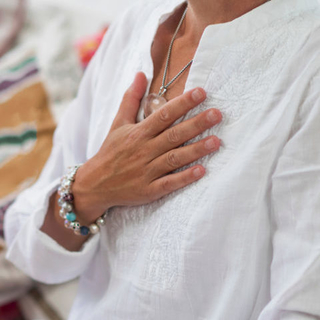
And then coming to the place in the center of your chest,
Known as the heart space,
Or the cave of the heart.
This practice in Tonglen is adapted from a Buddhist teacher,
Shambhavi,
And you can find her meditation on the app Insight Timer.
So breathing in and out through those pores and finding the center of your chest.
As you breathe in at the end of that inhale,
I want you to notice a small gap,
A space.
That space between where the inhale ends and before the exhale begins is a term called santhi.
And santhi is that perfect pause between the inhale and the exhale.
Santhi is that moment right between.
So as you begin noticing the breath and with your attention at the center of your chest,
As you breathe in,
You're seeing that exhale.
And in that moment of santhi,
I want you to absorb deep into the heart,
Deep into that cave or into that vastness of infinity.
As you breathe in,
You notice that moment of santhi before the exhale begins.
I want you to let your awareness just rest in the darkness of that calm space,
That beautiful nourishing darkness.
Santhi naturally occurs.
You don't need to to work at it.
It naturally occurs as your body breathes.
And as you're here breathing and noticing and noticing,
I want you to get in touch with everything that you value,
Everything about you that you value.
Your health,
Your intellect,
Your education,
Your body,
Your creativity,
Your kindness and lovingness.
I want you to really get in touch with those parts of yourself that you value.
And if it feels difficult to find those values,
Imagine that five-year-old once again,
That sweet,
Innocent,
Beautiful five-year-old.
And breathe them in.
Now,
I want you to think of a person in your life that could benefit from all you've received in your life.
Perhaps someone who's suffering.
Perhaps somebody with obstacles they're having difficult overcoming,
Addictions,
Attachments.
And now focus your awareness in the santhi,
That gateway into infinity.
Into infinity.
I want you to breathe in all of their pain and suffering,
All of their grief and their hardship.
I want you to breathe in their addiction and their attachments.
And I want you to see them absorbed in the sun.
He absorbed into that infinity within.
And as you exhale,
Give them all of your assets,
All of your opportunities,
All that you value.
Give it to them freely.
Give it all away.
Even if it feels fearful for you,
Remember that garden in your heart,
The perpetual blossoms that replenish with everything you give more return.
Breathe in their suffering and their pain.
Allow it to dissolve in the santhi and breathe out all that you've been through.
And breathe out all that you value,
All that would benefit them,
All that you have,
You give as a gift to them.
And with each breath in through every pore in your body,
You receive those hardships.
And as you breathe out,
You send them everything that you have.
Continue breathing in all their obstacles.
Give it away through your exhale.
Try to have a real experience with this,
That you're giving it all away to them.
And now expand the awareness of this one person and imagine all people who struggle with this same difficulty,
With this same addiction,
With this same grief,
With the same anxiety,
With the same judgment and hate and ridicule.
Send them all that you have to all that suffer with this challenge.
Continue breathing in through every pore receiving all of that difficulty.
And with your exhale,
Sending everything that you have.
Sending them all the help that they might need.
Now think of someone that you have trouble with in your life,
Someone who challenges you.
Perhaps it's a politician.
Perhaps it's a family member that supports a politician that you reject.
Perhaps it's an ex.
Perhaps it's a parent.
Imagine a person in your life that you have trouble relating to that causes you upset and strife.
How can you benefit them by what has benefited you?
If there's a value in you of love and kindness,
Can you send that to them?
Can you receive all that's difficult and challenging and send them what has benefited you?
Give it all away.
Inhale from them through every pore in your being and allow what you've inhaled to dissolve into that Sunday,
To be absorbed into that vastness and you exhale all that benefits them.
Feel it and see it with each breath.
In and out through every pore.
Inhale from them all of their obstacles and all of the things that annoy you.
Inhale it fully.
Take it in and dissolve it in the Sunday.
And exhale back all that they need to feel happy.
Give it freely.
You have plenty.