So,
I'd like to invite you to surrender to the process of just letting go into the here and now,
In order to work on relaxing and focusing the mind.
So,
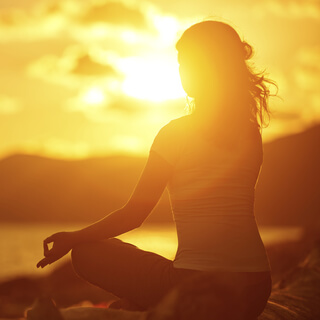
Starting with your physical posture,
You can arrange your legs in a position that is most comfortable for you,
Setting your back and spine to be as straight as an arrow.
Place your hands in a position of meditative equipoise,
With the left hand on the bottom,
Right hand on top,
And the index finger of your right hand touching against the thumb of your left hand.
Take this time to settle in and relax,
To make sure you're comfortable,
And that you won't be disturbed,
Or need to disturb anyone else during your quiet time.
So,
Get yourself comfortable and make sure you can settle down,
To focus on relaxing and letting go.
So,
Allow yourself to take this time to turn inwardly,
And explore your potential for deep relaxation.
Relaxation is the entryway to renewal and insight,
And the foundation of meditative awareness.
So,
Let's start by taking a deep breath in,
And relaxing with the outgoing breath.
Let your exhalation be long and slow,
With each inhalation drawing your awareness closer to the present moment.
And notice the growing sense of relaxation that is coming over you with each breath.
And allow your body to breathe naturally,
With no effort to control or change the breath.
Let yourself simply be the observer.
Notice your capacity to allow this moment to be just as it is,
Without adding anything to it,
And without taking anything away.
And at this point,
We might make a scan down through each and every part of our body,
Releasing,
Relaxing,
And letting go.
Beginning with relaxing and letting go of any tension in the crown of our head,
The forehead and temples,
The muscles around the eyes,
The muscles of the face,
And the cheeks.
Relaxing the muscles of your face,
Letting your face be like that of a marble statue.
Relaxing the jaw,
The lips,
And the tongue.
Feeling the flow of relaxation in the absence of struggle,
In the radiance of effortlessness,
As embodied in the poise of your posture of your body.
Relaxing the throat,
So that it becomes soft and open.
You might like to let your head shift gently to the right and to the left,
And feel how this relaxes the muscles of the neck.
Continuing by relaxing the back of the head,
The base of the skull,
The back of the neck,
Both shoulders,
The shoulder blades,
Down through the arms.
Relaxing the elbows,
The wrists,
The palms of your hands,
Your fingers and thumbs,
And inside you,
The heart,
The lungs,
The ribcage,
The organs of digestion,
The abdomen,
The diaphragm,
The lower back,
Both hips,
The backs of the thighs,
The tops of the thighs.
Relaxing the knees,
The calves,
The shins,
The ankles,
And the heels,
The tops of the feet,
Right the way down to the soles of your feet and your toes.
Then,
Turning your attention to the relaxation of the mind,
You can feel the flow of the breath passing into and out of your body,
Allowing yourself to relax further with each exhalation,
And entering more deeply into the present moment with each out-breath,
Letting go of thought to the past and of the future,
And opening up to the infinite presence of this moment,
Entering into the heart of this timeless present,
And invoking a quality of spacious awareness,
For now letting the linear,
Rational mind take a temporary vacation,
While engaging instead with the feeling of presence,
The direct intuition of who you are,
And engaging with our capacity to allow the moment to unfold in its own way,
In its own time,
Allowing your awareness to be like a vast open sky,
Where feelings,
Thoughts,
And sensations are constantly changing in form and shape.
You might persuade the mind caught up in the past or in the future to return decisively to the present moment,
Being present to the process of life unfolding moment by moment,
Where you are merely the witness,
The observer,
Relaxed,
Surrendering to the present moment.
And at a certain point when we feel comfortable within ourselves,
We imagine our whole body to be nothing but an empty space or a hollow cavity,
With no organs or tissues,
Muscles or bones.
Alternatively,
You might imagine your body to be like a transparent bubble,
With nothing on the inside.
But at this point,
You can remember back once again to the picture of the sun shining,
Or maybe a full moon,
A star,
Or a diamond,
Or perhaps an object that you can feel rather than see.
Whatever you've chosen,
Conjure it up in your mind.
The object may be clear to you,
Or it might be fuzzy.
But for our purposes,
It doesn't really matter.
We allow that object to float slowly downwards within the space of our body until it comes to rest somewhere around about the area of our diaphragm,
At the deepest point of the breath.
If our awareness wanders anywhere else,
Then we're going to bring it back to this point.
If the inner object disappears,
We can think of a new one.
And as for the problem of there being an excess of thought in the mind,
If you find that that is the case,
Then you may be able to reduce the number of thoughts simply by ignoring them,
By starving them of attention.
But if the number of thoughts in the mind is really too many simply to ignore,
It may be necessary to return to our good friend the mantra.
Hearing the sound of the words Samma Arahang coming up from the center of our body,
Or from the center of that inner object,
Almost like a silent music,
With the words Samma Arahang.
Samma Arahang,
Over and over again,
Lightly,
Gently and continuously,
Helping to keep our mind on track at the center,
But also reducing the number of thoughts in the mind down to a manageable level.
Until we reach a point where the mind seems to have settled into silence.
We maintain our mind with the utmost of gentleness,
Never rushing the process,
Never trying to force our hand,
Until eventually we'll reach a point where only silence reigns in the mind.
So in this way we continue to maintain our attention on track at the center of the body,
As we familiarize ourselves with adjusting the minimal lightness of touch needed to bring us to the sweet spot of our meditation,
For a few more moments now in silence until we come to the appropriate time.
So we continue to keep our mind gently on track at the center of the body.
If the attention wanders,
We bring it back to the center.
If the object disappears,
We can conjure up a new one.
And if the object changes,
Then we follow it in its new form.
Meanwhile,
We do our best to keep the mind free of thought.
And as the mind becomes more refined,
Then you will start to have access to more refined and subtle states of mind,
Because the mind can only have access to states that are as subtle as the mind itself.
In this respect,
There are seven ways in which our meditation resembles features of mystical experience.
Firstly,
Meditation experience is often difficult to describe or to put into words.
Meditation experience also has something called a noetic quality,
Where it seemed to communicate some sort of knowledge,
Which is beyond everyday waking life.
Often meditation experiences are transient,
And there's an element of passivity in them,
In that they arise and disappear,
Seemingly independent of any effort which we might make to manufacture them.
So they are something that seem to just happen to us.
In meditation experience,
We sometimes come across the combination of things we'd normally consider opposites,
Such as large mental objects being concealed inside smaller ones,
Or where there's a dissolving of the barriers that normally separate one thing from another,
Like the separation between ourselves and all other living beings.
With meditation experience,
Often there's a distortion of our normal sense of time,
As if during deep meditation we step outside time,
And with meditation experience there is a sense of touching upon a true sense of ourselves,
As distinct from our normal everyday self.
Of course meditation is more about accumulating wisdom,
Than reveling in weird and wonderful experiences,
But following a meditation lineage does help give us a framework of meaning for unfamiliar inner experience,
Where even disconcerting experience helps to pave the way towards the transcendental.
So for now we continue to keep our mind on track,
Lightly and gently for a few more moments in silence,
Until we come to time for some loving-kindness meditation.
And as we continue to connect with the inner experience at our center,
We can spread loving-kindness in a way based on the four divine abidings.
These four divine abidings can be referred to for short as love,
Compassion,
Joy and peace.
They impart the qualities of the divine to ordinary meditators,
Who cultivate these qualities.
So we allow our awareness to go deeper to our center,
Which is the source of all the divine abidings.
The first divine abiding is metta,
The divine abiding of love or loving-kindness.
So although the associated qualities are benevolence and goodwill,
It is said that the main underlying element of loving-kindness is empathy,
That you are not impervious to the suffering of others,
But also feel for them in their suffering,
Just as a parent might co-experience the suffering of a very young,
Dependent child in their care.
So we allow this sense of empathy to radiate outward,
Touching and blessing beings around us in all directions with this deep feeling of loving-kindness.
Not just individuals we know or like,
But all living beings without exception,
In ever-widening circles around us.
The second of the four divine abidings,
Karuna,
Is compassion.
So not only do you feel the suffering of others,
But also the urgency to love.
To relieve others of their suffering and restore them to happiness.
Just as no sacrifice might be too great for a parent to alleviate the suffering of a child in their care.
So we allow this sense of compassion to radiate outward,
Touching and blessing beings around us in all directions with this deep feeling of compassion.
Not just individuals we know or like,
But all living beings without exception,
In ever-widening circles around us.
We radiate compassion simultaneously in all six directions,
Like an ever-expanding sphere of light,
Deeply connecting with this feeling of caring for others and wishing them freedom from all causes of suffering.
Radiating this feeling of universal compassion in every direction,
Expanding from the center and blessing beings in all six directions.
The third of the four divine abidings is mudita or sympathetic joy.
So although the associated qualities are congratulation and magnanimity,
It is said that the main underlying element of sympathetic joy is being glad for the successes experienced by others.
That you are not jealous or envious,
But are glad for successes that are not your own.
Just as a parent might be glad of the achievements their child has brought about at school or in the performing arts.
So we allow this sense of sympathetic joy to radiate outward,
Touching and blessing beings around us in all directions with this deep feeling of magnanimity.
Not just individuals we know or like,
But all living beings without exception in ever-widening circles around us.
The last of the four divine abidings is upeka or equanimity.
So although the associated qualities are level-headedness,
Trust and freedom from bias,
It is said that the main underlying element is being there for another,
Being available and accessible for others if they should ever need us.
Sometimes this quality is useful to give us the awareness that another person's problems are too big for us to handle alone.
And sometimes it's trusting a person we have cared for to have the maturity to handle problems on their own without our interference.
Just as a parent might have the backs of offspring who have already grown up and left home,
So we allow this sense of equanimity and peace to radiate outward,
Touching and blessing beings around us in all directions with this deep feeling of trust in others' goodness and integrity.
Not just individuals we know or like,
But all living beings without exception in ever-widening circles around us.
So radiating all four divine abidings,
Love,
Compassion,
Joy and peace from our center,
We extend the intention that all living beings dwell in love,
Compassion,
Joy and peace now and forevermore.
The last few moments of our meditation together in silence.