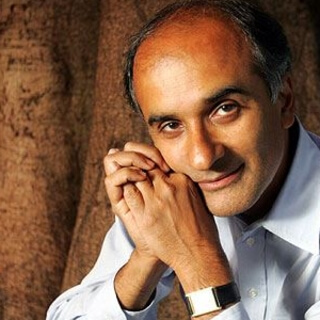
Hello and welcome to Tricycle Talks.
I'm James Shaheen,
Editor-in-Chief of Tricycle The Buddhist Review.
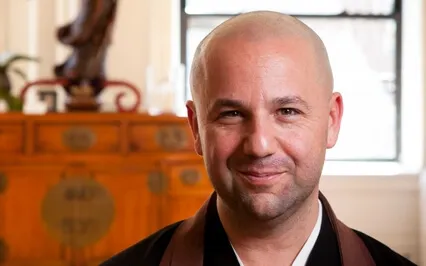
When Koshin Paley Ellison was just eight years old,
He already knew that he wanted to become a Zen Buddhist monk.
He began practicing meditation after a karate teacher insisted that he could never be free until he could be still with his pain.
Ellison now serves as a Zen teacher,
Chaplaincy educator,
And co-founder of the New York Zen Center for Contemplative Care,
And he helps others to learn to be still with their pain.
In his new book,
Untangled,
Walking the Eightfold Path to Clarity,
Courage,
And Compassion,
Ellison lays out how Buddhist practice can free us from our destructive patterns and help us access a greater sense of pleasure.
In today's episode of Tricycle Talks,
I sit down with Koshin to talk about the tangles that ensnare us,
The power of learning to become intimate with our suffering,
And how every aspect of our lives can become a place of practice.
So I'm here with Koshin Paley Ellison,
Co-founder of the New York Zen Center for Contemplative Care.
Hi Koshin,
It's great to be with you.
Koshin Paley Ellison It's so good to be with you.
Daishi So Koshin,
We're here to talk about your new book,
Untangled,
Walking the Eightfold Path to Clarity,
Courage,
And Compassion.
So you know what struck me first is that this is a deeply personal book.
I've known you for many years now,
And there was plenty I didn't know that I learned.
I certainly empathize with the rigors of childhood,
I get it,
But I can't say I knew what I wanted to be when I was eight,
And certainly not a Zen priest,
So why don't you tell me about that?
Koshin Paley Ellison I grew up in a house with lots of chaos,
And so kind of outwardly high functioning and inwardly not so high functioning.
Also all the people were quite beautiful people who had beautiful values,
But there was such a gap between their values and what they were doing or allowing.
And this is also very common for families like mine who come from trauma histories of the Holocaust or any kind of trauma history actually.
So I grew up in this sense of lots of chaos,
And I used to go out to visit my grandpa George in Newport Beach,
California.
He used to save these National Geographic magazines.
I remember laying on the white shag carpet,
And we would flip through the magazine.
You can still kind of remember the smell of that,
And at that time National Geographic was lost native tribes,
And so it was very unusual that they would have a profile of a city,
And they once had a profile of Tokyo.
I remember turning this page and seeing this picture of Tokyo and of this man with this huge bowl hat,
Which is called an aragasa hat,
And in his robes,
And all the people around him were blurry in the photo,
And he was in focus.
You couldn't see his eyes.
He had a slight smile.
And I remember seeing below,
It had this caption that said,
Zen Buddhist monk in Tokyo.
And I remember thinking,
In that moment,
I'm going to be that,
Which is amazing.
It turned out to be.
So,
Kushin,
The first teacher you found was at a martial arts sendo.
What did that teach you?
Just the other day,
My dad even brought up Sensei White.
He was such an important part of my life and changed my life,
I think,
Forever.
Back behind the local strip mall I grew up in suburbia,
In the basement underneath the drugstore was this martial art karate studio.
And I used to go there,
And there was not really kids classes,
So it was a little unusual,
Which is a theme through my life.
And he used to have us sit in Seiza,
Where your legs are underneath yourself,
On this like fake wood floor.
And it was really painful,
Without any cushions.
And we would just sit there and he would walk such an intentional,
Thoughtful way around us and say,
You'll never be free until you're still with your pain.
And as a young gay kid and a young Jewish kid,
You know,
It was this superpower training,
Superhero training.
I think it was maybe a very,
Very early image of compassion for me,
Because I realized that people in my house and the bullies,
Like,
I realized that they didn't know how to be still with their pain.
And I don't think I articulated that at that time,
But I realized that something shifted in me in relationship with the world.
Okay,
So let's talk a little bit about the book.
I just wanted to hear those things because I really enjoyed reading the book.
So the book is called Untangled.
What are these tangles that tie us up?
How do they limit our capacity for freedom and joy?
I think it's just the beautiful prescription that the Buddha laid out and the prognosis that he laid out,
Which is really that we get in trouble because we get tangled up in our own stories.
For myself,
That's definitely been true in terms of being a victim,
Which I carried around for a long time.
And I think that we get tangled up with the classical things that the Buddha talked about,
Which is the giant of greed and the giant of resentment and the giant of delusion and how we get so caught up in these veils that keep us away from the intimacy of life.
And the intimacy of life is always available,
And yet these things must be reckoned with.
I felt like I had something to say about these things,
And so I thought that we could work with them.
And when one of my students was aware of what I was working on,
She had this huge,
Massive knotted yarn.
And what she realized is she's like,
Oh,
Well,
Koshin's writing this book,
And the least I could do is untangle this yarn.
And she found it to be like this fascinating process of actually untangling it,
Which requires clarity and courage to stay with it and compassion.
And those are the words that she shared with me in her own process of untangling this thing that was felt impossible.
So,
You mentioned the Eightfold Path a moment ago as the means or the way to get untangled.
Can you give us just a brief introduction to the Eightfold Path?
You know,
One of the things that I have found in many writings about the Eightfold Path is that we tend to skip over the first three noble truths and we kind of want to get to the path like,
Okay,
Giddy up.
So actually,
Almost half the book is really about the first three and I feel one of the things that's so important is we get to the Eightfold Path,
Which I will get to in a moment,
But really facing what's hard and facing what is uncomfortable and facing what seems impossible.
And we can do that in particular when we have good spiritual friends,
When we have community and teachers.
It is hard and I think sometimes we get caught in what's hard and many people come to meditation practice and want it to kind of be easy and are hoping that they'll feel better,
You know,
In quotes.
So I feel that the Eightfold Path is quite powerful as it's really about,
In many ways,
About ethics and wisdom and compassion,
Which seems like a pretty good prescription for how to live a more sane life.
And the Eightfold Path starts with the right view,
Look back at our life and to really see how we've caused our own suffering,
To really see that.
And I feel like that requires the ability and willingness to be very embarrassed.
And I think some of us get to that and we feel shame and then kind of bury that and don't change has been so important to me to really just keep humbling myself and to realize what a jerk I have been to myself and to other people and how I've transgressed and I've moved away from what I care most about.
So I think that really taking that very rigorous and gentle look at that,
Having a healthy embarrassment,
There's a huge difference between shame and embarrassment.
And shame tends to move us away and almost ensure that our conditioning will continue in the same way.
But I like to kind of add healthy to embarrassment because sometimes we don't see it as healthy.
There's a Japanese expression that has been incredibly important to me in my whole life,
Which is fall down seven times,
Get up eight times.
So when we move through from the first of the Eightfold Path into these others,
We have this opportunity to actually be humble,
Embarrassed and lively and loving.
You mentioned earlier the sense of being a victim and I think many of us understand that,
Certainly I do.
And a certain attachment we have to being a victim.
And it's interesting because with that sense of being a victim,
One also feels shame.
When one begins to emerge from that and see what one has done to others and oneself,
Then that healthy embarrassment that you describe faces us.
And it's almost as difficult as the shame,
But at least it's generative and fertile.
Is that fair to say?
Totally.
And I think that in some ways,
I feel like it's just this ongoing process too and the willingness to be in an ongoing process of not getting it right.
I remember writing a sentence in my last book that I had never said aloud in public that I realized I had held a lot of shame around.
And it was a very,
In some ways,
A simple sentence to say.
And the sentence was that I experienced physical and emotional and sexual abuse and I'd never said it.
And it felt so powerful,
Almost like my cells rearranged when I said it and something about knowing that it was going to be published and public.
And I had done a lot of work,
I've been in therapy a long time and I have a very steady practice and intimate relationship with teachers and sangha.
And I felt like we were just never done.
There was like that little corner inside of my own mind that victim kind of shame.
And so I felt like,
Wow,
There's a lot more work to do.
And I found in writing this book and sharing and exploring,
Using the writing as a practice opened up things that I had never talked about before.
And actually,
Some of them I didn't even know.
There was something about the actual writing and the physical expression of that as a practice that changed these spaces that I was so ashamed of.
And I realized,
Like,
I can just say this happened.
Daishi And so opening up about that and being public about that,
First with the sangha or your intimates and then the sangha and then publicly in the book,
Did that serve to break the shame?
Dr.
Kammerer Yes.
And I think what also happened was that I began to actually feel freer.
There was a stillness kind of going back to that teaching of that you'll never be free until you're still with your pain.
It's like the pain of the shame,
Which was like this added layer over the pain of it.
I had kind of kept it as like this malignant thing inside of me as if I had in some ways chosen it or had wanted it or deserved it or was fully responsible for it,
Which of course I was not.
Daishi So we've talked a lot about pain.
But you also write that the eightfold path helps us to access true pleasure.
What do you mean by true pleasure?
And how can pleasure support us in our practice?
Because when you're in that place of shame,
When you're in that place of feeling like a victim who deserved to be a victim,
It's impossible to feel pleasure.
But what are you talking about when you say true pleasure that comes with the practice?
Dr.
Kammerer You know,
It wasn't until almost like 20 years ago that I felt like I actually began to experience pleasure in a truer way.
And I realized that so much of that conditioning actually kept me from experiencing a true pleasure because I was so far still,
When I was staying in the stories in particular around my victimhood,
I was really staying away from what was actually true and intimate.
And I found that literally the pleasure of walking down the street,
Now looking out the window and seeing the beautiful sunlight against the wall is incredible,
You know,
And the pleasure of being alive was almost coded over by all of this gunk that I was carrying around.
And I wasn't even aware of it.
And so far as I wasn't aware of the impact it was having.
My friend Liz,
In college,
We were walking down the street,
And she just turned to me and she said,
You know,
You seem so happy and happy go lucky,
I think she said.
And yet,
You also seem inside of yourself so sad,
Who actually gets to know you?
And so I remembered being so stunned by her,
Her courage,
First of all,
To be a good friend like that is to really ask a real question.
And how true what she was saying was,
And that I had kind of coded over,
I'm fine,
I'm fine.
I'm good.
I was smiling all the time,
Which I do smile a lot,
But it was kind of this weird clown smile,
I think.
And it was a little different than actual pleasure.
It was actually a mask.
And there's a big difference.
And you can feel when someone's smiling,
As opposed to it just is coming from within inside.
It was the beginning that I wanted to be known in a more intimate way,
Like my friend saw me,
I realized,
My goodness,
I could be seen and experienced as a complete person.
And there was actually something so painful about her question,
But also so intimate and pleasurable.
So in a way,
It felt like the beginning of a life of pleasure where you were not hiding,
You know,
We're mostly seeking pleasure,
We're pleasure seeking creatures.
And so how do we find and actually nurture a life where we're actually setting ourselves up each day for a life where we are open,
Aware and grounded?
Reminds me of the primacy of the ritual of Zazen and the Zen meditation posture where you're really feeling your body grounding.
And then really having your belly is soft,
And your shoulders are open and your spine is upright.
So it's like actually having that ritual while you're walking down the street or talking to someone that you know or you don't know,
And being aware that you can be grounded and soft and open and upright in the midst of our life.
You write that walking the Eightfold Path means balancing two principles,
Becoming intimate with our suffering and exploring what else is true.
I think you described being intimate with our suffering,
Being with it,
Being still with the pain,
Knowing it.
What else is true?
It's amazing to me how quick the stories come.
Someone wasn't showing up at a particular time and I had a story of like,
Oh,
They forgot.
And actually,
Of course,
That wasn't true and so I realized,
Well,
What else is true,
Koshin?
Is that really the story?
The story is that I'm just making up a story.
The only thing that was actually true was that they weren't there when we said we're going to meet.
I was in Union Square and just realizing,
Well,
What else is true?
It's like,
Well,
It was a very gorgeous and mysterious morning.
Clouds are kind of wild.
Some of the trees are changing in really interesting ways as we're heading into autumn.
And just to realize how much time we spend making up stories and then kind of holding on to it and how little we give ourselves sometimes when we just stay and just kind of ruminate.
And I found that also we all have,
At least in my experience,
I think we have like three or five main stories that we interpret everything through.
And there is so much else that's true.
If you've ever gone to a planetarium and you sit back in those seats and you look out and they show you what else is true.
And we think we know things.
It's like ridiculous.
I thought it was especially funny when you're waiting in line at the market and you saw a man mistreating the woman,
The cashier,
And you thought,
What a loser he is.
I mean,
He's so unpleasant.
And it turned out it was her boyfriend and she had done something unkind to him and he was angry with her.
So that turned out to be true,
Very different from what you thought was true.
Which takes me to your focus on the tangles of our thoughts.
And you cite Dogen's Dharma of sounds and forms as one way of breaking out of cyclic thought patterns.
Which is I think what you're talking about to some extent when we make assumptions and don't see what's true outside of that.
So you write,
When you are receptive to being more than your thoughts,
Something new can happen.
You can hear what the world is preaching to you about life all the time.
You realize you can think in a new way and imagine new possibilities of action.
So how could we cultivate this ability to be receptive to the world outside ourselves and to what's otherwise true?
J.
B.
Dokhan,
You know,
Just thinking about that beautiful expression from Dogen where he talks about continuous practice.
One of my wishes in this book is just to keep bringing up that everything is a place of practice.
And so if we really get receptive to the continuity and that there's no arrival,
It's so joyful.
It's so amazing because we realize that everything is just flowing.
I remember my friend and beautiful Dharma teacher Gil Fronsdale once talked about it's like,
You know,
Just sit on the bank of the river and just watch all the thoughts and feelings.
Take a look.
And I just love that image.
And it's always been super helpful to me to just see that because then we can see the river and then we can look up and see the mountain.
We can feel the grass maybe in our hands and that so much is true.
And then we'll realize that we'll fall back into that river again and get tossed around and then we can climb back out.
And so it's that capacity to be really foolish and delighted in the humbling practice of being alive.
You mentioned,
I think,
The James Webb telescope and that it shows us a fraction of what's and you were getting at,
I think,
Wonder and awe.
How do these things open us up to wonder and awe?
To me,
It's very ordinary.
For several years,
I worked in an emergency department.
And what you see there very often are how enormous things happen to people that they didn't expect to happen.
And what was the most heartbreaking to me about that is almost all their loved ones would come rushing in in a panic.
And I heard story after story like,
Oh,
Man,
We were in the worst fight this morning or I didn't even speak to them as they were leaving.
You know,
We can get so caught by our habitual patterns of just like,
Yeah,
I'm in a bad mood or whatever that is.
A friend of mine reminded me of this the other day.
Apparently Gandhi,
Someone was asking him like,
So you're always seem to be in a kind of a bright mood and he's like,
Well,
Who wants to die in a bad mood?
That's a good one.
That time in the emergency department kind of woke me up in that way.
Like,
What am I doing with my time?
All we really have is the time as far as we know that we have.
And so it really changed in particular how I take care of my mornings.
And I've never left the house now without holding Chodos face.
Chodos your husband.
Gorgeous,
Beautiful human.
Every morning for the last 22 years,
I hold his face in my hands and tell him how much I love him.
To me,
That is wonder and awe because every morning I look at his face and I really look at him because I don't assume that I will see him again.
And that has been such a poignant entry in such an ordinary moment of entry into awe.
Looking at his face in the morning,
Like even this morning,
Just like,
Wow,
I can actually see you.
To me,
Then that translates to each moment of our life.
We can actually notice we're getting caught up,
Ground ourselves,
Soften our belly,
Open our shoulders,
Get upright.
Those principles of zazen are just fabulous and delicious instructions for how to enter wonder and awe.
And I feel like when I'm really in my body in that way,
Then I can be really just in the body of the world and just really connect in surprising ways.
Yeah,
It's so interesting when we're stuck in habitual thought patterns or repetitive thoughts,
We take each other for granted.
We don't see each other.
Big time.
Let's take a quick break and we'll be right back.
What makes a good life?
How can we live well,
Even in times of crisis?
Join us October 24th to 28th for Living Well in Difficult Times,
Perspectives on Buddhism and Human Flourishing,
A donation-based virtual event series.
You'll hear from Buddhist teachers,
Psychologists and writers,
Including Kira Jule Lingo,
Steven Batchelor,
Sylvia Borstein and David Nicktern.
The series will explore what it means to live a good life and help you find practical tools for thriving under any circumstance.
Sign up now at tricycle.
Org slash events.
That's tricycle.
Org slash events.
Now let's get back to our conversation with Koshin Pailayilasan.
You discuss how we can work with the three poisons of greed,
Anger and delusion,
Which you call the three giants.
To examine the giant of anger,
You offer a practice you call the face of the other.
Can you share more about this practice and how it can support us in moving beyond anger?
Of course,
Koshin,
As you know,
I've never known anger.
You of all people have listened to my rant.
Well,
Just in this moment,
The face of the other feels very related to what I was sharing with Chodo.
You know,
Recently I was just reading a memoir by a political person who I wouldn't say I agree with at all,
But I was very inspired by my friend Andy,
Who encourages me to read these kinds of things.
To me,
It's like,
How do you behold that face of the other in a way of respect and dignity?
That doesn't mean we have to agree with someone.
We go through these cycles where we're very polarized to less polarized to more polarized.
But to me,
The medicine is always about how we behold the other and the face of one another.
And to me,
That's so important,
Particularly I call them giants because I feel like they are.
They just are.
They're huge.
To reckon with what is huge and dominating has to be done and all the great stories from actually world mythology had these giants and they were these embodiments of these qualities that had to be reckoned with.
And actually,
I think that when they're not reckoned with,
We can't really behold the other.
We can't really see.
We can't really feel.
And to me,
Life is about love and tenderness and that capacity.
And it's so rare because we get so caught up with our own bullshit.
And we feel that in some ways,
Whether we consciously think of it or not,
Our bullshit gets in the way of actually beholding the other's face.
We recently had the Columbia philosophy professor,
Allison Aiken,
On the podcast and she discussed how compassion,
As you've been describing,
Can be a substitute attitude for anger.
It seems like this practice is one way of examining our anger and cultivating the substitute attitude of compassion.
I think that's what you've been describing.
Is that correct?
Yeah,
There's no substitute in a certain way.
It's about,
Am I loving well?
Am I actually allowing compassion to be what I reflect on and take a hard look at how we're functioning?
In particular,
In how we're thinking,
I find actually like zazen and meditation is a total adventure of really the cuteness of attention to how I'm thinking.
And how do I really address in a rigorous and tender way so that I can actually realize how challenging it constantly is?
And when I'm able to do that and really take a look at how I keep separating myself from other people or having these like very quick thoughts of anger or delusion or greed or what I want.
And if I can really catch that,
I realize like,
Wow,
It's so tricky.
Everyone's dealing with that.
And so in some ways to me,
It's like,
How can you not be compassionate when you're really working with your mind in a very diligent way?
It makes the world pop in an incredible way.
You realize,
My goodness,
It's amazing to me that we can get up in the morning.
And most people are not tracking their mind like that or their thought waves.
They're just going around.
And so even if you're like being very rigorous with it,
It's quite challenging.
And so to me,
The experience in my own body and mind is to be more loving.
And to me,
It's like the compassion.
I love the kind of Western definition of is to suffer with.
It's like,
My goodness,
Like we're really suffering together.
Three years ago,
I worked with this group of fifth graders who are in a special education school that was located literally underneath the BQE,
Which is this huge expressway.
So they put this school for kids who are having trouble regulating themselves underneath this roaring expressway.
And these kids were so extraordinary.
They had come from backgrounds that basically what I would describe is a war zone.
And at that time,
It was during the war in Bosnia and there was all of these refugee children there.
And my goodness,
What they've been through.
And everyone told me,
Like,
Forget it.
You know,
They're never going to be able to reach them.
Poetry,
That's a joke.
That's not what these kids need.
And I was teaching them meditation.
They can't do that,
Forget it.
And what I've found is actually they could.
And when you give them that kind of attention,
They actually can learn.
At least these kids did.
I still remember that these two kids just were so amazing.
And their backgrounds is one kid whose mother was on drugs and the father was gone and he often would not see his mother for days and days and he lived alone somewhere.
And I just remember him coming in.
He's like,
Mr.
K,
Mr.
K,
You know,
Like something called me.
I wrote a poem.
I wrote a poem over the weekend.
He was so excited.
And he's like,
The poem was in the gutter.
I found a piece of a half eaten hot dog.
My goodness,
It was delicious.
And to me,
Like that is the most gorgeous poem where this boy,
You know,
10 year old boy or 11 year old,
Who,
As I had learned,
Like did not often eat and could find this half eaten hot dog in the gutter and eat it,
Enjoy it.
And this girl from Bosnia,
Who seemed like she was completely shut down,
Wrote this poem.
There are four chambers in my heart.
In the bottom left chamber,
There is an ice field and it's beginning to thaw.
And to me,
This goes back to your question about compassion,
As well as wonder and awe.
It's like in the midst of terror,
In the midst of suffering,
There can be such beauty.
And we often forget that.
You know,
Koshan,
I have to say that sounds pretty hopeful,
But you mentioned your suspicion of hope.
Can you say more about the relationship between hope and fear?
How can hope prevent us from taking action?
Well,
Hope is tricky,
Right?
And I love the story of Pandora.
She had these two baskets,
Sometimes later versions,
They say it's a box.
And she was curious.
There was a basket of blessings and a basket of curses,
And of course,
We're always curious about the curses.
And so she opens it up and all of the blight on humankind came out of probably greed,
Anger,
And ignorance.
And just as she was about to close it,
Hope popped out.
So I always have enjoyed the turning of that,
To realize that,
You know,
Hope is tricky.
And as if that would be the beginning of something,
That these two kids had this moment.
And now,
Sometimes I know in myself,
I'd want to put on that,
Oh,
Now they're going to be okay,
Or whatever that is,
Like,
Hope is like this future thinking,
Which,
Of course,
We don't know.
And so it's very,
To me,
Often tied to delusion,
As opposed to actually appreciating the moment.
You know,
I interviewed Joanna Macy,
And she said,
I'm a Buddhist,
I don't do hope.
I'm in love with what is.
So beautiful.
Yeah,
Hope I find deeply unhelpful.
And it's very popular.
And it's very much part of the world.
But you know,
Then again,
It's very popular hope.
But so is greed.
Many of us,
We live in a capitalist society,
Whether we like it or not,
Most people just are consuming,
Consuming,
Consuming,
As if that's going to help them.
So for me,
Hope is perfect for that kind of world.
Oh,
Well,
I hope it'll get better.
I hope if I buy this,
Whatever it is,
Then my life will be better.
I hear this all the time.
You know,
At our Zen Center,
We have lots of amazing young people.
And there's still this thing of,
Well,
If I do this enough,
Then I'll be better.
And it's the same kind of thing with hope.
Hope is that,
As opposed to like,
What's up?
I prefer that question.
Like what's up?
You know,
What's real for you right now?
I find it more helpful.
That makes sense.
You know,
You write that the essence of Zen is taking responsibility for what we're doing in the present moment.
What do you mean by this?
And how can this guide our practice,
Taking responsibility for what we're doing in the present moment?
It's for me,
Maybe the most important thing.
You know,
As we were talking about earlier,
Like taking responsibility for what we're doing to ourselves,
Taking responsibility for how I think and what my words are and my actions and how all of those ripple out.
And most of us,
You know,
Whether we've been practicing a minute or decades,
It could be such jerks.
We all can get caught in our crap and we do.
And that's why to me,
Taking responsibility is so freeing.
Kind of goes back to that humbling process of realizing,
Yes,
I'm at one with all of these thoughts,
Words and actions.
I'm responsible for how it ripples out.
And I find it actually enlivening.
I'm responsible and you're responsible and we're all responsible.
And I feel like it's such good medicine and such a great and powerful part of the practice.
I think that many of us come to the practice kind of looking for cookies or cash and prizes.
Exactly.
And behind this curtain.
And I think that it's a really a deeply missed opportunity to actually realize my goodness,
What am I doing and how are my actions affecting other people?
And learning to say I'm sorry,
Learning to be humble never stops as a learning opportunity.
And I find it important to realize that we're always somewhere between the bodhisattva,
Beautiful bodhisattva and a total jerk.
And it depends on the moment and the context that we're in.
And I think that all teachers and monks and nuns,
We're all human beings.
Everyone is a human being that I've talked to.
Well,
Yeah,
Our teachers too,
You know.
Totally.
And that's always important to remember.
In fact,
You write about your own journey in coming to study with Mysumi Roshi after news broke about his alcoholism and sexual indiscretions.
And yet he was so beloved.
Can you say more about what you learned from him,
Particularly in witnessing his practice of atonement?
I mean,
Something that we often skip because we feel such shame about the things we've done.
I'm deeply inspired by Mysumi Roshi,
In particular,
What happened after the whole thing blew up.
So tied to responsibility.
What I experienced is that this person was really the first person I've ever experienced not making excuses or defending what he did.
And as someone who had come from the background that I come from,
I thought that was mind blowing.
I felt like that is character.
That is bodhisattva activity.
So what I saw was a man who didn't defend and didn't pretend,
Didn't gaslight.
And just like,
Yes,
I did that.
I created immense harm.
And he used to,
After the morning sits,
Just invite people to scream at him,
To cry with him,
Be enraged with him.
He never stopped practicing.
And to me,
That's where our practice gets so interesting.
When everything goes off the rails.
To me,
That's the moment where we see what our character actually is.
And I think that in many of those stories of indiscretions with spiritual teachers across everything,
Which is also in the business world and everywhere,
But very unusual to see a story of someone saying,
Yep,
I did that.
And I'm responsible.
And I remember watching him creating this calligraphy of wah,
Which is harmony and just feeling so moved about like,
Yes,
Harmony sometimes is just allowing for that dissonance and not turning away from it.
And I know for myself,
There have been so many moments where I wanted to defend just normal everyday things.
I just noticed that desire in myself.
And I just always think of him and saying,
I can do this.
I can take responsibility.
I can sit here in front of you and realize I am an imperfect human and imperfect and complete and lacking nothing because I'm imperfect.
And I feel like that is the most amazing medicine for all of us.
I feel so nourished by that.
It reminds me of this story that I love very,
Very much where this Tenzo,
The head cook of the monastery,
Was very late in creating this meal and he forgot the soup.
And so he ran out in the garden with a scythe and cut all these vegetables and he put the soup together and like,
You know,
In Zen,
Everything's very formal and beautiful and organized.
And so all the soup goes out and the abbot of the temple puts his spoon in the soup and a snake head is there and they're vegetarian.
And he just invites the Tenzo to come up to him.
The Tenzo,
The cook,
Just bows to him,
Takes the snake head from the spoon,
Pops it in his mouth,
Chomp,
Chomp,
Chomp.
They bow again and it's done.
I love that story about responsibility.
To me it's like,
That's a healing vision of it.
Yes,
I can just take responsibility.
I did it and I can eat it.
To me,
My zumi roshi is a model of practice for me in terms of that.
Yeah,
I just wonder,
As a teacher,
Do you ever feel the pressure to appear impeccable?
Is that something that simply has gone away or is there that strange pressure?
Because we do expect so much of people.
You can say you're a Buddhist,
You lose your temper and someone goes,
Well,
You certainly don't act like one.
A mutual friend of ours used to say,
I'm a Buddhist,
Not the Buddha.
I thought it was a very good answer.
But do you ever feel that pressure?
People are watching and expecting something or can you relax around that after your experience with my zumi roshi?
I guess there's probably certain moments when maybe I might feel it.
As a teacher,
You get a lot of projection,
Like most people are just assuming a lot of things about you.
So I feel like that's super important.
That's why I stay in therapy because I feel like actually that's an ethic of mine.
I feel like it's ethical that I have to keep checking myself and being in a process.
And I also have an amazing peer group of other Zen teachers that I meet with every month.
We have a little accountability group.
And yet I don't really feel like I need to be that.
Actually I enjoy the imperfection and I love our sangha so much.
And often people feel like,
Oh,
Well,
They were scared to come to a Zen center,
But our Zen center feels very warm and loving.
At the same time,
We hold the ritual very,
I think,
Beautifully.
And yet with lots of cracks,
Everything can be a tool or a weapon.
So like any kind of ritual rules and regulations can be held in really different ways.
So to me,
Part of the teaching is to appreciate mistakes and appreciate our weird,
Freaky imperfections.
It's interesting,
Almost everything we're talking about,
All of the rough spots are about relationship,
Either with ourselves or with other people.
And you have an unconventional,
Or at least very interesting take on stealing.
You write that not sharing ourselves can be a form of stealing.
I'm guilty of it often.
But what do you mean by this?
And how can we be more generous in sharing ourselves?
Because often I really do feel I don't see the people passing me or asking for directions,
Or I don't even see the person I live with.
I mean,
All of these things happen when I'm,
Say,
Anxious or feeling fear,
Or I'm very self-referential.
So tell me about stealing.
We steal all the time.
And so actually,
When we think about the precepts or the ethical guidelines,
I always like to start with all of these,
Like just to realize like,
I'm a thief.
Tell me about how you're a thief.
And I realized that I'm a thief.
And so for me,
One of the ways that we're thieves is that we don't share openly,
Even with people who we have that kind of relationship with.
And we kind of fall into these habit patterns of stealing from them the opportunity to have that wonder and intimacy with us.
And it doesn't mean that we should walk around sharing freely all the time.
But we all kind of know in some ways how much we're holding back.
And do we really need to hold back all the time that we're holding back?
So to me,
It's more of an interesting question.
One side of it,
You could say,
Yeah,
We steal from people,
Which I think we do.
And the other part of it is,
How do you hold back from that opportunity?
And do you really need to,
James?
Yes,
Sir.
I'll be very careful to be more giving and loving and compassionate and perfect,
In fact.
So there is a line in the book that comes from a woman who's at the end of her life.
And I think it's,
Don't hold back.
How do we hold back aside from not sharing ourselves?
Or is that all of it?
I mean,
Almost in every aspect of my life,
I can see there is some way in which I hold back.
So can you say something about that?
Well,
She was an amazing woman.
And Chodra and I had the opportunity to care with her.
She was a rather exuberant person.
And she had held back much of her life as she described.
And she just said,
Promise me not to hold back in your life.
I've met so many people and anyone who's been with dying people,
Just the message is consistent.
What was I holding back for?
Like why was I so afraid and I was so stingy and fearful?
All those years.
For what?
And so to realize that kind of deliciousness of life,
Of being in the complexity of the space between terror and love is where we live.
And uncertainty is our ground.
And so how do we walk in a way with integrity,
Thoughtfulness and tenderness?
To me is like the way that we not hold back and get to know your neighbors.
Just reminds me of one other story is that one of my students was asking me like,
How's my practice going?
And I said,
Tell me the names of the people who you see at the grocery store and some of your neighbors on your block.
And he was like,
What?
Well he must live in New York.
And so he has begun to actually practice.
And he finds now walking down the block very pleasurable.
Because now he's gotten to know some of his neighbors.
He knows some of the stories of the people in the grocery store.
He's not holding back.
And it actually turns out,
I can't say it is true for everybody,
But tends to feel good.
Might even be truly pleasurable.
True pleasure.
So Koshin thanks so much for joining us.
It's been a real pleasure as always.
For our listeners,
Be sure to pick up a copy of Koshin's book,
Untangled,
Walking the Eightfold Path to Clarity,
Courage and Compassion,
Out November 8th and available for pre-order now.
Koshin,
Thanks so much.
Thank you,
James.
You've been listening to Tricycle Talks with Koshin Paley Ellison.
We love to hear your thoughts about the podcast,
So write us at feedbackattricycle.
Org to let us know what you think.
If you enjoyed this episode,
Follow us and leave a review on Apple Podcasts.
Tricycle Talks is produced by As It Should Be Productions and Sarah Fleming.
I'm James Shaheen,
Editor-in-Chief of Tricycle The Buddhist Review.
Thanks for listening.