Welcome.
This is a brief practice of mindfulness and compassion called RAIN.
This version is adapted to support you if you're feeling overwhelmed by too much on your to-do list or if you feel like you're drinking from a fire hose.
In this practice,
We will experiment with opening to the feelings and sensations that are present,
Explore these from a mindful lens,
And hone our ability to listen to ourselves and tend to our needs through self-compassion.
In this practice,
I'll invite you to bring to mind this sensation of having too much on your plate or a sensation of overwhelm,
Whatever is relevant to you.
But please do take care of yourself at all times.
First of all,
Not choosing something that's too intense.
And if at any point in this practice my guidance doesn't feel right to you or if the practice feels too intense,
Please feel free to adapt or adjust to prioritize your safety and well-being.
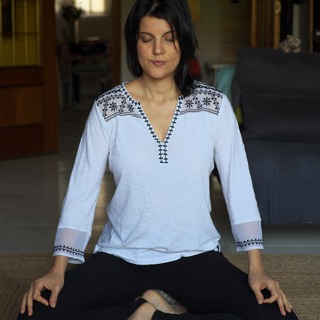
So now inviting you to do this practice sitting or lying down or however is comfortable for you.
No matter what your choice is,
Inviting into the body a sense of dignity.
Perhaps if you're sitting,
Having your back straight but not rigid and your front relaxed,
Letting the muscles that are not needed let go and relax,
While also inviting an intention to pay attention and explore for a few moments.
So to start the practice,
Finding those sensations in the body where it's in contact with the surface you're on,
Maybe a chair or a cushion,
Or maybe even where it's in contact with itself.
Noticing any sensations of pressure or contact or warmth,
Coolness.
Allowing your attention to begin to shift into those sensations.
And from there,
Shifting now to finding an anchor.
And by anchor,
All I mean is a place in the body that is easy for you to rest your attention,
A place that's a little more of a narrow focus.
Could be the breath,
For example.
Noticing any sensations where the breath is more noticeable,
Like the chest moving in and out or deep in the belly,
Or even just some sensation of clothing or movement as the breath expands and contracts.
Or you could also choose something else like the palms of your hands,
Any place in the body that you find grounding or stable.
And once you've had that,
Inviting your attention to rest there,
Almost like a home base,
Just like an anchor would bring a boat back to itself,
Back to that centered place.
Inviting your mind to come back to this anchor as many times as you need.
So whenever you're noticing it,
Wander away,
Just inviting it gently to come back to those sensations there.
And it's normal that the mind will wander,
So not judging or not worrying too much about that.
Just inviting it back,
Almost like taming a puppy.
And now with that,
Having the mind just a little more centered,
Inviting you to expand your awareness out to the whole body.
Inviting your attention to spread throughout the body,
Getting a sense for the general sense or feel of the whole body here,
Just as it is.
You might notice sensations of warmth or pressure,
Inward sensations,
Or sensations on the surface of your body.
Maybe some movements.
As best as you can.
And maybe noticing no sensation at all in some areas,
Not worrying too much about that,
Just registering.
And now with your attention alive to the body,
Inviting you to bring to mind a situation or experience,
This experience of overwhelm or having way too much to do,
Or any other experience that you'd like that might feel a little bit intense.
But again,
Always choosing something that's not too intense,
Something light.
And we start this practice with the R in RAIN,
Which stands for recognize.
And so bringing to mind the experience,
And we start to recognize it for what it is.
Maybe it was a moment or a memory that you have,
Or just a sensation or an emotion.
So allowing that to come to mind as best as you can and labeling what's there,
Who was present,
What emotion is present there.
And just noticing and recognizing it for what it is.
And the next step is the A in RAIN.
So our natural tendency is to push all of these things we don't normally like away.
And in this case,
We're doing the opposite.
We're gonna invite these sensations in,
We're gonna invite this experience in just for a few moments just to explore it for a little bit.
So this step of allowing is really just relaxing into this idea of letting those things just be there for just a moment.
So this overwhelm or this sensation that you notice in your body or whatever's there,
Just saying,
It's okay,
I can look at you for just a moment.
If it's helpful,
You could breathe into the sensations or the emotion there to soften any reactivity.
And once we allow it to be there,
We can create some space now for the I,
Which is investigate.
And just like we do in research,
We observe and explore this experience as best as we can and with as much of an impartial mind as we can.
So inviting this investigative approach and beginner's mind to what's here right now.
So let's start with the emotion.
What's that emotion that you're noticing arising?
And maybe it's more than one.
Overwhelm,
Fear,
Frustration,
Maybe just a little annoyance.
What's here?
And maybe you could locate any sensations in the body that arise as you bring to mind this emotion.
There may or may not be.
Just taking a peek now into the body,
Noticing if there's any sensations that arise there.
And what are they like?
Perhaps you could give the emotion a color.
If you were to give it a color,
What color would it be?
Maybe a deep red or bright yellow or black or blue.
What about a shape?
What shape would it be?
Is it something geometric or more organic?
And the texture,
Does it have a texture like a roughness or softness,
Smooth or shiny?
Or any other qualities?
Just noticing as if it were an object.
You could move around or look at.
Is it hard or soft,
Mushy?
Is it moving or vibrating?
And all is welcome.
We're just getting to know what's here right now and how it shows up,
How this emotion might show up as an object.
Now,
Imagining that this emotion,
This object that you've created is a part of you that is feeling sensitive or scared or exhausted.
And so inviting in this part of us,
This sensitive side,
Maybe it's helpful to imagine that as a smaller version of yourself,
Like a child version,
Whatever works for you.
And at the same time,
Inviting you to connect to this part of you that is observing,
This more wise sage,
The part of you that's resilient,
Almost like a wise parent or adult.
See if you can give this sensitive side a voice.
So perhaps acknowledging and accepting the emotions that you've identified by saying something to this person.
Like,
I see that you're angry or overwhelmed.
I see that you're upset.
And maybe reassuring them.
You know,
I'm sorry to see that you're feeling that way.
Whatever words work for you.
So taking that first step to acknowledge their emotions,
This sensitive side of you,
And reassure them.
Maybe noticing if their concern or maybe their facial expression maybe softens a little bit with that,
Maybe not.
And asking the sensitive side of yourself,
What has you concerned?
Tell me about this.
Why are you here?
Why are you here with this emotion right now?
And just listening for the answer.
Perhaps it's expressed something like protecting you from something or it's afraid of something.
So inviting in another question.
What do you need?
Ask this sensitive side of yourself.
What do you need right now?
And listening for their answer.
Listening for maybe what beliefs that side of you might be having.
But also listening to how do they need you to show up?
And so now perhaps you can answer that need.
So what do you know about yourself that you can offer to support them through this?
And if you can offer them what they need,
Inviting you to do so.
Maybe it's a hug or some kind of commitment to them.
Maybe taking care of yourself in the future or doing things differently.
And also checking if they're feeling in on the beliefs.
So if the belief that they had was perhaps not founded or the concern they had was maybe a slight overreaction.
So inviting you to correct or redirect that to something that's more realistic.
So perhaps the thoughts that come from that sensitive side are I can't handle this or I'm always X,
Y,
Or Z.
And maybe that's not quite true,
Right?
Maybe it's not that you're always overwhelmed or you're always procrastinating.
So this is a reframing.
This is where we get to catch them up with the reality of today.
And so if it feels right,
Inviting you to make that commitment to them,
Tend to their needs,
Or make whatever gesture is appropriate for you right now.
And this is the N in RAIN,
Nurture.
So noticing how they might feel as you've listened to them and tended to their needs.
And if it feels right,
Maybe even committing to being there for your emotions or that sensitive side.
To listen and reassure them and tend to your needs,
Maybe reassuring them that you'll be there always for them like a good caretaker or parent.
And now noticing if there's been any changes in the emotion or felt sense of the emotion.
And if it feels right,
You could breathe into it.
Maybe noticing if there's any shift or change by bringing that emotion into your life.
Bringing the breath to that place in the body or into the emotion.
And if not,
That's okay.
And if it feels right,
You could invite that child self or inner self or sensitive side to perhaps melt into your heart.
And remembering that you can be there for yourself anytime from this wise and resourceful adult as part of you that knows whenever your emotions are activated or the overwhelm is too much,
Remembering that you can show up for yourself with mindfulness and compassion and tend to anything that you need.
Now just inviting you to let go of any imagery and just returning your attention back to your whole body,
The physical sensations of your body.
Maybe sensing the outer sensations,
Sensing the air on your skin and any areas of pressure.
And at your own pace,
Opening your eyes and moving into the next moments of your day.