Welcome to our ancient practice of deep relaxation,
Also known as Yoga Nidra.
For this practice,
You will need a yoga mat and a quiet space to start.
In order to start the practice of Yoga Nidra,
We have to understand the multiple states of Yoga Nidra.
First,
The stage one,
Physical relaxation of the body.
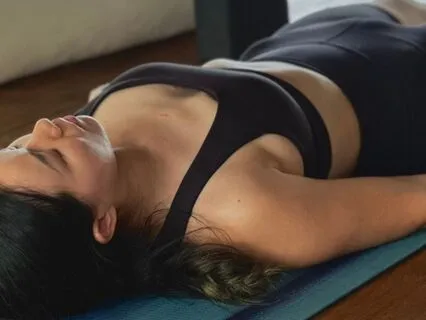
So slowly start to comfortably lie down onto your mats and begin to scan from the top of the head to the shoulders,
To the ribs,
Down to the hips and all the way to your feet.
The different areas of body which need to rest.
And do any micro adjustments needed in order to relax those areas.
So,
Each different body part completely rest and relax comfortably on floor.
Now after micro adjusting the different areas of the body,
The physical body start to become still and here where the inner body,
The mind can become more aware.
Since the external senses,
Specially your eyes,
They are completely covered or closed.
And this is where Yoga Nidra,
The yogic sleep which requires the restness of physical body but awareness and awakening of mental body really take a place.
Now first we need to make this state one,
Physical relaxation more depth.
Now first understand,
When you are laying in this physical relaxation position,
Savasana,
Each body part becomes so still that even you want to move those body part,
Your body refuse to move those body part.
They have sense of stillness,
They have sense of heaviness in them.
And in order to awaken or in order to deepen this sense of heaviness,
We have to start paying attention to the breath.
Now imagine what happening,
Whenever you are inhaling,
Your stomach is slightly rising up and whenever you exhale,
Your stomach start to fall and relax all the way down.
And you continue observe for couple of round,
The rise of your sternum,
Your rise of your stomach and the fall of your stomach.
And notice how it change the sensation of the body.
Whenever the stomach start to rise up,
Muscles around the body start to feel lighter.
And whenever you exhale,
The bones on your body start to feel heavier towards ground.
Each time this inhalation and exhalation becoming more softer and more calmer.
And you might experience,
The sense of exhalation is quite becoming long in every round.
And this exhalations actually allowing your body to become more still over time.
Your heart rates drop down,
Body start to come into state of relaxation.
Your nervous system start to relax down.
And here is the practice or here is exactly the practice begins.
You start becoming still with physical body and then you start to become more aware and alert by setting intention for your practice.
We call this part as Sankalpa,
A intention setting journey.
So it's time for us to set an intention for our practice.
It could be as simple as that today throughout the practice,
I want to feel relaxed but still very awake.
And try to repeat this Sankalpa to your consciousness at least three times.
For us,
If you don't have a Sankalpa,
You can repeat again with me.
Throughout the practice,
I want to feel relaxed but still awake.
Throughout this practice,
My body wants to rest.
But I want to remain very awake throughout the process.
Relaxation of physical body,
Alertness of mental body.
Since we already have set intention,
It's time to deepen this to state two,
More deep state.
In this state,
First you try to introduce your body to the external sound or the exposure of external environment.
The sounds which comes from different directions as further as away.
And instead of identifying the source of the sound,
Your goal should be identifying different sounds without attaching or judging to the source of the sound.
So try to hear all the noises around space.
Now notice how stillness and the sense of calmness is in around you.
In everything,
There's a stillness,
This calmness.
Now here exactly,
Your body is actually relaxing.
Your mind has become focused.
Your mind has become relaxed.
Those running thoughts,
The tendency of that monkey mind which fluctuates from different topics,
Different subjects,
Different thoughts and emotions have somehow stopped itself.
This is where more deeper layer,
Deeper states of yoga nidra such as scanning the body,
Rotating awareness on different area on the body.
In order to cultivate flow of prana on those areas,
Really begin.
Those areas start to heal themselves by just focusing and bringing awareness on those body parts.
So for this short practice,
Let's really quick start scanning.
First from down to your feet.
Pay attention to your both feet,
Specifically to your toes,
To your second toes,
Your third toes,
Your fourth toes and then your fifth toes.
Pinky toes.
And notice if you're really paying attention to these all areas,
They are radiating,
They are vibrating with such intense energy.
Even all these toes feel quite aware compared to the rest of the body.
They feel connected like a string of energy to each other.
Now move slightly upward to the whole feet,
Those heels,
The back of the heels which are touching the ground.
All those body parts start to feel very connected and aware.
More higher to both shin bones below your knee.
Now from the toes down below the knee,
Everything feels radiating and connected.
Now to your kneecaps,
Patella.
And this connection,
Move upward to your thighs,
Your quads and to the back,
Your hamstrings and your hips which are resting and supporting you on the floor.
This sensation of connectivity is moved down from the toes all the way up to your hips now.
So your lower body feels quite different compared to your upper body.
You feel more aware of itself.
Now pay attention to the stomach.
You don't have to change or alter your breath.
But just pay attention to the rise and to the fall of stomach.
If you become very aware,
You can even find separation below your ribs,
Below the sternum.
And notice how individually this belly moving up and down.
Even within every exhale you can feel sensation of deep relaxation from your lower back on the ground,
Within every exhale.
Then the chest area begins to feel more aware.
Now you move down to both shoulders.
To your hips,
The triceps,
The biceps,
The elbows and to your forearms.
To back of the wrist,
To your whole palm.
Now pay attention to specifically each thumbs,
Index,
Middle,
Ring and pinky fingers.
And if you really pay attention,
You also can find the sense of aliveness,
Sense of awareness to the tip of each fingers.
They feel very vibrating,
Very connective to the whole body.
Now awareness moves upward to your throat,
To the back of your neck.
And it moves upward the same way to the face,
To your lips,
Even the tongue which is resting on the base of the jaw.
The lips,
The facial skin,
The ears,
The eyes,
The eyebrows,
The nose.
And the equal inhalation and exhalation from both nostrils.
Even the forehead and the top of the head also feel connected.
Now if you notice the whole body is feeling quite connected from down to the toes to the top of the head.
Here actually body starts to self-heal as the cultivation of prana on different areas of the body is quite high.
By just putting attention and awareness to those areas.
And now sensory withdrawal,
The third state happens here.
Pratyahara,
The withdrawal of senses turned inward.
The most common,
The most easiest withdrawal happens from the nose and the ears.
Instead of your ears hearing outward,
They start to notice their own sound of breathing.
Each inhalation and each exhalation can be heard very clearly by your ears.
And I will let you observe this for one more minute.
Right now you are or you have entered in a deep state of relaxation,
In a yogic way of resting the body.
Slowly,
We will try slowly and very gently to break this stillness.
But in order to break the physical stillness,
First we need to break the stillness of breath.
Because breath and body is directly connected.
So first on your own,
Try increasing with a slight force of inhalation and a slight deep force of exhalation.
When you repeat this couple of rounds,
The belly starts to push upward,
A deep inhalation comes.
And belly starts to rest with a forceful exhalation.
And this allows small movements in your body to happen,
Like your toes,
They start to move.
Fingers,
Wrists,
And ankles start to move.
Breathing becomes more heavy,
But still there is a sense of calmness.
Then your neck moves side by side.
And then body starts to find a length and stretch by extending the hands to the back and toes and feet to point forward.
Then your knees,
They want to come closer to chest.
You hug your knees and you massage by rolling right and left,
Left and right,
Back and forward.
Then you choose a side,
The right to roll over,
Where your knees come again closer to your chest to hug yourself.
And you stay here for a couple of more minutes.
And you stay here for a couple of more breaths.
And whenever you're comfortable,
You push yourself off the floor,
Sit down with the crossed legs,
With the closed eyes in Sukhasana.
First you try to sit straight through your spine to keep the spine straight and tall.
Then,
To finish your own practice,
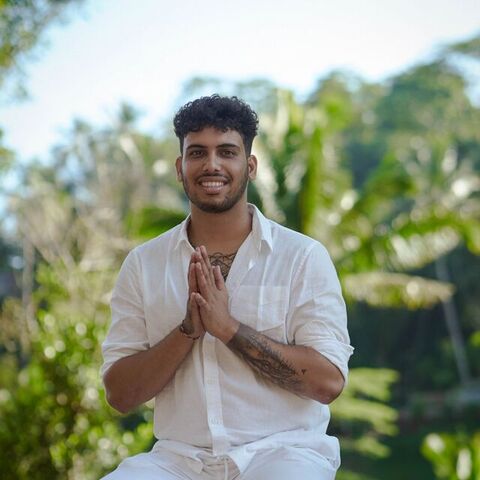
Your palms come to your heart center.
You try to remind yourself the intention of this practice.
Then you bow down the head forward to be grateful for yourself and to your practice.
Then whenever you're ready,
You relax your hands down on the thighs.
The head is still bowing down.
First the eyes open as you look at the ground.
Then you slowly reach your head upright,
Gauging at one point.
Taking a last inhale with the nose.
And you open your mouth as you exhale out.
Namaste.
That's it for this Yoga Nidra practice.
I'll see you guys very soon in another video.
Namaste.