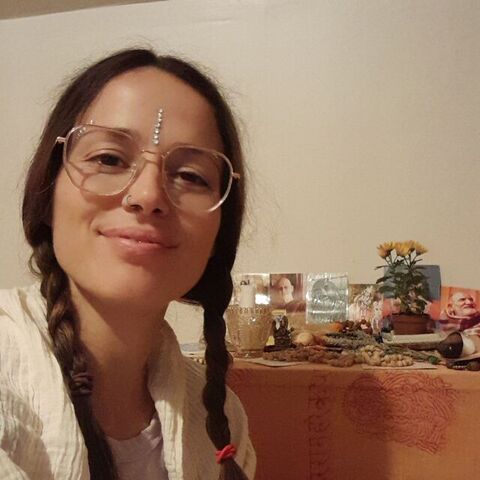
Welcome to the meditation.
I'm going to guide you a basic mindfulness breathing meditation so you can practice by yourself as well.
First of all,
Make sure you're in a comfortable posture.
Try to sit.
Be seated and you can sit cross-legs on the floor or cushion.
You can sit on your heels when in your knee.
You can even sit on a chair.
Just make sure your back is straight.
Your shoulders can go back and down.
Open your chest slightly so the breath can go freely,
Travel freely.
Make sure your back is straight but not tense.
You don't need to have a tense posture when we meditate.
We should find peace and relaxation.
But in a way that we are aware.
We don't relax in a way that we get sleepy.
So it's that awareness.
But if we are too tense when we start,
It's very difficult that the mind is going to relax.
Because the mind and the body are connected.
So just use props or a chair.
Anything that allows you to have a controlled posture with your back straight.
Close your eyes.
You can relax your hands and your knees or your lap.
We're going to explore the breath in three different points.
One is the nostrils.
You can bring the awareness to the nostrils,
The beginning,
The door of your nostrils.
Just to watch,
To feel,
To perceive the breath going in and out.
We're going to use a specific point of awareness.
So we're not going to watch the breath traveling in and out.
We're just going to choose one point.
So around the nostrils some people might feel more the breath in the upper lip.
So that is one option.
Just check how it feels for you.
If you can notice the breath there.
In and out.
So we're just going to explore the three points for you to understand which one is easier for you to perceive,
To feel the breath.
So now we're going to check in the chest.
Might be an easier point,
Might be not.
Just expand with the inhalation.
And exhale,
Watch the chest going back.
Inhale,
Expanding.
Exhale,
It goes back.
We're not trying to modify the breath here,
We're just observing your natural breath.
Just breath as it comes naturally.
It might change when you get relaxed,
It might change,
It might go longer,
But let it happen naturally.
And the third point is the belly.
So now inhale and feel how the belly expands.
And how the belly goes back.
Now we're going to start the second part of the meditation.
For that you have to choose one point.
Choose the one that you feel more comfortable with,
Choose the one that makes you feel the breath easier.
But try not to change the point of awareness.
Try to stick with it,
Because the mind can get bored and then can,
Maybe wants to change and play around.
We're trying to discipline the mind to be present,
To be focusing in one point and not wander around.
So if you choose the chest,
For example,
Try to stay with it in the whole meditation.
You can change your point in a different meditation,
But try to apply this discipline when you start.
Unless it's very uncomfortable for you,
Obviously.
We're just trying to avoid the mind to be wandering,
But of course we can make a judgment.
If it's too uncomfortable.
So the second part of the meditation is to be aware of the breath.
And be aware when the mind goes wandering,
When the mind gets lost in thoughts.
Which is going to happen,
It's a habit,
It's normal,
We all do that.
It's a habit,
Which is training our awareness.
When we catch ourselves thinking in the past,
In the future,
We just have to come back to the point of the breath.
We try to do that with compassion,
With patience.
It's quite natural.
Some people get frustrated when they realize they're lost in thoughts.
But here what we're trying to do is to celebrate.
Celebrate that you have caught yourself in thoughts,
And now you can choose your awareness,
You can choose where to put it.
You put your attention so you can bring it back to the breath.
And this is going to be a slow process,
Because it's a new habit that we are teaching the mind to do.
The habit of the mind is to wander,
And now we're just bringing it back to the present moment,
To here and now.
And that just takes time,
Patience and training.
That's why we meditate.
Every time you're thinking in something,
Smile,
Celebrate that you have noticed and come back to the breath.
You can practice this every day,
Just five minutes.
Maybe with time you can increase to ten minutes or fifteen minutes,
In order to train,
To develop this capacity of coming back to the breath,
To the present moment.
Allowing yourself to come back from stories to this moment.