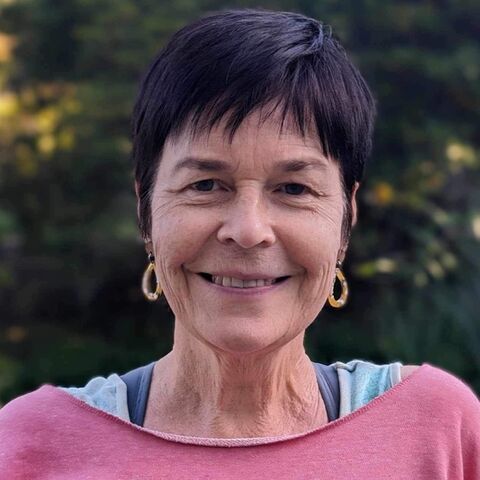
Recorded by MBSR teacher Adele Stewart live on Zoom in the Blue Mountains,
June 2020.
The background noise is the fire crackling.
Just taking a little bit of time to find yourself a comfortable reasonably upright seated posture.
Making some little movements to make yourself nice and comfortable.
Yet still having the intention to meditate,
So having some degree of uprightness in the posture.
Noticing any activity in the mind,
Thoughts,
Perhaps memories.
Noticing without needing to change whatever your mood state is right now.
Noticing the contact of the body.
Perhaps just noticing if there's any areas of the body that could do with a little bit of conscious relaxing.
Common areas are between the eyebrows,
The base of the skull,
The shoulders,
Between the shoulder blades.
The belly.
The buttocks.
Just noticing if there's any areas that perhaps you can breathe into just to relax that little bit more.
And allowing the attention to rest on the breath as gently as a petal landing on a pond.
Perhaps using that gentle,
Kind curiosity to notice where is the breath easiest to find.
Easiest to find today.
No need to strive at all.
This is a time to not strive.
Being,
Not doing.
Perhaps you've been doing a lot of meditation lately or you're quite calm and it's very easy to focus on the breath calming the mind.
And perhaps you've not been doing much meditation or there's a lot of stress in your life.
And it'd be quite natural that it might be a little bit more difficult.
No need to try.
Just watching with that gentle curiosity how it is to be with the breath.
And with the breath in a really physical way.
Noticing the felt sense of the breath.
No need to analyse it or imagine it.
Or manipulate it in any way.
Just lightly being with the natural breath.
Constant ebb and flow.
No need to try.
No need to try.
No need to try.
And while the breath is at the forefront of our attention,
Of course the mind will do what the mind does.
It will think.
It will be distracted by sounds,
By body sensations.
No need to block that experience out.
It's a part of the meditation.
It's gently and smilingly noticing whatever experience is there.
Bringing the attention back to the breath.
No need to try.
No need to try.
No need to try.
The breath is both a constant thread through our lives from birth to death.
And ever changing.
No breath quite the same as one before or one after.
And also connecting us to the outside world.
No matter how alone we might feel sometimes,
We are constantly connected to the outside world.
No need to try.
No need to try.
No need to try.
No need to try.
No need to try.
No need to try.
As soon as you notice your attention is on some other experience,
Congratulating yourself for being mindful and noticing.
Bringing the attention back to the breath.
No need to try.
No need to try.
No need to try.
Perhaps now you might be noticing,
Developing a little more steadiness of mind.
Mindfulness might be deepening.
Or perhaps not.
And you can continue focusing on the breath as we have been.
Or if it feels supportive,
I'll drop in a few rhetorical questions to help investigate that breath closer.
Really getting intimate with it.
These questions are not to be thought about.
Just allowing answers to emerge.
Maybe not even in words,
Just in a knowing.
Perhaps noticing the speed of the breath.
Fast or slow.
Is it regular or irregular?
Is it deep or shallow or a mixture?
Do you have a sense of the tonal quality of the breath?
Somewhere on the spectrum of alive,
Bouncy and springy.
And flat or lifeless.
Do you have a sense of texture or textures?
Smooth,
Silky.
Rough,
Ragged.
No need to label really,
Just noticing textural qualities of the breath.
Do you have any sense of different temperatures,
Perhaps in and out of the nostrils or in the throat or chest?
And any resistance to the breath coming in and out?
Perhaps you might notice what's the difference between the in breath and the out breath.
Is one longer than the other?
Is one more comfortable than the other?
As soon as you notice a thought,
See if you can catch whether it happened on the in breath or the out breath.
Maybe even if there was any difference in the breath caused by the thought.
Now breath can be such a great barometer of what's going on in the mind.
Perhaps you might notice the spaces between the breaths.
The little gap between the in breath and the out breath.
And the out breath and the in breath.
Is that a pleasant place to be or not?
Is that a pleasant place to be or not?
Is that a pleasant place to be or not?
Gently following the breath.
One half breath at a time.
Perhaps being really curious about the constant subtle changes.
Perhaps being really curious about the constant subtle changes.
Perhaps being really curious about the constant subtle changes.
Perhaps being really curious about the constant subtle changes.
Perhaps being really curious about the constant subtle changes.
Perhaps even having some sort of appreciation for this amazing thing.
The breath that just breathes itself.
And we can have conscious control over it.
Perhaps being really curious about the constant subtle changes.
Perhaps being really curious about the constant subtle changes.
Perhaps being really curious about the constant subtle changes.
Perhaps being really curious about the constant subtle changes.
Perhaps being really curious about the constant subtle changes.
Perhaps being really curious about the constant subtle changes.
Perhaps being really curious about the constant subtle changes.
Perhaps being really curious about the constant subtle changes.
Perhaps being really curious about the constant subtle changes.
Perhaps being really curious about the constant subtle changes.
Perhaps being really curious about the constant subtle changes.
Perhaps when the meditation is over,
As you go about your day,
You might notice the breath a bit more in daily life.
Knowing it's always there.
At any time,
Noticing the breath for 1,
2,
3,
10 breaths.
A simple breathing space during daily life.
A simple breathing space during daily life.
A simple breathing space during daily life.