Hi everyone,
Welcome to this mindful eating practice.
This is a practice that I enjoy doing with young children in classrooms and it's also one that I recommend families do together,
Either at the dinner table or at a picnic or just because.
So what you'll need is a piece of food,
An item to eat and commonly used for this practice is a raisin.
I use popcorn,
A piece of popcorn with students.
Today I have a prune just because that's what I have today.
So before we get started with this practice,
Let's settle ourselves using meditation.
I invite you to close your eyes if you're comfortable doing that.
And when we close our eyes it sends the signal to the mind that we're going inward.
It helps I think,
It helps the mind to relax.
However some people aren't comfortable with their eyes closed and that's totally fine.
Do what feels right for you.
So we begin by noticing our body in our sitting area.
Leave your eye a chair,
A bend,
A cushion.
We notice the area that's actually sitting.
Pelvis area,
Buttocks.
And we notice the weight.
Breathing in,
I know that I am grounded.
Breathing out,
I know that I am safe.
In order to bring ourselves to this present moment,
We also notice our feet and our legs.
One of those parts is in contact with the ground and that brings us more stability and it builds our foundation.
And I invite us to notice roots coming out of our sitting area and our legs and feet as if we're a plant growing from the earth and those roots are stabilizing us.
Breathing in,
I know that I am connected to this earth.
Breathing out,
I settle into the comfort of my sitting area.
So now continuing to use our breath as our mindful anchor,
Our meditation awareness home base.
Let's next notice our head.
Remember the posture that's a dignified back straight,
Head reaching the sky.
This posture is bringing us in contact with the sky,
The sun that nourishes plants,
That create the food that we eat and that nourishes us.
Maybe visualizing a string that is attached to the top of our head and that reaches up to the sky,
Allowing us to sit more straight,
More dignified or more alert.
That string goes all the way down through our body into the roots that are in the earth below us,
Let's take a couple more breaths to really bring relaxation and bring our minds to settle ready for our mindful eating practice.
At this time,
If our eyes are closed,
We can open them and take our piece of food in our fingers.
We're going to use the five senses first to get to know this item.
And I encourage us to bring curiosity and openness and almost as if we had never seen this object before.
We're going to get to know it through mindfulness.
We'll start with the sense of sight and look at all sides of this object.
You can move it from one hand to the other,
Twirl it around,
360 degree observation.
What do we notice?
Shiny or dull?
Wrinkles or smoothness?
Is it concave or circular?
What,
How do you describe your piece of food?
When you're ready,
We'll bring it up to our ear.
Maybe squeeze it a little bit gently.
See if there's any sound.
Stickiness,
Squishiness or nothing at all.
Incidentally,
I wanted to say that we're not playing with our food.
We're actually learning about our food.
Now let's bring it to our nose,
The sense of odor,
Of the odorous sense,
The sense of smell.
Maybe closing our eyes is helpful.
What do we smell?
Describe your food with a sense of smell.
Pungent or spicy,
Sweet.
And finally,
We're going to put this piece of food into our mouth.
But don't chew.
Let it sit there on the middle of your tongue.
Maybe move it around the tongue to the tip and to the back.
And what happens in the mouth?
Do we feel right away the saliva coming to start digesting?
In our mouth is the only place we have taste buds.
So when we eat quickly,
We actually don't get to taste our food.
That's why we're told to chew your food well.
So now we're ready to chew.
I encourage us not to take just two or three chews and then swallow them.
See how long we can actually keep it in our mouth as we're chewing.
Maybe notice what the tongue does.
The tongue is moving it around the mouth.
Finally,
It moves to the back of the tongue and goes down into my throat.
Let's close our eyes now and let's notice any remnant sensations,
Any senses,
Right?
Do we still smell it in our mouth?
Do we still have the taste of that food?
Are there any visuals that come to mind?
You know,
Sometimes we eat food and it brings back a memory from childhood or when we went to the store to purchase this item and maybe something happened there.
Our senses are very acute and they're linked to memory.
Whenever you're ready we can just take a few breaths.
You're just allowing this activity to just settle into our mind,
Settle into our body.
If you're willing,
I invite you to maybe notice the path that your food has just taken from the mouth,
Down the throat,
Knowing that it's going to end up in the stomach where more is going to happen there.
While we are in this state of curiosity and openness,
I would like to invite the story of this item of food.
So I'd like for us to think about where our food started.
Now,
All food,
Real food,
Food that's grown starts with a seed.
It starts with a plant and it starts with a seed,
But came first,
The seed or the plant.
That's a good koan to consider.
In any case,
Let's start with the seed.
Someone planted this seed in a field,
In a garden somewhere.
The seed was watered,
The sun shone,
Warmed up the soil,
And the seed sprouted and turned into a plant.
Do we know what the plant looks like of this food item that we ate?
Well,
My prune was a plum on a tree and a flower came first before it turned into a fruit.
A raisin comes from a vine.
It also had a flower that turned into the different grapes and then the grapes were dried like my plum was dried.
What about a popcorn kernel?
So that was also a plant,
Of course,
A seed and then a plant.
And it turned into an ear of corn,
A special type of corn.
And then what comes next?
So if we grew our own food,
Then we would know that we picked it,
Brought it home,
And so forth.
But if we bought it at the store,
Let's follow the path of the food in a commercial sense.
Either way,
They ate everything started in a garden or a farm,
But someone gathered,
Someone harvested this food.
And in many cases,
It's humans,
It's people who work hard to pick our food.
They deliver it to some kind of a processing plant or in a farm,
A small farm.
They deliver it to some central place.
And then it goes out.
It goes out into the stores in a truck.
Someone loads the truck,
Someone unloads the truck.
Someone puts it on the shelf in the store.
A person purchases it,
Someone from your family,
Maybe yourself.
Someone drove it home.
We're not done yet.
And it gets home and it has to be put away.
And in the case of my examples,
The popcorn was either popped and we brought it home in a bag or maybe we popped it at home.
And the raisin came in a package.
We put it on our cereal or whatever,
However way we eat the raisin.
And my prune was in a bag as well.
It came home and finally came into my mouth.
So at this point,
I'd like for us to bring gratitude to the path of our food and how it gets to our body and nourishes our body.
So again,
Let's bring ourselves into a meditative posture,
Meditative state of mind.
Noticing our body,
Noticing any lingering sensations of having eaten something.
Bringing to mind the story that I guided you through for identifying the path and the story of our food.
I'd like to ask and invite us to bring a smile to our face and visualize some image that represents the story of this food that we ate.
Do we visualize a person harvesting it?
Do we visualize one aspect,
Maybe the truck person who bought it?
Or can we make in our mind a kaleidoscope of all types of images that have to do with this item of food that we just articulated together?
So let's take a few breaths in silence with gratitude.
Notice the kaleidoscope of our food,
The kaleidoscopic story of our food.
A little smile on our lips,
Bringing gratitude inward and outward.
Breathing in,
Grateful for this food that nourishes my body.
I'm breathing out,
Sending gratitude to all,
All parts of the story of this food,
All those who touched in one way or another this food.
Gratitude for the different forms of life,
For those who made it possible for us to eat this food.
So if you will join me if this is comfortable for you to put our hands together at our heart,
A gesture of gratitude,
A gesture of kindness.
And with compassion and gratitude,
I thank you for joining me in this mindful eating practice.
And I encourage and welcome you to bring this into your family.
You can do this at the dinner table,
Lunch table,
Breakfast table,
Snack table,
Picnic table.
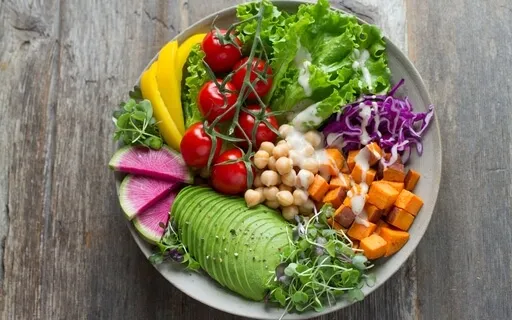
You can start your meal with just noticing the colors on your plate,
Picking one item and telling the story of that one item,
One food item,
Green beans,
Lettuce,
Meat.
And maybe each person going around the table and picking one of the items on the plate and saying something about it,
What they,
What they notice using their eyes,
Using senses of smell.
And then maybe all the whole family or the group can take a bite of a piece,
You know,
One bite,
One spoon,
One small,
Even a half a spoon,
Put it on their tongue and notice what happens in the mouth.
Notice the taste and then gratefully chewing and swallowing.
I hope you'll bring this practice into your day,
Into your family,
Into your classrooms,
To groups,
Into potlucks.
And thank you.
May all beings benefit the merit of this practice.