Hello everyone,
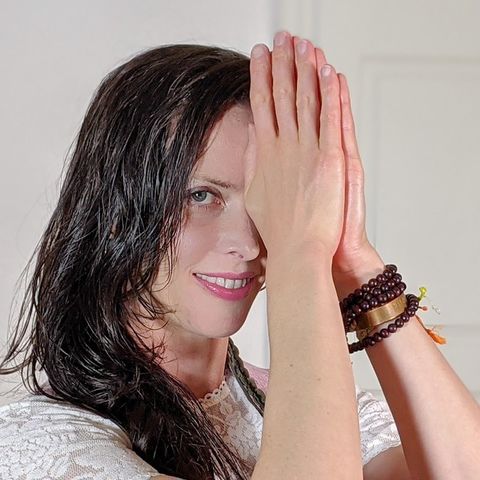
My name is Caroline Wirtle and today I would like to talk about yoga nidra,
What it is,
What it can do,
What fascinates me about it and is there any scientific study or evidence what it does to our bodies.
So how did I get into yoga nidra?
It was actually a couple of years ago,
Maybe six,
Seven years,
I was in Zurich attending a yoga workshop and there was another yoga teacher during lunchtime,
We got to talk and she said listen,
I have children and I'm always lacking sleep.
So I got into the habit of having one yoga nidra session,
20 minutes,
Half an hour at lunchtime and it even became such an integral part of our daily routine that even my kids know that during 12 and 12.
30 I'm not to be disturbed,
So the doorbell rings,
They would answer like mommy is doing yoga nidra or answer the phone saying mommy is doing yoga nidra and is not to be disturbed and so she said she can't do without because it's like the equivalent of four hours of sleep and so I was really like whoa and being busy and traveling and working a lot I was also always a little bit lacking sleep or not sleeping well enough,
Having trouble falling asleep,
You know the drill,
So we can't really relax and things start to turn our heads.
So I tried yoga nidra and what what was what I experienced,
What got me hooked on yoga nidra was that actually the relaxed and refreshed state.
You just feel amazingly light after yoga nidra sessions,
It's like your body is so much lighter,
You really relax,
All this tension falls off,
You're not in this busy busy state anymore,
Like okay what do I need to do next,
To-do list and phone calls here and there and so it really relaxed me in a way that I got out of the yoga nidra session and was like okay what's next but with a much calmer approach and it's not the same when you get up in the morning because you're still in this half sleepy state,
Still a little bit tired,
You need a coffee and after yoga nidra you're not tired,
You're the opposite,
You're calm and awake and refreshed,
So that's what really,
You can get addicted to this feeling.
Sometimes I'm doing more than one yoga nidra session a day because it's just so amazing and the other thing that really caught my interest is the sankalpa,
The resolution that you do in the beginning of the yoga nidra session and you actually repeat it after the relaxation,
You form a small positive sentence in your mind that you repeat three times and I didn't know what it really was and how it worked but I pretty clearly understood that it has a very directional character and it makes you become very clear about what you want and what you want to achieve because you feel this is something important,
This is something that could really work and out of my own experience it does work and that's what the yoga nidra theory or the textbooks say,
That you can achieve anything with your sankalpa,
With that resolution,
That seed that you're putting into your subconsciousness and so these two things,
The refreshed state,
The really like making up for missed sleep and this sankalpa got me hooked and so let's dive a little deeper in what exactly is yoga nidra and it's a dynamic sleep.
Nidra means sleep and we're switching off our consciousness,
Our making,
Doing mind and our subconsciousness remains receptive.
Our subconsciousness is always receptive so we're basically switching off the layer of the consciousness.
You do it lying on your back,
Your eyes closed and we're trying to reduce stimulation with the way we lie on our back,
Neutral position,
Neutral spine,
You can cover yourself but mostly you turn your hands up so the fingertips don't touch anything so you get at the least stimulation possible and since you can't really switch off sounds,
It usually starts with drawing the senses inwards and getting your mind detached from these sounds that are always so interesting to us,
Like listening to what's going on and oh my god there's so much noise or someone's shouting or car horns,
So it usually starts with this drawing the perception inwards and this happens either through breathing or through the awareness of the support of the body supported on the floor and this voice that leads the yoga nidra meditation is usually trying to have you do things in a relatively quick succession so your mind doesn't start thinking and it doesn't really matter if you're not doing it all or if you kind of fall asleep or drift away a little bit,
At least if you don't start thinking,
You're still doing yoga nidra and i especially when i'm really really tired i always fall asleep sometimes it just takes me five minutes and i'm gone i'm asleep and i wake up at the end like the session of yoga nidra is now complete that's when i wake up but this is still fine it's okay when your body needed to sleep and your subconsciousness still followed the practice so it's not a concentration that's why the voice is relatively fast and gives a lot of instructions and so after the withdrawal of the senses from the outside world to the inside world we do our sankalpa and it really is a positive intent and after reading a little bit about it what kind of sankalpa would be a good sankalpa or are there any bad sankalpas i have a couple of examples for you for example i awaken my spiritual power or i am a positive force to others i am successful in everything i begin i am conscious and purposeful i am perfectly healthy i am full of life and good ideas so beginning with yourself i am also the present tense is really important so not i will be or i will have but it's basically you're stating a fact about yourself in something like a general very positive short sentence and do avoid to include other people or other things like um i have or i am with someone or these kind of things so don't include other people always focus on yourself and try to formulate it as generally as possible if you want a relationship so don't say i want a relationship with this and that person but just say i am having a relationship or i am having a wonderful relationship or whatever you are aiming for um so these would be great sankalpas and the idea is to keep them for a few weeks or even months until they become true until they realize themselves so don't use a different sankalpa every time but use the same one over and over again until it manifests so after we do our wonderful sankalpa we um first we clean the body so this is um what i think is what gets us into this refreshed state into this deep physical relaxation and this is the body scan or the circling of the perception through the body and it's done in a certain way you should always begin with the right thumb circling through the right side of the body ending with the right little toe then going over to the left side same thing left thumb ending with the left little toe and then uh going to the back of the body and this is where we switch from right to left so right heel left heel right calf left calf in kind of a quick succession and this is also connecting the two hemispheres of the brain and um i think this is already leading to some kind of emotional um normalization it normalizes your emotional world connecting um your emotional creative brain side with the rational brain side and then we come to the front of the body and then we do the whole body so whole right leg whole left leg whole right arm whole left arm etc and uh this is when sometimes you just fall asleep because it's kind of monotonous but it's also a great way to really get your body calm down and relax it becomes a little bit of an automation and when you do it you should direct your energy to that specific part of your body i sometimes say you can breathe into it um but just putting energy into it is enough you don't need to move it and in in the textbooks it says it cleans the nervous pathways towards uh these parts of your body organs muscles um so and it also cleans uh the parts in our brain that stimulate or direct these parts of our body and um i think this is a fantastic way that helps us to also rejuvenate and clean ourselves um then after this body scan there's certain things that you can do sometimes they're done in yoga nidra sometimes not depending on how much time you have or how long the meditation is you can then add an emotional release or an emotional relaxation with coupling images this is a visualization technique where you have images that represent emotions like um fear or anger couple with positive emotions of joy and security and you do this in relative quick succession that you put yourself into that image and feel feelings of compassion and gratitude rather than anger and greed and hate um yeah it's a very strong uh word but you and this is um kind of evening out your emotional structure it um you become more relaxed from an emotional point of view more neutral in some way so you kind of get your levels down to a normal level and this is all happening without you really wanting it you don't need to tell yourself i don't want to be angry anymore so it's just happening in your subconsciousness via this wonderful visualization technique and your subconsciousness is just processing images basically that you're not really aware of in your consciousness so your subconsciousness is doing um the whole work the whole time and you don't even realize that you just feel more normal more balanced happier satisfied it's uh it's a great way uh very subtle and soft emotional release um and then you can follow with a mental relaxation um these are usually images that are very general um depending a little bit also on cultural background this can be a laughing buddha playing children laughing children uh blossoming trees a sundown sunrise waves on a beach so all kinds of positive visualizations and images that also your subconscious mind will process and do connections with your own imagery your own memories your own experiences and basically processes it it says um so in the textbooks they say we're burning uh through um some scars and some scars are basically our own habits or you know something that limits us because um we we're afraid or we have memories of something that are compulsions and um these visualizations of images that your subconscious mind connects to processes it burns through it releases it um it's a great way to get rid of these compulsions or restrictions in your um behavioral pattern um this is really deep right now but it actually it is it's so much more than just a meditation and a relaxation and the um this mental relaxation always ends with positive images um and i sometimes add or replace this with a dream journey like walking through a forest and then reaching a temple for example or walking through a winter wonderland and then finding a lodge and entering the lodge and there's warm warm fire etc and so this is this um journey is kind of a journey to yourself so the temple or the lodge represents our inner self so we're entering our inner self that we fill with positive energy with positive feelings emotions um we take the time to look at ourselves um to be aware of ourselves to feel us to see ourselves and to then arise back from this point of safety and security um back into the real and outside world so i try to construct these dream journeys from the perspective of retreat into our own personal temples and um basically filling ourselves with the awareness of ourselves and self-love if you want so so then uh there's a repetition after what you could call an emotional mental and physical relaxation um depending how it's constructed i would always do the body scan and then you can add the emotional and mental relaxation or the dream journey um we repeat the sankalpa the resolution the same one from the beginning three times and then it's basically time to get out of the dream um even though we would like to stay there forever and remind ourselves of our breathing remind ourselves of the body uh imagining the body lying there so getting our outward senses back um hearing breathing maybe smelling and then slowly starting to move hands and feet and opening the eyes and getting up and then the session is complete and um so there's various forms of yoga nidra and there's even some more purposes that i found that yoga nidra is used for and that's for uh increasing memory which i think is extremely interesting um so if during yoga nidra you remember what you did yesterday a week ago or months ago you can basically improve your memory or your how you experience these situations if it's something you really want to remember because it's amazing like birth of a child or your first kiss or something um and you want to remember it you want to cherish it then remembering it doing yoga nidra would be a great way to keep it in your present um memory and also uh learning languages or learning whatever so if doing yoga nidra someone reads something to you like the spanish vocabulary or the physics textbook um then you that's the theory i haven't tried that one yet but i will um and if you then read it during the day while you're conscious you make the connection between that subconscious information and your conscious mind and you'll have it available in your conscious mind and this is like a hack it's like a memory hack so this is something i recommend you to try of course you will either need to record your own meditation for it and get you into yoga nidra state first or have someone read it to you or speak you through it and um there's even a use for healing if you are meditating and concentration or concentrating focusing on different parts of the body for healing um basically reinforcement of sensations of positivity energy compassion security and then focusing this light um or bathing parts of your body in this light uh this is especially good for healing um so what exactly is happening doing yoga nidra do we have any scientific evidence studies and yes we do so we can measure brain waves for example in yoga nidra state um and uh normally we are in um better brain waves this is like the activity state and doing yoga nidra the brain switches to the alpha waves and um this is known for the for this moment between sleeping and waking um and this is also where we relax or recover actually the most doing uh while we're alpha waves so the um the alpha state when we remain alert and conscious in that alpha state we can gain deep and complete relaxation and it's actually more effective and pleasant than normal sleep and uh as so it says a gateway to a higher level of consciousness are basically opening the third eye staying conscious in that alpha state is what yogis try to achieve with the meditation so also in that way yoga nidra is like a meditation hack if you want so that gets you to that higher level of consciousness faster than you might with meditation especially if you're struggling with it um so so we have a really high quality of rest during yoga nidra even if you're not interested in any spiritual or higher level of consciousness and it refreshes the body and the mind um so why does it refresh the body and the mind and the the thing is that we have two different nervous systems we have the sympathetic nervous system which is um our active action fight flight making doing running around stressing thinking um this is the sympathetic nervous system and the parasympathetic nervous system is the one responsible for digestion repair processes immune system response and we usually in a stressful state we over emphasize doing and making and we fart a little in the parasympathetic mode and this can lead to imbalances in for example hormonal composition or chemical composition of the body too much stress too much blood pressure and um too little repair and too little immune response and this is usually when people say oh i went on holidays and i was ill i was sick the first week because then people switch off get into the parasympathetic nervous system and then the body says oh well okay now we're getting there now we can start repairing and actually dealing with what we accumulated and this yoga nidra is like um a little holiday and while switching off the parasympathetic nervous system switches on so during yoga nidra the body gets the message to now is the time to repair to discharge waste products to fight viruses and bacteria so the immune system can work properly and um so so especially for people fighting with high blood pressure stress um the um effects that hormones like adrenaline and cortisol have on our body this is a good way to wind down and also organs need that deep physiological state of rest and relaxation too so they can have uh set these regenerative mechanisms in motion and this actually arms us against stress it makes us more resistant against stress we're not stressed from so much anymore we're not on edge anymore um so let's see what the scientists say and so it's been found to decrease signs of neurotic or compulsive behavior it improves power of concentration it increases mental and psychological well-being and it releases healing energies and i think we now understand why that is healing energies our immune system repair processes it also changes the frequency of electrical rhythms in the brain the alpha waves it decreases the heart rate and systolic and diastolic blood pressure basically the heart needs to work less it changes the circulation of the stress hormones adrenaline and cortisol and those hormones are actually quite destructive for the body so we kind of eat ourselves up when we are under stress and we have a decreased sympathetic that's the excited nerve activity and we also have an increased galvanic skin resistance which is a sign of increased relaxation and this skin resistance nobody really knows or at least i haven't found what this is um scientists have just found that it increases with relaxation and it decreases with stress and we find the same pattern during yoga nidra the skin resistance increases and i'm no expert but i find this to be like a little shielding maybe i'm wrong but to me this sounds like the body's shielding is increasing against environmental effects and now from a psychological perspective it is successful in the therapy of anxiety neuroses and also in long-term disorders it even help people with severe disorders and they can then actually practice alone and are not dependent on a therapy session anymore so it's a great way to do something for yourself independently from a therapist it also helps with depression probably not with all types of depression but depression is probably being related to anxiety stress suppressed feelings um this i guess we now understand can be really helpful um so it says that deep-seated conflicts and tensions are resolved through yoga nidra and this happens with these visualizations and this emotional relaxation it also says that excessive consumption of coffee cigarettes alcohol and drug decreased on its own without even trying to for people who regularly practice yoga nidra and um so last question would be how often should i do it and the answer definitely is regularly um so you get used to it you get on on something like a a good path like an you build on what you've achieved the next day so if you can do it every day that would of course be perfect but also if you do it every second day or every week that's already really really helpful um i tend to be not so regular i sometimes do it once a day and then only once a week and this is also fine we all have our daily lives and we're busy but always try to think about it and like plan it that okay tomorrow on the weekend i can do yoga nidra again doing it every day at lunchtime of course uh would be ideal so your body gets used to it you have a little bit of a routine and it also says not to do it too late during the day so you don't compromise on sleep because you're so refreshed you might not be able to sleep afterwards um however if you're really really tired it actually says you can do it any time of the day um i sometimes use it for falling asleep because it just gets me into that alpha state that i just can switch off and then you're gone um sometimes i forget to not auto play or repeat and then four hours later i wake up to listening to the same track um yeah so these are all things that we learn with the yoga nidra how to how to switch the phone off after the meditation is complete so that it doesn't continue playing um yeah so so practice experience your own yoga nidra of course find your own teacher the voice you like to listen to the progression you like to do and especially look for someone diving deeper doing the body scan and diving deeper into the emotional and mental relaxation because i think this is where we benefit then the most um yeah so enjoy have a good time stay safe take care of yourself and i hope this was helpful for you and i'll see you all next time bye