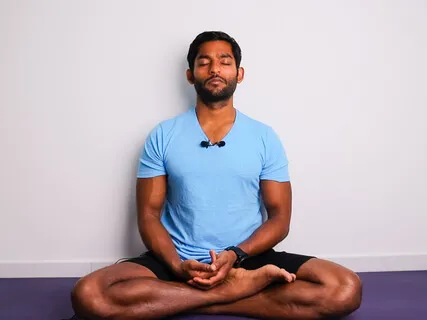
Namaste and welcome to this daily life meditation session with me,
Dhyansi.
30 minutes every morning with me in these sessions of contemplation of meditation will take you one step closer to peace,
To silence,
To harmony,
To love,
Compassion,
And one step closer to putting our life back in order.
It doesn't matter in which situation you are in life,
What we are discussing,
What we are going through in these spiritual moments,
In these meditative moments are going to help you today or tomorrow.
We'll come back to you,
We'll become important for you at some point in life.
So if you already put in 30 minutes,
If you lay the foundations of spirituality,
Of meditation in your lifestyle,
In your daily life,
It will go a long way.
We right now are on the hills of Tibetan Buddhism with Atisha and acclimatizing ourselves to what all this spiritual world is about,
What all meditation is about.
And Atisha is a perfect start.
We right now are on point number 3 where Atisha is expounding on how to convert adversity as an opportunity for awakening,
As a chance to convert everything into the path towards enlightenment,
Towards pure consciousness,
Towards being who we really are in the truth,
In nature.
Let us go through what Atisha says and then I'll dive into today's sutras.
Atisha says,
When beings and the world are filled with evil,
Transform unfavorable circumstances into the path of bodhi.
Drive all blame into one.
Be grateful to everyone.
The unsurpassable protection of emptiness is to see the manifestations of bewilderment as the four kayas.
An excellent means is to have the four provisions.
In order to bring any situation to the path quickly as soon as it is met,
Join it with meditation.
You will enter the sutra which is focused on emptiness,
On the manifestation of confusion.
Let me repeat what Atisha says.
The unsurpassable protection of emptiness or Shuneta is to see the manifestation of bewilderment as the four kayas.
Let us pay attention to the fact that Atisha is directly expecting us to understand that we need to protect the emptiness.
We need to protect the Shuneta that we have in us.
So he is already expecting a lot from us.
Some of us may not even have experienced inner emptiness,
Inner Shuneta.
When I say emptiness,
When I say Shuneta,
It doesn't mean the absence of things.
This emptiness that we understand as the absence of things does not apply to the inner world,
Does not apply to the spiritual realm of things.
Inner emptiness,
The state of Shuneta,
Is a kind of a presence.
It is nothingness.
It is,
In a way,
You can say,
The absence of thought,
The absence of contents in our consciousness,
But it is also the presence of pure consciousness.
So a thousand ways to say the same thing again and again and again.
This pure consciousness,
This emptiness,
This Shuneta,
Absolute silence,
Absolute awareness,
Is what is the game,
Is all the aim and is what we need to protect.
And in this Sutra,
Atysha is warning us and helping us to point out when we are confused,
When there is an illusion,
When there is a Maya of illusion on our eyes,
On this pure consciousness,
When we do not recognize ourselves as pure consciousness,
As this emptiness.
Why does that happen and where to find the clues,
Where to see,
How to see that we have this confusion,
That we do not see ourselves as this pure emptiness.
Until we recognize ourselves as emptiness,
Until we protect this emptiness,
There is a sort of confusion that we cannot explain.
And Atysha is trying to classify this confusion by saying that look for the answers to this confusion in the four kayas.
Kaya means embodiment,
Means a body that is given to something.
And we,
As we are,
We are also embodied with several layers,
Not just the physical,
Not just the mental,
But this is a way to look at oneself.
So don't take it literally,
Don't take it and start conducting scientific experiments with it to validate it.
It is a way to look at oneself.
It is a way to slice the existence and see who we are,
How we are constructed,
Where is the truth lying,
Where is the confusion lying.
So let us look at how Atysha is slicing the kayas,
The embodiment of this manifestation that we call as ourselves.
Atysha says the first kaya is swabhavika kaya.
What does swabhavika kaya means?
The embodiment of the default program.
You can think of it as when you buy a new phone,
It comes with the default programs.
And we all know how much of these default programs are useful.
So swabhavika kaya,
Meaning our default programs,
Is something that creates the confusion.
That we,
When we are confused,
See that one layer of confusion is coming from these default programs that we carry along in us from our very birth to our very death.
It is that embodiment which is known as swabhavika kaya from this Atysha's way of explaining what embodiment is,
What kaya is.
You can,
If you wish to,
You can see this in very simple terms,
Your body as the representative of swabhavika kaya.
Your body is what creates the confusion.
Because the body is also coming along with default programs.
If you see when we are born to how we grow,
How our body grows,
We don't have much to say in that.
It happens on its own.
It has a certain default program.
If a person is short,
He's always going to think that he's short.
If the person is tall,
He's going to always have this experience of the body which is tall.
So there is a sort of a default that is set and that also creates confusion about who I really am.
What is my true nature?
Am I this pure consciousness or am I this tall body,
Short body,
Fat body,
Thin body?
Everything that comes along with the body with the default program.
Then the second slice,
The second kaya which Atysha brings in is sambhogakaya.
Which means the experience program.
All the experiences that we have gathered in our life,
All from the birth to wherever you are in your life right now.
That collection of experiences,
The sambhogas is what also starts creating confusion.
It doesn't let you be in the present moment as you're hearing me,
You're also hearing from all the experiences that you had in the past.
It doesn't let you hear me right now directly and that creates confusion.
That doesn't let you fall into clarity with rest.
And that's what Atysha says as sambhogakaya and that's where the confusion can lie.
You can see this as the experience embodiment or if you want one word,
It's your perception.
Your perception is built on your experiences from the past and that's something which also creates confusion and you need to go beyond your perception.
To see the truth,
To understand,
To realize your true nature which is pure consciousness.
The third layer which Atysha proposes and says is nirmanakaya.
Which is the ability to manifest,
To ideate,
To create,
To think,
To have emotions,
To have this sense of creation.
This is representative in very simple words of our mind,
Of the thinking process.
And Atysha is saying this is what creates most of the confusion.
This nirmanakaya in us,
This embodiment of creating something all the time,
This trying to interpret,
Trying to analyze,
Trying to make conclusions,
Trying to judge things which our mind is constantly doing all the time.
This comes into the way of you and the truth,
You and your realization of being pure consciousness.
And the fourth which is Atysha says dharmakaya.
It's slightly difficult to understand,
It can have several meanings,
Several interpretations.
I see this as the embodiment of what we call as self.
Meaning,
When you take the layers of perception of body,
Of mind away,
Still there is something left which we call as self.
Which sometimes we call as I,
But if we strip off all the layers of the I,
Still there is this sense of I,
Which we may consider as the truth.
If we stop,
If on our spiritual inner exploration,
If we stop,
Then we can call that self as the truth,
But that's not where the journey ends.
This self,
This sense of self is also an embodiment,
A manifestation which is an embodiment and we need to go beyond that.
This embodiment is also creating the confusion that I am this self.
I have this purpose,
This self has this purpose,
This dharma in this world.
So out of this sense of self,
A sense of purpose arises,
A sense of dharma arises which creates this dharma,
Kaya,
This embodiment of the self.
And in meditation,
In our silence,
In our journey towards emptiness,
Towards Shuneta,
We have to even cross that realm.
We have to even escape this realm.
You can see this as different layers in the atmosphere that you have and while you are in a rocket with the escape velocity,
You have to pass through all these realms and don't stop in the middle.
If you stop in the middle,
You'll get stuck,
You'll get confused,
You may fall back,
But you will never be able to cross all these realms and reach the emptiness.
Of what's outside and what's inside us,
Which is pure consciousness.
I would like us to reflect on these four kayas in our meditation today,
In our silence.
All you need to do is observe these four embodiments,
These four kayas in your own inner world,
In your own experience and don't try to create a science out of it.
Don't try to analyze it too much,
Don't try to judge it too much,
Just observe.
See that your confusions,
That your illusion that you have which is not allowing you to see your true nature,
Which is not allowing you to be at rest when you sit in silence or when you sit in any situation.
Why is your mind not at rest?
Why are you all over the place?
It's because of these confusions and you see these in your meditation today and from there on move into silence.
Please close your eyes.
Sit in a posture that is comfortable for you.
With your back straight,
Shoulders down,
Head straight,
In a relaxed face.
As you bring your awareness inwards,
Allowing your body,
Your mind to settle.
Take a nice deep breath,
Inhale from the nose and exhale from the nose.
And with that,
Let go of your body,
Let go of your mind,
In awareness,
Brightening,
Settling in your inner space.
Awareness and attention on your body.
Simply observe the state of your body,
If it's rested,
If there are any sensations anywhere.
And acknowledge this.
And acknowledge this layer of kaya,
The embodiment as the physical body,
Which comes along with its nature,
With its default programs.
If you're liking something,
You're disliking things,
You're being at rest or slightly in sensations.
Howsoever your body is,
Acknowledge,
Observe,
Remain aware.
Move on to the second kaya,
The Sambhoga kaya,
Which is the embodiment of experience.
Your sense perceptions right now.
Your attention on your sense perceptions.
What you see in front of your closed eyes.
What you hear.
What you smell.
What you taste.
And what you feel on your skin.
Awareness on your sense perceptions.
Move on to the third kaya,
Your mind,
The Nirmana kaya.
And see how thoughts are rising and falling,
What all is being created and destroyed as thoughts,
As ideas,
As plans in your mind.
All the images,
Fragments of voices and non-verbal movements in your mind.
All the images,
Fragments of voices and non-verbal movements in your mind.
Don't try to change anything.
Simply remain aware of your mind.
And move to the fourth kaya,
Which is this sense of self,
Dharmakaya.
This sense of I.
Beyond the body,
Beyond the mind,
Beyond the perceptions.
This sense of self.
And now leave all focus,
All attention.
Simply remain silent and aware for another minute.
And now leave all focus,
All attention.
And now leave all focus,
All attention.
And now leave all focus,
All attention.
And now leave all focus,
All attention.
If you wish to stay in this silence,
Please continue with your eyes closed,
Maintaining this awareness,
This silence.
For some more minutes,
Or very gently and slowly,
You may open your eyes.
And take this sense of awareness,
Silence,
In your reflections from the meditation in your day,
What doesn't allow you to realize your true nature,
Remain centered in your true nature as consciousness,
What doesn't allow you to remain rested in the emptiness.
Observe that during the day.
I'll see you tomorrow.
Namaste.