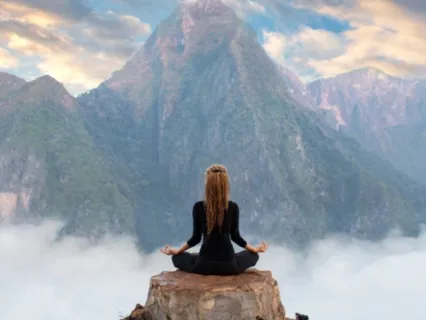
So taking a moment to find a posture that you can sit in,
In an alert yet relaxed fashion.
So this might be sitting on your meditation cushion,
This might be sitting in a chair.
And taking a moment to really settle into that posture and starting by just becoming aware of the point of contact between your sitting bones and the surface that you're sitting on.
And you might even rock a little back and forth,
Left and right,
Just settling into the posture and a sense of stability.
And then allowing the back to be erect and yet not stiff.
And when you're ready,
Allowing the eyes to close or the gaze to fall softly in front of you on the floor.
Starting in this new sitting position,
Becoming aware of the breathing body.
And then bringing the attention to the sensations of breathing.
So following an in-breath in and noticing how the belly rises and how it then relaxes again as the breath goes out.
And then just noticing where you feel the breath the most,
So it might be in the belly region,
It might be the chest as it fills.
It might be sensations of temperature as the air flows in and out of your nose.
If you're having difficulty finding that spot,
That's not a problem.
And perhaps just bringing the attention to the belly region for whatever there is to notice of the breath.
So you've attached your attention to the breath.
We almost there.
.
.
And you're likely to have noticed already how quickly the attention wanders off.
Like a curious puppy exploring everywhere,
It gets distracted by sounds,
By thoughts,
By memories.
And each time that you notice that the attention has wandered off,
You're almost noticing where it's gone to,
And then gently bringing the attention back to the breath.
Noticing how each breath comes in,
And there's a little pause at the end of the in-breath before the breath becomes the out-breath again.
Then the breath flows out,
And then there's a pause again right before it becomes an in-breath.
Ever flowing,
Ever changing.
And the breath just breathes itself.
There's actually no need to control it here,
No need to change it.
Breathing is a process that happens very naturally without any conscious effort.
And here we just practice noticing and being aware of that breath.
.
If the mind has wandered off,
Where is it?
You notice wherever it's gone,
Knowing that it's not a failure or a problem,
This is just how minds work.
And then you bring it back to the sensations of breathing,
Wherever you feel them the most.
.
.
.
.
.
.
.
.
.
.
.
.
.
.
.
.
.
.
.
.
.
.
.
.
.
.
.
.
.
.
.
.
.
.
.
.
.
.
You have a couple of options.
You could decide to allow the sensation to become the object of your attention.
So shifting the attention from the breath to whatever the sensation is.
Seeing how it changes.
Exploring it.
Bringing that curious attention to the sensation.
And then of course the second option would be that you make a decision to mindfully move.
So you bring your attention to the intention to move.
To the movement itself.
And to whatever results from that movement.
And in both of these ways you can allow the uncomfortable physical sensations to become a part of your practice.
Whatever you decide,
Take good care of yourself.
This comfort is not always a bad thing that has to be gotten rid of immediately.
But there's also no need to subject yourself to unnecessary pain or to hurt yourself.
And of course physical sensations can also lead to thoughts.
And if that happens,
There's many reactions in the mind,
You can always return the attention back to the breath.
So bringing the attention back to the breath.
And watching its ebb and flow.
Anderson is someone I always told I started as And in the same way that you can bring the attention to physical sensations,
You can also bring the attention to your other senses.
So bringing the attention to the sense of hearing,
Registering the sounds as tones.
Almost like your microphone just picking up sounds.
Not getting lost in the stories that come up around the sounds or their reactions,
Irritation.
Just allowing the sounds to come to you.
Just by the way.
Each sound is in the room.
The sound is above you.
To the left.
And to the right view.
And you can even register sounds very close by.
The sound of your own breathing.
Or the sissing in your ear.
Maybe you can even hear your heart beat.
And of course here too you can also bring the attention back to the breath.
Following the breath in,
The chest rises,
The belly expands.
The body relaxes again as the breath flows out.
And just so you can register sensations or sounds,
You can also register thinking.
And for this a metaphor might be helpful.
You might imagine sitting on a hill watching the sky,
Watching the clouds pass by.
Sometimes there's one,
Sometimes the clouds are filling the sky.
Sometimes they're moving quickly,
And other times quite slow.
And some days they're quite large and dark.
And other days they're light and fluffy.
So in the same way that you might watch clouds passing by,
You can do the same with thoughts.
The thought arises,
It passes by,
And it dissipates.
So you can observe thoughts without getting caught up in them.
And then this way too,
The thinking can become part of your practice.
And you also might find it helpful to label your thoughts.
And then you say,
Oh,
There's my to-do list.
Yeah,
Thinking about the past.
Oh,
There's worry.
Or if there's lots of thoughts,
You might just say many thoughts.
That's how it is right now,
Many thoughts.
And of course there's also thoughts that are so strong that you get carried off into the stream of thinking.
Just in the confidence of the thoughts.
And if you find it difficult to return to observing the thoughts,
You can always return to the breath.
Anchoring the attention and the ebb and flow of breathing.
And so in the same way that you can observe sounds.
Thoughts.
You can also observe emotions and moods.
You might notice that there's a particularly pleasant or unpleasant or neutral mood.
You might notice that a mood comes with certain thoughts.
Or even that a mood has its place in the body.
They say the body knows our moods before the mind does.
And so if you find the spots in the body,
Or whatever mood there is and wherever you notice it,
You can always explore breathing with it.
Breathing into,
Breathing out of the space.
And then here too you can return to the breath without getting lost in whatever mood there is.
We notice it.
We label it.
Breathe with it.
And we return to the sensations of breathing.
Whoever they're most noticeable.
Breathing in and breathing out.
Breathing out.
And so we've shifted our attention from physical sensations to sounds.
To thoughts.
To emotions.
Using the breath as an anchor.
And now see if you can take a few minutes to just sit with whatever it is that arises.
So maybe it's thoughts or sensations or sounds.
Whatever arises you can make room for it.
Noticing what it is.
Whatever it is that steps on the center stage for that moment.
Taking it in your practice.
Observing.
And of course if you find that the attention is carried away,
You can always use the breath as an anchor.
So taking some minutes now to just sit with whatever it is that arises with an open,
Welcoming attention.
Let me turn it over torench the.
.
.
.
.
.
.
.
.