A Simple Course in Meditation Session 3 Hi,
I'm G.
S.
Renfri.
Welcome to this third session in the series.
If you have completed the first two sessions and have taken the time to practice between each,
Then you may have already begun to experience some of the benefits of meditation.
Maybe you've enjoyed the grounding,
Relaxing effects of box breathing,
Or the two variations of the full breath.
Perhaps you've had some truly mindful moments practicing anapanasati,
The breath-based meditation introduced last session.
Anapanasati is the foundation of this series and is arguably the most effective meditation technique commonly practiced today.
It can be reworked into countless meditative variations for self-care and exploration.
In today's practice,
We'll meditate longer and with fewer instructions and redirections.
But first,
I'd like to introduce you to one more breathing technique that comes directly from yoga.
It's called alternate nostril breathing,
Otherwise known as nadi shodhana.
According to yogic traditions,
Nadi shodhana has numerous benefits,
Among which are its ability to relax and settle the mind and engender increased mental focus.
As such,
It can be an effective way to prepare for meditation.
The practice may seem complicated when you first try it,
But it's really quite simple once you get the rhythm down.
You'll probably notice right away that it's quite similar to box breathing,
Which is actually based on nadi shodhana.
The practice of alternate nostril breathing does have some rather unique features and benefits,
However,
So it's certainly worthwhile to learn it and explore what it can do for you.
So when you're ready,
Sit with the grace and dignity that befits the importance of your practice.
It's time to be present here and now.
To begin,
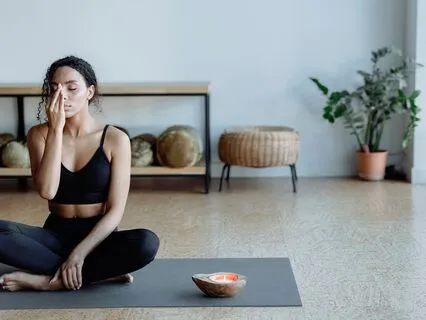
Bring the index and middle fingers of your dominant hand to your forehead,
Just above the space between your eyebrows,
And rest them there gently.
Position your thumb so that it's just touching one nostril and your ring finger the other.
Close your eyes.
To begin the first breath cycle,
Exhale all of the air from your lungs as you would when engaging in a full breath.
Now close off your right nostril by gently pressing against it and taking a long,
Slow breath through the left nostril.
When your lungs are full,
Depress the left nostril as well and pause for a comfortable moment.
Now allow the right nostril to open and slowly breathe out through it.
When all of your air has been expelled,
Pause for a comfortable moment and breathe in through the right nostril.
At the top of the breath,
Close off the right nostril and pause.
Then open the left nostril and do a complete exhalation,
Completing the first cycle.
This is then repeated.
In through the left.
Close the left at the top of the breath and pause.
Open the right and exhale.
Pause.
In through the right.
Close the right at the top of the breath and pause.
Open the left and exhale.
Pause.
Repeat this on your own time for the next few moments.
Pause.
If you find one nasal passage blocked or nearly blocked during practice,
Which is sometimes the case,
Feel free to cheat a little by only partially closing the blocked passageway when using it to breathe in or out.
Practicing this way will help you get the pattern down for when both passages are clear.
How does that feel?
Nadi Shodhana is an excellent way to calm the mind and centre yourself.
I've always found my mind to be noticeably more awake and sharp after practicing it for as little as 60 seconds.
Although it can't be done as inconspicuously as the other breathing techniques we've covered,
It can be a nice centering ritual for the beginning of meditation.
Let's move on into our Anapanasati practice.
Make any adjustments you need in your seating to be comfortable and close your eyes.
For the next few breaths,
Take in a full breath to the silent count of five.
Pause momentarily.
Then release the breath to a count of five.
Repeat that.
In.
Pause.
Out.
Pause.
In.
Pause.
Out.
Pause.
Notice whatever breath sensations stand out for you today.
Take another full breath and direct your attention to those.
Release conscious control of your breathing and allow it to settle into its natural rhythm.
Do you notice the change in your chosen breath sensations?
Are they more subtle?
If your mind wanders,
Gently redirect it back to the breath.
If you completely lose focus,
Take in a full breath to recenter yourself.
Then release the breath to its natural rhythm.
Give yourself the space just to be here in this moment.
There's nothing more important for you to be doing.
Accept where you are in this moment of time in your life.
That's today's practice.
How do you feel?
Is it becoming any easier to simply accept what is during your practice without judgment?
Are your moments of being fully present in the now increasing in frequency or length?
Whatever your experiences have been during this course so far,
An important part of the training is to simply accept where you are in your practice.
The busy doing mind is prone to judgment and disparaging comments,
And as we continue to practice it often ramps up its attempts to thwart our efforts,
As though trying to regain control.
If you find that,
Just accept it without judgment and recognize that your doing mind is just trying to do what it's always done,
Manage your life and keep you safe.
With continued practice,
You should find that the felt need of the doing mind to maintain tight control over your internal world diminishes,
And that this overactive aspect of your mind will come under greater and greater conscious control.
So congratulate yourself on taking the time for your practice today.
I recommend practicing this session at least two or three times before moving on to the next in the series.
You can use this recording to do so,
My Insight Timer Meditation entitled,
Anapanasati 1,
Or simply practice without guidance using a timer.
Thank you for taking the time to meditate with me today.
May you be warm and safe,
And may you live in peace and happiness.