Hello and welcome to our sound meditation today.
Let us begin by taking a seat.
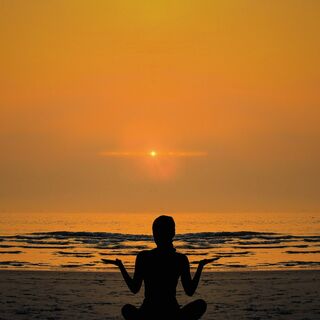
This can mean seated on the ground in a cross-legged or half lotus position with your back upright,
Not uptight,
Your shoulders rolled back,
Opening your chest and your heart area.
Or for this practice you may be lying down or you may choose to kneel on your knees.
There are a few different ways to view your posture for today's practice.
Let us begin by taking three deep purging breaths.
Inhaling through the nose and exhaling through the mouth,
Releasing any tension to be here now.
With each breath settle into your body being present here now.
Allow your breath to gently return to a natural rhythm.
In our Samatha practice we use breath as an anchor where we return to it when we find that our thoughts are going elsewhere.
We can also use other anchors including the environment that's around us.
Today I would like to take us through a meditation that uses all our senses.
Notice where you feel your breath the strongest.
Is it in the rise and fall of your chest?
Perhaps you notice it most strongly in your abdomen or in the air that's entering and exiting your nose.
Hone in to one of these areas.
Try to feel the quality of this breath in that particular anchor spot.
Now place your hand on whatever location you chose as your breath anchor.
If it's on the air entering and exiting your mouth or nose,
You may place your hands on your lips so you can feel the air there.
If it's your chest,
Place a hand on your chest so you can feel the rise and fall more clearly or any other place that you notice the breath.
And experience the sensation of touch.
Feel the sensation from within your hands itself.
You may notice a tingling sensation or perhaps you feel the temperature,
Whether it's cool or hot or humid or damp.
As you notice these sensations,
Become present to them without creating a story about.
Now feel the sense of touch through the experience of breathing.
Move your awareness out of your hands and into the breath.
Rest in the sensation of your body being breathed.
Now shift your awareness to your sense of smell.
You can place your hands back on your lap or your knees and allow the aromas of the room to enter your nostrils.
Notice the quality of the sense that you experience when the thought of positivity or negativity around a particular scent occurs,
As it often does.
Let go of the opinion that you have regarding that smell and sit with the smell itself.
Gently place an equal awareness on the sense of smell and the breath as it enters and exits your nose.
Notice if you experience any waves of scent or the diminishing of scent.
As you exhale or inhale,
You practice this without any judgment.
And when judgment arises or thoughts arise,
We bring it back to the breath itself.
Now shift your awareness to the sense of taste in your mouth.
Notice any subtle flavors,
Qualities of the sense of taste.
Relax your jaw and your neck and become present to your tongue.
Slightly open your mouth if it is closed and I invite you to try inhaling through your mouth to examine how the quality of taste changes when breath comes into contact with your sense receptors.
Now let us shift to placing the focus on the sounds in our environment.
Allow any noises in the background to enter your ears.
Notice which sounds are first approached by you.
Perhaps you first notice the loudest noise.
It may be a sound that normally triggers activity such as a cat scratching at the door,
Waiting to be let in,
Or children calling out for something.
Let those sounds pass without reactivity.
By becoming present to some of the more subtle sounds in your environment,
You may choose to start far away,
Listening to a distant car,
Airplane,
Something else in your environment,
And slowly bring your attention all the way inwards,
Closer and closer to you until you reach the sounds of your breathing and your breath.
Now listen to the sounds as they enter you through your breath,
Gently placing awareness on both.
Now open your eyes fully,
Allowing sight to enter your presence.
Bring in the colors in your environment.
Notice objects with a sense of curiosity.
If your mind jumps to wanting to complete a task or seeing something that needs changing or something that you believe is misplaced,
Gently allow those thoughts to remain as simple thoughts that are passing.
Return to the sensation of seeing,
Seeing without a story.
One way to amplify this is by choosing a point as your focus point and then gently looking with your peripheral vision around those points,
Or that point if it's a singular location.
Becoming present to the entire periphery from top to side to bottom of your view and your vision,
Perhaps noticing the quality of the light,
Dark or bright.
Now gently become present to the breath with sight.
Relax the muscles around your eyes and notice if you can perceive the sense of breath in your eyes itself.
For this last minute,
Return to your breath fully and offer yourself some gratitude for coming to this practice,
For exploring the senses as they interact with the breath.
The interplay of the two is something that we can draw upon wherever we are.
We have the opportunity to hone in to one of these senses and to notice the breath alongside these senses.
Becoming present to our current state and to our moment of being.