Hello,
So nice to be here with my dear friend and fellow hiver,
Megan Whitney.
Thank you to everyone who shared this post and wants to talk about this subject today,
Because if you haven't caught it before,
Megan and I did talk about this.
I don't know when we first met,
Like how many months ago now?
It's probably like eight,
Maybe months ago,
We had a conversation about this.
It's been a little while.
I'm super excited to jump in on a round two here and talk again about,
I think a topic that I feel like burnout has never been a hotter topic in the nonprofit space and everyone's rebounding still a little bit from COVID,
But I'm going to let the lovely Megan introduce herself quickly before we jump in.
And thanks to everyone for joining us today.
Yes.
Hello everybody.
I am so glad to do round two of this discussion with my friend,
Tasha.
I think it was November that we last discussed burnout and nonprofit work.
And today I'm excited to get a bit more into the actual practices and experience that can support you and preventing burnout,
Recovering from burnout.
Tasha said,
This is a huge burning topic in the nonprofit sector.
And I'd love to hear all of your perspectives.
Write a word of your intention for joining today's conversation.
Awesome.
Thank you for sharing that.
My intention is to build community and to really share my compassion with you all.
I have recovered from burnout myself.
This is a very personal issue to me.
And if we haven't met yet,
I can just share that I'm based out of Chicago.
I've worked in nonprofits for over 17 years and committed to doing social justice and equity work.
And I burned out about 10 years ago and my nonprofit job.
And it wasn't until about four years later when I was going through a crisis with a divorce that I discovered mindfulness and started practicing meditation,
10 minutes a day and self-awareness practices that helped me realize this is an essential skill that most of us have not learned.
And so super passionate about sharing what mindfulness is,
How it can support us in preventing burnout and hearing what works for you,
There's no quick fix.
Like our society loves a magic button solution.
Yes.
It takes effort,
But it's often not as difficult as people think or just time consuming.
Tasha,
Would it be helpful just if I shared a little bit of my personal connection,
My nonprofit burnout?
Absolutely.
I,
Yeah,
I think,
I know you and I bonded talking about your work experience and where you'd been at,
And I have personally heard this conversation echoed across nonprofit,
Regardless of the roles I have many wonderful consultant friends who are on here as well.
And part of the reason why some of them moved into consulting is because of burnout,
Intense burnout they were experiencing in an attempt to put in boundaries,
Not that they wanted to leave social impact work,
Just that they felt that was their only option to get to where they needed to be.
So I'd love to hear more about your journey for sure.
Yeah.
Absolutely.
You are all in good company.
I think the survey that we did had over 200 folks respond.
And what was it?
77% of folks have experienced total burnout in nonprofit.
Yeah,
77%.
It's just a wild number.
And I think what was also more interesting is there was a little tiny 3% who were like,
No,
I feel great.
My job's always been like,
I've never experienced this in any way,
Shape or form.
Yeah.
That extreme ends of the spectrum and how different they were was really eyeopening.
Yeah.
Sadly,
The results do not surprise me.
And I think that it's also really supportive just to see you are not alone.
And this is a pervasive systemic issue that it's time for us to change and to work together to do some things differently because what's been going on is not working.
So maybe as I get into this,
I feel like I want to get more of a sense of the room,
Tasha.
Can we do this question?
And so personal.
Absolutely.
So we're going to start with this,
But the idea being that you have an opportunity to say a word,
A phrase,
Something that brings you to the idea of what comes to mind when you hear the word burnout,
And we'll give everyone a minute here,
But the goal here just to see what comes to mind for you.
Because I have my own thoughts that come to mind.
So I'm going to just jump in.
And I'm finally seeing the chat and I'm finding some beautiful faces that are familiar to me.
And love that Jennifer says,
My intention is to recognize that burnout is a thing.
We don't talk about this topic enough.
So it's so true.
Oh,
Crispy.
That's one of my favorite words.
Crispiness.
You can almost feel the crunch around the edge.
You're not overcooked yet.
You're getting close.
And sometimes we can recognize that.
Yes.
Exhaustion being the number one word.
So maybe you're familiar with the definition of burnout,
Or maybe you just know it in your bones.
And I have so much empathy for you and I know what that's like.
Yeah.
Just to share as folks are rolling in what your experience is.
Burnout is defined as chronic prolonged stress that is related to work just to summarize it.
But it actually is comprised of three different things.
I think we use this word a lot of I'm so burned out.
And I want to say that stress is an inevitable part of life.
It is a daily occurrence and it is not always necessarily bad either.
I think a lot of us are scared of being stressed.
And what I've learned is that burnout is that result of compounded stress.
And it typically manifests in a few different ways.
And as I share,
I'll incorporate my personal story to hopefully it'll land more and curious to hear more about what folks are thinking to what resonates for you,
Everybody's experience is different.
So the first component is emotional exhaustion and physical exhaustion as well.
Those two go together,
Right?
The mind and body are connected.
So when I burned out about 10 years ago,
I remember feeling exhausted.
I would come home from work.
And at the time I was married and would do a lot of venting to my husband,
A lot of negative,
Just trying to get support,
But also just fried,
I was not sleeping.
Well,
At the time I thought,
Oh,
The women in my family are bad sleepers.
And this is just like who I am.
There were so many ways that I wasn't seeing how these aspects of my unhealthiness were connected to stress.
I just thought it was like unrelated because I didn't know at the time,
As many people who work in nonprofits can probably relate,
Having always worked in the social justice space,
I had conditioned habits that I know now we're trying to keep me safe yet.
We're contributing as well to my burnout,
Martyrdom,
People pleasing.
Perfectionism.
I thought if I just work harder,
If I just get through this to do list,
Then I'll feel better.
Yet I wasn't actually managing the stress itself.
And yeah,
I can talk more about that in a bit,
But just to wrap it up around what the characteristics are,
Emotional exhaustion and physical exhaustion.
Depersonalization and cynicism is the second one.
So having,
I was having this thought of just what does it even matter?
And just telling myself,
Like,
I'll just not care anymore.
That's a common coping mechanism.
I hear a lot as a mindfulness coach from clients who work in nonprofits is I'll just decide not to care.
And the thing with that is that our body does not respond to our thoughts or our logic.
We actually need to tell the body,
Like that it's safe and mindfulness is one way to do that,
But there's many other ways as well.
And then I would say decreased sense of accomplishment is the third aspect.
When I feel tired,
I'm sure folks can relate to this.
Our brain is foggy and we have headaches and it's hard to do our best work when we're exhausted.
I have a teacher that I love,
Shout out to Reggie Hubbard,
Who says that something to the effect of it's impossible to have a creative idea from an exhausted brain.
Maybe not impossible,
But certainly hard.
That can really weigh on our sense of self-confidence,
Of self-trust to feel like I know I can do better,
But I can't,
I physically can't show up this way.
Yeah.
At the time I would have told you the reasons for my burnout were mostly completely unrelated to myself.
And I want to be super clear that I'm not about blaming and shaming individuals,
And if you're experiencing burnout,
It's not your fault.
You're not alone.
There are so many,
As we talked before this,
There's so many systemic factors,
Capitalism,
Racism,
Back-to-back meetings,
Scarcity culture,
Like I could go on.
You all feel free to add yours,
But I would have told you there were organizational changes outside of my control.
And there were people that were annoying that weren't supporting me.
Yeah.
And my work,
It was my workload.
And of course those are all stressors.
And to go back,
What I was saying earlier,
Though,
I had no clue how to actually manage the stress itself that was showing up in my body,
How to listen to my emotions and process them rather than push them down or avoid them with Netflix,
Wine,
Instagram,
Not like these things are wrong,
But it's helpful just to know how am I approaching these activities?
Am I trying to avoid my life or am I actually enjoying Schitt's Creek rewatching?
I was going to say,
Schitt's Creek is,
It's comfort food,
Right?
It's almost like everyone has their thing that supports.
But,
You know,
I think there's a little bit of dissociation part to that as well to go,
Oh,
Here's part of myself over here.
And here's the part of myself over here.
And somehow I have to keep these two separate in order to cope,
Which,
You know.
Yeah.
Yeah.
And I'm just checking out the chat.
I really appreciate folks sharing their personal experiences.
Alana says a big thing I experienced often was basically hiding out,
Isolating and not letting my creativity and spirituality to shine through because hello,
Very often we're told to leave ourselves at the door for the mission of the nonprofit.
Anyone feel me?
Yeah.
I so feel you.
It's true.
And we are human beings,
Whether we are at a funeral or at our desk,
Like we,
We bring emotions to work and don't always have the capacity to bring our full entire selves to work.
And I want to acknowledge with oppressions in our society,
Many folks don't feel safe bringing their entire self to work.
And there's certainly times where I don't either.
And we,
We need to be able to make a choice about who we want to bring to work that day and feel as safe as possible to be accepted as we are as in our full humanity,
Whether that is showing up,
Feeling off or depressed.
I'm all about the realness whenever possible.
Yeah,
I think that's so true.
And as some people are noting in the chat as well,
Mission driven individuals and people who are passionate people who are helpers or carers.
I think there's a higher risk in some ways of burnout because we,
There is such a deep empathy and a well of caring and a well of voluntary martyrdom into some degree,
Just by who you are as a human and the fact you're attracted to this work.
And so I think this is,
I see every word on there for burnout and think,
Yeah,
I've thought all of these exact things myself at different points in different careers.
No,
I love these things that you're sharing in this chat is amazing.
Love it.
Yeah.
Claire,
I want to acknowledge and appreciate your comment.
I feel this must also be harder,
Be much harder for people of color who also fight conscious and unconscious bias daily.
Absolutely.
Yeah.
I've certainly seen research showing there was a specific study around single women of color who are mothers disproportionately affected by burnout and with the unjust society we live in that that shows up in all aspects of our work.
And so this really,
It is a social justice issue.
And I get really sensitive around folks talking about mindfulness as a productivity tool,
As a way to manage stress.
Like it's all on you.
This is not,
It's a both and so like burnout is a systemic issue.
And I wholeheartedly believe there are ways that we can manage that stress as individuals.
And something that is coming up to share for me around this is if you're not familiar with Reverend Angel Kyoto Williams,
She's a Buddhist social justice teacher.
And she says,
Without inner change,
There can be no outer change,
Without collective change,
No change matters.
So it's that change does start with from within,
But it's not all on you and we need to be doing this work of healing and community with each other.
I love that.
And yeah,
And I think in so many spaces of social impact and the people that supporting and chatting with through the nonprofit hive and this community that's growing,
I think there are some changes that absolutely should be happening internal in,
In nonprofit culture as like the greater whole of nonprofit culture.
But I think as you're noting,
There are things that we can do as individuals,
Which is why I was thinking it would be so great to have you on and talk about this,
Because I know this is a conversation you and I on a much more personal level have had you very much coaching me and saying,
These are things you could be doing,
Despite the fact that there's this other huge conversation about nonprofit culture itself.
I love that.
Are you wanting,
How do you want to move into,
I know we want to respect people's time and we're super excited.
I'm very thrilled that Megan's willing to do a mindfulness moment here with us.
And we have a next slide,
Opal,
Because we wanted to see,
Read the room a little bit here in terms of what people have done.
So I'm going to throw up the next one here,
Megan,
Where,
What's your experience with mindfulness folks who are joining us today?
What,
Have you had an opportunity to practice mindfulness before?
Will this be your first time with mindfulness,
Just dabbling in some great resources here as well,
Coming in from folks.
So I'll let people take a moment before we start.
I just want to say,
I am loving the chat lighting up and I wish I could acknowledge and have a chat with every single one of you because you're all brilliant.
And I so value you bringing your perspectives because this is not about Tasha or me being experts.
Like we are all each other's teachers and have so much to share.
And I also believe that you are your own best teacher.
So as we move into soon of mindfulness practice,
I really encourage you to listen to your body,
To take this time for you and really all of it's an invitation.
So take what serves you,
Whatever doesn't work for you,
That's fine too.
But I'm excited to be in this playground with you all just to really take those action steps together.
So I'm seeing a lot of dabblers in mindfulness,
67%,
33%,
Pretty solid mindfulness practice.
No one is brand new.
Okay,
That's cool.
Yeah.
Mindfulness,
Just to give it a definition,
While there are many,
I was chatting with Emily in the chat yesterday about this,
Like a simple,
One serviceable,
Simple definition is that it's about paying attention or self-awareness,
If you want to make it longer definition,
Paying attention to what's happening in the present moment,
In our mind,
Our body,
In the external environment,
With an attitude of curiosity and kindness.
So I think Emily said awareness without judgment,
But this is not something that actually necessarily takes any additional time.
So folks often are like,
I have no time.
How am I going to do more?
I barely can brush my teeth,
Megan,
And you expect me to take this time.
We can practice mindfulness right now through deep listening with each other,
Through journaling,
Through walking.
So meditation may not be your jam.
That's okay.
And today I'm going to offer a practice just to expose you to a way that I like to practice checking in with myself to hopefully support you and being able to do this as a dedicated practice in the future,
Or just on your own,
Because the power of taking one conscious breath is often underestimated.
And it only takes a breath to pause and become aware for us to move from a reactive state to a responsive state that is grounded in more of a sense of wisdom and connectedness rather than how we often operate on autopilot reacting and fear to everything.
For sure.
Yeah.
I think there is that removing ourselves from autopilot is it's a conscious action,
Right?
It's not like autopilot is going to just turn off.
We have to decide to set that aside.
Okay.
I love this.
This is fantastic.
So we're going to make,
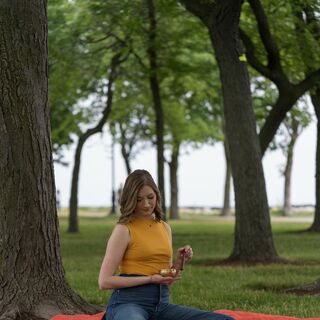
It's made this beautiful slide that I am going to leave out with the beautiful wood setting in the background and Megan's going to use her beautiful mindfulness set up here to talk us through a little bit of midweek mindfulness.
I love this.
It's Wednesday.
I absolutely need this today.
So this is great.
Heck yes.
So happy to be here with you all.
I will just talk through a few tips for folks that may be dabblers and a little bit newer.
I think something that prevents a lot of folks from trying meditation is because they think that there's a right way to do it.
And there really is not.
There's also thousands of styles of meditation.
So it's as broad as saying,
I like to exercise when you say I like to meditate.
So today we're going to practice an exercise around checking in with yourself and becoming more attuned to what your body is telling you it needs.
And this is a key way that we prevent ourselves from burning out.
It's where we're checking in with that,
That stew that we're stirring it.
We're not just letting it sit and burn up.
Shout out to Catherine Leesfield for that metaphor.
So yeah.
So listen to your body.
You don't have to be in stillness.
In stillness,
You can lay on the floor or you can walk,
Sit,
Stretch.
You do you.
You are welcome to close your eyes unless you're driving or operating heavy machinery.
Let's be safe out there friends.
And please try to be kind to yourself.
So this is also about building a muscle of compassion and,
And recognizing the mind wanders at least 50% of the time,
If not more.
So you're definitely not like the goal here is not turn off the thoughts.
Think nothing.
We are learning about ourselves and building a sense of self-awareness.
And if you want to make a mental note when your mind wanders,
It can be helpful just to make the note of thinking whenever you notice I'm thinking about that grocery list.
I'm ruminating about that thing.
I just said to a friend.
All right,
Friends,
I invite you to find a way to sit,
Stand or lay down.
Noticing what the body is needing right now.
If you're sitting,
You might appreciate putting your feet on the floor.
And your hands can be placed in your lap.
Or if you're needing a little extra care right now,
I always love placing one hand on my stomach and one hand on my heart.
Again,
No right way.
So see what feels nurturing to you.
If you haven't already,
And it's safe,
I invite you to close your eyes.
Or you can also gently lower your gaze.
Looking down a little bit with a soft focus.
And again,
Everything I offer here is an invitation.
And so I encourage you to tune in to what feels good.
You're always welcome to open your eyes and reground yourself by listening to the sounds in the room.
Or feeling the sensations of your feet on the floor.
This practice will heavily be hanging out in the body.
So if you prefer just to listen,
That's beautiful.
As well.
I invite you to find your breath with your awareness.
Breathing in.
I know I'm breathing in.
Breathing out.
I know I'm breathing out.
Where can you feel your breath most prominently in the body?
Maybe it's in the belly.
Expanding like a balloon on the inhale.
And contracting on the exhale.
Perhaps it's in the chest.
Perhaps it's the cool air entering the nostrils.
Or the warm air exiting the nostrils.
Have you ever noticed that change in temperature?
It's always happening.
So the breath is a natural medicine.
And we nonprofits love free things.
So this is always here for you.
Whenever you're breathing.
If you're encountering the stress or the overwhelm.
Tuning into the sensations of breathing will serve you.
Because it will naturally calm the mind and soothe the nervous system.
The breath and the body can only be in the present moment.
My friends,
If you're feeling like my mind is racing,
I'm not following this.
Please offer yourself compassion and just be yourself.
Know that throughout this practice,
The mind will do what it does.
And you are creating this space which will serve yourself and so many others.
Simply by being here exactly as you are.
If you're interested in calming and grounding a bit more,
It can be really helpful to extend the exhale longer than the inhale.
I'll give you a moment just to experiment with the breath.
Maybe you can just breathe in.
Even sigh it out.
Noticing how the body is responding to you taking this time.
And reconnecting with your intention.
What brought you here?
Now I'll invite you if you can scan through the body.
Imagining you're turning on a flashlight.
Seeing what color appears.
Pointing it to the top of your head.
And slowly scanning down the body with this flashlight.
Down the forehead.
The cheeks.
The jaw.
Simply noticing what sensations are here in the body as you continue to move your attention down.
For some folks,
It can feel challenging to tune into the sensations in the body.
So again,
Be gentle with yourself.
And just explore.
What's it like to drop out of thinking about the hands to actually feeling the sensations in the hands?
What's it like to feel the heartbeat?
And breathe through the heart?
Physical sensations are messengers of deeper feelings within.
So maybe there's a feeling that you'd like to name or even multiple feelings.
For me,
I'm feeling a sense of tightness in my neck and shoulders.
So I can name to myself.
This is nervousness.
I'm feeling a lightness in my chest.
I can name this is joy.
So this is a practice called Name It to Tame It.
And if you can drop out of the story in your mind,
And into naming and feeling the feeling,
That helps us to process the emotions,
Help them move through the body like waves,
Just passing through a sensation.
Before we move to a close,
I encourage you just to take a moment to think about before we move to a close,
I encourage you just to take a moment to reflect.
What is this feeling?
What is this body needing right now?
Listening to whatever comes up.
What feels important now?
As we move to closing this practice,
You may enjoy envisioning all the beautiful humans,
All the change makers on this call,
Meditating together,
Sharing our energy across the world,
Sending out the love,
The peace,
The ease,
The gratitude,
Or whatever other sentiments you've cultivated,
Sending them out to the world.
Taking a collective cleansing breath together and opening the eyes when you're ready.
Returning your gaze to the space.
I'm gonna come back on camera.
Encourage you just to notice how the body's feeling.
Are there any shifts?
And welcome you if you'd like to write a word in the chat.
I'm gonna give you a couple of minutes to do that.
And then we'll move on to the next part of the practice.
So,
I'm gonna give you a couple of minutes and welcome you if you'd like to write a word in the chat,
How you're feeling.
All feelings are welcome.
Thank you all so much.
I'm feeling very touched.
It's awesome.
I feel very centered as my word just coming back into my own brain space instead of feeling like I'm trying to escape it.
It's lovely.
Thank you for sharing that.
Absolutely.
Yeah,
I'm feeling much more connected and grounded myself.
Thank you all to the wonderful humans who came.
And I know that Chelsea had jumped in.
I'm still gonna pull up if you have any thoughts to add as well.
Carmen had talked about women suffering burnout more and the desire to fix things and try to do it all.
And I know we've even connected a little bit about this,
Megan,
Just that I'm a little curious to see how the next generation approaches work.
Like I definitely feel as a 41 year old woman in this space,
Particularly as a mom,
There are times where I'm just like,
I was very much taught that you just work harder when there's more work and you work more.
And that is,
So I guess I have some hopes that there is a generation coming up that maybe has some more semblance of work-life boundary.
Yeah,
Absolutely.
I'd love to answer Carmen's question and also hear your thoughts in the chat.
I love to journal as well.
Chelsea and Zoe feels very relaxed.
So I love that.
Beautiful.
Yeah.
And I wanna acknowledge too,
Sometimes we meditate,
We don't notice a difference.
Sometimes we feel more in a funk.
And so it's not about trying to get somewhere.
It's really noticing what's happening here.
And oftentimes I can have a very relaxing state afterwards too.
So love hearing that.
But yeah,
As far as the question Carmen asked about women being more likely to burn out,
I,
Okay,
The question was asked,
Do you think that women are more likely to suffer burnout because we want to fix things and try and do it all?
My answer personally would be absolutely.
And I would recommend the book,
Burnout by Amelia and Emily Nagoski,
Which is specifically focused around women and burnout and talks about the bikini industrial complex and the ways that women are conditioned.
I definitely resonate with this,
Being raised a helper,
Being raised in the Christian church and really wrapping up my identity and validation and my ability to serve others.
So yeah,
That's partly why I initially focused my coaching practice around supporting women.
But then it just didn't feel as inclusive to me as I wanted to,
Because I really want to support all humans.
But yeah,
Absolutely.
I would say there's a strong association.
Those conditioned habits that I mentioned earlier that at one time kept us safe.
They show up a lot in women especially,
But can in others as well.
So yeah,
What do you say?
Yeah,
I think there's lots to be said for sure about how culturally we're taught to handle.
As you noted,
Life has stressors and it's more what coping skills we've been taught in order to work within those stressors is very different.
And I think as a woman who's definitely flirted with burnout on and off for years and years,
Read the Body Keep score,
I can see it and feel it on the regular.
And so there's so much,
This is such a huge topic.
And what I think is really interesting is that I'm really excited to see it being talked about in the nonprofit space.
Because when I first entered supporting nonprofits eight years ago,
This seemed like it was very much a topic that was focused in onto people in social work and hospital settings.
And those helpers and carers,
But that had a medical kind of,
Or therapy base to their work.
And now I think it's becoming clearer that this maybe applies across the board and even further reaching obviously than nonprofits.
And I appreciate so much all of you wonderful people who showed up with us here today and gave your time and your energy.
And please connect with Megan.
She's just like one of the best humans and is doing such cool work actually in her day job as well,
That I'm sure she'd be happy to share with anybody who wants to look at what would be required to bring mindfulness into your nonprofit on a more nonprofit cultural level as well,
Outside of the one-to-one or coaching style session as well.
Thank you so much for coming and doing this with us.
You've been a huge support in the Hive,
Just in general,
As like a human talking to other humans who work in nonprofit,
But this is next level.
And I think it's such a needed conversation.
Thank you,
Tasha.
If I can just leave folks on one special note,
Is that okay?
Absolutely.
Really compelled.
I'm a big fan of sharing.
So this is a quote I keep on my desk all the time that is profoundly impactful to me.
So this is again,
Reggie Hubbard,
Check him out,
A yoga teacher and social justice advocate.
He says,
How can I be the me the world needs?
Not the me I'm comfortable with.
And so I think for me,
What really lands here is that it is about being me.
It's about being you,
Your authentic self.
And this work of social justice and bringing mindfulness into your culture does require a sense of putting yourself out there,
Of maybe getting a few eye rolls,
Of feeling uncomfortable.
And I found that the more that we show up as ourselves,
The more we shine our light on the world that can really inspire others.
And for the folks who do want to take the time to explore these tools,
It's life-changing.
So just want to encourage you all to keep being you and just to offer my gratitude and a wish of hoping to stay in touch.
Amazing.
Thank you so much.
All of you who have been just amazing.
Thanks Megan for agreeing to do a round two of this with me.
I just felt so strongly about it that I was just like,
I'm just going to bring Megan along with me to do this again in my newer workplace session because I just,
I believe really strongly in the work that you're doing and how life-changing it can be for those who decide to embrace it.
So this is great.
Yay.
Thanks everybody.
Everyone's so much for joining us for your thoughts and reflections.
It's great.
Cheers.
Bye everyone.
Bye y'all.