So we're going to talk about sound and then we're going to play with some sound tonight.
And I hope you'll come into this practice with an open mind because sound is so powerful and an intentional sound.
We're talking about intentional sound tonight.
So let's get into a little bit about what I'm talking about and what I mean by the word intentional.
So I've given a few presentations this year so far about the power of sound and it really got me thinking about the actual power of sound in my own life.
So I realized as I kind of did two different presentations and they had two different ideas behind them and one of them I talked a lot about the emotional healing that I've gotten from sound as well as the physical and then the other one was the physical pain event I did where I talked about how sound really helped me release a long standing pattern of pain in my body.
And so this was my missing piece,
This intentional use of sound.
So I've been a musician since I was a kid.
I have a degree in music.
I've played music for years and years and years.
I've always loved music.
I already said that I didn't start out on the sound and music practice.
It sort of just happened and that's how the best intuitive kind of paths open up to us is that we get into flow,
We get into that state of integration and things just naturally come to us.
That's what I talk about when I'm talking about abundance versus scarcity.
When you're in abundance,
Things just kind of start to flow to you and through you.
So as I was doing these new practices,
I started to notice I was feeling deeper vibrations.
I was feeling vibrations in areas of my body that I couldn't really access prior to starting the sound practice and I knew that my intuition and creativity were really exploding,
Were really opening up.
But I didn't start out,
I didn't say,
Oh,
I'm going to get rid of my terrible endometriosis pain by using sound.
That happened,
But to me it was almost like a side effect.
It wasn't my goal when I started this sound practice that I've been doing and writing this intentional music.
And just like when I started writing my kirtans,
I didn't sit down and write my first kirtan,
Which is Agnimo,
Thinking this is going to be a clearing kirtan.
This is going to clear energy out of the body and out of the space.
And so if you've had a bad day or you're feeling kind of nasty or blah,
You can play Agnimo and it clears that energy out for you.
And especially more so if you sing along with it.
That just kind of came through me.
And after I started practicing it myself,
I was like,
Oh,
This is the clearing kirtan.
And then I wrote the Divine Mother kirtan and that's a call to action.
And then I wrote the Pain Release kirtan,
Which was specifically for Pain Release.
So as I've started working more and more with this intentionality behind my creation of music and sound,
I see that I'm channeling certain vibrations or frequencies that have an actual purpose,
Which is amazing.
And anyone can do this.
And that's why we're going to do this tonight.
So this is not something that is unique to me.
It's something that's opened up for me and it helps that I have a musical background as far as the writing and everything.
But just making sound with your body is something that anyone can do.
So I wanted to mention a little bit the types of sound I'm talking about because I keep using the word sound.
Like what does that mean?
So I made a short list here of just things that came into my head.
And of course this is not an all inclusive list,
But we're talking about things like chant,
Things like intentional music and singing,
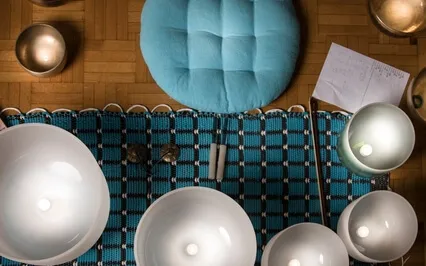
Singing bowls,
Whether they be crystal or the Tibetan metal kind,
Which I usually,
You've probably seen me use my little bowl and we'll probably use that tonight.
And toning.
And toning is what we're going to focus on tonight.
So I wrote down a definition of toning that I liked,
But I want to mention briefly before I get into that,
The one other thing I had on my list,
Which is breathing with sound.
So using sound while you're breathing.
A couple of weeks ago I went into a lot of detail about the oxytocin breathing.
That's the haaaaa.
So when you make that haaaaa sound,
You're actually vibrating the vagus nerve.
You're bringing your body out of that sympathetic,
That fight,
Flight or freeze back into the parasympathetic or the ease response.
And the sound is what does that.
If you've done yoga,
You might have seen people use lion's breath.
And that's a,
That's a real weird looking breath.
I'm going to look real silly here for a minute,
But it moves a lot of energy.
So that's called lion's breath.
And you hear that sound that,
And that's part of the release.
That's part of the movement of that energy.
You're moving more energy out of your body.
It's more detoxifying when you make that weird sound and stick your tongue out than just taking a little silent breath.
So we actually use different types of breathingless sound.
And now I want to talk more about toning because we're going to experiment around a little bit with toning.
So here's the definition I wrote down that I really liked.
And this is we're talking about vocal toning.
Vocal toning means using your voice to harmonize and balance yourselves and energetic pathways.
And oftentimes vocal toning is one note per breath.
When we do the chakra,
The primordial chakra tones,
That's a single note per breath.
So you're just holding one note out for an entire breath.
And I call that kind of prescribed toning.
I completely made that up.
It's just what came into my head when you're sort of being told to hold a single note or sometimes like if you go to a Kundalini yoga class and you're doing Sat Naam,
It's usually done at the same pitch at the same frequency.
That's kind of prescribed toning.
But the type of toning that really kind of that toning absolutely lights my fire.
I was going to say the type of toning that really lights my fire because that primordial chakra practice has changed my life.
But the type of toning that I have more fun with,
Let's put it that way,
Is this kind of free form or intuitive toning.
And if you've watched any of the last probably six or seven shows,
Maybe somewhere in December,
I started using this kind of intuitive toning in my practice with you.
And this is something that I've done before but it never really occurred to me to share it until I met this amazing woman named Mama Donna who does vocal freedom and all sorts of cool things.
And if you follow my social media,
She and I will be working together coming up soon and probably offering some things.
So keep an eye out for that because she's amazing.
And I heard her tone and I was just,
It just,
It was like the first time I heard the crystal singing bowls.
I felt something in myself just open.
And again,
I felt this kind of fire ignite and I couldn't help myself.
We were on a Zoom and I was muted luckily and I just started toning with her.
It was like the music just started coming out of me or these tones just started coming out of me.
And so I started doing that more and more and then I started sharing it here.
And it's just such a freeing,
Joyful practice.
It's kind of like freeform movement.
If you've ever done anything where you just put music on and let your body move.
So we're just going to let our voices move.
We're going to let our voices come through.
And again,
I said the vibration of your own voice is one of the most powerful tools we have to change our frequency,
To take that disharmony and transform it to harmony.
And I always say this when I talk about sound and it's very important to me and if you've heard it before,
Just bear with me.
You probably could not hear this enough times cause I'm still telling it to myself.
When we're using sound in an intentional way in this spiritual practice,
This is not about aesthetics.
This is not about beauty.
This is not about how wonderful our voice sounds.
This is not about carrying a tune.
This is not about matching my pitch,
Which that was a really,
That's a really hard habit for me to break.
When I first started the primordial chakra tones,
I kept wanting to match the exact tone that I heard as I was learning them rather than finding my own tone.
But your body knows the frequencies that it will respond to.
And that's why using your own voice is so powerful because you can intuitively tap into whatever frequency your body is calling for and bring that,
Introduce that into your energetic field.
And that's a little bit of what we're going to do tonight.
I'm going to describe a little bit of what we're going to do in the meditation because once we get into the meditation,
I don't want to get too much back into this mind space because I really want us to get intuitive and have fun with this tonight.
And you might start laughing at yourself.
I might start laughing at myself because sometimes these sounds are weird.
And that's the other thing like about aesthetics.
You may be making a sound that doesn't sound like a musical note.
You know,
You might be,
You might be making a weird kind of a guttural grunting sound or like a weird,
Almost like a nails on a chalkboard.
That's part of this process.
So we have to kind of retrain our brain a little bit.
We have to let go of that feeling that everything has to sound good.
That we want,
You know,
We want to hear the scales that we're used to hearing in the Western world which are tend to be major,
Minor or modal.
Or you know,
We want to hear a beautiful tone coming out.
We don't want to hear like,
You know,
Something that sounds like it came out of a horror movie.
But sometimes that's what our body needs.
And so allow yourself to go there.
No one's listening to you.
I mean,
Unless you're out in public somewhere,
I can't hear you.
You look at me.
I'm totally willing to make a fool out of myself here making all these weird noises and stuff.
So let yourself try this and let yourself practice this if this calls to you.
If this is a practice that like me really excites you and you feel this kind of ooh about that,
You know,
Give it a try.
Try it in the next few days.
Come back to the meditation.
And I'm going to describe just briefly one of the things we're going to do in the meditation again because I want to get out of the mind space and kind of into really that intuitive physical space.
And I'm sorry,
I made my throat sore by making my guttural example noise.
So I'm going to do some toning to start.
I'm going to share with you the sound invocation that I got from Trish Devney that I love.
And to me that's enough to bring you into that intentional space.
Saying this invocation with intentionality brings you into that intentional space and you don't have to do anything beyond that and you'll hear the words of it.
It's basically like asking for your highest good.
And we've talked about that before.
We're sort of asking sound to work for the highest good of all and that's the highest intention you can hold.
So beyond that,
You don't need to think about specifically what you're doing until we get to the part of the meditation where I'm going to ask you to focus on something in your body or in your emotional state right now and send some sound to that area.
And I'm going to demonstrate that and possibly sound weird so hopefully you won't feel weird about it and so that you get an idea of what I'm talking about.
So right now my throat feels kind of itchy and dry because I've been talking and I was making that weird noise.
So my throat's a little bit uncomfortable.
So I'm going to kind of close my eyes and really get in touch with my throat,
Kind of send my awareness to my throat and then I'm going to make the noise that my throat is calling for.
I'm not going to think about this noise.
I'm going to let it come out of me.
It might be really weird.
It might be pretty.
I don't know.
But this is the noise that my throat is calling for.
So that was a little bit weird,
Right?
But my throat actually feels way better already and you could hear me going down and up in pitch and that's moving that energy.
It kind of dropped some energy out and then evened itself out.
I didn't think about that.
It just came out of my body.
And so that's what I'm going to ask you to do when we get to that portion of the meditation.
And we might do it a few times.
I don't,
Again,
I don't really plan these other than I have a vague idea.
So have fun with it.
Be gentle with yourself.
As always,
Don't judge yourself.
If you're afraid to make sound,
Just give it a shot.
And it might be a tiny little sound like this.
And that's okay.
If that's your sound,
That's your sound.
Or you might be inspired to really get into it and that's fine too.
Whatever happens,
Just let it flow and have fun with this.
Like let's be playful.
That is a part of spirituality that I think sometimes we miss.
We get very serious and I'm very guilty of this for sure.
And we've done a lot of kind of heavy work in these Wind Down Wednesday practices.
So this is a fun practice.
If you start to kind of laugh at yourself,
Then laugh at yourself.
That's maybe part of the frequency that your body is calling for.
If you want to practice some chant,
Which is also a great way to get comfortable with sound,
And if this is a little like out there and weird for you and you want a little more of like a prescribed sound,
You want someone to kind of guide you in what to do,
The meditation that I did last week,
Which was essentially meditation for people who can't meditate,
Was involved like a little short chant that you can practice.
So you can always go back and watch that.