Welcome to the Mindfulness Meditation Podcast presented by the Rubin Museum of Art.
We are a museum in Chelsea,
New York City that connects visitors to the art and ideas of the Himalayas and serves as a space for reflection and personal transformation.
I'm your host,
Tashi Chodron.
Every Thursday,
We present a meditation session inspired by a different artwork from the Rubin Museum's collection and led by a prominent meditation teacher from the New York area.
This podcast is a recording of our weekly in-person practice.
In the description for each episode,
You will find information about the theme for that week's session,
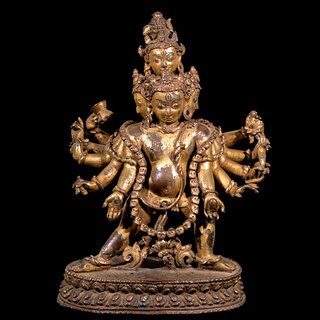
Including an image of the related artwork.
Our Mindfulness Meditation Podcast is presented in partnership with Sharon Salzberg and teachers from the New York Inside Meditation Center,
The Interdependence Project and Parabola magazine and supported by the Frederic P.
Lenz Foundation for American Buddhism.
And now,
Please enjoy your practice.
Welcome to Mindfulness Meditation.
I'm Tim McHenry,
Deputy Executive Director,
And it's a rare pleasure to be the host of this session with you this afternoon.
So this is the Rubin Museum of Art,
In case you hadn't noticed,
A global hub for Himalayan art here in the foothills of Chelsea.
So welcome to being here.
We're going to go on a journey metaphorically and possibly also literally this afternoon.
So get ready.
You know,
Those of you who have been with us before know the drill.
We explore a work of art as a way of understanding our theme of acceptance.
And then we invite our teacher,
Sharon Salzberg,
Who will be with us virtually today,
To give us a brief teaching and then have a 15 or 20 minute sit.
So the work of art that we want to explore this afternoon is the Vajravali Mandala.
It's a five mandala painting,
Five in one,
And it's quite exquisite.
It's part of a set that was painted in the middle of the 1400s as a commission by the Nyor Monastery in Tibet,
Employing six itinerant Nairwari artists from the Kathmandu Valley.
And so the intricacy,
The extraordinary filigree that you see painted here is visible on our gallery floors on the fifth floor.
And I just wanted to draw your attention to the top left quadrant here,
Which itself is a complete mandala,
Which has at the center,
The Vairochana in a six armed version of Vairochana,
Who is the sort of cosmic representation of emptiness.
But at the same time,
He's the cosmic flip side of the historical Buddha,
Shakyamuni.
And so Shakya or Sakya Simha is the emanation seen here.
And if you don't yet understand what the Vairochana teachings are about,
Ultimately they're about clarity,
Understanding how we can not confuse our feelings for an event for the event itself.
And on the third floor,
There's a richly experiential version of our interpretation of the Vairochana mandala in which you can be witness to your own feelings of pride and anger and envy and attachment through scent,
Through banging a gong and dipping into water.
All these practices we've invented in order to give you a sense of what the metaphoric teachings are actually about,
Even though they're not the practices themselves,
Very deliberately a secular approach.
So you know about mandalas,
Very often they are done,
Performed as sun mandalas,
And then frustratingly wiped away,
You know,
What has taken days to create is then wiped away within minutes and cast into a body of water to be dispersed throughout the world.
And that,
Of course,
Is the ultimate acceptance,
Isn't it?
Acceptance that everything changes.
And by virtue of it always having the capacity to change,
It allows us to understand that everything is interconnected because it's all energy.
And so that acceptance is one form that we'll be exploring in this next month.
But we have the delight of welcoming Sharon Salzberg back to the Rubin,
At least virtually,
And accepting how everything changes and the fact that everything changes is reality.
And as Sharon Salzberg has pointed out in her latest book,
Real Life,
That form of acceptance is vital to our navigation of the memories that we store in ourselves of trauma and unhappiness and find our way to some grace and appreciation of what we have and what we can have and what we can be for others.
Sharon,
Of course,
Is really the founder of mindfulness meditation here at the Rubin,
But perhaps more universally also the co-founder of the Insight Meditation Center at Barrett,
Massachusetts.
She's been the author of many,
Many books.
And rather than listing them,
Let me just point out what she does better than anybody else.
She's able to channel our confusion,
Our collective confusion,
And address it with such simplicity,
Lucidity,
And clarity that allows us to sort of take a breath and appreciate,
Oh,
That's what I should be doing.
And that's the sign of a great teacher,
Sharon Salzberg.
Tim,
It is a rare delight to be with you.
That is very true.
We are old friends at this point.
We met through the Rubin Museum at first and I call Tim the closer because once I was struggling,
I think it was either real love or real change.
It might have been real change.
One of my other books,
I was having a terrible time,
Terrible time figuring out the end of it.
And I had dinner with Tim in San Diego.
And over dinner,
It all came to me in his presence.
And so I've had to struggle on without him ever since,
Which is really too bad.
Somehow I've managed to finish the books.
But it's tremendous to be with him,
To be with all of you and the glorious Rubin Museum.
So I'm told that this month's theme is acceptance,
Which is a tricky,
Tricky word.
It's a word that often conveys to people,
Sort of on the spectrum of all those words that are seemingly positive,
But often disdained.
Words like acceptance.
Presence.
Compassion.
Gratitude.
All those words that can imply and often do,
Unfortunately,
Imply in a mistaken fashion.
Being indolent,
Being lazy,
Not caring,
Not having standards of excellence,
Being a little vague,
You know,
Kind of spaced out or out of it.
It's like,
Yeah,
I'll just accept it how it is.
Like,
What the hell?
That person's suffering so much.
But I'm just accepting things the way that they are.
So it's also associated a lot with up leveling and being disconnected from the reality,
The vibrant,
Pulsing,
Changing,
Sometimes very painful reality of what is happening right now.
So in thinking about the term,
Most of us have to do a pretty deep dive of exploration.
Like,
What can it mean and not mean despite conventional understanding and despite maybe what we've been taught?
So many of you,
No doubt,
I'm sure I have here in the past,
Talked about the acronym that is often used in mindfulness circles of RAIN,
R-A-I-N.
And it goes back to mindfulness as a practice,
Which I'm sure we've also really talked about,
Being not classically so entirely about enjoying our cup of tea,
For example,
Because we're not multitasking for a change.
We're really smelling the tea and feeling the warmth of the cup and tasting the tea and doing that instead of drinking the tea in a hurry,
Not experiencing it at all while you're checking your email,
While you're on Zoom,
While you're,
You know,
Is not a good way to live.
And we all feel the repercussions as people get more lost,
Feel more addictive tendency,
Like I need better tea,
You know.
We so rarely blame or look at the quality of our attention as having any role in our dissatisfaction.
It's got to be the tea.
It's got to be the object.
It's got to be the person.
It's got to be the thing.
You know,
There are many troubles that are eased that we are when we are learning to look more carefully at our experience as it actually is.
And that's so much what mindfulness is considered these days.
But classically,
The main,
Main purpose of mindfulness was wisdom or insight.
Was not just living our lives fully,
Which is a very good thing,
But really understanding our lives because we've seen for ourselves.
We've taken a look at the flavor,
The characteristics,
The dimensions of anger when it arises.
We can talk about what's positive,
What's which is the energy of it.
We can talk about what's damaging about it when not when we're feeling it,
But when we're lost in it,
When we're consumed in it,
We're overcome.
We lose information.
It's like if you think about.
The last time you were really,
Really angry at yourself.
It's not a time where we tend to think,
Oh,
You know what,
I did five great things the same morning,
As I said,
That stupid thing.
That's not what's happening,
And so those five great things are gone.
We see the limitations of certain states,
We see what happens in our bodies with certain states,
And so we have like a self generated wisdom.
That might say the next time you feel really about to be overcome by anger.
Maybe I want to look for an alternative source of strength,
Real strength.
But not with all this burning and lashing out and so on.
Because we've seen and so we want wisdom,
We want insight to develop as it will naturally out of our mindfulness practice and to do that.
Mindfulness really has to be mindfulness,
Which means you're not,
Say,
Just knowing that you're hearing a sound.
I think,
Damn it,
You know,
Why am I hearing that sound?
Or you're having a certain pattern of thoughts and thinking this is unbearable.
You know,
I've been meditating all these years.
Why do I still have these thoughts?
I'm terrible.
That's not exactly in a sort of popular definition of mindfulness being with what is without judging.
There's great judgment in there.
And so the key ingredient that isn't always spoken about is a kind of acceptance,
Not for the sake of complacency,
Like,
Great,
I'll just be afraid the rest of my life.
It's all right.
I'm accepting it.
And not for the sake of indolence,
Like I'm not going to do anything about this,
I'm accepting it.
But because when we're fighting against something,
When we're ashamed of it,
When we're hating ourselves for it,
We're trying to push it away.
And when we are overcome by it,
There's not kind of the right relationship to actually be looking at something,
Learning it,
Paying attention to what it feels like in your body.
Paying attention to its component parts,
Very often these feelings are very complex.
And if we just don't really look,
Or we're holding an assumption about it,
Or we're not paying attention,
We're fighting,
We're overcome,
There's not going to be a lot of learning that goes on.
Maybe there is,
Within that anger,
There's a lot of fear,
Within that desire,
There's a lot of loneliness.
We won't know until we can actually look.
So we need that kind of acceptance,
That ability to say,
This is what's happening right now,
Rather than jumping on the train of,
I knew I needed a new therapist,
Why didn't I do that three years ago,
And I spent all that money,
It's like,
This is what's happening right now,
It's fear.
There's this.
And then we have the platform to look,
You could say,
Into the heart of the fear,
Not why is it here,
And what is it about,
Or the anger,
Or whatever it might be.
But first,
What's it like in my body,
And then,
If I'm just hanging out with this,
If I'm just being like a companion to this state,
What do I see?
You're kind of watching the anger movie,
You're watching the fear movie,
And then you come back to what is usually a kind of primary object or home base in our practice.
It might be the feeling of the breath,
Which is what I'm going to suggest as we sit together.
It certainly might be something else,
Listening to sound,
Feeling other sensations in your body.
But the idea is that there is an object of awareness,
Which is like our home base,
And that it'd be something that,
If we're then commuting,
We're on the subway,
Or we're at work,
Or some more intense,
Disorganized,
Chaotic,
Loud environment,
And we're starting to feel anxious or unsettled,
We can reach for that object,
It's not so remote.
You don't need equipment,
That's why it's something like the feeling of the breath,
Or something else happening in your body.
We rest our attention on that object,
Lo and behold,
Our attention wanders,
We see that,
We see if we can let go and come back,
And when something comes up,
Some intensity,
A sensation in your body,
An emotional wave,
A thought pattern,
We try to recognize it,
Accept this is what's happening right now.
And then see if we can come back to that original object,
Say the feeling of the breath.
And that kind of acceptance will follow us into our day.
Again,
Not because we get lazy or complacent,
But because we're not in battle with every element of our lives all the time,
We can see more clearly,
We can go deeper into all of our experiences.
And then when we act,
It's coming from a whole different place.
Okay,
So let's sit together.
You can sit comfortably,
Close your eyes or not,
However you feel most at ease.
And start by listening to sounds,
Whether it's the sounds of my voice or other sounds.
It's a way of relaxing deep inside,
Allowing your experience to come and go.
Of course,
We like certain sounds and we don't like others,
But we don't have to chase after them,
To hold on or push away,
Just let them come,
Let them go.
Bring your attention to the feeling of your body sitting,
Whatever sensations you discover.
See if you can feel the earth supporting you.
See if you can feel space touching you.
Bring your attention to your primary object,
Which let's say is the feeling of the breath,
The sensations of the in and out breath,
The natural breath.
You don't have to try to make it deeper or different.
You find that place where the breath is most prominent.
Maybe it's the nostrils or the chest or the abdomen.
Bring your attention there and just rest.
See if you can feel one breath.
You don't have to be concerned about what's already gone by.
You don't have to lean forward for even the very next breath,
Just this one.
If images or sounds or sensations or emotions should arise,
But they're not very strong,
If you can stay connected to the feeling of the breath,
Just let them flow on by,
You're breathing,
Just one breath.
But if they are strong and you get pulled away,
You might need a moment to actually relax and say something like,
This is what's happening right now,
Fostering acceptance.
Then recognize you can hang out a bit with that strong sensation or emotion,
Paying attention to it,
And then see if you can let go.
Bring your attention back to the feeling of the breath.
And for all those perhaps many times you're just gone,
Way spaced out,
In thought,
Or you fall asleep,
That's all right.
Whenever you can recognize that is good.
Because after all,
It's like a practice of recovery.
You realize,
Oh,
It's been quite some time since I last felt a breath.
It's okay.
See if you can let go then and bring your attention back to the feeling of the breath.
And when you feel ready,
You can open your eyes or lift your gaze,
And we'll end the meditation.
But Sharon,
For that glimpse into what real life could be.
That concludes this week's practice.
To support The Rubin and this meditation series,
We invite you to become a member at rubinmuseum.
Org membership.
If you are looking for more inspiring content,
Please check out our other podcast,
Awaken,
Which uses art to explore the dynamic paths to enlightenment and what it means to wake up.
Season Two,
Hosted by Raveena Arora,
Is out now and explores the transformative power of emotions using a mandala as a guide.
Available wherever you listen to podcasts.
And to stay up to date with The Rubin Museum's virtual and in-person offerings,
Sign up for a monthly newsletter at rubinmuseum.
Org slash enews.
I am Tashi Chodron.
Thank you so much for listening.
Have a mindful day.