Welcome to the mindfulness meditation podcast presented by the Rubin Museum of Art.
We are a museum in Chelsea,
New York City that connects visitors to the art and ideas of the Himalayas and serves as a space for reflection and personal transformation.
I'm your host,
Dawn Eshelman.
Every Monday we present a meditation session inspired by a different artwork from the Rubin Museum's collection and led by a prominent meditation teacher from the New York area.
This podcast is a recording of our weekly practice currently held virtually.
In the description for each episode,
You will find information about the theme for that week's session,
Including an image of the related artwork.
Our mindfulness meditation podcast is presented in partnership with Sharon Salzberg and teachers from the New York Insight Meditation Center,
The Interdependence Project,
And Parabola Magazine.
And now,
Please enjoy your practice.
Hello everyone.
Welcome.
Welcome to the Rubin Museum of Art's weekly mindfulness meditation practice.
So great to be here with you on this kind of cold and dreary February day here in New York City.
It's kind of cloudy and overcast and a little drizzly and there's kind of old ice and snow everywhere,
But never fear.
We are about to warm ourselves around this theme of the month,
Which is love.
And we're not talking about the hallmark kind of love.
We're talking about real love.
And that comes in so many forms.
And that includes self-love as well.
And we have a wonderful teacher,
Sharon Salzberg here to talk with us about that and how we can really incorporate that into our practice.
And I'll bring her on here in just a couple of minutes.
For those of you who are new to us,
Welcome.
We the Rubin Museum of Art are a museum of Himalayan art and ideas in New York City.
And we're so glad to have you all join us for this weekly program where we combine art and meditation online.
Love to hear from you in the chat.
Let us know where you're coming in from.
Let us know how you're doing.
And in a moment,
Inspired by this work from our collection,
We will look at the artwork together,
Hear a brief talk from our teacher,
And then we'll have a short sit,
15 to 20 minutes,
Or a meditation guided by Sharon Salzberg.
And now let's take a look together at this beautiful artwork with our theme in mind,
Love.
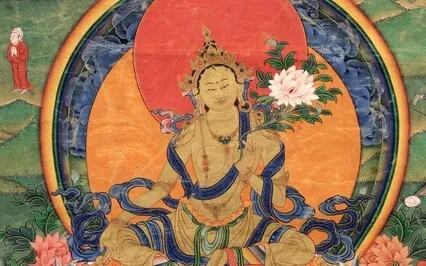
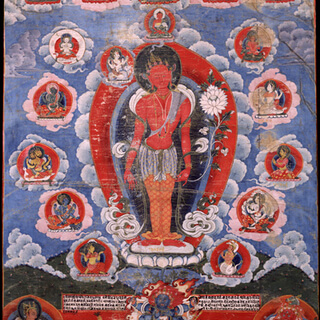
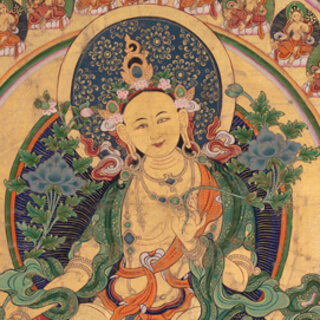
We're looking at Tara,
Protecting from the eight great fears.
This is from the Kham Province,
Eastern Tibet,
19th century,
Pigments on cloth.
And Tara,
I'll just talk specifically about Tara,
The main central figure here.
Tara is one of the most popular female deities in Tibetan culture.
She's particularly associated with protecting us from the eight great fears.
So here they are depicted all around her in this narrative type painting with all of these different vignettes.
And we will go into some of these later,
But these include things like fire,
False imprisonment,
Snakes and lions.
And while these dangers might center on the worries of secular life of a particular time period,
They do have symbolic meaning as well.
So we'll learn a little bit about that.
But Tara is just known as this loving,
All loving mother figure who gives a kind of generosity with her love.
And you can really see that by her posture here.
She's seated on this beautiful lotus throne in a kind of cross-legged style,
But with her right leg jutting out a little bit.
What that indicates is that she's ready to jump out and help you at any given moment.
So let's bring on our teacher,
Sharon Salzberg today,
Who has really quite a number of things to tell us about love.
She wrote a book on the subject,
Real Love,
And it'll be really,
Really beautiful to hear her connect this concept to our practice.
Sharon Salzberg is the co-founder of the Insight Meditation Society in Barre,
Massachusetts.
And she guides meditation retreats worldwide and has for many years.
So well renowned teacher and so beloved,
Especially in our community here.
Sharon's latest book is Real Change,
Mindfulness to Heal Ourselves and the World.
And the recent Real Love,
The Art of Mindful Connection.
And in that book,
She says,
If we truly loved ourselves,
We'd never harm another.
That is a true revolutionary celebratory mode of self-care.
You can find out all about her books and teachings and activities at SharonSalzberg.
Com.
Sharon,
Welcome.
Thank you so much for being here.
Thank you so much.
It's a delight to be here with you all.
I'm in Barre,
Massachusetts.
It's raining here as well and cold,
And it's nice to be warm to the side of Tara.
So I,
Of course,
Love this topic and I was happy amongst the various pieces of art that the Rubin Museum sent me to choose amongst to see Tara as the antidote to fear.
Tara is the energy source we call upon when we're afraid.
And that reminded me of the legend surrounding the Buddha's first teaching of loving kindness meditation as a methodology.
So as a methodology,
That particular style of meditation is one where we silently repeat certain phrases like,
May you be safe,
May you be happy,
And so on.
There are other ways of applying the same energy,
Which we'll do together today.
But they say that the Buddha had this group of monks that he was sending off into the forest,
A particular forest,
To meditate.
And they went off to the forest,
Which happened to be haunted.
And there were these tree spirits that lived in the forest who did not really appreciate the presence of these monks.
They wanted to drive them away.
They appeared as these terrible ghoulish sounds and horrible apparitions and trying to scare the monks away,
Which in fact they succeeded in doing.
The monks became terrified and ran away.
And they ran back to the Buddha and they said,
Oh,
Lord Buddha,
Please send us to a different forest.
And the Buddha said,
I'm going to send you back to that very same forest,
But I'm going to give you the protection that you'll need.
And that was the first teaching of loving kindness practice.
He urged them to go back to the same forest to not just sort of do an empty recitation of like,
May you be happy,
May be safe,
But to really do a practice of wishing well in effect to entities,
Beings,
Forms of life that one might consider a very other,
Really scary.
And so on.
And the monks did that.
They went back to the same forest.
And as these classical traditional stories all tend to end so happily,
They say the monks were so overcome by the beautiful energy coming their way from the loving kindness that they decided the tree spirits were so overcome by the energy.
They decided to serve the monks and feed them and take care of them and so on.
So in real life,
The stories don't always end quite in this fantastical way,
But we're better.
We're different when we are coming from that particular kind of energy rather than being completely subject to fear.
And you can kind of see whether you believe in tree spirits or not,
Just the psychological roots of that as love as the antidote to fear,
Fear being a kind of withholding and frozen state,
Pulling our energy back into ourselves,
Trying to withdraw,
Trying to avoid what's happening or actively declared to be untrue and some kind of denial and love is considered spacious,
Open,
Interested,
Not necessarily like the gooey sort of romantic love.
Here we are in Valentine's day season,
Um,
Which is I think a real narrowing and a limitation on the idea of love.
Love can be as I'm using the word,
You know,
As we tend to use the word,
Um,
In the Buddhist psychology,
It's not even necessarily emotional.
It could be inclusion.
You know,
Those times we have real strong impression about somebody else and conclusion about somebody else,
Maybe not even from our own experience of them,
But from something we've been told or some prejudice we hold some kind of bias we hold.
And then we realize that's getting in the way of our actually listening or taking in this person.
So we relinquish it and we really listen that kind of openness,
That ability to ascertain for oneself how we feel about this person.
That's a kind of love or the state where we,
Um,
Have been ignoring somebody.
We look through them,
We discount them.
They play some role in our lives.
Um,
People we,
These days call essential workers,
Uh,
No checkout person in the supermarket or,
Um,
Anybody that we might see on a regular basis.
So we actually might count on on a regular basis,
But we don't tend to actually notice very much.
We,
We just have that habit of indifference.
So what happens when we really look at somebody rather than through them,
That's the state of love.
It's not gooey.
Uh,
And it's not even necessarily emotional,
But it's,
It's genuine connection.
And that's really how I'm defining the sense of love.
It's a state of genuine connection.
It doesn't mean you like somebody.
It doesn't mean you're going to spend any time with them.
You know,
You're not putting yourself in a situation where you're bound to spend a lot of time with somebody or anytime with somebody,
Um,
Or adopt their point of view or stop fighting against their point of view.
It's not that,
But it's like a bone deep sense that our lives have something to do with one another that we,
To continue a theme,
Do live in an interdependent universe and that our lives are connected.
That the sense of self and other and us and them while useful as a construct is just a construct.
And ultimately there's,
There's a kind of we,
That is the reality of our existence.
The closer we come to reality,
Always the happier we are.
So when we say love and kindness for all beings as an antidote to fear,
Um,
That's an invitation to experiment.
And when people often say to me,
Why should I try to have loving kindness to this person who politically doesn't think I should have any rights or I should exist even,
Um,
That's full of hatred themselves.
And I say,
It makes no sense if you define love as agreeing with or being passive around or,
Um,
Enjoying,
You know,
Or wishing somebody to triumph,
It starts to make sense.
If you just contemplate the Buddha taught this as the antidote to fear,
What might that mean to take out some of the fear in,
In certain relationships,
Either because we've blocked off knowledge of somebody or,
Um,
We've had maybe a truly terrible experience or anticipated really terrible experience.
Like what's it like to be strong and to be clear and to have boundaries and yet to have this profound sense of connection because it's actually the truth of things.
And it does,
You know,
Just as Dawn said,
It starts with how we relate to oneself.
And this is very much a part of what we experience in say mindfulness practice,
Where,
Um,
To deepen loving kindness,
Uh,
For oneself or love for oneself doesn't mean that we're ignoring real problems or that we're trying to pretend we are perfect,
Or it doesn't mean we're insisting that we not feel fear,
Anger,
Um,
Regret any of those things that can be painful to feel.
Uh,
It doesn't mean that at all,
But that it's almost like the holding environment we are working on creating is one of being able to be present and having that kind of spaciousness,
That openness,
That caring,
Um,
And that interest,
Even just interest,
If we substituted some of the major judgments we have about ourselves and what we feel and what we think,
And,
Um,
Just thought,
Well,
That's kind of interesting,
Isn't it?
You know,
And looked at it in that way,
Watching things unfold,
It would be different.
So love,
Uh,
Here too means connection and it's a kind of caring connection.
Um,
As we sit together as the fundamental example,
As we rest our attention on,
Say the feeling of the breath as the primary object or,
Or the home base,
How do you speak to yourself when you realize you're a million miles away?
Um,
When you realize you've just taken a little trip to India or you,
Um,
Are 10 years from now,
Uh,
Or whatever it might be,
There's a moment where we confront the fact that our mind has wondered where our attention has drifted from what we have set out to look at.
So how do we speak to ourselves?
And to the degree that that voice is harsh and punitive,
Sometimes we just say it again,
Like,
Or we,
Or we say the corrective,
You know,
Not in a nasty way,
But just like chance to begin again.
Oh boy.
Oh,
Wow.
I can start over.
Or,
Oh,
Uh,
Look at that.
I caught that,
Um,
Before it escalated something like that.
And,
And was kind of a recognition that attention wanders.
This is just conditioning.
It's not personal.
It's not just you.
We were realized we were practicing,
Letting go.
I'm a practicing beginning again,
And that's the right thing.
And then for all the many feelings and thoughts and sensations that arise,
This is not something we really have control over.
And yet we blame ourselves as,
As though we did.
So what's it like when we recognize,
Oh yeah,
This is what's happening right now.
Um,
There's sorrow,
There's sleepiness,
Or maybe there's joy,
But I can't seem to hold onto it.
Um,
And we really have,
Again,
It's that kind of a holding environment of loving awareness of interest in all of our experiences.
We watch it come and go.
So we're going to bring forth that energy,
Um,
No matter what might arise in the course of listening.
So if you want to sit comfortably,
You can close your eyes or not.
You can start by listening to sound.
I don't know if you can hear my rainfall,
But I'll share it with you.
If you do just allowing the sounds,
Whatever they are to come and go.
And bring your attention to the feeling of your body sitting,
Whatever sensations you discover.
Bring your attention to the feeling of your breath,
Just the normal,
Natural breath,
Wherever it's strongest for you at the nostrils,
At the chest or at the abdomen.
And for some reason the breath doesn't work for you.
That's fine.
Something else happening in the moment.
You can stay on with sounds or feel your hands touching something like that.
This is the primary object,
The resting place for the mind.
Remember if you're with the breath,
It's just the normal,
Natural breath.
The operative word in any case is rest.
And as images or sounds or sensations or emotions should arise,
They're not very strong.
If you can stay connected to the feeling of the breath,
Just let them flow on by your breathing.
It's just one breath.
But if something is strong,
It really pulls you away.
And especially if you get lost in thought,
Spun out in a fantasy or you fall asleep,
Don't worry about it.
See if you can remember that gentleness,
That caring,
That presence as you realize you've been gone.
Gently let go and begin again.
No matter how many times you might have felt like this.
You might have to let go and begin again.
It's fine.
And again,
If you hear that harsh voice,
Like you're the worst meditator that ever lived.
You're distracted again,
Whatever.
Can recognize that.
Be kind about that,
But don't let it govern you.
You realize that you've kind of fallen sway to that.
See if you can let go and just bring your attention back to the feeling of the breath.
If you want,
Whatever you might say to yourself in that transition,
It's okay.
We're starting over.
What's happening right now?
Something like that.
Okay.
You you you you you you you you you you.
Day Final Thank you,
Sharon.
That concludes this week's practice.
If you'd like to support the Rubin in this meditation series,
We invite you to become a member.
If you're looking for more inspiring content,
Please check out our new podcast Awaken,
Hosted by Laurie Anderson.
The 10-part series features personal stories that explore the dynamic path to enlightenment and what it means to wake up,
Now available wherever you listen to podcasts.
Thank you for listening,
And thank you for practicing with us.