Hello,
This is Ryan and welcome to 20 Minutes of Mindfulness.
The purpose of this track is to act as a kind of scaffolding for your own dedicated time to intentionally practice mindfulness,
And can be used as often as you need.
The idea is to keep reminding you of what you're doing,
And also to support and bolster you when practicing mindfulness in this way might begin to feel discouraging.
We will be using the physical sensation of breathing as the primary object of meditation,
So you don't need to follow the instructions exactly as long as your intention is to pay attention to what it feels like to breathe.
So let's begin.
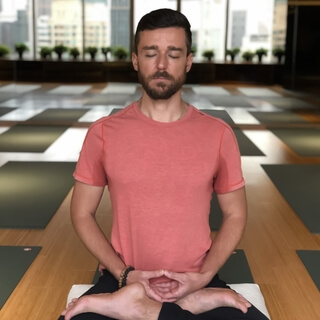
Start by finding a comfortable seated posture.
If you're sitting on a chair,
You may want to bring your back away from the backrest so that you're using your body's own strength to hold you up.
If you're sitting on a cushion or on the floor,
You can choose to sit cross-legged or on your knees if that's more comfortable for you.
You can also use a cushion if you like underneath your buttocks to elevate your hips slightly so that your spine can be relaxed and that your lower back doesn't need to work too hard to keep your spine straight.
The posture should be one of kind of a straight spine.
So the spine does have a couple natural curving spots in it,
So allowing those curves to kind of naturally show up,
One in the lower back.
You can even place your hand there in the lower back to see if that little curve in the small of the back has appeared there,
And that will help support you as you work to practice.
The crown of the head towards the ceiling,
Shoulders are kind of down and back,
Or just whatever way that you can feel relaxed,
Yet fully awake,
Fully alive,
And fully alert.
If you like,
You can allow your eyes to close,
Or if you prefer to keep your eyes open,
Perhaps choosing a spot maybe a meter in front of you,
About 45 degrees downward gaze with your eyes,
Just allow the gaze to soften,
So whatever seems more comfortable or more appropriate for you and your practice.
And becoming aware that you have a body,
That you have a head,
You have a neck,
And spine,
And can you feel the effect of gravity on your body?
So gravity's pulling down on the body,
And so we can feel that in the head,
In the neck,
In the spine,
And we can even feel it on the supporting surface that's pushing back.
So we may feel our cushion,
Maybe the chair.
If your feet are on the floor,
You can feel the floor pushing back against your feet.
So noticing how pressure is something that we can detect with our sense of touch.
And this is the point of interface from our bodies and the outside world.
So gravity doesn't pull us all the way to the center of the earth,
No,
In fact,
Something pushes back,
And that sensation of the pushing back is how we detect the boundary between ourselves and the outside world.
And so I'll invite you to take note of what your body feels like right now in this posture.
Sitting up straight,
Yet relaxed and comfortable.
Notice where the head is.
Notice where the shoulders are.
Notice where you've chosen to place your hands,
And in what position.
Are your hands folded together,
Are they on your knees?
So just taking a moment to notice what it feels like to be here right now in this posture.
And as you are aware of yourself,
Of your body here and now,
In your aliveness,
You will notice that one symptom of being alive is that you are breathing.
It's the symptom that we share with all other life,
Exchanging gases with the external environment.
And this symptom comes with physical symptoms of its own.
You can feel the motion of air at the nostrils.
As you breathe in,
You can feel cooler air coming into the nose.
As you breathe out,
You can feel warmer air coming out.
And you can be aware that that cycle continues to happen.
As long as you're alive,
Inhaling,
Exhaling,
We can feel the touch of air on our nostrils.
And then we can feel air moving in the sinuses.
In and out,
Cycling as we breathe.
Maybe noticing how the sinuses slightly change size.
Inhaling that vacuum pulls the sinuses in,
Makes them slightly smaller.
Exhaling there's a slight expansion as the pressure in our sinuses increase.
And then we can feel air moving in our larynx,
In the throat.
Is it obvious to you or is it subtle?
And then as the air enters the lungs,
We can feel the lungs expanding.
Or maybe an easier way for you to notice the lungs changing shape is the rising and falling of the ribcage.
The ribs are in fact expanding slightly as well as you breathe in and contracting slightly as you breathe out.
Can you monitor that feeling?
And I'd also like to invite you to notice that in no two moments are the feelings in the ribcage exactly the same.
As you breathe in,
The ribcage is constantly expanding.
As you breathe out,
There's a constant contraction,
Relaxation as the ribcage gets smaller.
And next,
The diaphragm.
This muscle,
Which as it moves downwards towards the internal organs,
Makes the space in the lung cavity bigger so that air naturally moves into the body.
As you breathe out,
That muscle relaxes and air comes out,
Pushes out naturally.
And you may notice along with this,
As the diaphragm moves downward,
The space in the abdominal cavity gets smaller.
And so as that space gets smaller,
The organs in the abdomen begin to push outwards and you feel your stomach going out.
Your belly starts to expand as you breathe in.
And that's just the diaphragm moving those organs,
Pushing against them so that your belly moves outwards.
And then as you breathe out,
You can feel the reverse of that happening.
So breathing in,
Noticing the abdomen expanding.
Breathing out,
Noticing the abdomen contracting.
And so let's see if we can put all of that together.
So starting at the abdomen,
Feeling the abdomen moving in and out.
To the chest,
Feeling the chest rising and falling.
The larynx,
Air moving through the region of the throat.
The sinuses,
Kind of expanding and contracting in the opposite way of the rest of the body.
As we breathe in,
A slight narrowing.
As we breathe out,
A slight expansion as the pressure inside the sinuses increases.
And then the nostrils.
And so let's just do a little experiment.
See if we can follow the breath as we're breathing in,
From the tip of the nose all the way down to the belly.
And then again,
Reversing it as we breathe out.
So on your next in-breath,
Noticing the nostrils,
The sinuses,
The larynx,
The chest,
And the abdomen expanding.
As you breathe out,
Abdomen,
Chest,
Larynx,
Sinuses,
Nostrils.
So see if you can continue,
Continue to follow the breath at these places.
Breathing in,
Nostrils,
Sinuses,
Larynx,
Chest,
Abdomen.
Breathing out,
Abdomen,
Chest,
Larynx,
Sinuses,
Nostrils.
In,
Nostrils,
Sinuses,
Larynx,
Chest,
Abdomen.
Out,
Abdomen,
Chest,
Larynx,
Sinuses,
Nostrils.
So see if you can pay attention to that feeling on your own.
So monitoring the breath at each stage of the inhalation and the exhalation.
And we may,
From time to time,
Find ourselves getting distracted by thoughts or by things happening inside of our environment.
Each time we notice a distraction,
Just recognize,
Hey,
That happened.
It's already happened.
So I can,
Through acknowledgement,
Just gently release it.
Remember what I'm doing.
Hey,
I'm focusing on my breath and coming back to observing the feeling of breathing in each of the stages of the breath.
Congratulations on having made it through our practice today.
So if you like,
You can transition slowly out of your practice.
And I'll close practice with three rings of the bell.