So I think we can make a start.
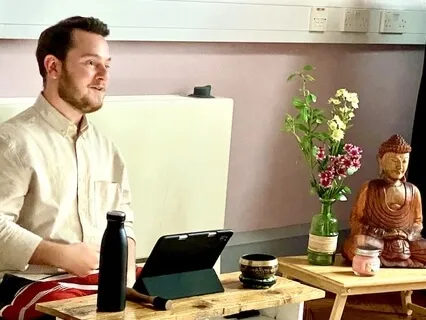
So welcome everyone to our first in-person class here in Mountain Ash.
Just to obviously introduce us,
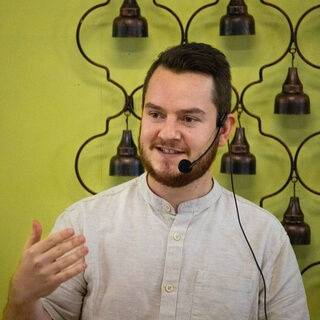
I'm David and Manu is the one behind the table.
We're the two founders of Samadhi.
Just to give you a bit of background on me,
I first found meditation and mindfulness back when I was working in the NHS.
I was working in North Wales and I was working in psychiatry.
And I was introduced to meditation and mindfulness as a tool to help the people I was working with with anxiety,
Stress,
These kinds of things.
Because it's very helpful for that.
And it was really actually through my own journey with my own depression,
My own mental health,
That meditation actually started to come into its own for me.
And I wanted to start to get to the roots of where did it come from and what more could I get from meditation.
And through that I ended up discovering Buddhist psychology,
Buddhist philosophy.
And my upbringing was actually an atheist background and I was very religion averse.
It was like all of them are evil,
Bad,
Don't go anywhere near them kind of thing.
But through my googling of feeling depressed,
The things that started to come up made a lot of sense.
They were quite practical.
So I ended up going along to a couple of classes and what I found was a group of people who were trying to figure out why we were experiencing stress,
Why we were experiencing anxiety,
Why do we experience negative minds,
What can we do about it,
How do we get more peace of mind.
There was nothing to believe in,
There was no sort of leap of faith,
No heaven and hell God or anything to sort of like jump for.
But it was all just really practical and helpful.
And so that really resonated with me and you know fast forward I've studied for a while with various teachers and was asked to teach and the rest is history really.
So the whole point of these classes is because I want to share what I know has helped me and what I've seen help others.
Meditations,
New ways of thinking that can help us let go of some of that stress,
Let go of some of that anxiety and start to live with greater ease.
So the format for these classes,
I'll normally do a bit of an introduction,
Then we'll do a meditation about 15-20 minutes,
Then a talk which will be whatever the topic of the week is,
Whatever the new way of thinking is and then we'll have some time for discussion,
Question and answer and that kind of thing.
So my goals for you,
My goals for us for these next five weeks,
So today on these next five weeks we're looking at meditation for beginners,
Learn to meditate.
So we're going right back to the basics of what is meditation,
How do we do it,
Why do we even want to do it and looking at some of the things like well I always get distracted,
What can I do about that or I always fall asleep,
What can I do about that.
Because so many times we're introduced to meditation,
We know it's kind of helpful but every time we do it,
Every time we try,
We're just like I just can't.
We use an app or we hear about it somewhere,
Read something but it's not really very helpful,
It doesn't really help us,
How do I do it,
How do I stop getting distracted.
So that's going to be the whole point of the next five weeks and alongside that I'll be introducing techniques to reduce anxiety,
Reduce stress,
Tools that we can use in our daily life so that when we do get frustrated,
When we do get jealous,
Angry in our daily life we have somewhere to turn to,
We know what to do with it.
Because right now we kind of don't,
We have this feeling in the body and mind and it comes out in any way it needs to,
Slamming the door,
Shouting at people,
Whatever it needs,
However that energy needs to come out because we don't know what to do with it.
And Buddhism can offer us lots of ways of channeling that energy in a different way,
Making it more practical.
So as we're all here in an unfamiliar environment,
I think it would be good to start off with our meditation.
So we'll do a 15,
20 minute meditation,
Somewhere in between.
And this meditation is called Settling Body,
Speech and Mind in the Natural States.
And so this meditation I was first introduced to by my own teacher and I found it really,
Really helpful.
It's a way of preparing ourselves for meditation actually.
So it can be used as a full meditation session or when we're really familiar with it we can use it as a preparation for doing another meditation.
We can also use it as a preparation for meetings,
Exams,
Any time that we really want to bring the best mind.
You know,
When we want our problem solving,
We want creativity,
We want a calm,
Composed mind,
We don't want to sort of turn up like a bull in a china shop,
But we want our best mind.
This meditation is great for that,
Just pressing the reset button.
So normally in my classes I say to people that you can either lie down or sit down.
I can see actually in this venue we do have space to lie down.
If you do have a yoga mat,
You're welcome to lie down for this meditation or be seated.
If you are seated,
Then the main points are that your back needs to be straight,
Relatively straight.
And so that's not sort of like really tight and tense,
You know that you're really tight,
But just naturally straight.
So if you do have a cushion,
That's very helpful if you're on the floor to put that cushion under you and bring your knees more towards the floor,
That can help just sort of align your spine very nicely.
If you're in a chair,
Then it's quite helpful to have your feet flat on the floor in front of you.
Your shoulders will be quite level and your head tilted ever so slightly forward.
And then with your hands,
You can rest them anywhere that's comfortable for you or you can use the classic mudra of meditative equipoise,
Which is your right hand on top of your left with your thumbs gently touching and just place them right here.
But wherever is comfortable for you could be on your knees,
Could be just wherever they fall.
So just take a moment to get into that posture.
Try and get yourself comfortable and lie down if you wish.
And try and get a feel for this posture,
Maybe rock yourself back and forth a little bit,
Try and find good balance with your legs.
If you are on the floor,
You do have a couple of options.
Obviously,
We don't want our legs to go dead.
Your posture is very,
Very good for meditation.
I could see you've done it before.
So that's going to be very good.
You're not going to get a dead leg hopefully.
Classic sort of folding your legs can give you a dead leg.
So there's different approaches.
There's that approach where you have sort of your knees touching the floor.
Cross-legged might be quite comfortable for you or you could have one leg out.
It's one of those things you just got to experiment with to know what's going to work for you.
So find that posture and then let's go straight into our meditation.
Let me get my timer.
So we're not sat here all night.
Yes,
You can take your mask off for the meditation.
Thank you.
So when you're ready,
Gently close your eyes.
And as we just settle into this posture,
Take a moment to bring to mind your most meaningful aspiration not just for this meditation but for this class as well.
Thinking about what it is you wanted to get out of this class,
Out of life in general.
With that aspiration in mind,
Let your awareness now descend into the body right down to the ground where you're in contact with the cushion,
The chair,
The floor.
Right down to these tactile sensations of firmness and solidity.
This is what we call the earth element.
And then like a fragrance filling a room,
Let your awareness rise up and fill the entire space of the body from the soles of the feet to the top of the head.
Now we've let our awareness descend into a space which is non-conceptual and that means there are no thoughts here in the body.
It's only sensations.
So likewise try to attend to the sensations in this way,
Not thinking about the body but just noticing what feelings you find.
And as you maintain this mindful presence of the body,
Take notice of any areas that feel tight or tense and invite yourself to relax and release that tension,
Especially with the out breath.
Bring your awareness to the face.
Allow your forehead to feel spacious and as well between the eyebrows.
Relax those muscles.
Likewise around the eyes,
Soften the eyes.
Relax the muscles around the mouth and the jaw.
And if you need to,
Let your shoulders drop.
And if you are comfortable,
It should be quite easy to remain still for this meditation.
This helps to maintain the composure of the mind,
Helps the continuity of attention,
Helps us focus.
So except for the movements of the breath,
Try to remain as still as possible and let yourself relax.
And then we settle the speech in its natural state and that is one of effortless silence.
So outwardly we've already achieved this and then we turn inwards to the mental chit chat,
The commentary of the mind.
And to help us settle the inner speech,
We settle the respiration in its natural rhythm.
That is we allow it to flow in and out completely unimpededly without controlling it or constricting it in any way,
So that the belly feels soft.
And let that breath flow all the way out and all the way in,
Like a wave washing upon shore.
And as you exhale,
Every time you exhale,
Relax more and more from your core in the body.
Also with every exhalation,
Release any thoughts that have captivated your attention.
As if the breath were a gentle breeze blowing away dry leaves,
As you breathe out release any thoughts and relax more.
Take this as an opportunity to relax like you've never relaxed before.
And then we settle the mind in its natural state.
And we do that by first of all allowing ourselves to set aside any hopes and concerns about the past,
Any worries about the future,
And even any thoughts about the present.
There is nothing that needs your attention right here right now for the next 10 minutes.
And then bring your awareness back to the body,
Let your awareness come to settle here in stillness.
Just noticing the sensations of the body.
And as you do rest here in stillness of mind and stillness of body,
Is it not the case that the rhythmic sensations as you breathe in and breathe out rise up to meet you?
So start to take notice of these changing sensations as you do breathe in and as you breathe out.
And for the remainder of the meditation we have only one job.
And that is to keep our attention on the sensations of the breath in the body wherever we feel the most.
And that could be in the belly,
In the abdomen,
It could be the chest,
It could be the sensations of air,
The nostrils.
It could be the whole body at once.
And whenever you get distracted,
Whenever something captivates your attention,
Instead of becoming quite tense,
Frustrated,
Let your immediate reaction be to relax.
And as you relax,
Release that thought with the out breath and just gently guide your attention back to the breath.
And we can experiment with counting the breaths as well.
So the very end of the in breath,
Just before you breathe out,
Just a very quick count,
One.
And allow the breath to flow out,
Allow it to breathe in again,
And then a very quick two.
And see if you can maintain your attention on the breath in between those counts.
Just count one to seven,
One to seven.
If you notice that you are starting to become dull,
A bit vague,
Spaced out or sleepy,
Tilt your head back ever so slightly.
You might want to open your eyes a little bit just to let some light in.
And for the last few minutes of this meditation as you do,
Stay with the breath to the best of your ability.
Start to notice the calm and stillness.
As things do start to settle.
Good and when you're ready you can relax your concentration gently open your eyes and bring your meditation to an end you may want to gently stretch it out especially if you've got a dead leg so this evening I just wanted to talk a little bit about what is meditation why do we want to meditate what's the point in watching our breath when I could just watch Netflix or do something else so meditation is of course it's something we do with our mind isn't it it's a way of directing our awareness our attention to something specifically and the Pali word for meditation is Bhavana and that translates to cultivating to training the Tibetan word is Gom and that also translates to familiarizing and so it's all about training the mind cultivating the mind in a certain way and generally regardless of where the meditation comes from in Buddhism there's two categories for meditation but generally any meditation will fit into one of these two and they're Shamata and Vipassana you might have heard these words especially if you do yoga or Vipassana meditation in yoga and so Shamata is any of the meditations in which we concentrate or focus on one thing at a time so let's say the breath,
It could be a stick,
A pebble,
An image our mind,
A screaming child,
Any one thing that we focus our attention on that's a Shamata meditation and then the other type is Vipassana,
Vipassana is all about the inquiry the asking questions,
So maybe you've calmed your mind you're observing the mind and then with Vipassana you start to investigate what are thoughts where do thoughts come from,
How do they work,
How does one thought turn into another how does a thought turn into an emotion,
So all of these kinds of things so it's these two types of meditation and they go hand in hand really Shamata is sort of the foundation,
You need to have a calm,
Clear concentrated mind to be able to ask those kinds of questions and investigate otherwise you're just going to be all over the place so meditation is all about training,
Either one is all about training and so why would we want to train the mind?
And the point is that right now we don't really have very much control of the mind,
We might just think back to that meditation we just did,
Perhaps you found the breath and you were there for a second or two but then straight away you were off what's my shopping list,
What am I going to have for dinner later what am I going to have dessert,
What have I got to do tomorrow you're just off from another one,
Ooh there's the breath,
I'm supposed to be on the breath and gone again,
And you're just wandering around,
Different sounds,
Different thoughts and so we don't really have much control of the mind we kind of just seem to be an observer and the mind just goes wherever it wants almost like a balloon in the wind is an analogy,
You're holding the balloon it is here,
It's with us,
But it's in the wind and this balloon is just going everywhere and we can't really hold it still.
In Buddhism it's often said of the monkey mind,
The monkey jumping from branch to branch ooh what's this,
Ooh shiny object,
Ooh what's that,
Just constantly here,
There and everywhere,
Something happens,
Somebody says something and we're off we don't have any say in it,
We're just gone and so what's the issue with that,
Isn't that normal human behaviour,
Isn't that okay,
That's fine,
And it is very normal human behaviour,
But it brings us to the most basic teaching of Buddhism,
If you know anything about Buddhist psychology,
It's the first thing we're always introduced to,
And that is that every sentient being wants to be happy,
And they want to be free of suffering,
And that's sort of like a given,
You know,
We all want to experience happiness,
Joy thrill,
Excitement,
Peace of mind,
All of these nice things and we don't want to experience any discomfort,
Any unhappiness,
Any stress frustration,
That's just obvious,
And I'm sure if you know,
If I asked you if you had a preference for what you'd rather experience,
Everybody here would say yeah,
I've definitely got a preference for which one I'd rather experience you know,
We don't wake up in the morning and think,
You know,
I'd love to be a bit anxious and tired this morning,
A bit of stress when I get to work existential crisis at lunch,
Cry myself to sleep,
You know,
We don't sort of plan our day around that,
We plan our day around the good things,
I'm going to have this for dinner,
Let's go do this,
Let's have this holiday,
We plan our day around the good things,
So sometimes we're up,
Sometimes we're down,
You know,
Even one day could be a bit of an emotional rollercoaster,
Might wake up quite excited about something that's going to happen and then we're caught up in traffic and we're quite stressed on the way to work and then something else happens,
You know,
So one day can just be like up,
Down up,
Down,
Up,
Down,
And it's exhausting,
You know,
We might have a job that's not very physically demanding but at the end of the day we're tired and we don't really know why and it's this emotional toll,
This mental toll that not having much control over the mind does.
So despite this preference that we all have,
You know,
We can all say we have this preference for experiencing the better things and not experiencing any of the frustration,
The jealousy,
The anger,
Despite that preference and despite the fact that from day one we have always worked towards this.
You know,
Even a baby can say no to food that they don't like.
From putting on a blanket when we're cold to taking one off,
All of that is because we want to be comfortable,
Not uncomfortable.
So every single decision we've made is in this pursuit and so the question comes up then despite this preference to be happy,
Fulfilled,
Content why am I not,
Why have I not found it yet?
And the Buddha's answer is that our recipe is a little bit faulty like having a recipe for a cookie that always comes out hard and inedible but we just keep still making this cookie the same recipe and we don't really question it.
And what is our recipe?
Well our recipe is we believe that the happiness,
The fulfilment,
The contentment that we really seek will come from getting the perfect things.
You know,
If I could just get the right job that pays enough,
Gives me enough freedom but isn't too stressful,
Don't want something too high up.
So I just have enough money,
Just enough freedom,
Just enough respect.
And then the perfect partner who respects me always picks up their socks never disappoints me,
Always gives me what I need.
The right phone that does all the cool things I want it to do,
The nice car,
The house that's not too in the city,
Not too in the countryside but just in between.
You know,
All of these things,
Whatever it is for us,
We think if I could just get all of these things sorted out,
Then I'll be happy.
We sort of have this thing,
When this is sorted out in my life,
When that's done,
Then I'll be happy.
That's what's missing.
Just this thing,
Then I'll be good.
Then I won't have stress anymore.
And it seems logical,
It makes a lot of sense,
That's the way we're brought up and we have some happiness,
It's not like all of our lives are awful,
We have some enjoyment from the things we have but we want a bit more.
I get some enjoyment from the TV,
I get some enjoyment from my gadgets,
From the things I do but I want more.
My partner brings me some pleasure but I want more.
So there's an issue here and what the Buddha and philosophers east and west have all come to discover is that there's two types of happiness.
And if we use the Greek terms it's hidonia and it's eudaimonia.
And hidonia is about what we get from the world,
It's those things,
It's that walk on the beach,
It's a nice meal,
It's the new phone the perfect house,
It's the pleasure and the joy that we get from the external world.
And generally there's a couple of issues with this.
Not issues,
Faults I would say.
So the first one is that it never truly satisfies.
So we think when I get this thing my life will be much easier,
It's all going to be good,
Everything will be great.
And then it doesn't quite last,
The satisfaction that we get from it is kind of fleeting,
Maybe only the last five minutes.
I remember when I first moved out into my first flat,
I didn't have a lot of money then but I saw this advert for a Dyson Hoover and it was one of those ones that you know you attach to the wall and it charges itself and it's really light and easy and I thought you know my floor is always dirty,
That's why,
Because I don't have a convenient Hoover.
If I got this Hoover then it would be like super easy,
Convenient to always be charged,
My floors would be so clean,
It tells you a lot about me.
But it's these silly sort of things that we tell ourselves,
That we convince ourselves,
I really need this thing,
It's really going to make my life easy and convenient.
And of course you get bored of that thing and it's not as fun as it was and I never clean my floors anymore,
Man who does it.
So that happens.
So the first one is that it never truly satisfies.
It lasts for a while but then we're like,
What's the next thing,
What's the next one?
Moving on.
The second one is that it only lasts as long as the stimulus is present.
So let's say it was a meal for example.
The moment that nice meal is done,
That pleasure,
That joy is done.
So because it's stimulus driven the moment the stimulus is done,
It's done.
The third one is that it can turn into suffering.
And this is,
If I use the meal example again,
If having a good meal was a source of pleasure then the more we ate,
The happier we'd become,
The more pleasure we'd feel.
But I think we all know that the more you eat,
You start to get uncomfortable at some point.
So it has a threshold and at some point it will turn into suffering.
A walk at the beach,
You know,
People say,
Oh I love being out on the beach,
I love being out in nature,
It makes me happy.
But the longer you spend there,
The more hours you spend there,
Eventually it starts to become quite uncomfortable and you wouldn't like it anymore.
Too hot,
Too cold,
Too windy,
Too rainy,
Whatever it is,
It would start to lose its fun.
The fourth is that it can't be enjoyed with an uncontrolled mind.
So let's say that that walk on the beach,
On your way there,
You got some bad news.
Or you tried to go down to the mumbles on the first day that the restrictions let up and there's no parking and it's filled with people and it's really windy and it's really rainy.
If you're in a bad mood,
That thing can't suddenly change,
You know,
And protect you from a foul mood because you brought it with you.
And the fifth is that it's unreliable and unable to be controlled.
And so if we think about our partners,
For example,
You know,
They're supposed to bring us pleasure,
Bring us happiness,
But even our partner we can't control,
You know,
We can't make sure that they pick up their socks,
We can't make sure that they always put things in the dishwasher,
You know,
They're their own person.
You're looking at me with a smile.
It's more the other way around,
I'm always the one who leaves his socks on the side.
So it's unreliable,
Essentially,
I'm unreliable.
And then the sixth one is that it's subject to impermanence,
So everything that comes to be will eventually cease to be.
So we buy these nice cars or nice phones and things and we think they're going to last and they should last,
But eventually they're going to break,
They're going to fall apart and we get so frustrated and disappointed when that happens,
But they were impermanent all along,
So it was always going to happen.
And that's true for everything.
So it's not that hedonia is necessarily bad,
And that's not what the Buddha says.
The Buddha doesn't say,
Sell all of your stuff,
Get rid of all your people,
They're the problem,
Go live in a cave in a loincloth,
And just ignore everyone and give up everything.
That's not the problem.
We just need to know that they are subject to these faults,
That is their true nature.
And if we know that deeply inside,
Then when something does break,
We're not disappointed,
We're not frustrated.
It doesn't satisfy,
It's okay.
We don't crave these things,
We don't think,
I really need to get that thing because it's going to give me all the happiness that I need,
Because we know,
Okay,
Actually,
It's limited in that sense.
So it kind of just gives a bit less craving,
A bit less of that anxiety,
Less of that frustration on the external world needing to be perfect and bring us that.
But hedonia in itself is important because,
For example,
A roof over our head,
Food,
Access to money,
Clothing,
All of these things are hedonia,
Pleasure from outside,
And nobody's saying they're trivial.
And in fact,
Without a roof over your head,
Without enough money,
Without enough food,
It's very difficult to be happy.
Somebody could say,
Oh,
Do some meditation,
That'll sort you out,
And you're like,
Are you kidding me?
So we need a certain amount of things.
But what research shows and what our experience shows,
Actually,
Is that it can only bring you to a certain point.
So when you have enough food,
When you have enough money,
You have a roof over your head.
You don't get twice as happy from having twice as much food or twice as much money.
In fact,
Once you have enough food,
You have that the worries are sort of gone.
What research has shown is that the levels of happiness that people report tapers off because you still get your anxiety,
You still get your stress,
You still get everything else.
You don't become ten times happier by having ten times as much money.
And we see that from the richest of the rich,
They're some of the most anxious and stressed people with some of the worst problems.
And in fact,
I was reading the other day that apparently the eighth most richest people in the world have the same amount of wealth as the poorest 3.
5 billion.
And that's just crazy.
And they still want more.
Those eight people,
They still want more.
They want to be on the top.
But it doesn't bring them that satisfaction,
That contentment that they're looking for.
So,
Hedonia is important,
But it has its limits.
And so what's the second type?
And the second type,
The Greek term is eudaimonia.
In Sanskrit you'd say samyaksuka.
And you could translate that as genuine happiness,
Authentic well-being.
And this is about what we bring to the world,
Not what we get from the world.
So it's that experience of fulfilment,
Satisfaction that we just have from having a very healthy,
Very balanced mind,
Emotional balance,
Emotional health.
It's about how we're feeling,
Not what we're getting.
And so importantly,
It's not dependent on having the perfect external circumstances.
You can be in the worst of situations.
And this way of being,
This genuine well-being,
Can carry you through.
And there's so many examples of that.
Yesterday evening,
At our class,
There was a lady who came who's been coming along to our classes for a while.
She has been dealing with the terminal illness of her partner.
And through meditation and cultivating some mental balance,
Getting more in tune with calmness of mind,
She says she's found peace in that.
And she's now able to enjoy the time she has left with her partner.
Whereas before she was like,
Why,
Frustrated,
Angry with everyone and everything.
And she's,
You know,
A living example that you can have genuine happiness and genuine inner peace,
Even in the worst of circumstances.
And we see that as well for people who are going through immense suffering of themselves.
A peace and a calm can just come and you think,
How could you be joyful?
How can you be happy at this time?
But you can be,
Because it's not about what you get from the world,
But what you bring to the world.
And so,
It's not subject to those same faults as Hidonia,
You know.
It's,
It is reliable.
It is sustainable.
It is something we can control,
Something we can sustain.
Something we can cultivate.
And generally,
What the Buddha taught and what psychologists have found is that there's three avenues by which we can experience yudhim and yia.
The psychology,
Western psychology definitions are slightly different,
But they're getting at the same point.
And it's interesting that they came to the same point without meeting each other,
Supposedly.
So the first way is through ethics,
Morality,
Living a benevolent way of life,
A non-violent way of life.
And that's not about sort of following any ten commandments,
Some list of,
You know,
If you don't do these things you'll be bad,
You'll go to hell.
But it's about just knowing that your place in the world is good.
That you're not hurting people.
You're not like kicking the cat and screaming at people in traffic,
But you're just,
You're having a good influence in the world.
You help people.
You're quite giving.
At the very least,
You're not harmful.
There's a certain contentment and a certain inner well-being that comes from that.
Even a child can understand that,
You know,
The gift is in the giving.
When you give to others,
When you're kind to others,
There's a well-being and a feeling of joy that comes from that.
And that's coming from what you brought to the world,
Not what you got from the world.
The second one,
The second avenue by which we can experience Udamaniya,
Is about mental balance.
And that mental balance is all about meditation,
Having a calm mind,
Being able to regulate our emotions so that we don't sort of jump to the heights of,
Or the lows of anger and stress and then straight over to excitement and just that massive emotional bandwidth.
But we experience what's appropriate and we're able to control it.
So that if,
It's not that we become a robot,
But when it's appropriate to feel grief,
When it's appropriate to feel sorrow,
We do.
But it doesn't turn into,
You know,
15 weeks of something we can't get ourselves back out of.
But we have mental balance,
Emotional balance.
You know,
Through meditation a calm,
Quiet mind.
And then the last type is happiness from being very confident in you know,
It's wisdom,
It's confidence of knowing.
So knowing ourself,
Knowing our place in the world.
It's the opposite of a mid-life crisis,
You know,
Being quite sure of,
You know,
Where I'm going,
What I'm doing.
There's a well-being that comes from that as well.
So if I just go back to meditation,
We're coming to our last 10 minutes.
So meditation,
Of course it helps us relax,
It helps us unwind,
Which is very important and very valuable.
But it also helps us calm the turbulence of the mind.
Get in touch with our true nature.
I don't know if you,
You know,
You might not have experienced it in that very short meditation,
But the true nature of the mind is calm and peaceful.
Our baseline right now is like stress and anxiety and we don't even realize it,
You know,
We're holding this tension all the time.
But the true nature of the mind is calm,
It's peaceful,
It's joyful,
It's happy just naturally.
And the more we meditate,
The more we get in touch with that.
When we calm the turbulence,
It just bubbles up naturally.
It's not like we have to,
You know,
Calm the mind,
Let go of thoughts,
And then do something to make the mind happy.
The moment you calm that turbulence,
It just is happy,
It is peaceful.
It also helps us understand our experience.
We get to know our mind,
Get to know our thoughts,
Our emotions.
And that's so important because it's by the way,
By way of our mind that we experience the world.
If our mind is positive,
If our thoughts are positive,
Or if they're negative,
That affects the kind of reality that we inhabit.
So if we start to get to know our mind,
Get to know our thoughts,
Our emotions,
It's no longer why me,
Why am I experiencing this,
You did this to me,
But we know the causes,
We know what's going on and we can do something about it.
And I also see meditation as prevention.
So it is the tablet for the headache,
You know,
The remedy for stress or anxiety,
Calm ourselves down,
But it also is about,
You know,
Why do I get the headache in the first place?
What can I do to stop getting headaches?
It's about,
You know,
Getting to know the mind,
Getting to know what are the true causes of stress and anxiety inside and what can I do about that to stop them even happening in the first place?
And that's what meditation can unlock for us.
So my sort of last point before I wrap up is if we are done feeling anxious,
If we're done feeling stressed,
If we really want to take back control of the mind,
Our experience of this world,
Then meditation,
Cultivating the mind,
Is the way that we do that.
We're the only ones who have access to our mind.
We're almost sort of wanting the external world to fix our mind,
You know,
We say,
I'd be fine if you stopped doing this,
If that thing would stop going wrong.
We're expecting external things to fix our anxiety and stress,
But the moment those things are fixed,
We're still going to get anxious again,
We're still going to get stressed again when something else happens.
So we're the only ones with access to our mind.
Nobody else can do it for us.
And if we want to start taking control of it,
And we say,
I'm done with feeling like this now,
I'm done with feeling so stressed,
Then meditation is the way that we do that.
You know,
We often before we go out,
We take a look in the mirror,
Don't we,
To check how we look,
Make sure we're presentable,
We're not going to scare anyone.
But how often do we do that with the mind?
How often do we go,
You know,
Is this the mind I really want to take to spending time with my family,
My friends,
Or at work?
Is this really the best mind to take?
But that's so important,
I think,
That's the way that we experience the world,
You know,
We neglect this part of our experience so much.
So meditation is not this sort of esoteric thing,
You know,
It's this niche thing.
It comes from a culture of people who were done,
You know,
The Buddha himself,
His whole journey was about seeing suffering in others and saying,
There's got to be a way out of this,
There's got to be something better than this,
And finding out,
Okay,
What are the true causes and then sharing that with other people.
Our Western approach has been to make things more convenient,
You know,
Make the phone faster,
Make the car quicker,
Make it better,
You know,
Make things faster,
More convenient,
Bigger,
Whatever it is,
You know,
It's all been about like external progress.
And life is not any less stressful or easy now,
You know,
Things are very fast paced,
Things are very difficult,
And I don't think we've made life much more convenient and easy.
It's different,
But it's still different,
You know,
Still challenging.
So I would encourage you to,
If you don't already have one,
To start up a regular meditation practice.
It could be 5-10 minutes in the morning,
If you don't have 5-10 minutes,
Try to get up 5-10 minutes earlier.
We can all find an extra 5-10 minutes,
Even if we have to lock ourselves in the bathroom or sit in the car in the car park,
We can all find 5-10 minutes to just watch the breath and see how that starts to affect our daily life.
What I often find,
And none of this,
Nothing I've said here today and nothing I'll ever say is to be taken at face value.
The Buddha was always like that,
He said don't believe something just because I say it,
Just because it's in a book,
Just because people believe it.
You need to experience it for yourself.
And so what I often find that people say when they come to classes,
When they come back on week 2 and week 3,
They say I did 5-10 minutes,
And you know what,
My life got easier.
I still got upset,
I still got stressed,
But I had a bit more calm,
I had a bit more space before I responded.
And so try it for yourself,
See if it can make a bit of a difference.
If you prefer to do a meditation guided we have a free podcast,
You can find it on Spotify,
Apple Podcasts anything like that,
Ask Alexa or Google Home,
And that meditation we just did,
There's several meditation on there that you can use at home if you wanted to.
And just try,
Give it a go.
Early mornings are best for most people they find because you're not you're quite rested,
Late at night people just fall asleep.
So try early mornings,
Just 5-10 minutes and see what difference it can make.
And try lying down as well at home it's very relaxing isn't it to do the meditation lying down,
So try that as well.
We have 5 minutes left for discussion,
Question answer,
If anybody does have anything they want to ask or they want to share something about their meditation practice,
Don't be shy,
The floor is yours.
We will do another 4 weeks of this same meditation for beginners,
We'll start to go into how do we stop getting distracted,
How do we focus our attention a bit more how do we stop falling asleep,
All these kinds of barriers that we have to meditation and look a bit more into Buddhist psychology as well,
How that can help us.
So we have already had some bookings for next week but you can get a spot with Manu now if you let him know,
He can sort it out now.
And there is some nice things in his little shop,
We made homemade candles this week and some other nice things that you're welcome to have a little browse of.
And I think there's two other things to mention is that we have a couple of retreats coming up so on the 5th of June,
These flyers are at the back as well we're doing a day retreat in Lampeter,
So we've got hired out this retreat centre in the countryside,
It's a really nice space we're doing 10 till half 3,
There's a lunch and refreshments and everything else so that should be hopefully a very nice day,
That's a relaxation day retreat.
And then in July we're doing a 3 day meditation retreat in Oxfordshire,
It's about a 2 hour drive from here and that's all inclusive,
En suite rooms and yoga in the morning,
Meditation sessions and everything else that should be a nice weekend as well,
So there's flyers at the back there if you're interested in coming along to either of those.
And if not thank you for coming and I look forward to seeing you again soon feel free to hang about if you want to ask any questions.