Namo tassa bhagavato arhato sammasambuddhassa Namo tassa bhagavato arhato sammasambuddhassa Namo tassa bhagavato arhato sammasambuddhassa Arriving,
You might begin straight away with a full in-breath and out-breath,
Letting the in-breath draw in fresh energy,
Fresh aliveness,
Letting the out-breath drop away anything that needs to be set down or let go of.
The in-breath drawing the spine into brightness,
Uprightness,
The out-breath relaxing around the eyes and jaw,
Shoulders and chest,
Belly,
Bowl of the hips and into the earth.
In-breath fills the whole body and exhale,
And we settle deeper into the posture of meditation,
Delighting in stillness.
If stillness is a struggle,
Either in body or mind,
Continue with a deep breath for a while and just focus on washing the body and mind with the fresh energy and intention of a new breath.
You might focus,
As we begin,
On the center of the chest,
Both physically through a gentle lift in the solar plexus and the sternum,
Letting the shoulders fall open a bit more without pulling,
But they might set back slightly,
So there's a brightness through the heart center,
And you might feel the breath both in the front and the back ribs,
What we might call the front and the back of the heart space,
Opening,
Breathing,
So that we don't open the front by closing off the back,
Nor strain the back by collapsing the front.
As we do this,
The head sometimes settles back a little bit onto the axis of the body,
And there's a deeper sense of upright balance.
Chin can drop slightly back toward the wall behind you without pulling.
Breathing through the nose,
Lips together,
Teeth falling apart,
Tongue at rest,
Either on the upper palate behind the teeth or resting in the floor of the mouth.
And we breathe,
And we feel how the breath,
Like the wind of the world,
Pours into the body and out again,
As if the body is open space,
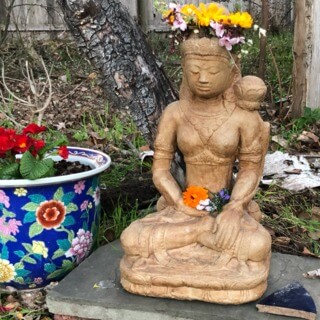
And we'll come into a meditation associated with the Bodhisattva Kuan Shui Yin,
She who hears the cries of the world while resting at ease,
Or they who hear the cries of the world while resting at ease.
Kuan Shui Yin is imagined as female in the Chinese tradition,
But male in the Tibetan tradition as Avalokiteshvara.
So there's a fluid presence here that inhabits many perspectives.
For this mythic being,
A quality of compassion shines forth.
They are,
In a way,
The form of compassion.
And the form this compassion takes is a meditation through listening.
You can think of it as having three aspects.
There's the listening,
So you might tune in to sounds,
Bring your attention to sounds so that there's conscious or active listening,
Knowing what we're hearing,
Listening far out into the space of the world.
Hear the sounds that are near you,
Near or far.
And notice how sound gives us the felt sense of space and distance.
So the first part is the hearing,
Kuan Shui Yin,
They who hear the sounds of the world.
So the second part is the object of the hearing,
The sounds.
Begin by hearing literal sounds nearby or further away,
Whatever is happening in your field.
For Kuan Yin,
It's not just sounds,
But it's the cries of the world.
So here,
There's the hearing not just of what's physically audible,
But the way that throughout our days,
We hear the cries of the world.
When we talk with those we love,
We hear their cries.
When we hear or listen or tune into our community,
We hear their cries.
When we tune into the larger stories of the culture and the globe,
We hear the cries of beings.
Not just humans,
But animals,
Living beings of all kinds,
The spirits of place.
The great runs of salmon or the geese crying overhead.
The clover and the lilies and the sorrel in the woods.
The tiny plants,
Maybe the fairy spirits that live in the fragrant plants in the Buddhist system called Kinnaras.
Or the divine musicians,
The Gandhabas.
Or the great water beings,
The Nagas,
That snake along the winding rivers,
Fly in the clouds,
Live deep under the waters.
The great wrathful beings,
The Rakshasas,
The Yakshas.
The fierce spirits,
Understood in their South Asian Pali and Sanskrit names,
Raksha,
Yaksha.
Or in their Western names,
Demon,
Troll,
Ghost.
The petas,
The hungry ghosts.
The devas,
The gods,
The deities,
The demiurge.
All the beings that fill the immaterial realms.
The beings that are idea,
Emotion,
State of mind.
All the humans,
Our siblings,
Their cries.
Those in war zones.
Those in unhappy homes.
Those without enough.
Those with too much.
All of those haunted by greed,
By hatred,
By fear,
By delusion,
By anger,
By confused passions.
They hear the cries of the world.
So we rest in the hearing.
We allow our hearing to become broad so that all of that information we take in,
From the news,
From the entertainment,
From the living people around us,
From the ecosystem,
It can all be listened to,
Heard,
Held in loving witness.
See what comes through or beyond the list I just named.
Who or what have you been listening to?
What have you been hearing?
You might take a moment and hear that voice again in your own heart,
Or speaking to you over a long distance,
And just listen.
Everything that suffers cries out,
Longing to be heard.
So we listen.
Sometimes when we're listening,
Images come up.
Sometimes stronger feeling is stirred.
If the feeling is ever stronger than you want to be with in this moment,
You can open the eyes,
Let your gaze look around.
Just come back to the room you're in.
Notice any feelings that come as we listen,
As we remember the cries of the world.
If the news of the world comes to you more in visual images than the sound of voices,
Which is often true for us now,
In the era of image,
Listen to the image.
Listening doesn't have to be through sound only,
But you see the image in your mind's eye.
Maybe an image of a ruined street,
Or a grieving parent.
Just listen.
Listen through the image to the human that's there.
The third part of the meditation is sometimes the most difficult.
There's hearing the cries of the world.
Often we can't avoid this now.
The practice is in the third part,
While resting at ease.
She hears the cries of the world while resting at ease.
Feel your posture.
Feel the body on the earth in this place.
Protected for this moment from the harsh winds.
Can you feel yourself resting at ease?
Can you marry that resting with the hearing?
Sometimes it's hard to feel both.
I can connect with the body and relax toward rest.
Or I can connect with image and memory.
The horrors of the world.
And there's a leaning off my seat,
A leaning toward the distress in the world.
What can I do?
There's a place for both.
This place in meditation is for holding both.
Relaxing into deep presence,
Nourishment and rest.
Without turning away.
Using the rest.
The stance of resting at ease.
As a way to listen further.
The way that you get very still if you want to hear something quiet or distant.
Even the mind stops.
For a few minutes in silence,
Become as still as possible in this moment.
So that the listening can reach as far as it can.
Resting at ease.
They hear the cry of the world.
Finish with the mantra of Kwan Shu Yin.
Namo Kwan Shu Yin Pusa.
Join in if you're in a space where you can make some sound.
Namo Kwan Shu Yin Pusa.
Namo Kwan Shu Yin Pusa.
Namo Kwan Shu Yin Pusa.
Namo Kwan Shu Yin Pusa.
Namo Kwan Shu Yin Pusa.
Kwan Shu Yin Pusa.