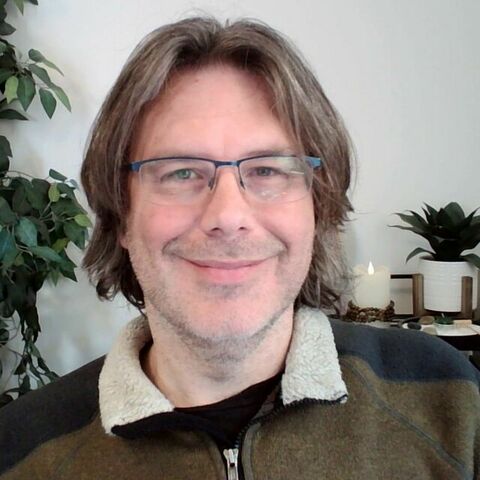
I'm Tim Fortescue,
A life coach coming alongside of folks in their personal and spiritual development.
Today,
I'm going to talk with you about the basic assumptions of the IFS or Internal Family Systems model.
And this is the primary modality that I use in my coaching practice.
If you have questions,
Please comment and go to my profile and you can find ways to reach out to me there,
But I would love to engage with you if it makes sense.
And you may be familiar with the movie Inside Out.
The tagline of the movie is,
Meet the little voices inside your head.
If you're not familiar with the movie,
You can easily find the trailer online.
The movie is based on the Internal Family Systems or IFS model founded or discovered by Dick Schwartz.
The characters in the movie are disgust,
Fear,
Joy,
Sadness,
And anger.
And they are preteen Riley's emotions or parts as she copes with a move across the country and the new situations that brings.
And it's not just what happens inside of her own mind.
It's how Riley's parts,
Disgust,
Fear,
Joy,
Sadness,
And anger interact with and set off her parents' parts too.
And we all have voices,
Emotions,
And parts that can surface as beliefs,
Feelings,
Impulses,
Thoughts,
Among many,
Many other things.
And these voices or parts reside inside of us.
And so let's look at some of the basic assumptions of the IFS model.
Number one,
We're all multiple.
It's the nature of the mind to contain an indeterminate number of subpersonalities or parts.
I'm sure you've heard someone say,
A part of me really likes this and a part of me really doesn't.
It's the nature of the mind to contain an indefinite number of parts or subpersonalities.
This is natural,
It's universal,
And it's useful.
Trauma doesn't cause the phenomenon of multiplicity.
The burdens from traumatic experiences make parts extreme and conflicted internally.
As a subpersonality,
Each part has its own characteristics,
Full points of view,
As well as emotions,
Beliefs,
And behaviors.
For example,
A resentful part may feel hurt or sad,
Have many opinions,
And reveal itself through the body in certain ways.
Assumption number two,
Everyone has a self.
And I mean that with a capital S.
So what do I mean by self?
Self describes the essence of you,
How you came into the world,
And who you are when you're feeling calm,
Curious,
Compassionate,
Confident,
Courageous,
Clear,
Creative,
And connected.
And if the capital S,
Self,
Can be triggering,
For you,
I invite you first to see that as a trailhead to exploring the parts that come up around that trigger.
See what you notice,
See what gifts those parts may be bringing to you.
And then consider this,
If it helps,
And if not,
Just take it for what it's worth or disregard.
But from a Christian perspective,
I like to think of self as my beloved self,
The beloved child of God that I was created to be.
So put that word in a context that works for you.
But we all have a self.
Assumption number three,
Parts are forced into roles they don't like due to trauma and attachment injuries.
And the impact of unsafe and negative experiences burdens parts with extreme emotions,
Memories,
And sensations.
And these memories,
Emotions,
And sensations can cause,
By these negative experiences,
Can cause these parts to get locked away,
Causing other parts to protect against re-experiencing these burdens.
In addition,
Parts may carry burdens inherited by the family or absorbed from the culture or society for many,
Many generations.
Then assumption number four,
The non-extreme intention of each part is something positive for you,
For the individual.
There are no bad parts.
And the goal in getting to know yourself and your parts better isn't to eliminate parts,
But instead help them find their non-extreme role and to be unburdened.
Parts hold information and other gifts worthy of discovery and reclamation.
And at their core,
Parts also hold self-energy and they have aspects of self.
And depending on your spiritual upbringing,
The idea that people are basically good can be triggering.
Provide another trailhead to just be curious and notice the parts that come up.
And for those from a Judeo-Christian background,
It might be helpful to remember that humans are declared first and foremost to be created in the image of God.
Yes,
This image has been covered by sin,
Flaws,
Mistakes.
However,
If we can translate original sin as burdens,
We're talking the same language here.
Assumption number five,
As we develop,
Our parts form a complex system of interactions internally,
Much like a family or group of people who are polarized or form alliances and hierarchies,
Similar to external relationships when applying family systems techniques,
The inner system can be reorganized.
When that happens,
Parts can change rapidly and the transformation process can begin.
And then finally,
The sixth assumption,
Changes in the internal system will affect changes in the external system and vice versa.
The implication of this assumption is that the dynamics of both the internal and external systems should be assessed.
Changes to the person's internal system don't happen in isolation.
They're part of a context,
Contexts such as external relationships with family members,
Significant others,
Coworkers,
And so on.
So let me recap these six assumptions and then I'll lead us in our meditation.
We're all multiple.
We all have a self.
Parts are forced into extreme roles they don't like.
Number four,
There are no bad parts.
Each part's doing the best that it can and their gifts that it brings,
Their intention is good.
As we develop assumption number five,
Our parts form a complex system.
And then finally,
Changes internal will affect the external.
With that,
Let's take a minute and just get mindful.
Begin to check in with these parts that are coming up.
What are you triggered by?
Maybe there's a part that believes that there are no bad parts.
There's a part that can't quite take that in.
Just notice the parts that are coming up.
Maybe it's in reference to a person or something you've got coming up.
Just welcome your parts.
Let them know that they're all welcome.
If you can stay curious,
Just keep noticing what's coming up.
Maybe ask the question,
Who needs my attention right now?
Who wants to have a little time with me?
Is there one part you notice the most?
Sit down with it for a bit.
See how your other parts are doing.
Maybe they're a little fearful.
Maybe they're wanting the attention.
Maybe there is a part that needs more of the attention and needs to come to the forefront.
See if your other parts could soften back for a bit and just witness you engaging with this part you notice the most.
Check and see where you notice that part.
What indicator gives you the part that you're,
The indication that you're noticing it the most.
Maybe it's a tightness in the chest or tingling in the lips.
Maybe it's a color.
Maybe it's an image of that part as a young child sitting under a willow tree.
Where do you notice it?
How do you feel toward it?
There's some self-energy,
That calmness,
Curiosity,
Compassion,
Courageousness,
Confidence.
They don't have to be seas.
It could be joy or gratitude.
If you're feeling some of the self-energy toward the parts,
Let it know that.
Maybe you're not.
Maybe you're feeling some resistance.
Just realize that that is likely a part of you that's feeling resistance and may need your attention right now.
So maybe it would be helpful to focus on that.
Check back in and see that sensation of where you're noticing the part that's most evident.
If you're feeling some curiosity,
Calmness,
Some self-energy,
Ask that part,
What do you need right now?
See how it's doing.
Maybe you need something from the part.
Ask it.
Or maybe you need to say something to the part.
Spend some time letting the part share with you and you share with the part.
Ask the part if it would like to spend more time with you.
And feel free to pause and take your time with even this recording if you need to.
But if the part would like to spend more time with you,
Let it know that you would like that if you would.
Let it know when you'll do that.
Maybe later today or tomorrow.
Just continue letting it feel that energy of your beloved self,
Who you are at your essence.
Thank the part for its courage,
For its vulnerability in coming forward.
Let it know you're not going to forget about it.
Then as we close,
Check in with all the other parts that were witnessing this interaction.
Thank them for their courage in coming forward and let them know that they can have a chance to have time with you too,
If you'd like.
And spend some time with your parts more over the next week,
Particularly the one that we focused on today.
With that,
You can bring your awareness back to where you are.
Take a couple deep cleansing breaths.
If your eyes were closed,
You can open them and you can continue about your day.
But thanks for joining me and I hope this was helpful.
Feel free to let me know if you have questions and take good care of yourself.