Hello and welcome to Tricycle Talks.
I'm James Shaheen,
Editor and publisher of Tricycle,
The Buddhist Review.
In this episode,
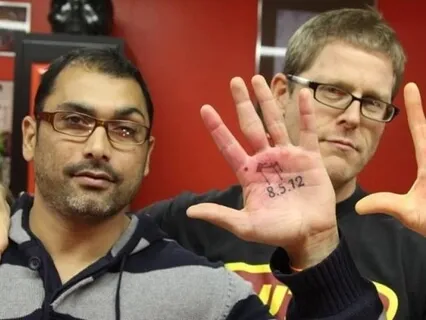
Tricycle web editor Matthew Abrahams is joined by former white supremacist Arno Michaelis and Pardee B.
Kalika,
Whose father was killed in a shooting at a Sikh temple by a white supremacist.
The two men now tour the country together,
Speaking to schools and communities about how to disarm hate by meeting it with compassion.
They've also written a book about their work and friendship called The Gift of Our Wounds.
Arno,
Who is now a Buddhist,
And Pardee B.
Raised in the Sikh tradition,
Say that the only way to save someone from the self-destruction of a hateful ideology is to plant seeds of kindness and hope that they one day take root.
Now let's listen to Matthew in conversation with Arno and Pardee.
Arno,
Pardee,
Thank you for joining me today.
Thank you,
Matt.
It's our pleasure.
Thank you,
Matt,
For having us on.
Now,
You both grew up in Milwaukee,
But in sort of two different worlds.
And then a tragedy brought you two together.
Pardee,
Can you share that story with our listeners?
Yeah,
So me and Arno met two months after the tragedy that brought us together.
On Sunday,
August 5,
2012,
Wade Michael Page,
An affiliated white supremacist,
Walked into the Sikh temple of Wisconsin and murdered six people,
One of those people being my father and temple president,
Sithawan Singh Kalika.
At that time,
It was one of the deadliest race-based hate crimes committed in the U.
S.
By an affiliated white supremacist.
And it just changed my life and the trajectory of my life moving forward.
My father was the temple president for 15 years.
He had helped to build a communal gathering place,
We call it Sikh temple or Gurdwara,
And died in the place that he helped build.
Thank you,
Pardee,
For sharing that story.
I know it must be difficult to repeat that so many times.
Arno,
Now you weren't the shooter,
But you founded the white power organization that he was a part of,
And you also helped spread white power music.
How do you feel about the way you may have influenced his thinking?
Wade Page was actually a member of the gang that I was involved in getting off the ground back in the late 80s.
So while the gang started down south initially,
And then my group in Milwaukee was the first crew from the Midwest to get involved,
It eventually spread over the entire world.
There are members of that gang in every continent but Antarctica at its height,
And Wade Page was part of that gang.
So there was a very direct tie that way.
The music was another tie.
I had a lot to do with putting white power music into the world,
And I would be stunned if Wade Page had never heard of my band.
It was very likely he was actually a fan,
And he was in some white power bands himself.
So in so many ways,
This man was exactly who I used to be,
And therefore I felt a great responsibility and an urgency to help respond to it in the most peace-building way I could.
To be part of Pardee's healing process and to be part of the healing process of the Sikh community is one of the greatest gifts I could ever ask for.
So in the book you mentioned that you reached out to Arno looking for answers.
Did you find the answers that you were looking for?
Yes,
I reached out to Arno to find out,
You know,
Just find out the whys,
Why people do things like this,
And why Wade Page walked into the temple that day and murdered six people that he didn't know.
And that was my inspiration for reaching out to Arno.
But there was also other factors,
Like when this person did this,
He took his own life,
You know,
The murder,
Suicide,
Because he wasn't going to be taken alive.
And so the motive was really dead,
But the inspiration to kind of carry on was still there,
And we as a community felt a responsibility.
And so reaching out to Arno was definitely about understanding the why,
But also having someone be accountable.
And for some reason,
I just had faith that Arno had that same feeling of accountability and responsibility and would help carry this mission forward.
And you guys were nervous to meet each other.
You're right that you weren't convinced at the outset that Arno had actually been reformed.
How do you feel about that now,
Pradeep?
I think just as much as you want to believe that people will change and do change,
And that's obviously the constant truth in life that change happens.
There's a part of you that kind of doubts it.
And this doubting was definitely happening for us when rubber sort of meets the road and say,
Okay,
Now you got to put your faith into practice.
And but that's kind of what faith is about,
Is to put it into practice in the real life and say,
Okay,
Now at this moment,
Can I have the courage to drive past my doubts?
And the doubts were being reinforced by family.
They were being reinforced by honestly,
My wife at the time.
And I mean,
She's still my wife.
You know,
And people are just out of concern.
We're like,
You're going to reach out to who?
This person was,
You know,
This person was a white supremacist.
And from what they gather,
White supremacists never change.
They're always going to be the same.
And while I wanted to fight against that,
Part of that,
Part of other people's concern really seeps into you.
And as it does,
You have nothing to do but to challenge it and to have courage against it.
And as I reached out,
There was that faith.
It was just having that faith and saying,
Okay,
Because of what I believe,
My ideals are going to be tested.
And what is the ideal?
The ideal of Sikhism is that we are one.
And if I believe in this,
I truly got to fight against this person who is trying to cause this ideology or that's trying to cause the separation.
Arno,
In the book,
You claim that your parents weren't racist,
And that you were drawn into the white supremacist movement because of a thrill seeking tendency you had.
Can you talk about what the allure was about that ideology?
Really put,
The ideology was attractive to me as it really pissed people off.
And ultimately,
That's all I was looking to do was to repulse people to anger civil society,
Which I interpreted at the time as fighting against the status quo.
In the late 1980s,
I saw the status quo of society as one of multiculturalism.
This is the time when white kids are starting to listen to Public Enemy and NWA.
Interestingly,
I was one of those white kids before it was cool.
I would listen to Run-DMC and Grandmaster Flash.
I used to break dance.
But then when it started getting popular,
I'm like,
Oh,
I can't do this now.
It's getting trendy.
And so I saw the status quo of Midwest society as one of multiculturalism and therefore,
I wanted to buck against that.
Had I really been aware that the status quo of really the entire planet Earth has been one of white supremacy for 500 years,
I think that would have changed my idea of fighting against the status quo.
But as it was,
I didn't look back.
I really just kind of looked around me.
A really important element of this was my suffering.
I think without the suffering,
I would have went rock climbing or skydiving or some other kind of thrill,
Adrenaline junkie pastime that didn't hurt people.
But because I was suffering,
I wanted to pass that suffering on to other people.
Steve says all the time that pain not processed is transferred and that's exactly what was happening as I was growing up.
Michael Scott Now,
You talk to children now.
You talk to high schools trying to push people away from white supremacy.
Is there anything that someone could have said to you when you were raging like that,
When you just wanted to contradict what anyone else was saying that could have possibly changed your mind,
Especially after you were radicalized?
Steve McQueen Today,
Especially when I'm dealing with young men,
I believe all human beings need challenge in their life.
It's how we learn.
It's how we grow.
It's how we expand our comfort zone.
It's really without facing challenges and failing and then facing challenges and succeeding.
Without that process,
Life is kind of an empty thing.
And so today,
When I'm dealing with young men,
I challenge them to say,
Yeah,
It's easy to respond to aggression with aggression.
Any fool can do that.
It's literally like falling into a raging river and just being swept away by it.
But responding to aggression with compassion takes true warriorship.
That's falling into the raging river and walking against the current and setting your path driven by your genuine self rather than being led by your circumstances.
And so I challenge young men to be warriors and understand what warriorship is all about.
And had that been presented to me by the right person at the right time,
I think that that certainly could have been effective.
It's also important to understand,
Though,
That when you're talking about interrupting violent extremism,
Quite often when people are like deep in the throes of it,
You're not going to be able to reach them.
All you'll be able to do is plant a seed.
And that seed may come to fruition a year later,
Two years later,
Seven years later.
It may never.
But that's really all you can do until somebody says,
Hey,
Until they have the realization that like I got to make a change.
And once they do have that realization,
Then having someone to guide you toward your next steps is a huge help.
You said that one of the people who planted a seed like that for you was a woman working at McDonald's.
Could you tell that story?
Sure.
So I dropped out of high school after sophomore year because I'm a gifted genius.
And as a gifted genius,
Like what need do I have for high school?
And I know this is true.
As my mom says,
I'm a gifted genius.
So being so gifted,
I had this idea that if I ate nothing but ramen noodles,
I'd have more drinking money.
So really all week long,
I ate ramen noodles except for payday when I go to McDonald's and get a Big Mac.
And the McDonald's I went to was by where I cashed my check.
I didn't have a bank account.
And when I walked in this McDonald's,
I was just kind of blown away by this elderly black woman who was working there behind the counter because she had this beaming,
Genuine smile on her face that just shone like the sun.
It was absolutely unconditional.
It was for everyone who walked through that door just like the sun.
The smile didn't care what color your skin was.
If you're a white power skinhead,
A gang banger,
A Nobel Peace Prize winner,
Just shine for everyone.
And that smile made me really uncomfortable.
Like I'm trying to hate black people and here's this sweet old woman smiling at me,
Making that seem as stupid as it is.
And so I went in and I got my food and I kind of scurried out of there.
A week goes by,
I'm drinking,
Fighting,
Printing t-shirts,
Eating ramen noodles.
Payday again,
I go for another Big Mac.
She's there again.
This time she recognizes me.
She remembers what I ordered.
She remembers I drank Diet Coke.
She's asking me about my day.
She's talking about the weather,
Making me all the more uncomfortable.
This whole process is making my skin crawl because I'm trying to assume the ideology of white supremacy as who I am.
And this woman simply by being kind,
Sweet person that she is,
Is like blowing all that out of the water.
So once again,
I get my food,
I go scurrying out.
A week passes,
Between paydays,
Somebody came by the house with a homemade tattoo machine and the gifted genius in me strikes again and I had this idea to get a swastika tattooed on the middle finger of my right hand.
And that was specifically so when people responded to my hostility with more of their own,
Which is exactly what I was trying to provoke from everyone at every minute of my day,
I could show off my middle finger with the swastika on it before closing my hand into a fist and hitting them.
As I came to McDonald's that next payday,
I froze in the doorway and it was like an instinctual,
Irresistible feeling that I did not want this old lady to see my swastika.
I did not want to disrespect her with it.
And it was involuntary.
I just kind of stood there in the doorway for a minute and I'm like,
Doesn't anybody else work here?
Where's the next closest McDonald's?
It was cold out.
I wasn't going to walk a couple of miles to another McDonald's.
So I figured I'll just keep my hand in my pocket and she won't see it.
But while I was paying for my food,
She saw the swastika and she just says,
What is that on your finger?
And I was already 6'3 by that time.
I was a good foot taller than her and I fell about six inches high when she asked me that.
And all I could do was stare down at my boots and just say,
It's nothing.
And she waited until I looked up at her and she said,
I know that's not who you are.
You're a better person than that.
And I was just like,
Can I have my Big Mac,
Please?
And I got my food and I scurried out of there and I never came back.
And actually I went back to my house.
I got drunk as fast as I could.
I went on the streets.
I picked a fight with the first person I could find.
Like I wanted to put as much distance between me and the singularity of humanity that I had experienced.
But the human psyche doesn't work that way.
Like when something happens to us,
It's part of who we are going from that day forward.
And that seed,
Which was planted within the first couple months of me becoming a white power skinhead,
I believe was instrumental seven years later when I was so exhausted that I was literally looking for an excuse to leave.
That woman's kindness was a constant reminder of how wrong I was.
And it's very important to say also that her kindness was true resistance to what I was doing.
Her kindness was truly defying everything I was trying to provoke.
I wanted people to hate me.
I wanted people to be aggressive with me.
And when they were,
They were literally putty in my hands.
But this woman said,
Instead of letting me make the rules of this interaction,
She was going to make the rules and show me how human beings should treat each other.
So I think for our listeners and just in this climate nowadays,
People want to resist and they want to fight.
That's great.
I want people to resist and to fight,
But I need them to do it the right way and not fall into the hands of their opponents because that's not going to solve anything.
Yeah.
Well,
It's interesting because it's kind of unfortunate that the job of being compassionate falls to the people who are being oppressed or attacked.
How do you feel about the fact that as the victim of white supremacy,
It's your job to be the person who's compassionate for people who have no compassion for you?
For me and for us as a culture,
We love it.
We basically,
We want to be able to respond to that.
And before this incident happened,
Really nobody knew about,
I mean,
A lot of people didn't know about who Sikhs were and what they represented.
They were the fifth largest religion in the world and really remained unknown to America.
And even after this happened,
We were like,
Well,
You know what,
Let's stop waiting for people to come to us and let's go out and show people who we are.
And so with that said,
We got to represent so much more than a person.
And who doesn't want to be able to do that?
Who doesn't want to be able to represent the ideal of compassion?
Who doesn't want to be able to represent the ideal of forgiveness,
The ideal of peace going forward?
And so we're honored to do that.
We have a name for that.
We call it kurbani.
We call it sacrifice.
And since the conception of Sikhism,
You could not die a better death than to die one for a cause.
It's interesting that you bring up that idea.
There seems to be a few religious ideas at play.
And Arno,
You turn to Buddhism and in the book you talk about loving kindness.
You don't directly relate that to Buddhism but did you get that from your studies in Buddhism,
The idea of using loving kindness?
Arno Yeah,
Absolutely.
I was fascinated with dharma ever since I first set to meditate and was taught Sine in Shambhala Center in Milwaukee.
Michael Scott The Sine,
That's the same as that shamatha or kama-abiding meditation.
Arno Exactly.
Peaceful abiding.
And the first time I really put Metta into practice,
There was a neo-Nazi rally in Wisconsin and I got very early wind of it.
And I had hoped to organize a counter-rally like somewhere else and really like just steal all their thunder,
Leave them shouting into thin air,
Don't get them any media coverage.
But there's a lot of people who felt important to be there like screaming in their faces.
And no matter how much I tried to explain to them that that just serves their purpose and that's what they're trying to provoke,
Like there's a lot of people that didn't want to listen to me.
And when the day for the rally came,
I was pretty miffed because I wasn't being listened to and I was like,
I'm not even going to go.
It was like one of the last nice days of the year.
I'm like,
I'm going to the beach.
Like to hell with all these people.
But as it came up,
I'm like,
I can't do that.
I got to work with the world as it is and not as I want it to be.
So I went to speak at the counter-protest,
Ideally to make it as peaceful as possible because I knew that any aggression that happened would serve the purpose of the neo-Nazis.
So what I did is I got 2,
000 people to close their eyes and take a deep breath and picture someone that they love very dearly.
And then I asked them to sit there for a minute and then open their eyes and look around and understand that the world before them is the world that their loved one occupies and that what they put into that world is going to affect their loved one's life,
Whether they're face to face with neo-Nazis or they're out picking strawberries.
Like if whatever we put into this world shapes it and that's what I was trying to get across.
And it was very abbreviated meditation.
I had about three minutes.
It was a pretty tense situation.
But it was that idea of picturing someone that you love very deeply in a personal level and then carrying that outward to the world around you,
Even to neo-Nazis,
People who certainly don't deserve that love but they are the ones who need it most.
And as my story is evidence of,
That's what transforms people.
That's what moves the needle.
You're never going to out-aggro neo-Nazis.
You're never going to out-hate white supremacists.
The only way to have victory over them is through compassion and loving kindness.
And on the issue of your meditation practice,
You said you had post-concussion syndrome.
Is that right?
I do.
So you have mood swings.
You say you still feel a lot of anger and you still have the thrill-seeking tendencies when you think back to your fights.
They still excite you.
But did you say the meditation helps with that?
Yeah,
Absolutely.
When you have a meditation practice and you spend 10 minutes a day connected with your breath and just being giddy,
Joyful,
Happy just to breathe,
It makes that breath so much more powerful throughout the rest of your day.
So when somebody cuts me off in traffic or if I read something about an event that happened that really makes me angry or whatever happens,
That breath helps disconnect who I am from whatever this external thing is.
It helps me return control of what's happening to my mind.
And I remind myself that it's my lens that resolves my reality and I dictate how that lens works.
I say over and over again that without my meditation practice,
I wouldn't be able to do what I'm doing by any stretch.
And I honestly don't think I'd be able to function doing anything because I'm facing the physical consequences of my stupidity like every single day and meditation helps me deal with it.
You're listening to Matthew Abrahams In Conversation with Arno Michaelis and Pardip Kalika,
Co-authors of The Gift of Our Wounds.
If you're enjoying this podcast,
Don't forget to visit Tricycle.
Org slash podcast,
Where you'll find more conversations featuring some of today's most compelling Buddhist writers,
Thinkers and teachers.
At Tricycle.
Org,
You can also watch our monthly feature films,
Interact with well-known Buddhist teachers in our monthly Dharma Talk series,
Or download one of our ebooks on Buddhist teachings.
You can also explore our magazine archives spanning 27 years.
Now let's return to Matthew,
Arno and Pardip.
So Pardip,
I want to ask you about the Chardi Kala,
The relentless optimism.
And that seems to kind of overlap with the loving compassion idea.
Could you unpack it for me a bit?
I don't know if I completely understand this concept.
Sure.
You know,
The entire passage goes,
Nanak Nam,
Chardi Kala,
Teri Bani,
Sarva Tapala.
And what that means is that we shall be relentlessly optimistic for the peace and prosperity of all humankind.
And Sikhism is very much driven by the Dharma,
As is Buddhism,
As is lots of Hinduism,
Like there's an Eastern philosophy.
So you're going to have crossover,
But I think some of those are just universal properties and ideals of Christianity,
Judaism,
You know,
You name it,
And that transcends all religions.
So relentless optimism is something that we've kind of said,
And that we've said that whole saying,
Almost every single day,
Without me really knowing the importance of it.
And as Arno talks about those seeds,
And even the seeds that were probably put into him as a child growing up,
We're all gardeners.
We all are,
And we all plant seeds on a day to day basis.
Sometimes we stick around to see like,
Did they germinate?
But a lot of times we don't.
And who's to say what you're doing and when you do it is not that,
You know,
That vital seed that that person needs to be able to change.
So for us,
Those seeds were always planted within our faith.
And really,
August 5,
2012,
Really just tested and said,
Okay,
You know what,
If it's going to show up,
It's going to show up now because whatever you've planted,
I have to take it,
I have to pot that,
And I have to like present it to the world and show them that these flowers grow.
You know,
That's where we said that day is like the really like the responsibility and mission of saying,
Okay,
This is what who's six are,
This is who immigrants are,
This is the difference between,
And even thinking about the difference between white supremacy as an ideal and a white supremacist as a person.
And saying like,
You know what,
We can vilify a culture of white supremacy,
But when we start vilifying people and saying that this white supremacist is bad,
We're being consumed.
And without us even knowing it,
We're being consumed into this hatred that if you don't think a person is capable of change,
How can you have that gratitude and that relentless optimism that we speak about?
So for us,
It was really just testing of ideals.
I'd like to add to that,
Matt,
Too.
Going back to talking about warriorship and challenging young men,
I cannot think of a more magnificent demonstration of strength than to respond to your father being murdered and five people in your community being murdered senselessly because of the color of their skin by saying,
I have relentless optimism for the peace and prosperity of all humankind.
That is just devastating to all of the fear and ignorance behind the white supremacist ideology and behind every violent extremist ideology and just behind pure violence.
That kind of gratitude and that kind of inner peace and the strength to say that is just so magnificent that it can't be understated.
And it's also the biggest challenge that you can give to somebody.
So it's easy to be grateful when things are going great.
Show me how you can be grateful when things really suck.
And then I'll be impressed that when you challenge young men with that,
That's going to again,
It's going to plant seeds that can really transform lives.
Yeah.
And I mean,
It's easy to also be like Arnold said,
Like it's easy to the kind of,
Okay,
If I agree with you,
I had the same ideology as you.
I had the same skin complexion or share the same culture as you.
Well,
It's easy to see the humanity in that person.
Let me see you see the humanity in somebody who doesn't agree with you.
Do you think you have managed to forgive Wade Page?
Oh,
Yeah.
We forgave Wade Page.
To not forgive Wade Page would be too consumed in one person.
And he wasn't going to get that kind of power.
He wasn't going to get the power of like coming in to divide a community and say,
Oh my God,
We're so devastated.
There's no way that I don't think Muslims would do that.
I don't think other cultures would do that to say you have so much power over us.
And you see it all the time.
You see it.
We see it in Charleston.
We see it in other communities who are devastated by a person.
And to say,
You know what,
As a person,
You're not going to get this kind of power to make me not forgive you.
I'm going to go home and I'm going to take care of my kids.
And I'm going to be a loving husband and I'm going to be a great community member.
I'm just going to amp up what I can do within a culture and then really like understand the systems that are in play and heal those systems.
And that was really like the inspiration of the book.
You know,
The gift of our wounds is that we are all healing agents and we are really healing a lot of the wounds of the past.
About the book,
The thing that actually was just the most surprising to me about it was you're a former police officer and you really reconstructed the shooting in really startling detail.
I was wondering what that process was like for you to go through it and to talk about each room that he walked into and what happened there and how everything transpired.
You and Arnold were talking a little bit about processing and really processing the past.
And I was thinking about as the book and how we detailed that and wanted to be very,
Very specific and painting that picture for readership.
Part of all of this since the shooting has been my own personal process.
And not being deflective,
Not being blaming,
Not repressing,
Not suppressing.
And really just saying,
Okay,
This is what it is.
This is what we have.
And we don't choose what happens to us,
But we can choose how we respond.
That can either keep communities safe or it can devastate communities and say if we respond in the wrong way,
Then we can paint the picture for the person that's watching out there that you can go out there and because you do a mass shooting,
You can devastate a community.
And so that responsibility of like really painting that picture for readership,
I wanted them to really empathize with what we were going through.
With my story,
With Arnold's story,
As much as we talk about a lot of the macro issues,
We wanted to keep it,
Here's two boys.
And these boys are growing up in very different circumstances.
And somehow,
Some way,
They're trying to become men.
And even when they become men,
This is what happens to bring them together.
And so we wrote it,
Yes,
For like readership,
But we also wrote it for the little boy in us.
Yeah.
Because you tell your story side by side,
It came to me as coming across as terribly unfair from like a cosmic perspective of your early childhood life is trying to,
Your party is trying to adjust to a society while living with a different society at home,
You go to college,
You do everything right.
Meanwhile,
You flip back over to Arno,
Who's dropping out of high school and getting into fights with people and trying to tear his life apart.
I really,
I appreciate that you saw this unfairness that really struck you.
I'm going to make an assumption and just assume that you're a pretty enlightened person to begin with.
And you're not the type of person.
Well,
We're all enlightened here as tricycles,
Not kid ourselves.
But the point is,
Is that storytelling has the power to get that same point across maybe as somebody who's thinking that immigrants are bad for our country.
And so we want those people to read this book and they will get that same sense of unfairness that you're getting.
They're going to have the same feeling of like,
So Arno is this horrible,
Wild menace to society and nothing happens to him,
But like party,
But his family did everything right and they worked so hard and they loved each other so much.
And then this guy comes around and kills them like that's just wrong.
And that's what we want to get across.
We want people to get out of their comfort zone when they read this book.
And that what that does is it expands their comfort zone to places where it wasn't before.
And I honestly believe that that can not just necessarily our book on its own,
But that kind of work is what we got to do to transform our society into one where all people are valued and included.
Yeah,
I want to talk about now the current political climate.
You detail what white supremacy looked like in the 90s and you talked about anonymous PO boxes.
And that seems so foreign now when there's Reddit threads and Twitter threads of just racist screeds and it could just happen behind anonymous screen names.
And it's so easy for people to connect now.
How do you see the white supremacy of today?
I mean,
You've been working against it and it seems like the problem has gotten a lot worse.
Yeah,
It can certainly be imposing.
Steve and I are – I mean,
We're human.
We're not superheroes and we have times when we get down and we feel beat down by what's happening in the world and we feel discouraged.
Every single time that happens,
There's somebody there to lift us up.
There's somebody to remind us that there's way more good than bad about humanity and to not lose faith.
And so before any discussion of the current state of white supremacy happens,
I have to say that we cannot lose our faith in humanity.
Once we do that,
They win.
When I say they,
I mean that ideology.
It's not even the human beings who are stricken by it.
It's the ideology itself.
The way that white supremacy is in many ways mainstream today is a huge concern to me.
Back in the late 80s,
Early 90s,
When we used to wave guns around and yell about watering the tree of liberty with the blood of tyrants,
Like we got sent to prison.
We had like federal recall laws slapped on us and we got dragged in front of the grand juries and sent off for federal time.
And when I say we,
I mean the skinheads of my day.
I was fortunate just through dumb luck to never have been incarcerated.
Nowadays,
The exact same rhetoric is coming from the White House.
The exact same rhetoric is coming from the huge news outlets.
And yeah,
Technology is a huge reason for that.
We were in the days of PO boxes,
As you noted,
And like handwritten letters.
And you really had to work to put information out there and to connect with people.
And we did it through PO boxes and stolen calling cards on payphones.
Nowadays,
It is way easier.
It's way easier to spread hatred.
But fortunately,
It's also way easier to spread the countermeasures that we need as human beings.
So technology is a double-edged sword.
It always will be.
Fire can eat your house and keep you alive during the winter or it can burn your house down and kill you.
And so because technology is such a force nowadays,
To me,
It's just all the more reason why we got to understand our responsibility to use that technology in a positive way.
And I think there's been great strides in that direction by huge social media platforms like Facebook and big tech companies like Google and Tesla even.
I really feel good about the future.
I'm an optimist,
Relentlessly optimistic you may say.
And I think that human progress has always been two steps forward and one step back.
And even though you're taking that step backwards,
You're still moving forward.
So the way I see the current political climate,
The current political regime is that this is a good thing because it's an opportunity for us as a society to have conversations that need to be had and that haven't been had in the past.
This is our chance and it's very important that we seize that opportunity.
No,
Does the strategy have to change if there is white supremacy in the White House?
I mean,
You see figures like Steve Bannon there and you have to think that there is some degree of white supremacy in the White House.
When white supremacy is the authority and it's not a fringe movement,
Does your response to it have to change?
I think from time to time,
There's tactical adjustments you got to make.
But it always boils down to the fact that you're never going to extinguish violence with violence alone.
Everybody likes to quote MLK as do I.
He's a great hero of mine and hate cannot drive out hate.
Only light can do that,
That kind of stuff.
Those are important things to keep in mind.
White supremacy has always had a position of power.
Otherwise,
It wouldn't have been supremacy.
That has been going on for 500 years.
It's just coming out to the forefront right now and people are being outright about it,
Which honestly,
Again,
I think is a good thing.
I'm of the opinion where if I'm talking to somebody,
I would like them to lay their cards out on the table and tell me exactly how they feel about these issues rather than being coy about it and dancing around the issues and,
Okay,
The cards are on the table now.
We see what's up here and people are mobilizing,
Not just people of color,
But the human beings across the board and especially young people.
We're super inspired by March for Our Lives.
We're inspired by Black Lives Matter.
We're really feeling good about the future because of youth movements like that,
While at the same time,
Even movements as noble as those can find themselves in this position where we're fighting hate with hate and that's a recipe for disaster.
Michael Scott You just mentioned that you like when people have their cards out on the table.
There's a chapter where you talk about having David Duke of the KKK at your house and during your hateful punk rock days,
You thought he was too soft because he would use dog whistles.
He would talk about equality for white people instead of specifically saying what he wanted to say and there's Milo Yiannopoulos' Breitbart emails got released and there's all this talk about the white nationalist Richard Spencer and them going,
No,
We can't really talk to him because he's too obvious.
You know,
We need to do this,
But we need to stay in the mainstream.
We have to use these dog whistles.
I'm of course paraphrasing.
David Duke Well,
I mean,
Just on that approach in general,
My first thought is that when Pardeeb and I are working in counter violent extremism projects and we're trying to stop kids from getting involved in violent extremists of any sort,
Whether it's religious or political or racial or whatever,
We always say we want to have as wide a range of offerings to young people to divert them.
Like martial arts,
We want music,
We want visual art,
We want writing.
You want to have all these different angles and the more you can offer,
The broader spectrum of people you're going to reach.
I think – I don't necessarily know that this is conscious or that there's even – it's written down somewhere.
But what I see happening on the far right right now is that,
Yeah,
There's this whole wide range of far right to choose from.
There are like the blatant Sikh Highland,
White power guys like Richard Spencer.
There's the wacky Jewish gay guy Milo and kind of everything in between and what that effectively does is you have this very broad range of offerings for people who are right leaning and it increases the odds that they're going to connect with one or the other of those voices.
Jonathan Even when we think about,
Let's say,
The comments that are coming out of the White House,
I think it's happening too often to be considered unintentional.
You know,
A few days back,
The president was given a softball question,
You know,
What did you think about MS-13 and something like that,
Something to that effect.
And he laced into the they,
You know,
You wouldn't believe how bad they are.
And what it does is it – Aaron I believe he called them animals.
Jonathan Yeah,
And then calling animals and it's like that same rhetoric.
Now you have the president calling people animals and saying that somebody can be an animal.
And that goes on to paint the perceptual picture of might not be just those people,
It might be all those people.
And that's not a far leap.
And that's the thing is like our psyche works in grouping mechanisms.
What we're used to hearing,
We confirmation bias that and we say,
Okay,
You know what,
I knew those people were bad.
And you might not even know all those people.
But the law of closure means that like,
Whatever you don't know,
You're going to fill in the blanks and act and then basically assume that you know all those people and give out advice as if it was gospel and you've done all the research.
And it's not that way.
But this is kind of what's happening.
And we need to we need to kind of address that and say,
Okay,
What psychological picture are you painting when you talk about all those people?
When we talk about gun legislation the way that we do,
We're not talking about the psychological implications of gun legislation.
We're talking about in numbers.
And that's easy to argue.
But we're not talking about the veteran that comes back home and how his family situation might be if he's having conflict with his wife,
And they know they have a gun in the house.
Perdeep,
Arno,
With Serve to Unite,
And for our audience,
That's serve the word to the number,
Unite the word.
You go around the country talking to teens,
Children visiting schools.
How does the younger generation react to what you have to say?
So with Serve to Unite,
We have been for the past five and a half years going to talk to schools and communities.
We've been able to travel various communities who are going through some of the similar difficulties that we were going through in Oak Creek,
Which is typically demographic change.
And how do we navigate that?
Serve to Unite was formed as an inspiration to get our community out into the broader community and not wait for communities to come to us and understand us.
And I think the time that you have to adjust to a new culture,
Just like everything else,
Has become faster.
So as the Irish and the Germans and Polish and other communities were able to assimilate before,
New communities who are coming in,
New immigrant and refugee communities,
Are having to assimilate much faster.
And so we're trying to help ease that with Serve to Unite and just engaging in these conversations and having people understand that we truly want people,
First and foremost,
Before all the uniquenesses that create our identity,
Such as race,
Religion,
Nationality,
We are one.
We were just at a school a little while ago in Wisconsin.
Children are really embracing that.
Teens are embracing that.
The younger generation understands that,
That first and foremost,
We are one.
And so they gravitate towards that.
And what Serve to Unite does in a practical sense is we do arts-driven service learning and global engagement.
So we ask our young people what issues in the world they're concerned about and what issues they want to address.
And when they answer,
We just help facilitate service projects to address those problems.
So over the years,
Our young people from second grade through college have addressed issues like human trafficking,
Homelessness,
Veterans issues,
Islamophobia,
Racism,
Homophobia,
Environmental issues.
We've done a lot of Holocaust remembrance and education,
Done a lot of genocide prevention stuff.
And for anyone to roll up their sleeves and do work on these issues,
Like physical,
Get your hands dirty kind of work alongside someone else,
We believe there's no more powerful exhibit of humanity and no more powerful demonstration of what we have in common.
And we believe that all the young people who go through our program will leave with a very deep sense of that oneness that we're talking about and carry that forward with a real zeal to serve other human beings because they understand that's how they connect with that oneness.
And there's a lot of self-interest there,
Honestly.
If you want to be happy,
As the Dalai Lama has said,
You think about other people.
You don't just think about yourself.
And that's what Serve Tonight is all about.
Well,
Arno and Pardeeb,
Thank you both for sharing your story with me today and with our listeners.
Congratulations on your new book and best of luck with your work moving forward.
Thank you,
Matt.
It's been a pleasure.
Thank you,
Matt.
You've been listening to Matthew Abrahams in conversation with Arno Michaelis and Pardeeb Kalika,
Co-authors of The Gift of Our Wounds on Tricycle Talks.
We'd love to hear your thoughts about the podcast,
So write us at feedbackattricycle.
Org.
Tricycle Talks is produced by Paul Ruest at Argo Studios in New York City.
I'm James Shaheen,
Editor and publisher of Tricycle The Buddhist Review.
Thank you for listening.