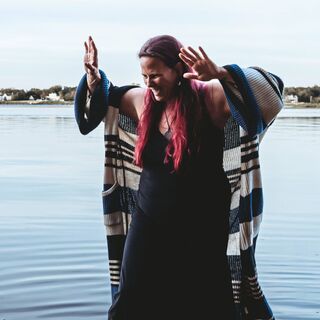
Welcome.
I'm Jocelyn.
One of the beautiful techniques and breathing practices that has helped me through anxiety and insomnia and moments of emergency in my own mind and heart is the physiological sigh.
And it's something that's helped me through some of the hardest moments in my grief.
So I am recording this for those of you who when you have a moment and your mind wanders and your heart tightens up and maybe you get to that place of anxiety,
Maybe you have a little bit of panic,
This is for you.
So it's simple breathing,
But I'm here doing it with you.
Just find yourself wherever you are.
And if you can,
If it's okay for you,
Close your eyes and just start to feel your natural breath.
It might be fast,
It might be shallow,
And that is okay.
Just allow yourself to feel it.
And start to feel the shape of your body wherever you are.
How is your body shaped in this moment right now?
Can you feel it?
You might even take a hand and place it over your heart and feel your hand over your heart.
Can you feel the weight of your hand?
Can you feel your body heat coming from your hand?
Over your heart space.
Can you feel a rise and fall of your chest with each inhale and exhale?
Just know that you are here and you are safe in this moment.
You can either let your hand go or keep it there as I walk you through the physiological sigh.
The physiological sigh is a very simple breath.
It's two gentle sips in of air through your nose and then you open your mouth and you simply sigh out the breath on the exhale.
It's like this.
Inhaling,
Two gentle sips in.
Opening your mouth and sighing it out.
That's how simple it is.
And we're going to do it together for nine rounds.
Here we go.
Inhaling.
Now that we've done nine rounds,
Go ahead and place your hand back on your heart.
Feel the weight of your hand on your heart.
Feel the body heat of your hand on your heart.
Allow yourself to feel the rise and the fall of the breath.
Just allowing yourself during this time to have your natural breath however that is for you.
Let your body breathe you.
Take notice of the temperature around you right now.
Can you feel the temperature outside on your skin?
Can you notice the breath going in the nostrils and out of the nostrils?
Does it have a temperature?
Notice what the inside of your mouth feels like.
Just bring your awareness to your eyes,
Inviting them to let go back and down.
And let your awareness travel to your ears and your inner ears.
Can you open up your inner ears to the sounds on this recording and the sounds in your space?
We're going to do nine more rounds of the physiological sighs so you can release your hand down,
Keeping your eyes closed.
Physiological sighs,
Two gentle sips in through the nose,
Opening your mouth and sighing out.
We'll start now.
Inhaling.
Now that we've done a second round of nine,
Go ahead and place your hand on your heart one more time.
Can you feel the breath going in and out of your nostrils?
Can you feel the breath going in inside your heart beating?
Are you starting to feel a little more calm?
Is there more space within you?
Take a moment to feel the shape of your body.
Do you give your body the intention of letting go?
Anything known or unknown that you no longer need?
You are safe.
You are here.
We're going to do one last round of nine physiological sighs.
On this last round,
We're going to vocalize on the sigh out.
When we bring voice to the sigh,
It massages the vagus nerve.
It allows for even more balancing of the nervous system.
If you are comfortable,
Go ahead and vocalize during the sigh,
But if you aren't comfortable,
You don't have to do it.
And we'll begin now.
It is again,
Two gentle sips in through the nose,
It is again,
Two gentle sips in through the nose,
Opening the mouth.
And when we sigh out this time on this round,
We'll be vocalizing as well.
Here we go.
Inhaling.
Exhaling.
Ah.
Ah.
Ah.
And letting that go.
Allowing your natural breath to breathe you in your own time,
In your own place.
You can,
One more time,
Place a hand over your heart,
Maybe two hands over your heart.
You may want to give yourself a hug.
Or you may simply want to just feel your breath,
Your natural breath,
As it is.
And when you're ready,
You can open your eyes.
My hope is that you feel a little more calm,
A little more safe.
That you were able to slow down for just three rounds of breath.
That you were able to balance your nervous system just a little bit.
I know this is something that has absolutely helped me.
And I know that I can go ahead and do that physiological sigh whenever I need it.
And so can you.
And so can you.
Thank you so much for joining me on this adventure in physiological sighs.
Again,
My name is Jocelyn Bates.
Namaste.