Welcome Mindful Writers.
Today we're going to take just a moment to talk about posture in our sits.
You can sit or stand or lay anywhere that is comfortable for you when you're meditating.
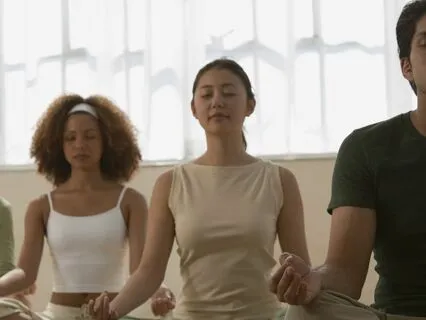
The only reason that you always see pictures of people sitting on the ground is that this is a very old tradition that dates back to a time when not everyone had chairs.
It's simple.
If you're comfortable sitting on the ground,
By all means,
Sit on the ground or a cushion.
You can sit on a chair.
If you're having some kind of discomfort that makes sitting hard,
Lay down.
And a trick for that to keep you from falling asleep,
It's a lay down with one arm bent at a right angle so that your palm is sticking up.
And that way if you fall asleep,
That arm will drop and hopefully wake you,
Alert you to the sleepiness.
Even standing is also a way to deal with sleepiness.
Simply coming to your feet,
Keeping your eyes closed.
Other than that,
I'll simply say that we can use our posture to our advantage as we're finding our meditation,
That if you're feeling kind of sleepy,
You can sit up towards the edge of your chair and engage your core muscles and that brings more energy to the posture.
If you're feeling a little amped up,
A little stressed,
Maybe sitting back against your chair,
Softening those muscles,
Bringing in a little bit of relaxation just through the posture.
So play with what works for you.
As always,
There's no wrong answer and you can always reach out if you have questions.
So let's go ahead,
Come into whatever posture is going to work for you today.
Close your eyes if it's comfortable for you.
And take a moment to come into the body,
Just noticing yourself in this space.
Generally,
I assume people to be seated,
So I always prompt people to consider their feet on the floor and bottom on the cushion.
But if you are in a different posture,
Consider the touch points that your body has with your surroundings.
If you're looking at the ceiling,
If you're looking at the ceiling,
If you're looking at the ceiling,
Consider the touch points that your body has with your surroundings.
If you're laying down,
That may be pressure against the back.
If you're standing,
It could just be the feet on the floor that you notice.
And then taking a nice big inhale,
Noticing the sensations of the breath,
Taking a couple more deep breaths and to come more deeply into the present moment.
Letting go of our worries about the future,
Thoughts about the past.
And instead,
Focusing on the rise and fall of the chest,
The movement of air through the nose or over the lips.
And once you've taken those few deeper breaths,
Letting go of any control around the breathing,
But letting and letting it find its own rhythm.
Trying to maintain the awareness that we cultivated with a deeper breath.
As the sensations become more subtle,
Try to stay with them.
And then we can use that attentiveness to check in with the rest of the body beyond just the mechanisms of breathing.
To see how we're doing.
If you notice a discomfort in your posture,
See if you can sit with it.
Maybe not for the whole sit,
But if you have the urge to scratch an itch or move your foot a little bit,
See if you can stay with it without moving and see if you forget about it.
If it doesn't,
Or if you're in actual pain,
Please don't torture yourself.
Go ahead and shift.
But it can be an interesting experiment to kind of play with our instincts to adjust our posture once we've begun our meditation.
And then as always,
I like to bring in a bit of gratitude for the body,
For its ability to take any posture,
For the gift of just sitting here and taking a few deep breaths,
Sending some thanks inward.
And then letting go of the gratitude practice as well.
Letting our attention come to an anchor.
You can return to the breath as your anchor if that's comfortable for you.
If not,
Perhaps try focusing on a physical sensation in the body.
The feet on the floor,
Hands in the lap,
Just getting curious about the sensations there.
Or you can turn your attention completely outside the body to the sounds in the room.
Whatever anchor feels right to you today.
We rest our attention there.
We rest our attention there.
And do our best to let all other thoughts drift on by.
Knowing that sooner or later,
We will get caught up in a thought.
Minds think it's what they do.
We do our best to notice that thought.
Come back to the anchor and begin again as many times as you need to.
And check in with your mind.
Just notice if it's wandered.
Come back to the anchor if you need to.
Again,
Check in with your mind.
Just notice if it's wandered.
Come back to the anchor if you need to.
Happy writing,
My friends.