Welcome to this breath work practice.
It's important to understand that breath work is different from a breath based meditation and when we are focusing on the breath in meditation we're not aiming to force or control the breath in any way.
This is quite different to our goals when we engage in breath work as an intentional act.
Breath work as a practice is about gently prolonging the breath or changing the breath with the intention of calming the body.
Our bodies are amazing machines and if we unnaturally prolong or delay the breath in any way that's uncomfortable for us or force the breath our body will actually force us to breathe and this will initiate a stress response which is the opposite to what we want to do through breath work practice.
So all breath work practices should only be engaged in within the comfort of your natural breath.
Any prolongation of the breath to the point of needing to force yourself to breathe or feeling a hunger for breath will have the opposite effect to the calming effect that we want this breath work to have.
So I would encourage you to only ever work within the confines of your natural easy breath and not move beyond whatever you feel as comfortable.
If at any point during this practice you feel uncomfortable in your breath please let go of any control of the breath and return to the natural easy breath that you were at the beginning.
So let's get started.
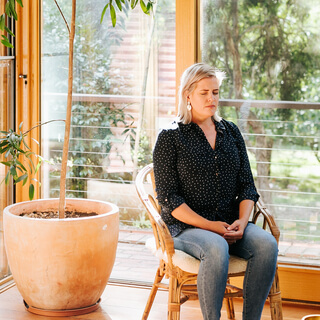
To begin this practice I'd like you to find a comfortable position where you can sit upright and allow your lungs to fully expand.
Wherever possible trying not to slouch,
Sitting forward off the backrest and allowing yourself to open the chest as much as is comfortable.
We'll begin from this place and I'd ask you to take three long slow deep breaths.
If you'd like to close your eyes please feel free to or just to soften the gaze while we engage in this practice.
And now allowing your breath to fall back into its natural depth and rhythm,
Not trying to force it or control it in any way,
Just simply allowing it to breathe itself.
And as you rest your awareness with this natural easy breath I'd invite you to simply count how many seconds it takes for you to comfortably inhale,
Followed by how many seconds it takes for you to naturally and comfortably exhale.
At this stage I don't want you to take any control of the breath other than this gentle witnessing of what feels comfortable for you.
Simply counting in and out so that you get some awareness of where your comfortable breath lies.
And as you have some growing awareness of what your comfortable breath feels like for you,
What I'd now invite you to do is without any expectations,
Letting go of any idea of what should happen,
I just ask you to invite your breath to gently prolong the exhalation.
Asking your body what it feels is possible and comfortable and simply allowing the inhalation to remain as it has,
But just very gently prolonging the exhalation by one or two seconds only.
I know you'll feel tempted to go further if you can but let's start with one or two seconds that we prolong the exhalation.
So breathing in in that comfortable place that you've already been counting,
Then breathing out for that same comfortable pace but extending the exhalation by one or two seconds.
And remembering that if at any point you feel that hunger for air bubbling up inside you or you feel discomfort in the breath,
Just giving yourself permission to let go of any control over the breath and returning to that natural easy breath and that in and out count that we started with.
And perhaps you notice now with this gentle prolongation of the exhalation by just one or two seconds that maybe you begin to notice that there's just a very short pause at the top and the bottom of the breath.
We're breathing in for whatever feels comfortable and a slight pause as the breath changes direction and we're breathing out with that gentle prolongation by one or two seconds of the exhalation.
And again we find a pause where the body is neither breathing in nor out before we change direction back into that cycle of inhalation.
And you don't need to create these pauses and if they're not there you don't need to force them.
I just invite you to perhaps notice them if they begin to appear just a microsecond at the top and the bottom of the breath.
Breathing in comfortably and counting,
Gentle pause.
Breathing out comfortably and counting just for that extra one or two seconds as we prolong the exhalation and a gentle pause again.
And at this point if you're beginning to notice that gentle pause at the end of your inhalation what I'd invite you to do is invite your body to inhale again.
So breathing in for that same count,
Pause,
And then inhaling again.
Extending the inhalation with a second breath.
Again noticing the change in direction of the breath.
Again noticing that change of direction and returning to the exhalation with a slightly prolonged exhalation by a second or two at a time.
Noticing the pause at the bottom of the breath where the body is neither breathing in nor out.
And then whenever you feel ready,
Feeling that need to breathe bubbling up inside of you,
Going back in that cycle of inhalation,
Pause,
Second inhalation,
Pause,
Exhalation.
Just slowly prolonging the exhalation by one or two seconds.
Still using the count that we were earlier.
Breathing in comfortably and then breathing in for another one or two seconds and then breathing out to the same count of that gentle prolonging of the exhalation by one or two seconds only.
And now letting go of any control of the breath.
Relaxing and releasing any urge to count and just simply allowing the body to breathe itself.
If it helps,
Just allowing yourself to count the seconds of the natural easy inhalation followed by the seconds of the natural easy exhalation.
But just giving yourself permission to no longer control the breath and simply allow it to breathe itself.
And as you rest your awareness with this natural easy breath,
I just invite you to take a moment to reflect on how your body feels in this moment.
How does your mind feel?
Can you notice any connection between the breath,
The movement of the breath and the sensations that arise in the body?
And even more than that,
Do you notice any connection between the sensations that arise in the body and the thoughts that arise in the mind?
It's all connected and often using a practice like intentional breath work to slow the breath can calm the body.
And in reaction to that,
The mind takes note and also begins to calm.
If you've found the opposite is true and the control of the breath has felt uncomfortable,
Which has led to a busy and uncomfortable mind,
Then perhaps a breath meditation where we simply watch the breath without the need to control would suit you more than intentional breath work in this moment.
I'd encourage you to simply use all of these tools with discernment.
Decide what is best for you in each moment.
I'll leave you with that thought and thank you for joining me today.