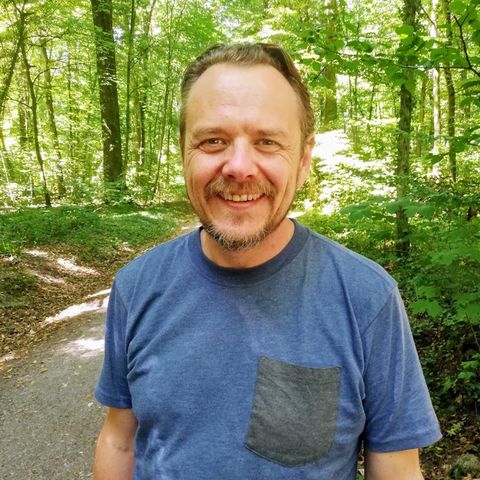
Hello and welcome to In at the Deep End with Gary Bridgman.
I'm your host Gary Bridgman.
On this episode I talk to Brian Penny.
Brian is a PhD psychology student who's studying neuroscience of addiction.
Brian had a really interesting story to share about his own struggles with heroin addiction and how he overcome that.
So in this podcast we have a really wide ranging discussion from everything about overcoming addiction,
Drug use,
Spirituality,
Language use and how you can transform yourself.
So I hope you get some key takeaways from the podcast.
I hope it's something that you find enjoyable.
If you have any feedback then please send it in to me.
I'd be more than happy to hear your thoughts on this episode.
But thank you very much for taking the time to listen.
Right,
Thank you Brian for coming on the podcast.
Today I'm talking to Brian Penny.
Is that how I say the last name?
It is,
Perfect,
Yeah.
And Brian you're a PhD student at the moment are you?
I am,
Yeah I'm doing my PhD.
In neuroscience of mindfulness as what you've read.
Yes,
Yeah,
Yeah and addiction as well so it would be my first time at this.
And addiction.
I've been really looking forward to talking to you actually because of the addiction,
Because of your story is quite,
I'm going to say inspiring is the word that come to mind but.
.
.
Different.
Yes it's different isn't it?
It's about addiction,
It's about drug use,
It's about your own story of drug use.
So should we just start there?
Let's just start with that story.
Let's start with how do you define yourself at the moment?
How do I define myself at the moment?
That's an interesting one.
I'm in flux at the moment.
So it's funny,
Things are changing Gary,
I'd say thanks again for inviting me to the podcast and delighted to be here.
But things are really changing for me at the moment what I'd say is this time last year I wanted to be an academic,
End of I wanted to be an academic.
My whole career was going to be in academia.
I'm still going to do my PhD but I don't see myself now as an academic.
I'll always have a foot in the door in academia.
But I think with me story I suppose,
I started doing speaking gigs last year and it stems from academia.
I started doing a bit of lecturing,
I lecture in Trinity as well and UCB and I spent a couple of speaking gigs and skills and stuff like that.
So I suppose where I'm at at the moment is getting the message out to as many people as possible.
And I suppose I've got a mission statement as well which seems a bit highfalutin as I say that out loud.
But basically my mission statement is I think we are what we think.
I relentlessly believe that we are what we think and that's the way we act.
Hence my interest in acceptance and commitment therapy,
Relational frontier and language.
I think we're defined by our language as a currency for our emotions and thoughts.
That's where the interest went with that and why I got into PhD.
That was the source of me suffering.
So I suppose now where I want to be,
I want to bring it more to the lay world.
I had a big realisation I suppose last year as well that even if,
I'm not saying I had,
But even if I had the solution to world suffering,
But if I couldn't translate it to the real world,
What would be the point?
So I suppose where my academic career is really going,
I'm trying to,
I want to get my PhD and make it as real life as possible.
But once I finish with my PhD,
I can see myself,
I'm doing a lot of speaking engagements now in the corporate sector and it's not about personal growth,
It's about language.
I'm doing one specifically on language this week.
But I do a lot of talks and skills as well and I really want to get,
I'm collecting a lot of tools and tactics and habits for life,
Self-care and good life tactics that I use myself that I write about.
And really I'd like to break them down as simply as possible and get them across to people that are suffering because the world is suffering and that's my goal.
Another realisation that I've had is that people don't want tools,
People don't want a solution.
I've said this before,
They want the solution,
But they want the quick fix solution.
So I'm trying to sort of come up with a way of making mine as fashionable as I can,
As palatable as I can and as easy as I can just to give to people so they can walk in the tools that have worked tremendously well in my life.
So that's where I am at the moment and I'm really loving the speaking gig at the moment.
A lot of people have asked me recently in the talks,
Is that still a bit of an addict?
You're addicted to learning and then you're addicted to this and I say,
Yeah,
I am.
We just caught a drive.
You just reframed the addiction problem.
Reframed.
Something a bit more positive,
Yeah?
Yeah.
And I suppose that's where I am right now,
Yeah.
Okay,
Cool.
I mean,
That's interesting to hear.
There's lots of unpack in that,
I think.
But let's talk about the addiction story.
Let's start there and just see where that goes.
Because you were somebody who was a heroin addict for 15 years,
I think you say.
Yeah.
A long time to be a heroin addict,
Isn't it?
Yes.
I mean,
Once you're sort of 15 years in,
I would imagine that your outlook looks very bleak,
Doesn't it?
I mean,
The statistics would probably say that you're not going to be somebody that's going to get out of this.
It's something that you're going to keep going.
So I'm interested to hear how you got into that addiction,
Because I know my own story is a little bit of a trauma-based background.
Okay.
I've had my own problems with drugs use,
But I've used different drugs from you.
So it would just be interesting,
That story.
I mean,
How did you get into it?
And then how did you get out of it as well?
How did I get out of it?
Yeah.
I started to want to see,
You don't have to pull me back,
Gary.
I jump everywhere.
I've been there as well.
So I pulled me back.
I meant to start there and I jumped out.
No,
No,
No.
Don't worry.
Yeah.
So for me,
And I say this all the time,
Was that drugs were never my problem.
And I don't think drugs are anyone's problem.
That's always an underlying issue.
My underlying issue as a child was twofold,
Basically.
It was trauma.
It came from trauma,
Which I'll talk about now,
But that turned into basically anxiety and overtinking.
So I had trauma early in my life when I was born as a newborn baby.
I had a lot of complications with my stomach and stuff like that.
When you go to sort of twist,
It's called intestinal malrotation.
I was misdiagnosed and I nearly died as a baby.
So I had a massive operation as a baby,
Which they didn't give anesthetics back in 1978,
Believe it or not.
Not until 85.
In 85,
They believed,
Oh,
We better give babies anesthetics.
Like it was some woman,
I forget her name,
Sort of found out that a child had open heart surgery without an anesthetic.
It was a crazy thinking that they didn't do that.
So I think from a classical conditioning perspective,
I think as an organism,
I learned the fear of the world.
So I got indications from that.
And the next year,
Year and a half was basically,
I literally just cried.
My mother apparently was,
My mother had this action where her head was back and forward just from rocking me pram.
That's what me auntie said.
Even when I wasn't around,
My mom was still rocking the pram.
I would have a lot of trauma as a baby and then growing up as well.
So with me,
Parents are amazing and they're brilliant people.
I get on great with them now.
They haven't got great life skills either.
They wouldn't talk great parents and life skills,
I suppose you'd call it.
And it was addiction issues,
Alcohol issues in the family.
So my overriding memory as a kid growing up was sitting at my window waiting for my parents to come in who are out drinking and I knew I drink drive.
And so I literally for years,
Remember waiting at my window for hours,
Literally waiting for them to come in and just being consumed by anxiety,
Just fear and always afraid that I was going to lose my family.
I was going to,
I was,
I was a very sensitive kid and I think that might've come from the baby experience.
I think it could be a temperament.
The boy logical thing,
A lot of my family be sensitive as well.
And I think I just grew this.
I just had this,
I was just a ball of anxiety.
That's all I remember as a kid.
I hadn't got a label for it at the time.
I just thought it was the way everyone was.
I lived in a very rough area as well and there was a lot of crime,
A lot of robbing and a lot of people were anxious in the area,
But we hadn't got labels for it back then.
I suppose then when I was about 40 and 50 and I was good in school,
I was pretty academic in school,
I was good in school and I was good at sports as well.
I was good at football.
I was talking to me,
Going off to England.
So I had a lot going for me as a kid,
But I was obviously this ball of anxiety.
And I remember starting trying drugs when I was about 40 and 50 and I had a football injury at the time.
I would never have gone near drugs.
I wouldn't even smoke a cigarette or something like that,
But I had a football,
Football,
Football.
But I remember being injured for a couple of months and I was up with friends up on the football dressing rooms,
Coincidentally enough,
Ironically enough of all teams.
And some of them were saying,
Geez,
You get a great buzz off a cigarette.
And I said,
Buzz off a cigarette?
So I did this,
This jump,
They started to grab me attention.
And I remember taking a little puff to see what this buzz was about.
Off a cigarette,
Only a cigarette to go sport then.
And I liked the lightheaded feeling it gave me.
And that was funny enough.
That was my little clear way into,
Oh,
I like buzzes.
I like buzzes.
I like this.
I like this buzz.
So as it was getting me away from myself and then my brother was smoking hash at the time.
And then he says,
Oh,
You get a buzz off hash.
So I started smoking hash and I looked forward to it.
And I started to just sense from there before I knew it,
I was drinking,
I was doing different drugs.
And then by the time I was 16,
I was,
We were drinking,
I'd smoke hash and stuff like that.
And it didn't really get me away from the anxiety.
Maybe it did to an extent.
But I remember when I was 16,
I started messing around with tablets and methadone.
I'd done methadone before heroin.
Cause it was happening to my area,
Which is a bit strange.
I didn't know it was a,
I didn't know it was a heroin substitute.
That was like a volume tablet.
So it took 20 mils of methadone.
And I remember it just made me feel so good because it would have just alleviated the anxiety,
Taking the anxiety away.
And I suppose I got very,
I was very,
Very curious about drugs.
And I think I was seven day on the first time I had done heroin and I wasn't pushed into drugs.
I was obviously started to be organized.
I was always into Jim Morrison,
Try everything once.
I used to blame Jim Morrison from you.
Believe it or not,
Jim told us to try it.
So we had to try it.
But I remember the first time doing heroin,
A few of us done it and me and another friend would be the only one that got strung out from that.
I remember thinking to myself,
Wow,
This is nirvana on earth.
This is the solution to all of my pain.
But I'm too clever to be a real addict.
I'll do this the right way.
And that's,
I rationalize myself into thinking I was into academia.
I was a footballer.
I had big plans.
I couldn't be a real addict.
Like I wouldn't be one of them.
And I just I was sent into that.
And by the time I was 20 then I was a full blown addict.
I was full blown addicted to heroin and I had to go on to a methadone program.
But I'd gotten a good job at this stage.
My football career went off the rails.
That was gone.
Drugs were the problem.
I blamed the knee.
I didn't do the physio.
And I got a job in a graphics company.
And from there,
Even though I became a full blown addict,
I was still started to live in the party lifestyle.
And like heroin was my little dirty secret with one of my best mates.
We started to use we would do that during the week.
And then when we got full blown addicted,
We started we still went down to have drinks and all.
Then we'd be going home at 11 o'clock and we'd be doing our little habit all the time.
But for years and years and years ago,
When I was 20,
I had to get registered as a registered addict.
For well over 15 years,
I was a registered addict.
So I was going to the clinic once a week to give a urine sample.
I was going to the chemist every day,
Pretty much every day to get a methadone and drink it.
But I was still doing heroin every day because that's what addicts do.
I just don't do methadone.
Methadone is just in case you can't get heroin and you take it anyway and you sell it to get heroin.
Even through all that time as I worked,
It was always at the start it was for chasing the buzz.
But for me,
It was always about reducing anxiety.
The function of the behavior was to always reduce anxiety.
And then you take more to get a buzz and feel great.
But then you'd wake up with anxiety and it'd be good to reduce the anxiety,
Do a little bit extra to get a buzz.
And that was the perpetuating cycle of my life for a long,
Long time.
Yeah,
It's interesting how you just mentioned it there about the function of it was to reduce the anxiety.
So my own drug story is not.
.
.
My drug use when I was young,
So my father died when I was nine.
And it was a kind of like,
For me,
It was a very black and white situation.
It was like one time he was alive and the next he wasn't.
But actually had been ill for a long time through cancer.
And at that age,
I just remember just getting on with it.
I just got on with life.
I went through.
.
.
I think for me,
It was like a very,
Very slow burn of this starting to impact my life as I grew up.
And as I hit my 20s and I got married young and then I didn't really notice that I had anxiety.
Like you say,
I didn't really have any labels for it.
I didn't really notice that was going on.
And I joined the military,
Joined the Air Force.
And obviously your accent,
I know you're from Northern Ireland.
So I was there for a bit as well.
And I kind of did all that for a while.
And it wasn't until sort of later on in my RF career that I started then to experiment with drug taking because it was a little bit.
.
.
So some of you,
I kind of been a little bit anti it for a while.
My mother was very much like,
If I catch you doing drugs,
I'm going to burn your hand or the other type of approach to.
.
.
For me,
It was like,
Really?
You're not going to do that,
Are you?
And the funny.
.
.
I wouldn't touch cigarettes either because my father died of cancer.
So I didn't touch any tobacco and I've never touched tobacco in my life.
And there's also one reason why I kept away from cannabis.
And I mentioned that because that became my problem drug.
Whereas I kind of then started doing ecstasy in my late 20s.
And then for me,
It was like,
Wow,
Ecstasy.
I loved it because it gave me this feeling of this thing that I was trying to find all the time,
Which is this feeling of connection and love and the thing that I was missing inside this whole diet.
And it kind of filled that for me.
And then ecstasies kind of led to psychedelic use.
And that for me was all about kind of searching for meaning,
Searching for purpose,
Trying to connect with something bigger than myself,
Connect with my spirituality.
But I never used to sort of go hard for psychedelics because they took me.
.
.
Because I was scared of the place they could take me.
I was scared of the darkness that I had.
It was kind of like,
I kind of knew it was in me.
So I thought,
I don't want to go to that dark place.
And so,
And then I kind of just started with cannabis.
And that for me was the anxiety killer because I was like,
Wow,
That stops me feeling anxious.
And then that use and with a relationship,
It just got worse and worse and worse and worse and worse.
And I was using it in the mornings before I was going to work.
Then I had it in my work drawer and I'd wait.
The relationship was getting really bad.
So I was at night,
I was just waiting for everybody to leave the office and smoke in the office.
And at some point you sort of go,
Hold on a second,
This is a problem.
You're naturalizing away.
I'm pretty much high all day.
It's not good.
It's amazing the way we can rationalize ourselves and think it's okay.
Isn't it?
That's the funny thing I find.
And something you touched on there,
Gary,
As well.
I was saying there was two functions of my behavior really.
And something you really touched on there.
So one was to escape the anxiety.
But what the anxiety was hiding was connection.
So disconnected from other people.
And I was looking for a spiritual solution,
But I haven't got a label for that either.
So I was always looking for something,
But I didn't know what existed.
And it was just,
Yeah,
It's crazy.
And so you posted that,
You got that picture on,
When was it,
October when,
On your website?
October the 8th,
2013 is when I got claimed.
So that picture would have been,
That photograph that I took would have been in 2011.
That's two years before I got claimed.
But two years before I hit rock bottom,
Before I got claimed,
I suppose.
And then the comparison picture was last year.
So it was funny because some of the stuff,
That must be one of your bad pictures.
But then my best friend wrote out a lot of what our pictures are,
And some of our words.
Like,
Wow.
So yeah.
And what was the rock bottom experience then?
What was the change of perspective that you suddenly realized that I need to stop this?
Right.
So what happened to,
For me was,
And similar to what I didn't have,
The realization that you had,
Well,
This is a problem.
I get,
I,
Sorry,
I didn't.
So a couple of times I had realizations,
Well,
This is a problem.
This is a serious problem,
But I was never willing to do anything about it.
I refused to go there.
I used,
I rationalized,
I justified.
I had a lot of debt.
I owed drug dealers money.
I owed credit unions money.
I owed banks money.
So I worked in the job and I had to earn money and I don't know a lot of scheme and I won't go into what the scheme was,
But outside of job,
I had to earn money to pay me debts to pay for my addiction.
So because I had all of this in action and I was always in,
In full flight,
I was like,
I can't get myself clean.
I have too many things going on.
I can't like have too many debts to pay.
So the thing was like chicken and an egg kind of thing.
I couldn't get out because it was in the middle of it.
And I,
But I was really just using that as an excuse to keep using drugs.
It was protecting the addiction.
This whole story I told myself,
Protecting the addiction.
So what has happened then?
I was nearly,
Physically,
I was nearly at that store.
So this would have been around 2000 and toward then in the months,
About two or three years previous to me getting clean.
I used to call myself a functional addict.
It's very debatable how much I functioned as a human being quite good at my job.
So even at 50% I could still get the job done.
When I was awake and losing it,
I started doing things well to an extent.
So big ups and big downs,
But the last three years,
Just everything started to start falling apart.
I lost my job.
I started going into nearly psychosis.
I started believing funny thoughts and stuff,
But where it really fell down for me was,
I just physically start breaking down.
Like I looked terrible.
I felt terrible.
The anxiety was just getting worse and worse.
The exponential and what had happened then was the drugs basically weren't working anymore.
Like I was waking up,
Taking seven or eight to 10 sleeping tablets in the morning just to function.
Then I take a hundred mils,
80 mils of methadone.
Then I'd go to when I was in work,
I'd go to work,
But I wouldn't take heroin.
I'd suffer through the day on borderline anxiety just to be able to manage.
And then as soon as I get out of jail with drugs,
Be comatose for the night,
Wake up the next day,
This whole cycle would start again.
So it was just like,
Absolutely,
I was living in torture,
Like absolute torture all the time.
But what really went to big point was the drugs stopped working.
So I remember then I lost my job and I was pretty much on everything.
And I decided,
He sits back around and he says,
All right,
You're going to have to go in somewhere.
And I said,
I think I really have a problem.
I think I'm a real addict,
You know,
Crazy.
I think if I had to be registered as an addict for a certain amount of time.
Twelve years.
Twelve years.
Twelve years going to the New Orleans temples.
But I'm not an addict.
I know.
There's a funny one.
I've done research in the clinic where I was previously.
And the counselor there says that the funniest story she ever heard,
The funniest person she ever heard coming in.
When I went to that clinic,
I told her,
I'm looking for a methadone clinic for non addicts.
Is there any of them around?
No.
I was right off on the wrong foot,
You know.
And so what happened then was I went up and so I was willing to go in.
I was losing my job.
My job is gone.
It's fundamentally gone.
I lost my job.
And I says,
Well,
I need to get clean.
But I wasn't actually willing.
I was still,
I still wanted a drink and I still wanted to do tablets.
I remember that was in my head.
I says,
Well,
I have to get off heroin,
I have to get off methadone,
I have to get off dem jokes,
But I'm not,
I'm going to keep bands of diazepine.
I still will have anxiety that needs something to battle anxiety.
So I remember going up to the counselor in the clinic where I was,
And he was saying that the detox facility wouldn't take me in because it bends up the azeopane and too much other drugs in my system.
I just had to have opiates in my system and I get everything else out of my system.
It was like,
Why?
That's ridiculous.
Like surely they take people into a detox facility if I have drug problems.
And he was saying,
No,
You'll be too much of a health risk.
And he was saying,
You'll probably have a seizure.
So I remember him saying that to me,
Especially me,
Special addict that's different from all other addicts.
I remember saying,
Awesome.
As if I don't have a seizure.
I'm not going to have a seizure.
I don't know why I believed that.
So when I walked out of there,
He wanted me not to come off benzodiazepine really quickly,
But I was taking 20 to 30 a day,
Like mad amounts of benzodiazepine.
So it was 20,
30 milligrams of tablets?
No tablets.
I was just eating them like smarties.
I bought them in two,
Two hundreds,
Like packs of two hundreds,
Not packs of two hundreds,
But you'd get them like a hundred euro for two hundred or something like that.
And they were from the Arabic market.
It was all Arabic Ryan.
So I don't even know if they were real.
I don't even.
Yeah.
Yeah.
They weren't working for me anymore.
So I just started taking more.
Like it seems like,
It seems like a mad amount of tablets to be taken,
But when you're taking two and three and that doesn't work,
You take four and five.
So my body had just stopped reacting to benzodiazepine.
So I was just taking more and more and more.
But I've since found out that once you take six,
That the rest of them just go through your liver and destroy your liver.
So it was actually pretty much a waste of time.
Yeah.
That's another story as well.
You could have saved all the money if you knew that.
I know.
You still wouldn't have done it anyway.
Yeah.
So what,
What,
What happened then was,
I had a,
I was two days into my own detox.
So I have to do a month at home.
I saw the benzodiazepine would take a month to come out of the system.
So I said,
All right,
I'm going to come off everything except methadone.
That was me plan.
Come off everything except methadone.
And,
Cause I had to come off the benzodiazepine to get into the detox center.
So it says,
Right,
I'll do that.
And then two days in,
I was having like tremors,
Tremors,
Shakes and all that in my house.
But two days clean,
I think I wrote an article about this.
I had like the seizure from hell.
And this is the story I tell a lot of people about.
And I describe it as not only the most painful night of my life,
But this was the most important night of my life.
So I woke up on the,
I woke up me sitting on the floor and there was blood all over me,
Clothes all on the floor.
And I was just like,
I was shattered.
I was absolutely shattered.
I didn't know where I was.
I can't really remember much.
I just remember waking up and what had happened was I had a full blown convulsive seizure and you know what a seizure is.
So it's all the cells,
Me cascade and affect all the cells,
Me brown for it at the same time,
Put all my muscles combust and where the blood had actually come from,
It actually driven me teeth through my tongue.
It was,
Yeah,
It was harsh.
And then from months after that,
I mean,
My mouth was in a bad way.
So I was rushed to the hospital and me,
Me family rallied around me that night.
And me brother,
My poor brother was actually,
I used to say he came running into the room cause I thought that's what happened.
But we were actually sitting in a program,
General breaking bad.
So we were breaking bad coincidentally enough.
And I just sat shaking on the couch and landed on the floor of blood coming out of me now.
So he actually thought he was sitting in with me watching each country with drugs.
So he tired diet.
He rang me dad,
Said,
I think Brian's dead.
So they all came up and to the house called the ambulance.
And we went to the hospital.
I have no memory of any of this.
Apparently like I didn't know my name.
I didn't know what year it was.
The ambulance guys were asking me this and the other day knew it was a drug issue and probably taught it was a recurrent team.
So we're in really that much interest at anyway,
Just getting the hospital,
Get them in.
But there was a,
The reason why that night was so important for me.
And I'll never,
Ever forget it.
I'll never forget the images in the hospital.
And I remember coming to on a trolley on the own in the hospital and I woke up,
I never forget the walls.
The walls always,
I just stuck in your memory.
They're like these orange,
Like brown,
Dark orange walls.
And they were just like,
We're hunting,
Hunting orange walls.
That's,
That's how we see them to me anyway.
I'm sure he went that way to the nurses and the doctors,
But it's still,
It still gives me a weird feeling to this day.
And I remember there was the smell in the hospital as well.
It was like this smell of disinfectant,
Another hospital disinfectant.
Yeah,
But it was mixed with vomit.
Maybe the vomit was on me.
I don't even know.
And then with the taste of the blood in my mouth.
And I remember just waking up in the hospital and just having this deep,
Anxious,
Fearful,
Weird sort of haunted feeling.
But I remember then me eyes fixated on this fire extinguisher.
And this was,
This was possibly the most important moment of my life.
I think the defining moment of my life.
And I remember looking at the fire extinguisher and I was looking at it,
Trying to make sense of it.
And all of a sudden I had this realization of what,
What is that object?
And it was,
It was a red fire extinguisher,
The symbol symbolically the word red was there.
It was red and it was a fire extinguisher,
But I couldn't cognitively say to myself,
That's a red fire extinguisher.
It was like the words didn't go together anymore.
And I kept on trying to,
Like,
I was thinking it was like maybe I'm faint,
Maybe I'm faint.
And I kept on trying to focus on it.
And then nothing made sense.
Words just weren't making sense.
And I remember saying to myself,
Oh man,
This is it.
It's game over,
Man.
This is brain damage.
And that's something like that.
Like I was always afraid of anything happening to me,
Anything happening to me,
Family,
My anxiety was driven by fear,
Fear of death,
Fear of anxiety,
Fear of something happening to me,
Family,
Fear,
Fear,
Fear,
Fear,
Fear,
And something like that would have sent me into a spiral.
But I remember having this realization that I just didn't care.
It didn't matter.
I think it was a moment of acceptance,
Surrender,
Wherever you might call it,
But I just lay back on the trolley and I just says,
Oh,
I've no more fight.
I've nothing to give,
I've nothing else in here.
Whatever is,
Is,
What is,
Is.
If this what is,
It is.
There's nothing I can do.
And that was a huge moment for me.
I was still in a lot of physical pain and I had to spend the next month,
The next month was the hardest of me life sitting on the ice,
Literally sat on my couch,
Going,
I had more seizures,
I had more mini seizures.
I was in another hospital visit or two from the seizures.
But that was the opening of the gates for me into awareness,
Although I didn't realize at the time,
But then when I went to treatments,
I went to detox and when I came off methadone,
Just a long,
Long answer to your question,
When I got off methadone,
I was two days clean and that's where it all changed.
I think the first thing was our moment was a chink in the ego,
A crack in the ego that opened me up to accepting reality.
But when I was two days clean,
It was like me mind went quiet,
Anxiety left me and it was like this glow came into me.
Like it was like you could smell,
Hear,
Feel,
Taste the difference,
Light look different,
Nature.
I was on a farm,
I was on a farm and nature,
The animals just blew me away.
And that was the moment of change where I just became aware.
I was like,
What the hell have I been doing for the last few years?
Why didn't anyone tell me?
But what I hear in that story,
The thing that's just come up for me there is that kind of awakening experience that we can have that some people have and some people have it like you,
You're like this like,
Whatever this bad moment where it's like,
All right,
This is actually it.
There's just nothing else.
This is actually it.
And for me that that experience,
I've had that experience and it took a long time for me to get there,
But it was for me,
It was like small,
Small,
Small,
Small,
Small things.
And then just one slightly bigger thing.
And it was like,
Oh,
Right.
This is actually it.
This is yeah.
But for you,
It's kind of this big,
Massive experience.
And in some way,
Don't you feel like everything up to that point had to lead you to that point?
If you look back at it now,
You had nothing but that point to get to you to where you are.
Nothing but that point.
And I am very grateful for the addiction.
I,
And a lot of the talks I do and a lot of what I write about,
I turn negatives into positives.
The biggest negative of my life was me addiction,
But it's the biggest positive of me life.
I think it was the comparison.
I think why it was such a big experience for me was a big shift,
A big boom as you describe us because I,
I resisted it for so long.
I built a wall,
Let's say a wall,
A dam,
And I was building a stronger,
Like a beaver,
I'm stronger,
Stronger,
Stronger,
And I made up moral lies and resisted reality so much to protect,
To protect myself.
Then when at all,
When the water came through that dam,
It all fell down.
It was like this big explosion and yeah,
I couldn't have gotten there without,
Without that pain.
I couldn't have gotten there.
I really needed that pain to get there.
My mama always often says to me,
Wouldn't it be great if you never had to go through all of that?
And I says,
Do you know what?
Where I was going before the addiction,
I would have been a materialistic,
Narcissistic kind of person.
I genuinely do not in a bad way.
I have good morals and I've got even an addiction,
I always got morals,
But I've been materialistic and I wouldn't have what I have now.
I'm very value space driven.
I'm very much about awareness.
I'm always checking myself with reality and I have the skills that I've developed and I got them all from that realization.
And the big realization for me was like some people call it awakening and all these different things.
For me,
It was a perspective shift,
Which fundamentally for me was,
Was variable.
And that's why I was so drawn towards relational frame theory.
I was so towards self-talk and the voice in our heads.
For me,
I was tormented by my mind,
Which nourished my addiction.
But once the mind quietened down,
The anxiety left me and I suppose going forward,
A big part of my career will be in academia and the real world.
We'll be trying to find out the relationship between mindfulness,
Emotions,
Language,
Self-talk.
That's where me interest,
That's where me career,
As I think it may be a big book I want to write is going to be in that area.
For me,
It was a perspective shift,
A variable perspective shift that the self-talk reduced and from a relational frame theory perspective where emotions traveling through language or psychological functions and that language is a vehicle for psychological functions.
It was like relational networks broke down for RFT people out there.
Let's talk about that in a minute.
Yeah,
Yeah,
Yeah.
And it just,
It just gave me an ease and yeah,
You could call it spiritual.
It depends what language you're talking about.
You're looking at the different thing.
We could call it that as well,
But that's,
That's,
That's where it allows us for me.
Yeah.
And I've said,
That's interesting.
You just pick up on that point of language.
So the point I've been having recently,
Especially from an RFT kind of perspective is that people,
However people formulate their languages about how they experience the world.
So there's always,
I see this kind of people sort of talk about,
Oh,
Somebody over here has had a heart opening or it's a spiritual experience or they're balancing their chakras.
And there's sometimes people will have a lot of,
Oh,
Well that's just pseudo science bullshit.
Shall we say for a wonder?
But to me,
It's about,
Well,
That's how that person explains their relationship with the world reality.
So you can't,
Yeah,
You can't say that's wrong.
It's just that's how they explain it.
And for me,
I'm a spiritual person and that's something that I worked out through my own journey through mindfulness and getting to the point I am now.
And I had a perspective shift and like that way of saying for me,
There was a perspective shift where for me very suddenly it became like,
Oh,
Hold on a second.
This is all one thing and I'm part of it.
And that was the shift that sort of got me over the line.
And for me,
That for me,
I like to explain it in a sense of spirituality.
That's how I got there.
But other people like to say,
They'll say,
Oh,
It's conscious as awakening or just a perspective shift or a heart opening,
Or I balance my chakras or whatever you want to say,
That's your way of describing that experience for yourself.
Then leaders on let's talk about RFT.
Let's talk about,
Um,
So what can you do?
It's a very complex thing to explain.
For me,
RFT is very obvious.
I've always been really kind of obvious of language use and how to use that language.
And I think my trauma of my father dying really made me come into contact with reality at the age of nine,
Just that point where your mind is starting to see separation,
Isn't it?
I think before the age of nine,
You kind of still part,
You still see yourself as part of everything.
And there's one thing I'm sure it's a shame we can't remember it,
But if we could remember that age might be a bit easier,
But you just coming to this point where you start to see separation in the world.
And I think for me,
It enabled me to be able to watch people.
And I'm very good at watching the scene of the language use and going,
Oh,
Hold on a second.
That's different from the reality.
You know,
Your language is completely different from the reality that you have,
And you're,
You're creating a different reality in mind.
So I find it obvious,
But I still struggle to explain what RFT is.
So I have an expert explain what RFT means.
Right,
I wouldn't say expert,
I'll do that.
I have a published paper on it and I'm writing a blog.
It's funny,
Right?
And here's the funny thing about language.
So just back on a point before we go into the RFT thing,
I consider myself,
I wouldn't call myself spiritual,
But I am spiritual spiritual for me is connection and awakening.
And again,
That's just a language thing.
Well,
One of the,
One of the biggest realizations I had,
Like I would be very,
I'm not religious whatsoever,
But the biggest hard hitting sentences that ever hit me was by Eckhart Tolle.
And he,
It was,
It was a sentence by Jesus Christ,
Jesus Nazareth,
Wherever that man was or whatever.
And he says to enter the kingdom of heaven,
We must return it.
We must return as children.
And the way he broke that down was the kingdom of heaven is stillness is reality is connection.
He's getting away from the compulsive tinker and to return as children is to go back to our roots.
So to get away from our thinking mind to reenter stillness where we belong.
So it's like,
It's just a play on language at the end of the day.
And it's like somebody made that translation from Latin or Hebrew into English.
And then us as non as anti-religious people,
Many people as anti-religious people are returned to the kingdom of heaven.
There's no such thing as heaven when it's just all about language at the end of the day,
Like the way Eckhart Tolle breaks that down,
It's heaven is stillness.
Heaven is peace of mind.
And to be awful way of putting it,
It's all just down to language.
But yeah,
It's,
That's just popped into my head.
That's nice.
It's the same thing for me.
It's like understanding that,
That it is just language.
And if you look back at the way it's described,
It's,
It's here,
Isn't it?
We're in it already.
This is reality.
So to be at peace with it and understand it's just,
That's what is,
And I can come to this,
This place of peace and happiness inside of me,
Which is just,
Okay,
I don't have to put any meaning on it.
I just have to see it.
And I like that bit where you suddenly became really kind of like,
There was this all factor that came into play where it was like,
Wow,
Look at this.
Wow.
Yeah.
I played a big part.
Yeah.
I played a big part.
And another piece on that,
I think it's an important point to get across for other people out there as well.
A big part before going to the RFT,
A big part that played it,
It was this all factor for me.
It was huge.
Wow.
The world is amazing.
But the belief as well.
And a lot of people do always ask me,
How did,
What was the change?
What was the shift?
And I can't give it to people.
But the one big thing I'll know is,
I'm not,
I fundamentally knew and believed I was never going to use drugs again.
And I was going to have a drive to have an amazing life.
And I believed I had the ability to get there.
There was no self doubt whatsoever.
I don't know where I got that.
It just sort of became into me.
But that was,
That was a fundamental piece.
So I think building belief into people and is a key part of,
If they believe,
If I believe something,
My actions towards that are going to be very different than if I'm doubting myself.
So I believe there's some magical concept.
If you can trick people into believing,
To save people into believing,
If that works,
Their actions will be aligned with their beliefs.
So it's a funny thing.
I don't like deceit or any of them things,
But it's like back to pragmatism.
If it works,
It works.
So that could be something going forward.
We need to hook people onto things another way.
If it keeps them playing,
We can tell them that we've saved them later on in life.
Come on.
But that's interesting because I always say that no belief is true.
So then everybody can true.
Yeah.
Yeah.
I like that.
Because you can then you can correct to construct a belief system that works for you,
Which has come back.
Let's talk about IFT,
Which is about constructing a belief system that works for you through your language.
Yeah.
Yeah.
So for going to the RFT then for me,
I'm actually writing,
It starts with,
It's a blog,
An RFT blog I'm trying to do at the moment.
And the way,
RFT for me simply,
I think there's a couple of core units in it.
So the one thing I think a lot of people miss in RFT as well is they think it's just language,
It's just words.
But the key part of RFT is the relationship between language and reality.
So I think Wittgenstein's theories of philosophy,
It's obviously really important for RFT.
But let's say that this is a bottle.
The word bottle is the same as that bottle.
So the key element of that is that's language right there.
That's really relate.
So RFT is relational frame theory.
So you're framing relations.
So the relationship between that is that the word bottle,
The sound of the word bottle and bottle is the same.
That's the relationship as an actual bottle.
So it's the link between reality and the words we speak.
Then this is a very lay way of talking about RFT.
So one of the key components of RFT for that reason is that it's arbitrary.
So the word bottle,
The spoken word bottle does not look anything like an actual bottle.
There's no similarity whatsoever.
So it's socially constructed,
Socially defined.
We have decided that that word bottle is equal to that object bottle.
And it's absolutely arbitrary.
We could have easily called that a window.
And now we call that a window.
So it's completely arbitrary.
So that would be the four key components for me of relational frame theory.
The second one would be degenerative nature of language and how we just,
Like so the Chomsky Skinner debate was Chomsky always says,
Well,
How come this language force that we have and Skinner wasn't,
Should have reinforced contingencies,
Wasn't able to say that everything's learned.
So it looks like true stimulus equivalence and the techniques of so A equals B and B equals C.
But without learning,
By knowing them relationships,
We'll know that A is the same as C.
So the simple way of describing that would be a chair is the same as a stool and a stool is the same as a seat.
So language able humans are able to derive that C same as a stool,
If I'm saying correctly.
We derive these other relations without actually being told about the relations.
And it seems very,
Very simple,
But this is the essence of degenerative nature of language.
If I'm then told that the word,
I don't know any languages,
But French,
Do you know the French for seat or chair?
Well,
I do,
But now you can be on the spot.
Let's just start with a non-sensational.
Yeah,
We could be anything.
Yeah,
Zuck,
Let's say Zuck.
Yeah.
And so then Zuck is the same of all of these other things.
But by learning a couple of things,
You can learn lots and lots of different things.
And that's the key component of RFT as well.
But the part of RFT,
I'm missing one part because I'm writing about four sections and I forget the other part.
So generative nature of language,
The symbolic nature,
Yes,
Symbolic language which I've touched on,
And then the arbitrary nature of language.
So I think that's where RFT really nails.
But the main thing of where my interest came from,
Relational French theory perspective,
Is the transformation of functions.
And just that psychological functions or psychological properties actually travel through language and is mind-blowing for me.
So again,
If I got mugged in a laneway years ago and I've developed a fear of laneways,
So if I hear about a laneway,
I get nervous or anything like that.
And then I hear a church is the same as a laneway.
Growing up I'd say,
Well,
I'm not going to the churches,
I'm afraid of churches.
I don't even know what a church is.
If I've never been in a church,
I've just heard it's the same as a laneway and I've developed an irrational fear of something I've never even experienced just because it's being compared to something else through language.
And the way I see that is from an addiction perspective or from a suffering perspective that if you derive then new relations of things you're afraid of or you're anxious of,
From an evolutionary perspective,
We're going to be on the lookout for things that we're afraid of so we can avoid them,
Which is counterproductive in itself and it's the essence of anxiety.
But as we develop new relations on that and being on the lookout from an evolutionary perspective of new things,
We're going to develop more new relations and be afraid of more new things through the functions transfer and through the new stimuli.
And the funny thing is the more active the mind is,
The more of a compulsive tinker you are and an analytic tinker you are,
You're going to develop more relations,
More functions are going to transfer through them relations and you're going to be a more anxious person.
And it's not surprising to me that analytical tinker's tend to be anxious.
That would be my simple breakdown of RFT in relation to suffering from my perspective.
Which brings the point of the whole kind of,
So for people who don't know,
Both you and I are in the kind of acceptance and commitment training therapy coaching world and the acceptance and commitment training,
Acceptance and commitment coaching and therapy is based off RFT,
Isn't it?
Which is this concept.
But there's also this acceptance and commitment therapy and training and coaching has come from this idea that the Eastern philosophy idea that,
You know,
That life is suffering,
But actually,
Well,
It's not about life.
It's about language.
Language use is suffering.
How we use our language is how we end up suffering about ourselves.
We do build these massive relational networks with something.
And even in your story about heroin use,
You started to build other relational networks about it.
Like,
Well,
Okay,
I'm going to an addict clinic,
But I'm not an addict because there's other reasons that I can relate to my use.
Yeah.
Keep that hierarchical relationship very separate there to protect me.
Yeah.
Yeah.
And I like the way you used it.
You're saying that I was protecting my addiction.
That I was afraid,
You was afraid of actually losing your addiction at some level then.
Yes.
Terrified.
Absolutely.
And not of losing the addiction,
Terrified of losing my weapon.
Anxiety.
Yeah,
That's what it was.
And I remember the book that were writing,
Me and Brezzy are writing,
That's not so much writing anymore.
We're going to come back to it.
We're going to come back to it.
But what I wrote in that book,
And I'll be writing this would be part of me story going forward,
But when I found,
I never heard of mindfulness in the detox center,
But I remember I found mindfulness and my anxiety was being based around my chest and around my heart.
We had a morbid spirit beyond heart.
So when people said focus on your breath,
I was like,
Oh my God,
Not a chance.
I can't go near me.
Body,
Body sensations terrified me.
That's where my anxiety was based.
But I remember,
I remember doing a mindfulness exercise on the nostrils and being able to focus on my nostrils.
And it's just had to come into me there because my weapon for dealing with anxiety was,
It was drugs.
That was me.
That was me weapon.
But I remember when I couldn't do mindfulness,
It was just too scary for me.
But I remember when I focused on the nostrils,
That was my first anchor.
And I remember thinking,
Whoa,
I can do this.
I have another weapon for anxiety,
A different weapon for anxiety.
And I thought that was very interesting where all of a sudden I found something to deal with my anxiety.
And very quickly down soon after that,
I had the shift.
I'm not saying mindfulness caused the shift or I don't know what caused the shift.
I think it was,
It was multiple variables caused the shift.
But I'd say it definitely played a part that the realization that maybe other networks fell away.
All of a sudden the network that I needed drugs to protect me as a weapon against the addiction.
Now I had a different weapon against the addiction and that probably helped me along the way to have me shift as well.
It was interesting.
Yeah.
No,
I like,
I like the idea that it was,
And it was just one thing that you started to use rather than this whole idea of,
You know,
I had to sit in a certain space.
I have to have a certain posture.
I have to breathe in a certain way.
Cause when I teach mindfulness as well,
I'm,
You know,
Whatever works for you,
However you get to it,
You know,
Whatever works for you to just start to bring your attention to something else other than your thoughts or what's going on in your body right now.
And then you can introduce everything else later.
And it's interesting for me and my mindfulness journey was like maybe three,
Four years ago now.
And I've gone through different stages of it.
So when I first did the,
Like an eight week course,
I did the eight week course and I,
You know,
I think the one,
Like you say,
Let's go back a bit because there's something just coming to my mind now about this idea of that protecting your addiction and you know,
You lose your weapon against it.
And it was the same for me.
It was like,
As I started to,
To get a bit more mindful and self-aware,
I was still afraid of losing other things that I was like,
Well,
I'm using all this stuff to maintain my,
My anxiety.
I'm using cannabis a lot.
I was using some other forms of psychedelics as well,
Which are a little bit allowed you to be a little bit more functional on them.
And that was still a big thing for me,
Sort of using all them.
And I was still scared of saying,
Well,
You know,
What's my life going to be like without these.
And it took me a while to find the meditation style that really kind of worked for me.
And that was kind of using a mantra based meditation.
I was just going to ask like TM kind of thing.
Yeah.
TM type thing.
Yeah.
So,
And that was the thing that really helped me quiet down my mind quite a lot.
And because it really helped me to see that there was a part of my mind that was repeating the mantra.
And then I started to see that my thoughts were still coming up,
Why I was repeating the mantra.
And then there was a part of me that could watch me repeat the mantra and see my thoughts at the same time.
Wow.
Yeah.
I was like,
That's the,
That's the bit I am.
That's my awareness bit.
And that enabled me to,
To bring my awareness to the front.
And you know,
You don't have it all the day,
But most of my days I've lived in that space now where that awareness sort of moved,
Moved frontwards.
And it's more like,
For me,
It's more like it's a,
I'm very much too,
I'm 2d from this point backwards.
Yeah.
So I'm very flat.
My awareness is all upfront.
And then behind that,
I've got a mind somewhere and my thoughts are very quiet.
There's somewhere in there.
I always describe it.
It's like,
They're in the same room as me,
But they're over there and I can turn to them,
Look at me if I want to,
Or I can come back and say,
Okay,
Well,
I don't need to look around.
That's brilliant.
I love,
I love that way of looking at that.
I love that.
Yeah.
Yeah.
It's nice.
There's a nice experience once you get there,
But like you say,
I don't think there's one way of getting there.
I mean,
There's people that never practice mindfulness and actually managed to get there.
There's people that have experiences to get there.
Naturally,
Naturally like that.
Some people are like,
Just naturally have that.
Yeah.
How lucky.
I know.
I know.
Yeah.
Not jealous at all.
It's funny.
I love,
I love that metaphor.
I'm going to use that myself because my form of mindfulness now would be my practice,
My soul practice.
It's funny you mentioned mantra meditation,
Because that's a new thing I want to get into soon.
I've been talking about it for a while.
I think,
So I still struggle with mindfulness and it's because me,
I'm not going to struggle.
I struggle during the practice,
But I think that's an important point to get across.
I need to practice mindfulness.
I need to practice mindfulness more because I struggle with it.
So for me,
I practice catching myself in unawareness.
That's what the practice of mindfulness is for me,
Catching myself in unawareness.
And I suppose the key practice for me is a self observation.
I'm always monitoring me,
Bodily sensations,
Me,
Thoughts and me feelings.
And what I found I've done is I've created a space.
I love Viktor Frankl's there.
I think it's the fruits of mindfulness.
Viktor Frankl's quote,
Between stimulus and space,
There is a response.
In that space is your chance to chill with your response.
And for me,
My mindfulness practice increases that space.
And I've noticed in the last couple of years,
I've been rigid,
Psychological flexibility and all that.
I've been pretty rigid about a lot of things.
So mindfulness practice is that.
So in 10 minutes in the morning,
10 minutes in the night,
Rigidly,
Every day without fail.
And maybe I need to get a bit more flexible about that.
But it works for me.
It does work.
And what I've noticed specifically is in the last few years,
I've had things that used to trigger me,
Especially with family stuff.
They just don't trigger me anymore.
Space is there and I can observe it.
And I've had a bit of a struggle of saying,
Where am I observing that?
I observe it.
I know I'm observing it.
But I'm going to use that just to turn around and just look at it.
I'm going to use that metaphor.
I think visualization is great.
I think that's a beautiful way of actually describing it.
It's just being able to look around and seeing it's there.
Let the awareness come to the front and say it's a great way of.
.
.
Yeah,
It's definitely how I feel that the awareness is upfront.
Which makes me feel like I say,
It makes me feel two dimensional.
It's like,
You know,
This idea that everything's projected on the screen of your mind.
It's like me and the screen are one now.
It's like I'm on the screen.
There's no,
There's no,
There's space,
But there's no space for interpretation of seeing it all come in.
It's like,
Oh,
This is all here.
Okay.
And then I can start to put judgments on it if I want to put meanings on it later or discuss it and see it as something different,
But it's all there.
But do you find also,
You said like,
Stop triggering.
This is the other triggering.
That's the other thing that I talk to people about is that it's not like,
It's not like you suddenly enter this kind of blissful space or you're always happy or you don't get emotionally triggered.
Of course you do.
You feel it.
And in fact,
I feel it more than I did do in the past.
Yes.
It's more there now than it was there before.
Yeah.
It's more,
But it's not as a,
It doesn't perpetuate.
It doesn't,
It's because you see it,
You can stop it.
Stop what would be wrong with you just feeling it's funny.
It's funny as well.
What you mentioned there's something that's out there jumping out on me as well.
And I think it's a car.
We can talk about my acceptance and surrender and all these different things,
But I would say I'd have a morning routine that I think is the essence of why I felt so good.
Like I,
I do feel I have me,
I wouldn't even call them ups and downs to be more very ups and more middles.
Like I pretty good a lot of times.
I never in bad news,
Even me laws are pretty good.
Like,
You know that way.
And I really think the reason for that is,
Is the morning routine that I sat down myself.
So I think this is,
I talked to a couple of people that just recently and I'm sort of sharing an excellent people seem interested in it,
But the one thing I would do meditate,
I have an acronym.
It's called Mavic M A V I G.
Basically I would meditate for 10 minutes.
That's the end.
Then I do,
That's a bit of a lie because meditation is at the end.
So,
But,
Uh,
Does it sound like the acronym doesn't work at the end?
So the first thing I did was affirmation.
So I literally say to myself,
I feel positive,
I'm positive,
Energetic and capable.
I'll be more than I appear to be all the world's power and strength lie within me.
So in a few little different affirmations,
Whatever works for me,
That just gives me sort of a trick the brain into sort of a strong,
Powerful feeling.
Then I will go into,
I love this one by Jocko Willock.
It's like discipline equals freedom.
The more disciplined you are,
The more freedom you have financial health and social,
The more you work,
The more freedom you have in your life.
So I've nearly done,
I bring that into a visualization where I visualize myself eating healthy,
Feeling healthy,
Sleep and healthy,
Physically healthy.
And I bring that into a visualization I'm disciplined and that,
And I have freedom in the health.
And then whatever I'm doing that week,
And it's only take a few minutes,
Whatever I'm doing that week,
I'm doing a talk,
I picture myself doing a great talk.
If I'm not doing a talk this morning for me,
Visualization,
I visualize myself writing the second book in the Alps and the walk in the house,
Feeling the sun on me back in the opposite.
I feel myself really being there,
Smelling the coffee on the balcony in the morning,
Like I'm there.
And I feel me acting to be aligned with that during the day then.
That'd be the V.
The I then is in our child.
So I had a lot of struggles.
I always picture the young baby or the kid at the window.
So I literally go over to visualize myself walking over to the young kid at the window and say,
Here I have you now,
Don't worry pal.
And I nearly just hold me in our trials or to visualize myself out,
Making a goalpost with me kid,
With me in our trials,
Three years of age and seven years of age and nine years that sometimes before playing football,
I would be back garden and I'm playing with them and telling them everything is all right.
And it's just started.
So I was at Caratale talks about the pain body,
Classical condition,
Like all that pains I've had anybody that are anybody.
It's just sort of a release of them.
So I only spend a few minutes on that as well.
And then the G then the G of the morning,
It's going to be gratefulness.
And I just practice gratefulness support,
Very specific,
Great.
It's a great example of all I'm doing.
I got off Maria for audio and instead of saying,
Saying,
I'm grateful for me from I'm grateful for my job and just naming things off.
I pick one thing and really focus on it.
Recently I picked me nephew.
So I was minding me nephew.
He's a gorgeous little smile.
He's only two,
But then I thought I've been grateful for it.
The joy that that brings me sister and his mother I'm grateful for the joy.
It brings me my mother,
His nanny.
And that helps me parent my parents relationship because he's just a happy little guy.
So I think I really dig deep into greatness and I really feel that possibly more small importance than me.
My first practice,
I believe is greatness and do a 10 minute meditation that takes me about half an hour.
I walk out my room every morning feeling like I can take on the world.
It's like an,
It's a different kind of injection.
It's like an injection of positivity in the morning.
And I was thinking to have a practice like that,
People tell me you haven't got time to deal with that.
That gives me the focus,
The positivity and the energy that I would get two or three hours back during the day based on that.
So it's,
It seems counter productive,
But that is a key facet of,
I strongly advise people to get some kind of morning routine into their life and develop their own back to whatever works.
Whatever works.
Yeah,
That was going to be my point.
Whatever works you because,
And you've got to work within the constraints of your reality.
So,
And I,
I've said this actually this morning on another Facebook group I talked about,
You know,
My morning routine sometimes gets,
It gets a bit disruptive.
So my stepson comes in every other week basically,
Or sometimes every two weeks,
Depending on the schedule with his father.
Yeah.
So we,
We have a week when he's here where my partner and the stepson,
They get out the house at half past seven and my routine's a little bit better.
And I always used to find myself struggling with it and arguing with it and saying,
Oh,
I wish they would get out of the house earlier.
And then I worked out,
Well,
Hold on a second.
I need to do it myself.
I need to work out what works for me.
So my routine is a little bit different.
So I get up at five and I do 20 minutes of exercise,
First of all,
And just yoga,
Stretching,
A little bit of press ups,
Things like just to build up a little bit of sweat,
But just get me moving.
I've got some arthritis in my back.
So that helps me with that.
Then I do 20 minutes of journaling and it can be anything.
It can be stream of consciousness.
It can be,
I have a little app for doing it called Journey,
Which is a great app.
So I can,
It's called Journey.
Yeah.
So you can,
It works on your phone as well.
So I can bring in pictures.
So sometimes I drag in a picture that like this idea of visualization works really well as well,
Doesn't it?
And yeah,
I want this point.
I was good in a minute about that as well.
So I,
So then I do journaling and I'm looking at,
You know,
I,
The things I want,
Um,
What I want my life to be about.
Then I finished with kind of like,
These are my intentions for the day.
Gratitude is a big part of that.
So it might be things like the,
And I got this from the,
You know,
Robert Sharma is the guy who wrote,
So I got it from one of his book.
It's not the best book about,
But it's a very forceful and spiritual.
It was my introduction to spirituality and detox.
The monkey.
Yeah,
That one.
Yeah.
Yeah.
So he talks about,
But he talks about just,
You know,
Being gratitude and as well,
Which is really important,
Isn't it?
So it's more like these are the 25 things I'm grateful for one day or it could be a deep dive into something.
I really liked that idea.
I might start using that.
So this deep dive into one thing or sometimes it's like a very meta type of gratitude.
It's like,
Wow,
I'm just grateful that I'm here,
That I'm still alive and I'm blessed.
And I've got,
Um,
Asking yourself questions like,
Why am I surrounded by love rather than love that.
Yeah.
So you,
You then you naturally go,
Well,
Why am I surrounded by,
Wow.
I have to write that down.
Yeah.
Um,
So I do like a lot of things like that.
And then I do 20 minutes of learning something.
So I read a book.
Um,
At the moment I'm,
I'm reading the new one about,
Uh,
Is it Louise?
Um,
What's her name?
Louisa.
She's amazing.
Q.
I mean,
There's some Q.
Yeah.
She's going to come to the podcast talking about the self context in contextual behavioral science.
I'm reading that one.
And then she got me to do me first ever lecture and that's one of the inquiry.
Yeah.
That's how I met through at Brezzi actually.
So the way is actually sort of was a keystone point that it was just by fate.
Someone didn't turn up.
So I had a lot to tank.
Oh,
She'll tell her when she's,
Hopefully she's going to come on the podcast later on.
And then,
Because then I have to work with my reality.
So then,
Um,
Then it's six o'clock.
So then I make coffee for my partner and then I actually go back to bed because my partner takes an hour to wake up.
So we go back to bed and we then meditate together in bed.
Um,
And I do like,
Um,
Now my meditation is changing out from,
Um,
Mantra based.
I'm going to more kind of like open awareness one.
So I use ones where I,
Um,
Uh,
Sort of just contact with my awareness and really sort of open my awareness out and see and imagine myself as borderless and feeling everything in my environment.
Um,
Or,
Uh,
Another one I'm doing at the moment was really about embodying,
Um,
Unconditional love.
And I find that really powerful as well.
Just imagining this kind of golden light coming into me,
Filling me up from the inside.
Um,
So I do that meditation and then that's my,
So my,
My actual routine is really long because I have to work with this with my reality.
So sometimes everybody's out there,
But that kind of sets me up for my day now.
So now I'm going to walk out and I'm all right.
I'm,
I'm good.
But then I have a shorter day than most people.
And that used to give me a lot of frustrations,
But because I do that nice long meditate that nice long kind of routine in the morning,
I realized that even if I only have like three or four hours in a day to do some work,
I know three or four hours are really productive for me.
Um,
Because I,
Because I work from home,
I end up taking more of the kind of childcare on when my partners,
Cause she's got a more demanding job than me.
Um,
And then I have more space,
But that's the,
How I want to set my life up to have lots of space in my life.
I like having,
Um,
Lots of downtime because I'm a quite a sensitive,
Emotional person.
Um,
I still don't know if I believe in,
In somebody being an empath,
But it kind of feels like I'm that way.
So it kind of feels like I take a lot,
A lot of people's emotions around me.
So I need a lot of time,
Just sort of relaxing and spending time with myself and creating that space.
But that sets me up nice for a day,
But this is the point that it has to work for you.
The one thing I wanted to mention quickly was this,
This whole idea of visualization and stuff.
There's this,
If you look at things like,
I don't know if you've ever looked at like the law of attraction and these kinds of things that go on,
But they all talk and Napoleon Hill talked about it.
It's like your thoughts,
Straight reality in some way you need to visualize.
So there's a lot of stuff that this has been in popular,
Popular,
Not psychology,
Isn't it?
It's just mythology for a long time.
It's this idea that our thoughts create our reality and they do,
But it's not a case of you sat here going,
I really want a Ferrari.
I really want a Ferrari.
It's a case of going,
Right.
I need to really visualize the thing that I want.
And then for me,
You know,
It's like these things that I want in a couple of years away from now.
So it gives me space to say,
Right,
I'm here and I want this thing in two years time.
And it's a big thing.
So I'm just going to imagine that happening and how I'm going to feel about it.
And then I need to take some action about it.
So,
You know,
Imagine what actions do I need to take about it?
This is the key piece,
Isn't it?
Is the action bit that you wish your life into.
You have to take the action.
I think the visualization works because you start to create a positive emotional environment around that,
That want or that desire.
Yeah.
And where I think this is really,
If I look at the mechanics and the mechanisms of why this is working so well for me,
So there's a lot of pieces to the puzzle.
So I've been visualizing for a long,
Long time.
I want to own a house in the Alps.
Now,
I was having kids the other few weeks.
I got a lot more expensive than I thought.
I'm still in the house.
I'm not the 10 million house,
But I'm thinking about a house in the Alps.
That's definitely what I want.
So because I visualize on that,
If I have opportunities during the day,
I want to take opportunities and act towards that visualization.
If that's who I want to feel and that's what I naturally believe.
And it was funny.
It's really coming to fruition for me lately.
So one of the,
One of the,
Something that I've done at the start of last year was I reached out to,
I wanted to learn,
I was doing talks and skills and I want that.
I wasn't,
I wasn't reaching all the kids.
I was reaching,
Reaching the kids that were anxious and the kids had addiction in their families or whatever,
But I wasn't reaching what I'd say to sports jocks.
The ones that,
What I got to learn off him,
The anxious,
The all anxious addict,
Like you know what I mean?
I needed to learn off him.
And what I'd done was I started getting,
I wanted to learn off other people,
Successful people.
So Tim Ferriss,
You know Tim Ferriss?
Yeah,
I know.
I've read his book.
So Tim Ferriss is tribe of mentors and I'm like,
I want the tribe of mentors.
So I reached out,
I wanted to learn off,
I researched really successful people and I wanted to build me own tribe.
So I reached out,
With true visualizations,
I reached out to people further along the path in Ireland.
So I'm at the forge and connections and I'm going to be writing a book.
I forged connections with some of the most successful CEOs in Ireland.
I'm going to have an interview with Roy Cain coming up as well and by people just by reaching out.
But that's all true visualization.
I visualize myself having interviews with these people and learning the tools of these people and writing me books.
The book in the apps is the book about tools and tactics for life where I've been interviewing all of these highly successful people and learning their tricks for life.
Success not being wealth,
Success being what success is defined by them.
But it really fits into the visualization piece and it's powerful.
And that's the,
I suppose what I'm saying is this,
That's the action piece I'd want to get across.
If I wasn't visualizing that stuff and didn't believe that stuff,
I wouldn't have sent that email out to them people.
It was based on the fact that I visualized this stuff.
And I suppose,
I think you can problem solve in your visualizations as well,
Even subconsciously there's problem solving going on and different aspects as well.
It's another way of looking at the world really I think.
Yeah,
I know.
And it also comes back to this point about building a belief structure that works for you,
Even if those beliefs can be slightly kooky in some way.
So for me,
It's this idea that everything here is happening for me rather than to me.
So I'm the only one having this experience.
Nobody else can have it.
So like,
So I'll give you a practical example of that.
Yesterday was a birthday party with some friends and I'm not great too much in those kinds of social settings.
Sometimes I'm a little bit of an introvert and I find it a little bit difficult to be really kind of open and bouncy.
But because I can sit in awareness,
I thought,
Well,
I just sit in awareness and in my mind I'm going,
Wow,
Look at this.
It's amazing.
Look at all these people and the way they're talking to each other.
I wonder what that one's going to say.
It's all happening for me.
It's like,
Look at it a bit differently.
You just basically changed your whole perspective on the whole situation.
All of a sudden it became brilliant.
Yeah.
It became fun just to watch.
And something else might be in the corner and say,
She's extroverted.
He's really enjoying himself.
He's enjoying himself.
Yeah.
Look at him smiling sat in the corner.
But that's the idea of just having great.
If there's no judgment here and if all this is happening for me,
Then just look at it like that.
It's like,
Wow,
This is all happening for me.
It's like,
I don't know whether you're real or not,
But Hey,
It seems to be a great experience.
And I don't know what this thing,
The universe is.
You know,
I don't think this is the other thing I get about science is,
Is that we probably only know about this much.
Don't we?
It's probably like here,
Isn't it?
And we're only just starting to understand certain things.
So I don't know what this is,
But it looks really good fun.
So I might as well just go out and play in it and have some fun with it and consider that it's all happening for me rather than to me.
And if I kind of think that my thoughts will create some form of reality,
Then I'll start visualizing what I want my future to be like,
And then go take some action about it.
Yeah.
The Maoris have a really good metaphor for,
For that for time.
So they say that you're looking out the past all the time,
And actually you're traveling in time backwards.
So,
And as you just constantly can the vamp,
But the future is behind you,
Not in front of you.
Cause I think a lot of people look out and they say,
Oh,
That's the future.
Well,
It's not.
And sometimes you look over your shoulder to see where you're going,
But most of the time you just looking at the past and you can then start to create things.
So you start,
You're building the picture up in the moment by doing things now and say,
Oh,
I'm doing this and doing this and build the picture.
I like that way of looking at it.
I love different perspectives like that.
That's beautiful.
And it really,
It really ties into where it really ties into the RFT stuff as well.
I just have a linguistic relativity is it?
It's like how you think defines your reality.
So they,
Their,
Their,
Their reality is different because they use our language differently as well.
Like it really ties back into that.
It's,
It's,
It's a confusing piece,
Isn't it?
When you say the language and reality piece,
It really is confusing.
But I think the science thing is a real key piece as well.
We have to be open minded.
Like RFT is not the answer.
It's a great answer right now,
But it's the answer in hundreds of years.
It'd be different.
I think the realization that we know nothing,
I hear we're back to bloody not Plato and Socrates isn't it?
Yeah.
The whole point of it is that I know nothing.
When you're in that viewpoint yet,
Take this,
Take the information on board as it is now,
But be open to anything.
I got very rigid about Skinner when I learned about Skinner in Ting.
I said,
Everything's reinforced and continues to look at the bloody Skinner reincarnate.
That was like,
I swear and nothing else existed.
You had pet pigeons at home that you were training.
Yeah.
And then,
Then I got into RFT big time.
I was like,
All of psychology is wrong.
Everything has to be discussed in terms of RFT.
Everything is wrong.
And I went like that with the philosophy of science.
And what I'm saying to,
I'm saying the last two or three years,
I suppose,
Just started to just be completely open minded that we don't have the answers.
I have huge issues with science.
They're replic,
Like chasing novelty all the time.
For me,
Yeah,
It's great to have novel finance,
But science has to be replication,
Fine and true.
And it's just part of this novelty going on.
And I think we need to,
It needs to be paired back.
Like the big journals have a lot to answer for because there's no replication going on.
And yeah,
It's,
It's funny.
Yeah.
That's not good.
It's an excellent,
Yeah,
That's not good.
A whole nother discussion,
But it's,
It's yeah.
Reacting rather than it's like,
It's becoming a new story,
Isn't it?
Like here's the one,
One,
Um,
Novel new study that,
Um,
Confirms this idea.
And then everybody jumps on that and they jump on the next thing.
But the replication thing is important because it's also the whole thing about motivation and building a life is about consistency.
So we have to build the consistency in science as well.
Don't we say,
Oh,
Well we look back and we've seen consistently this happens all the time.
So we're pretty sure that it's going to happen in the future.
Whereas sometimes it's like just one study and then everything jumps onto the next study and the next study.
That's interesting.
The one thing,
All right,
I wanted to come back to this whole idea that you said that you thought your,
Your future was in academia and then you,
And then now it's not.
And what I got from that was this idea that as you're developing,
You're more like,
Oh,
Actually I don't know where my life is going.
It's kind of unfolding a little bit differently.
Is that true or correct?
100%.
And that excites the hell out.
And it's,
Um,
Cause I'm all about,
I,
I,
I,
I really,
The academic stuff I love,
But what I found is that,
Um,
I had a very funny relationship with money where I can't be chasing money.
That's not a spiritual thing to do.
But the realization I found is that money is just another form of energy and people that are very successful in life be it spiritual.
Eckhart Tolle is worth 20 million.
If you're successful at what you do,
Be it whatever that is,
Money will just come into your life.
So it's what I found is that people that have a lot of money are very successful and not in terms of wealth are very successful in many aspects of their life.
Good men,
Not all of them.
Like look at Trump in many aspects of their life.
But so what I decided to do,
I started researching the people that are really good at what they do.
So I sat down,
Well,
That's how I got into visualization and Tim Ferriss and all of that kind of stuff.
And I suppose where my life is going now is tools and tactics to live tools,
Tactics,
Habits,
And living the most successful and best life I can and delivering them to other people.
Because I'm addicted to learning.
I'm willing to put work into this stuff and I get excited by it and I love it.
And I want to be the conduit,
The conduit,
I can't even pronounce that word,
To give the break,
To break that down,
Break down deep ideas and great practices as simply as possible and give them to other people.
What I found is that people don't want the tools.
They want,
They want what the tools give you without putting the work in.
It's really trying to make them fashionable.
That's the biggest thing in coaching as you see is these people,
They just don't want to do the work.
And I was also one of those people up until a point I was like,
I would be successful up until a certain point.
It'd become all overwhelming for me.
The anxiety would come up,
Then I would pull back away from it and not continue and go change onto something else.
And it wasn't until I started doing the work that actually that things changed.
It's all in the action.
It's funny.
And this is,
This is exactly there is some of the stuff I found.
These people,
These highly successful people,
The Dale Carnegie's,
The Stephen Covey's,
Some people in academia as well,
Like all walks of life,
These have the answers.
They've written about these answers.
And I suppose the reason why I come back to it,
I want to Stephen Covey's principles and the core principle of mine is start with an end goal in mind.
I use that for every aspect of me,
Like for all of me goals,
But I don't use it for me main goal,
Which is to be happy in the moment and let things develop organically and go with the flow.
And the more present I am,
I hope I make the right choices.
So I suppose I'm willing to open it up,
But the one thing that's stayed for the last five years,
Even throughout academia,
When I got clean and where I'm at now is learning new stuff and sharing them with other people.
That's the one constant,
Which has been since I got clean,
But just learn,
Learn,
Love learning this stuff.
And I love delivering it to other people.
And I suppose that's where me,
Where me life lies at the moment.
I would imagine the PhD is probably only part of it.
Like I suppose I'll have more authority going forward.
If I'm going around doing talks,
People,
Well,
He has a,
He was a,
He was a heroin addict for 15 years and now he has a PhD.
Sounds a lot better.
Well,
He's a heroin addict for 15 years now.
He has,
He got,
He got,
He got a diploma.
It just gives you that bit of,
I don't value labels as much as other people,
But some people do.
So I suppose I'm just ticking out of the box to say,
So people will listen to me,
I suppose.
Yeah.
Well,
There's a belief there isn't there?
That I need it so people will listen to me.
Yeah.
Yeah.
It's crazy.
It's crazy.
And it's nearly,
I really struggle with that as well.
So sometimes I think because I lived in addiction for so long,
Some people would think I was going to college,
He's still in public speaking,
He's still in a PhD,
He must know his stuff.
I missed out on many years of life,
Normal life.
So sometimes I missed the bigger picture.
So I was a kid,
I was in a bubble and then I jumped out and I'm this mad addictive learner now who was a big chunk of life.
And I think sometimes I can miss very basic things.
So I think that's important.
I always put that out there to people.
It's not something that we haven't touched on today is that one thing,
My favourite quote,
I don't like quote myself,
But it's one of my favourite things that I live by.
It's a life mantra that I came up with myself and it's be true to your wonderfully weird self.
Attract what you want and repel what you don't.
So I am willing just to throw everything out there and I'll attract what I need in my life and I'll repel what's not good for me in my life.
Some people think that's very naive and it could be to an extent,
I'll let the future be my guide for that.
But if I've decided to myself,
If people take advantage of me and I'm putting it all out there and I get burned 20% of the time,
Me living my authentic self and feeling so free and just to throw it all out there,
I'm happy to get burned 20% of the time.
If I start getting burned 80% of the time,
We might have to reevaluate.
But at the moment,
At the moment,
I'm happy to run with that.
So it's just at the moment,
Back to your question,
I suppose what I'm doing at the moment is just to be as free as I can,
Be me authentic self and have as much energy as I can.
For me,
Life energy is the true currency of life,
Having energy and life energy,
Not physical energy,
Life energy.
And I'm just putting in as many practices as I can to get self care,
Give me self life energy so I can learn as much as I can and pass it on to other people,
Which just gives me even more energy.
And I'm absolutely loving it.
So I'm hoping that continues,
But I'm very willing to change and let it organically change as I go along and see where it goes.
Yeah,
It's this idea of just,
Which is the whole kind of acceptance piece as well.
It's just allowing it to unfold.
And people struggle with it as well.
It's like,
How can I accept?
Because the thing is,
You just can't control it anyway,
Can you?
I mean,
I can't control it.
No one's in charge.
We all think somebody's in charge and they're not.
And just accept it and allow it to kind of unfold in the way that it needs to unfold a little bit.
I can't change this moment because it's just happened.
I'm never in the present moment,
Actually.
I'm always in the next one.
So it's just happened.
I can't change it.
Let's just move on to the next one.
And I know it's difficult for people to do.
And I know it's difficult for me to do as well.
But the more you practice it,
The more you just say,
I've got a goal.
I've got a place I want to go,
But they're going to be things that obviously come in my way.
And rather than trying to kind of push them away,
I just have to move through them and move with it and flow with it rather than try to resist against it.
So I have this constant idea of like asking myself,
Well,
What am I in resistance for today?
What thing am I not,
Am I trying not to do that I know I need to do?
How do I get balance?
I had a client the other day who was talking about that balance.
And she was saying,
You know,
I'm avoiding my abilities.
I'm avoiding my relationships.
I need to be in balance.
So I was like,
Well,
If it's a seesaw and you're like this,
How do you get back into balance?
She's like,
Oh,
It's my relationships.
Okay,
Well there you go.
Yeah.
And it's funny.
A lot of these things are very,
Very simple when you're down.
What I found is,
And it's,
It's,
Um,
I suppose it's,
Um,
I talked about a lot of tools and tactics and mental models as well on forced principles.
And I suppose for me is life is so complex.
Like that's just so simple.
When you think about that,
That's so simple.
Like there you need to do that because we're so caught up in our minds.
We need to have these rules of tome to bring us back into the breakdown,
The complexity of life.
And it's one of the things I started to do was I,
I,
This is some of the things that I do when we talk to people saying to love it as well.
I've got a metaphorical boat boat that I have.
And it was the British role team.
Do you ever hear of that?
They,
The British role team,
The 2000 Olympics,
They asked themselves to make decisions.
Will this make the boat go faster?
If they were asked to go out for a drink or what a drink or go out for dinner and they'll say,
Well,
Will it make our boat go faster?
So if it didn't make the boat go faster,
We said,
No.
And I think people,
Especially compassionate people and people with anxiety and care and people,
They struggle to say no,
They're saying yes to everything.
And it's usually because they haven't got rules.
And it's so simple what they have to do.
So what I did out of the metaphorical boat in my life where I'm very aware of my goals.
So my goals at the moment is my book,
They book them down to PhD and my speaking career.
There'd be three major goals.
So if I'm asked,
Faced with a decision,
I'll ask myself,
Instead of worrying and real mening and not knowing what's going on,
I'll say,
Well,
Will it make my boat go faster?
My goals boat.
Will it make me book?
Will it go faster?
If it doesn't,
I say no.
But then I'll have a purpose,
My mission statement,
With a relentless belief that we are what we think my mission is to show people that change is possible,
Demonstrating actionable steps to a lived experience.
But that's what I want to do.
That's my purpose and my mission.
So I'll ask myself,
Does this decision,
Will it make my purpose go faster?
But then it's like,
It can't be all about my purpose and my goals because there's other people and the care piece.
So that's where the values come in.
So my boat is made up of values,
Purpose and goals.
So I'll just scan the values and say,
Right,
Connection,
I value connection,
I value compassion,
Am I being compassionate?
And I just weigh it up with all these things.
But by having a tool or a tactic that I've used on a regular basis,
I can go to my metaphorical boat really quickly and say,
Boom,
Boom,
And then go.
And it just allows me to make decisions very,
Very,
Very,
Very quickly.
And I think people need more of that as the world gets more confusing.
We need more models for the world,
More tactics for the world,
And more tools in our locker.
And when I chat with people as well,
This is the point I really wanted to make was people that think,
How do you practice non-resistance like you were talking about,
Or check yourself in or accept reality,
Even when it's tough and notice your triggers and not react to them.
It's very,
Very hard.
But when you practice these things,
Not that they get easy,
But they just become what you do.
That's what I'm finding.
It's not all of a sudden that I'm saying these things are easy.
It's just what I do.
I get up in the morning,
I brush my teeth,
I get dressed,
And I do my morning routine.
When I was starting it off,
I got up,
I got dressed,
I brushed my teeth,
And I was like,
I have to do this morning routine.
Once you put the practice in,
It just turns into a practice,
And it's just what they do.
It's just one second nature.
I think that's an important point to get across with a lot of people that seem to have anything good in their lives.
They found the secret of action.
It's like that quote by Einstein,
The definition of insanity is doing the same thing over and over and accepting different results.
Sometimes you just have to change things.
It's so simple,
Change things.
You have to act,
And you have to be consistent.
Consistency piece is huge.
It really is huge.
With consistency,
You can do anything.
It doesn't have to be these big huge leaps or these magical leaps that are really,
Really hard.
Small baby steps,
Consistent small baby steps by taking action.
I just think wins the race.
The irony is that that's been around for years.
Years.
Generations.
Yeah.
Slow and steady wins the race.
We have all these societal means that have been passed down through generations,
And you see it all in scripture and writings,
And spiritual writings,
And motivational writings,
And what people are saying.
We're all just repeating the same stuff all the time.
We're repeating these dead people's ideas as well.
None of us are like.
.
.
Not none of us.
We are all taking action at some level in different areas of our lives,
But it's applying it consistently across all areas of our lives.
The thing I was consistent on was from the moment I did my first structured meditation in the course,
I've never stopped.
I've meditated every day now for nearly three years.
Nice.
That's been something that has been here all the time.
Even if that meditation has been like five minutes,
Even if it's like,
I can't get it in today.
Just by doing it consistently without putting a structure in of like,
I'm going to do it in the morning,
Just kept me going up.
I didn't want to break the chain.
Then now it's become more,
And more,
And more.
Actually,
I end up meditating more in my day than I do less.
It's just become something I do more of.
Then changing different styles up.
I can be consistent,
But still have enough novelty and curiosity in there at the same time.
Yeah.
I'm going to try a different meditation this week,
Or I'm struggling with this.
Let's try this kind of meditation for a couple of weeks.
See if that works for me.
Yeah.
I can be consistent,
But still I can have novelty and consistency.
Insistency.
I love that.
There's something that could actually help me self-ware here,
Gary,
And help other people that are listening as well.
I have that consistency at the moment.
I think on me app,
I record what I'm doing,
And I don't break the chain.
I love that.
I just break the chain with consistency.
I've gotten very,
Very busy in the last three or four months.
Great busy things.
I'm getting lots of opportunities.
What I've noticed is me mind has gotten busier.
I'm planning more,
Through the needs of many more,
Doing many more things.
I've noticed the quality of me meditation isn't as good.
I'm much more distracted in me meditation.
Only during the other day,
I started doing silent meditations instead of guided meditation.
I can drift easier in the guided meditations where I don't drift as much in the silent meditations.
I would say the quality of my meditation in the last couple of months has reduced,
But the consistency is still there,
And I wouldn't stop doing it.
Would you have advice there from me?
I haven't got this for myself.
This is Adiyashanti.
He talks about having three commitments,
And the three commitments are that you're just intentionally sitting,
Essentially.
Even if it's silent,
Just intentionally sitting still for the duration of your meditation.
The second one is to rest in the stillness of breath.
Even though the breath is moving,
There's this kind of concept of I can just rest in the stillness a little bit.
The breath is a place for us to come back to.
The third one is to not fight the distraction in your mind,
To allow your mind to go off a little bit.
If your mind is distracted,
Then it's that resistance.
Accept it.
It's distracted.
Allow it to go off and watch it if I can do and come back to my breath when I need to.
Just accept that you're distracted at the moment and stop fighting with that distraction that it's having in the meditation.
It's funny,
Because lots of the comments of mine there is,
I don't fight.
I rarely fight.
I'm not fighting the fact that my mind is getting distracted.
Nearly,
That's where the problem therein lies.
Because I'm not fighting it,
I'm not really doing anything about it.
I'm just letting it flow.
Maybe I need to be more intense.
I think it's the intention.
Because what I hear is this thing that I don't want my mind to be distracted.
It's not like you're fighting it.
It's just I'm resisting this point that my mind is distracted.
But that's the reality.
Your mind is distracted.
It's subtle,
Isn't it?
Just allow it to be distracted and see what happens.
I like the open awareness type meditations at the moment.
That really works for me,
Just because that allows me to be really sit in my awareness.
I like sitting on the emptiness that we are.
For a lot of time,
I fought that emptiness because it was the emptiness that was the thing that was driving my drug use.
It was the emptiness that was driving my behavior.
It was the emptiness because I was trying to fill this emptiness from the outside constantly.
I felt so empty.
I need this.
I need drugs.
Let's put drugs in there.
I need relationships.
Let's put relationships in there.
I need a new job.
Let's put new jobs in there.
None of it filled it until I actually accepted that we're empty.
There is no me in here.
There's just these concepts of ideas and thoughts and memories that I have.
But there's no me.
There's no you that I can define.
No self.
No.
Yeah.
It's the actual sense of self.
Yeah.
Exactly.
So now I allow the emptiness to be there because that's who I am.
I can sit in the emptiness.
That's what I go to a lot of the time during my day is that I walk around with that kind of emptiness feeling and be at one with it.
That's the thing that allows me to operate from that emptiness as well.
When I'm coaching as well,
I'm very much in that emptiness.
I'm very much in that empty space that I go to.
I think that was,
For me,
Coaching was one of the things that got me to the point of being mostly my awareness coming forward because I naturally noticed that when I listen to people,
I used to sit back in the emptiness without even thinking about it.
But now I'm aware of it.
I'm like,
Oh,
I can go to that empty place.
And then I started taking it outside of the coaching sessions and sitting in emptiness all the time.
And it just started being my natural mode of operation that I was like,
I'll just sit here and it's peaceful here if I want to be here.
Yeah.
If it gets all too distracting,
I go back to the emptiness.
Maybe try that.
Maybe try some sort of open awareness type.
I've had some good meditations on that.
Yeah.
It was funny.
I think I was on and I know it's not,
It's not about winning a race and meditation or anything like that,
But I think I was on,
I was getting close to where you're you're at and it started going backwards in it.
Like I was definitely progressing a lot more and I feel,
I feel I've gone a bit backwards in the meditation,
Which I'm accepting.
I'm actually happy with that,
But I think I definitely need to,
It's just a nice little trigger just to put me back on track.
I was actually going to try,
I think the try and the TM kind of met that might work as well.
That sounds very young.
I wouldn't have that feeling of open awareness.
Like I don't have a tool where I can sit back,
But I think I was close to it and I think I've lost it.
So I think I need to,
I think I need to reset myself with me meditation.
Let's try to open awareness stuff.
Yeah.
TM works out as well.
I mean,
I don't want to call it TM because there's this whole copyright thing around it,
Which I know.
Yeah.
Yeah.
I was going to ask you which I'm not sure what you can have it.
Yeah.
I did.
Okay.
Yeah.
It doesn't matter.
That's the point.
It doesn't actually matter.
My heart,
Vic arm,
Which I just made up,
It's just a three syllable phrase.
Um,
And the idea about it is that it has no meaning to me so I can repeat it and my mind's not like make a connection with anything.
Right.
Probably like nonsense syllables and relational.
It's not considerable.
It just means nothing.
And it's just easy to repeat in a meditation.
So for people who want to know about mantra based meditations is that it's just a case of just repeating it in your mind.
And you notice sometimes when your mind goes off and you're like,
Oh,
I'm not repeating the mantra anymore.
I'll come back to the mantra.
And then over time you enter this kind of no thought zone.
So once you enter it,
You can kind of keep it for a little bit and you keep the no thought zone going on,
Um,
Without much effort.
And then that's when you're probably sitting in an awareness and then you might see a thought pop up and be like,
Oh,
That's interesting.
I'm in this no thought zone and thoughts are popping up at the same time.
Um,
It doesn't take too long either with mantra based meditations to get to that point.
A few weeks of practice and you get there.
Um,
But you have to find out what works for you really.
Yeah.
Yeah.
It worked for me,
But I've stopped doing it now because I'm just developing another style of meditation.
Um,
I've got one that I'm developing at the moment,
Which I'll develop for,
Um,
Uh,
For act and acceptance commitment coaching is trying to go through the model,
Um,
As a meditation.
So that's coming up in the next couple of weeks.
I'm just trying to work out what that looks like.
Yeah.
You know,
The beat.
So we,
We here in activate life,
We kind of looked at it and be here,
Be here now.
It's the first part of the model.
Uh,
The next bit is a create space.
So,
Um,
To be here now is like,
Oh,
I can be here now.
I could be here now through mindfulness and on a tactical level,
But I can also on a meta level,
You know,
Sit back in my awareness and be here now at a kind of a whole approach.
And there's a creating space,
Which is this concept in a is diffusion as it,
Which is a,
What does that mean?
So we get a great space,
But there's also,
I can create space for my,
My thoughts.
I also can just create space in my life at some level.
And I can also create space by giving my thoughts to somebody else.
I don't have to have them.
I still have this thought I'll give it to you now.
So if I can get out and talk to other people,
I can write it down.
Then we have to check your story for selfless context.
So in terms of like,
Am I in my story?
Um,
Am I,
Can I look at my story in a different way?
Uh,
Then we have the accept and expand bit.
Uh,
Then we have know what matters for,
Uh,
You know,
Values.
And then we say,
Take intentional action for coaching that I need to take some intentional action to move forward.
And I'm trying to work out a meditation that goes through those six things as a thing for the start of your day.
Nice.
Playing with that at the moment as well.
Yeah.
It's a great structure.
I like that structure actually.
Cause it kind of feels like that's how you do it in the moment as well.
Kind of like you feel like you run through that to get to the end point.
Yeah.
It happens at the same time as well.
It's like you do it all at once,
But also it's like a process at the same time.
Yeah.
It's funny.
I need to deal more act work.
I think a lot of people that think I'm very active base,
But it's,
I've only just read the book.
I read the book on before your college.
So it's my experience with acceptance and commitment therapy and I went to Montreal.
I got,
I was found friends with Yvonne Barrington.
So let me go friends with Yvonne.
She would have taught me a lot of skills through,
Uh,
Not a lot of skills,
Just through chat and stuff like that.
So I really need to,
I think to do a course on acceptance and commitments,
Therapy to,
As Tom said,
Just having a bloody time,
But I need,
I need to get more of it.
I suppose I see,
I think I seem to,
Because I know all the principles based on the Buddhist beliefs and stuff like that.
And I suppose I've read a bit around the selfless context and set this perspective taking stuff is brilliant.
I've read a lot of papers,
Academic papers around what I don't really,
I've never really done a course.
How do people go about learning active?
I wanted to learn.
Yeah.
So learning it is,
Is pretty much,
Um,
I mean,
Ross Harris has probably the best books that are really more focused at a,
A public space.
I think that the point is now is just coming out of therapy into the coaching world.
So the one thing the podcast and the,
And the company activated life is really about our mission is try to take it out of therapy now and put it in a coaching person development context instead by,
But also respecting where it came from,
Trying to build some bridge between therapy and coaching,
Uh,
Because there are,
It would resist the coaching thing and saying,
Well,
You have to be a psychologist or therapist to be a coach.
I don't believe that because I'm not one of them.
Yeah.
That's crazy.
I think that that thinking will hold you back.
I think that's just a fear.
That's just a really,
Yeah.
I think that has to be self safeguards.
I think we have to build something where we say,
Right,
If we're training coaches that we have to respect that the person coming to you is coachable,
You know,
Cause coaching,
Coaching is about pushing coachings about,
Okay,
I need to provide a little bit of a kind of,
Um,
Yeah,
It's this idea of something for them to resist against a little bit.
Yeah.
So they can go in a certain direction and it's the same with in sports coaching is that sports coaching the same,
You provide challenges and you're trying to challenge somebody,
Get them to go a bit further.
Um,
And so the person that comes to a coaching,
They're different,
But the techniques and tools are all the same.
I will still go back and I still do like therapy type conversations and I still revisit things in the past and I'll still have those conversations that a therapist might go,
We can't talk about that.
You're not a therapist.
It's like,
Well,
If the person wants to go there and I can see that they've got the resilience to go there,
Then I can take them in that space because they know that's what they're asking for is to be guided into that space.
Therapy is more about supporting somebody the same right here.
Definitely.
Yeah.
And the important piece that as well,
Like if you,
If you're,
If you meet someone that's clinically depressed or clinically,
I'm not qualified to get people.
So I'm not going to go there and I'll push,
I'll put them up to someone who is qualified and that,
And that's really the key piece.
But for me it's even,
It's even like you should be picking up the best tools and tactics from all walks of life.
Yeah.
Everywhere.
Like I do as a bit cognitive reframing,
I just accepted as a commentary mindfulness,
All tools I've picked up and metaphors I picked up and whatever sits down on the day,
That's what I use with PBS.
Yeah.
No,
They've come to me.
What works for you?
You have to go and find out what works for you.
So I hate these kind of like old,
Like do these 10 things out and your life will change.
Well,
If you were the person that those 10 things work for,
Then maybe it will probably work because you need to go work out.
But what's you in your context,
In your environment with the results.
Yeah.
And this,
This was my issue as well with AA.
I don't know if I had an issue with AA,
But it was like,
Uh,
Like the treatment center I went,
They didn't much like me.
I came out with the detox,
I came out with detox like on cloud.
No,
No,
I had me perspective shift.
So then I was sent to a treatment center.
So you're supposedly all broken and afraid going into treatment centers.
But I went in there like the happiest I've ever been in my whole life.
I just had this amazing perspective shift and didn't know what to make me.
And I don't know how I sound because he didn't much like me.
But they won't let me have wallow in our addiction.
So the counselors were,
I think he taught,
It was a bit deluded.
I probably still am,
But it's five and a half years of the day.
I can live with that.
But they were like,
The 12 step way is the only way.
And I says,
No,
That worked for years,
But it doesn't work for everybody.
Like it's,
And I think the whole anonymity 12 step program is a phenomenal program.
It's a brilliant program,
But it's context dependent.
I went to meetings where the meetings weren't great.
So it's a great program,
But if you have bad people in a great program,
It's not going to be a good program in that context.
So it depends on the anonymity sort of hides it to an extent.
I had,
I wasn't ready for the 12 step program and it just didn't suit me,
But it comes down to that thing.
It works for some people and it advised people in addiction to try it first.
But then if that doesn't work,
There is other options like as well as I think it's context dependent as key in that as well.
No,
It's definitely key.
Russell Brown's very much about it,
I think,
Because it worked for him.
And like the parts of the 12,
I read his book recovery and the parts of the 12 step program,
I think,
Oh,
I need to actually,
That bit I need to work on a little bit.
One was like kind of going back and making a list of the people that I've essentially wronged and trying to put them right.
However way I could do,
Even knowing that some of them are not going to respond to me,
But yeah,
I did that.
And I went back and I wrote letters to people and I said some things to people that,
You know,
Just to say that I'm sorry for how I acted and,
You know,
Just to clear the shame a little bit as well as that you get the shame out.
But before I got to that point,
I had to practice forgiveness and acceptance for myself because I couldn't get to that point of saying to somebody,
Look,
I wronged you without understanding that actually I'm not a bad person.
I just did a bad thing.
And having that forgiveness and acceptance practice and get to there as well,
But whatever works for you,
That's,
That's what you need to go and find out.
And that's what a coach is good for.
I think,
Or somebody with you can see it and say,
Well,
You're locked in this,
You know,
Like you said,
You were locked in that pattern of,
I don't quite,
I'm staying in this behavior and I can't get out of it because I can't see a way out of it yet.
And just having someone else that can say,
Well,
Maybe you need to try this or try that.
And that's what works for coaching.
And then,
And the one thing as well,
Then I think they say for it to predict good therapy is the therapeutic alliance.
Like the ability,
Like you've been through suffering yourself,
I've been through suffering yourself.
So once the person knows that all of a sudden you're valid,
You're more valid than their eyes and that they can step,
You can step into their shoes and feel that they can feel that you can feel what they're experiencing.
And I think that's the same in the coaching environment as well.
I'm delighted to hear Act is moving into the coaching environment.
I think that's brilliant.
Well,
It's a great model for coaching.
But it doesn't say,
I always say this,
It doesn't really say anything different from everything else that's out there already.
It's just been packaged and put some evidence around it a little bit.
And so that makes it a little bit more comfortable for people.
It was funny,
When I read the book,
I was in fourth year of psychology,
I was literally just there with treatment.
And I read the book and I sent it to a community and I went to a farm bar in Tom's and this is,
You know,
We're all addicts that wrote that already.
This is a real addict vibe about that book.
And it was a bit of Buddhism,
A bit of 12 step recovery,
But it was just packaged in a beautiful way.
And that's all wherever we're always doing it.
It's just even,
Even for me,
Cognitive reframing,
Like CBT versus Act or it was possibly completely separate entities.
But at the end of the day,
It's just talking about it differently.
Like it's,
I use cognitive reframing for public speaking because I was struggling with anxiety.
So I was just saying,
Right,
This is exciting.
So it completely changed my language.
But there's still an acceptance piece in there as well.
Like they're all interconnected.
Like everything,
We're all connected and everything is connected at the end of the day.
And I think that's why language is so important.
Is that,
Do you ever read this book Awareness?
No,
I haven't.
Awesome.
An amazing book.
And it just says,
We use language to chop up reality.
So reality is there,
But as soon as we put language on it,
We chop it up and we package it and we try to grab it.
Like there's no such thing as,
There's no two people in the world ever had the same depression.
Yeah.
We say everyone has it.
They all have physiological things that make them feel and think and feel a certain way,
But none of it's the same.
It's just categorized the same in a certain way.
But we use these words and we label them and we need to do that.
But then all of a sudden we make them real and that's what it is.
And we live with touch.
There was a lovely,
Here was a lovely little description.
He said,
And it's back to the kids.
I have to remember the story.
It was like this little kid seeing a sparrow swim or going through the sky.
He was like,
Oh wow,
Dad,
What's that?
And he says,
Oh,
That's a sparrow.
He says,
That's a board he flies.
So the kid was mesmerized looking at the way it shaped its wings and the way it fluttered in the breeze.
So then a couple of days later,
The kid was out with his dad again and he said,
The dad says,
Oh,
Look,
There's a sparrow.
And he doesn't even look,
He says,
A sparrow.
I've seen one of them before.
So he's never gonna see,
All sparrows are different,
But he's seeing one sparrow,
He's seeing all of them.
And because of the simple words and you could put that to people as well.
He's saying,
That's an older man.
So obviously I know what older men look like.
I've no interest in them anymore,
But everyone,
We lose the uniqueness of things and people through language.
And that's my favorite book,
Awareness.
It's a quick read as well.
It's very hard hitting.
I can always wonder what it had been like at some point we never had language,
Did we?
No.
I wonder what it's like then.
I wrote an article on this Gary.
So I'm fascinated by this.
I've done the maths on this.
So the big bang,
So I says reality existed,
Let's call it for argument's sake from the big bang 14 billion years ago.
We reckon that language evolved 200,
000 years ago in and around.
So taking statistics,
Language has only existed for 0.
000074% of reality.
So if it's that young in the terms of reality,
The way,
So I'm,
We're trying to explain them with a EIOU and a couple of consonants and explain reality with this little new concept,
What I have to make it up like,
You know?
I know I can,
It doesn't seem that's for me what awareness is when you go to it,
It's just realized and not put any language around it because it's just there.
We didn't even have a word for beer,
But for a bit for beer,
We didn't have a word for beer,
Never word for beer or rabbits or plants.
We just,
We saw that it's like they were there.
I think that's one thing of practicing mindfulness as well.
Just remembering that,
Just think,
Well,
What would it have been like if I can't put a description on this?
What's that like?
What has no thought?
Yeah.
That,
Oh,
Okay.
That makes it easier for me a little bit to get back to that.
It's a powerful practice to say what if I hadn't,
What if I hadn't got a name?
Yeah.
What if I didn't put a label on this?
Yeah.
It's funny,
Isn't it?
Little tricks,
Little simple tricks like that.
Just,
It just changes it.
It's like little mini perspective shifts,
Isn't it?
Looking for the mini perspective shifts within that,
The little tools.
Yeah.
It's crazy.
Well we've been speaking for a while now,
Haven't we?
We have.
We haven't.
That's great.
I could talk all day.
I love this.
I was really looking forward to speaking with you and I'd probably,
But then again,
Visualization.
I was visualizing this podcast going well today when I was doing my little meditation at this point and just looking forward to it as well.
So it's been really,
Really nice speaking to you.
It's been fantastic.
And are you going to,
Are you going to the ACBS conference in Dublin?
Yes,
I will try and get there.
It's something that's on my list to try and do.
It's June though,
Isn't it?
It's June.
Yeah.
Definitely.
I went to Montreal last year,
So.
You are in Northern Ireland,
Aren't you?
Or did I get that wrong?
No,
So you got that wrong actually.
Dublin.
Dublin.
Yeah.
So I realized halfway through,
I was like,
Actually,
This is not Northern Irish.
Yes.
Look at me,
Correct it,
Actually.
Some people from Dublin are northern Irish.
Exactly.
Can you not hear he's a dub?
What's your,
What's your own,
So we're activating,
What's your,
What's your,
What's your,
What's your goals yourself going forward now?
Well,
My,
My social media profiles and stuff,
You mean?
Yeah.
It's a game,
Isn't it?
Yeah.
So yeah,
Activate your life.
Activate-yourlife.
Com is the website.
We're activate your life today on Facebook.
Activate something your life on,
On Twitter.
So that's how we kind of met,
Wasn't it?
Twitter.
Yes,
Yes,
Yes,
Yes.
I know I got in touch with Fiona and Louise.
And we have a little kind of Facebook group at the moment.
I'll send you an invite to that that we're building.
And they,
Yeah,
People just search Gary Bridgman.
They can find me.
Yeah.
But you yourself,
Where,
Where you,
Your,
For your,
Um,
Oh,
The profiles.
Yeah.
So I'm on everywhere.
I suppose LinkedIn is where I get the most traction funnily enough.
I'd be very much on the business team,
But,
Um,
So Twitter,
Facebook and Instagram as well.
Twitter is Penny Brian.
Instagram is Brian Penny 78 and then Facebook is just Brian Penny.
I suppose my website will be,
If anyone is looking for me and my website is there the place to go.
So it's www.
Brianpenny.
Com.
You got that little free download nine strategies that Yeah.
Nine strategies that changed me life.
Yeah.
Yeah.
Yeah.
And it'd be very much around the tools and tactics that I use.
Yeah.
Okay,
Good.
So I'll put them all in a note.
So,
But thank you for spending the last hour on a bit chatting.
Yeah,
It was an absolute pleasure,
Gary.
And I learned a few tricks.
I have a couple of gems to take home here as well for me.
Really appreciate it.
Thank you.
We'll speak to you soon.
Cheers.
Thanks,
Gary.
Thanks,
Last.
So that's the end of the podcast.
Thank you very much for taking the time to listen to this episode.
I hope you enjoyed everything that we talked about in this episode.
If you liked this episode or you think other people can benefit from the stories that we've shared and the lessons that we've learned and some of the key takeaways that maybe that you've found in this podcast,
Please share this podcast on your social media channels.
It just helps us get this kind of content out there so that other people can come into contact with it and maybe also benefit from some of the stories and some of the items that we discuss.
If you're not subscribed to the podcast,
Please subscribe.
You can subscribe either through iTunes or Radio Public.
So iTunes for Apple,
Radio Public for Android based systems.
You can also subscribe to my YouTube channel at Gary Bridgman where you can watch the podcast instead of just listening to it.
Just subscribe to my YouTube channel there as well.
This podcast is a work in progress.
I like to evolve things as I go.
So if you have any feedback for me,
Any ideas on the direction we should take the podcast,
Things that you really,
Really liked about the podcast or things that you didn't like so much about the podcast,
Then please just get in contact with me through my website so you can give me some feedback or send me an email at gb at garybridgman.
Me.
I'd be more than happy to take your feedback on board and consider how we can change the podcast and develop content that's really going to serve you well.
But thank you very much again for taking the time to listen to the podcast and until the next podcast,
Goodbye.