So this mindfulness practice,
What we're learning on some level is to be a companion to ourselves,
Like we're learning to companion ourselves,
Like a friend being a friend to ourselves.
And I heard some instructions really early on in my practice,
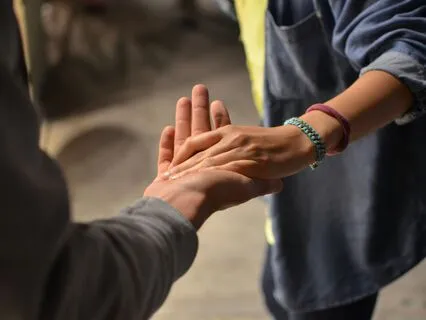
And the instruction was that we're kind of like holding our own hand.
You approach practice like you're holding your own hand.
And this image has been really helpful to me,
In particular while I was traveling during this period of time with my son.
Maybe you know this experience,
You know,
If you've held the hand of your partner,
Or of your child,
Or of an aging parent,
You know,
Holding the hand of another.
Nothing is needed in those moments when you're holding another's hand.
You don't have to change anything.
And that's what this practice is kind of about.
Like we're just,
When we're with ourselves,
We can hold our own hand.
We're accompanying ourselves as a companion on this path.
And being a companion to yourself in this practice is not a minor thing.
It's actually,
It's a pretty significant part of the practice.
When we can offer ourselves a supportive presence to our inner life,
Like it's to our inner life that we're supporting ourselves.
Companionship on how we are at any given moment,
At any given moment.
Allowing how we are to have space and to be with it.
It's huge.
It's really huge.
So in some ways this is what we're doing.
I noticed this a fair amount when I was,
I was traveling with my 14 year old.
And much of the time I was traveling,
Like he's,
We were mountain biking.
And he is a very fast mountain biker.
He took third place last night in the Snowmass races.
He's a fast kid.
And so most of the time I was traveling by myself.
I was chasing him.
And I was my own companion.
I was companioning myself.
And this,
So this is what we're doing.
And you know when we come together in this way,
We take some time together.
You know here it is the middle of the day on a Wednesday.
We slow down and we just settle into all of the different dimensions of ourselves.
We sit down and we see what's here.
Maybe it's pain.
Maybe it's memory.
Maybe it's rest in the middle of too much to do.
But it's this time that we have to sort of ask the question,
What is true in the body right now?
Oh well the body's sleepy.
Or the body's hungry.
Or the,
You know,
Or there's a lot of restlessness in the mind.
And in a sense like that's what's real.
That's what's real in the moment.
So being with what's real in the moment,
That's actually freedom.
That's our freedom.
And one of the purposes of meditation practice is to discover what your mind is like when you're no longer identified with all of the stuff that it's producing.
Because it is producing a lot.
Some of it is just nonsense.
So when you're no longer identified with it,
How is that experience?
Progress on the path is not measured by higher states of attainment.
I know they don't advertise that in the brochures on meditation,
But that's the truth of the practice.
It's more about a willingness to just begin again.
You sit down,
Your mind is anxious,
Cluttered with thoughts,
Planning the next adventures of the day.
And you come back to your breath.
Or you come back to open awareness.
What else is here?
What is here in this moment,
In this room at St.
Peter's?
What else is here in this body at this time?
Coming back over and over again.
Returning to ourselves.
This is what it's about.
And that's not as exciting as attainment.
So that's why you don't hear too much about it.
But as habit patterns arise in the mind,
And we choose not to act on them,
Every time we choose not to act on them,
This beginning again happens.
It's like,
Oh.
My husband likes to say,
How we do anything is how we do everything.
And I don't know who said it,
But I really appreciate this.
And raising a 14 year old,
This is a thing that we talk about a lot.
How we do anything is how we do everything.
So think about that in your life.
How do you get ready for a trip?
How do you work with a family full of,
Like a house full of family?
How do you do anything?
And that's kind of an insight into how you do everything.
And what we're doing here is we're training our minds.
We're training our minds by coming back to our breath over and over again.
Coming back to this room,
To the present.
And so when we're training our mind to respond with ease and with non-reactivity,
And we don't get sucked into reactivity,
What happens is we're encountering something very new.
Because we haven't really done that before.
We've been about action,
Reaction,
Action,
Reaction,
Right?
That's normally how the mind is wired.
And we've been taught this and conditioned this over eons.
And so now when we're kind of like learning to repattern,
What happens is something happens.
We're choosing not to react to it because we're training the mind.
And then we have to face the moment.
Then we have to face the moment.
And oftentimes that's a hard moment.
Something happens,
You're not liking,
And you have to face it.
That hardness,
That hardness in the body.
How hard it is to let go.
How hard it is that,
You know,
It's just like,
Oh I'm not liking this.
And there's some pain with that not liking.
And there's some grief with that not liking.
And that's right under the surface of our attempts of letting go.
Whenever we're attempting to let go of something,
There's that hardness.
Just check it out.
Check it out for yourself.
Like collect yourself for a minute and feel this moment.
Take a breath and feel what this moment is offering you right now.
Maybe there's liking,
Maybe there's not liking.
Maybe there's a sense of get on with it,
Lisa.
What are you trying to do with this?
But whatever is there,
It's like when we stop,
We're letting the energy,
The energy of our good hearts,
Meet whatever pain is there with clarity.
And that's compassion.
That's compassion.
That's self-compassion.
When we touch the pain within ourselves,
The pain that exists,
The greed that exists,
The aversion,
The not wanting that exists,
And kind of the delusion that kind of is like the the water that we're swimming in.
If we can meet it and touch that,
Those aspects of our humanity with care,
What we're doing is we're growing compassion.
I was told by my,
I used to volunteer at the Zen Hospice Project.
I was a volunteer for two years when my son was a little,
Little one.
And I would sit with the dying every Tuesday.
Tuesday was my shift and I would sit and I would go to the guest house in San Francisco and I would sit with the dying.
And the founder of the Zen Hospice Project,
Frank Ostaseski,
Who's a beautiful,
Beautiful teacher,
He used to say that compassion snuggles up with pain.
It snuggles up with pain.
And so think about that for ourselves.
It's sort of like I know what suffering is like and I'm right here with you.
And that's what I would do.
I would sit down.
Sometimes I would hold the hand of the person in the bedside.
Sometimes I would hold my own hand and I would breathe with that person.
Like understanding that one day,
If I'm lucky,
I will be the person at the bedside in the hospice and this particularly lovely hospice that I got to work at.
Hopefully it'll go this well that I'll be cared for in this beautiful way as I take my last breaths.
So compassion,
You know,
It's a willingness to be with what's uncomfortable,
What's hard,
And what hurts.
It's a willingness to be with it.
And sometimes compassion is described as a relief of suffering,
But in my experience,
It just gives us the capacity to be with suffering,
To stay in the room with suffering,
To snuggle up to suffering.
And we know that experience when the going gets tough.
We know that experience.
We're not going to get going.
We're going to sit.
We're going to stay still.
It's just like if you were with a child and they were running full speed down the street and they stumbled and they fell and they scraped their knee.
We're not going to be like,
Pick up the kid.
Here's a band-aid kid and take off.
We're going to snuggle up to suffering.
We're going to bring that child close in.
We're going to make sure that they have a little glass of water.
We're going to ask to help them calm down.
We're going to clean up their injury.
We're going to give them a band-aid.
Like that happens.
When the going gets tough,
We don't leave the room.
And the going is going to get tough for all of us at some point.
All of us.
So we get to practice.
And we get to be patient with ourselves in the practice of the cultivation,
The development of compassion.
You know,
Naturally,
Compassion arises.
You know,
It really does.
Like in the example of the child.
You know,
It's a natural instinct within us to care for somebody that is suffering.
You know,
If our child falls down,
We're going to want to relieve that suffering.
If our partner is sick,
We're wanting to accommodate and relieve their pain,
Their suffering.
It's just part of being a human being.
There's everyday,
Ordinary compassion that we experience all the time.
But we don't often experience it for ourselves.
That is why I'm inviting you into this practice of holding your own hand.
Companioning yourself.
I invite you to try it.
Place your hands together.
Hold your own hand.
Feel the heat of the hands together.
It's like you're holding the hand of awareness.
You're aware that you don't have to do this alone.
The Buddha said,
You know,
As I kind of bring you into self-compassion,
The Buddha said,
You can search through the entire universe for someone more deserving of your love and affection than you are.
And that person cannot be found anywhere.
You yourself,
As much as anyone in the entire universe,
Deserves love and affection.
So this is why we start with ourselves.
It's putting on our own oxygen mask first.
It's holding your hand.
You know,
Traditionally,
The way that it's taught in the canon,
In the Buddhist canon,
Is that compassion is a wish for the end of suffering for all sentient beings,
Human and non-human,
Including ourselves.
So the way that compassion came to me authentically,
Authentically,
Was that I had to give it to me.
I had to hold my own hand.
I had to companion myself.
It's okay.
One teacher in this tradition,
Her name is Sylvia Borstein,
And she's kind of like the grandmother of the Dharma.
And Sylvia is a Jewish grandmother,
But not in the sense that Dave and I were talking about earlier,
Where there's a lot of control.
A very different British grandmother.
She would say to herself,
It's okay,
Sweetheart.
To herself,
It's okay.
She would speak to herself like she would speak to her grandchildren,
Making it okay.
She was an example,
Is an example,
Of companioning ourselves in this practice.
So there's two pieces to this compassion practice.
There's the type that bubbles up for others.
We want to relieve the suffering of our loved ones.
We want to relieve the suffering of the ones close to us.
When we're sitting with somebody that is ill or is dying,
We feel it just bubbles up.
The compassion just bubbles up naturally.
But does it bubble up for ourselves when we're faced with something really hard?
No,
It doesn't.
So this practice,
This simple,
Simple practice of just placing your right hand in your left and feeling the heat of that,
That motion,
Holding your own hand,
It can make a really big difference.
It's a physical reminder of self-compassion,
Or it has been for me.
So there's everyday ordinary compassion,
And then there's the sublime state of compassion known as the Brahma-Vihara of compassion.
Brahma-Vihara means,
So Brahma is a god in the Indian pantheon,
And Vihara is home.
So it's kind of like this divine,
This god-like home,
Which we are,
It's aspirational in practice.
It's reaches this kind of state of,
You know,
Divinity where it becomes home in our own bodies.
It's not limited to our small group.
It's not limited to our friends and family.
It's actually extended out to all sentient beings,
To the person who delivers our mail,
To the people in the White House that we have issue with,
To all sentient beings.
So this obviously is a practice,
Because it's hard to offer compassion to all sentient beings sometimes.
And you know,
Just to remind you,
And we,
I talk about this a lot,
And we have explored this a little bit,
Every day we practice something.
What you do,
How you do anything is how you do everything.
In that same vein,
We are practicing something every single day.
And most of the time what we're practicing is unconscious,
Most of the time.
So what is it that,
What's unconscious?
Like let's bring on what's unconscious into awareness.
It's like,
Well most of the time I practice worry.
Okay,
So look at that.
Worry is my practice.
How is that going?
Like if it's not going very well,
Maybe practice something else.
So it's a,
It's a changing of a habit pattern.
And it's,
It's okay that you're practicing worry.
It's okay.
It's not like you're bad and wrong.
But it's,
It's really important to know what you're practicing.
It really helps to know.
That's how we change habit patterns.
So when we're learning to choose a practice,
Like this is a choice that we show up on a Wednesday afternoon to practice.
Some of you show up every,
You know,
Four times a week in our group to practice.
We're helping the mind choose other more beneficial,
More useful habit patterns.
Meditation practice,
Compassion practice,
Practices of clear seeing,
Practicing care for what we see.
Practicing care for what we see.
That's so important.
That helps stabilize our practice and bring authentic compassion to the world around us.
There's this old line in a famous samurai poem,
I make my mind my friend.
I make my mind my friend.
I really,
I really love that because in some way it expresses the entire path for us.
Making our minds our friend.
So I'd like to try it with you.
Let's make our mind our friend for just a few minutes.
Let's collect ourselves and sit together in this way of accompanying ourselves,
Companioning ourselves.
So start by holding your own hand in a really light and natural way,
Like the way that you would hold the hand of a child or a loved one.
Really simple.
And feel the sensation of the palms together.
The heat,
How it develops.
And just take a few longer,
Deeper breaths.
Arriving and allowing yourself to begin experiencing your body again after hearing this talk on self-compassion.
How is it in the body right now?
Are you judging what you practice unconsciously every day?
Can you put that down and just let it come to rest?
Now I'd like you to bring your mind to someone close to you,
Whom you love dearly.
It could be.
.
.
Stay within the human world and picture that person and how you care for them,
The way in which you care for them.
And noticing your heart right now as you bring this person into your mind's eye.
How you hold them in your heart.
Let yourself be aware of how they might suffer,
What their sorrows are,
What their challenges are.
And feel your heart opening to their suffering.
The movement to extend comfort.
And maybe there's a little fixing in there.
Just notice if that's there too.
But just the movement to extend comfort.
Snuggling up with their suffering.
Sharing in their pain.
And meeting them with compassion.
This loving being in your life.
Feel the natural response of your heart.
Feel the tender-hearted connection.
And with that same tender-heartedness,
Extend your love and compassion to more beings that come into your mind's eye.
The people in your life who bring you joy,
Whom you love and care for.
Understanding and knowing they all have sorrows.
They all suffer in some way.
And let the sorrows touch your heart and turn to compassion.
For your children,
For your spouse,
For your animals,
For your friends,
For your neighbors,
For the people who provide services for you.
Let the sorrows touch your heart and turn to compassion.
Extending your care and your mercy.
Feeling your warm hand touching your warm hand.
Letting your breath and your heart come to its natural rhythm.
And abiding in compassion in the midst of this world.